How we make this list: we compare pricing pages, product documentation and public user reviews. Ratings come from G2, Capterra or Trustpilot, with the date we checked them.
Key takeaways
- Headspace is the best structured starting point, with beginner courses that teach meditation step by step rather than offering a large unorganized library.
- Calm is the best choice for sleep, thanks to its sleep stories, soundscapes, and bedtime content.
- Insight Timer offers the largest free library, which makes it the best value for listeners who want variety without a subscription.
- Smiling Mind and Medito are completely free, which makes them the best options for anyone who wants mindfulness without a recurring bill.
- Balance personalizes a daily plan from an initial questionnaire, which suits users who want guidance without choosing each session themselves.
These apps support everyday mindfulness practice. They are not a substitute for professional care for anxiety, depression, or any other health condition.
Quick comparison
| Tool | Best for | Starting price | Free plan |
|---|
 Headspace | Structured beginner courses | $69.99 per year | Yes |
 Calm | Sleep stories and soundscapes | $69.99 per year | Yes |
 Insight Timer | Large free meditation library | $59.99 per year (Member Plus) | Yes |
 Balance | Personalized daily plans | $69.99 per year | Yes |
 Waking Up | Deep meditation instruction | See website | Yes |
 Ten Percent Happier | Skeptics and practical teaching | $99.99 per year | Yes |
 Smiling Mind | Free evidence-based programs | Free | Yes |
 Medito | Free nonprofit meditation | Free | Yes |
Is your product missing or out of date?
We review this list regularly. Vendors can request a listing, send updated pricing or ask about featured placement.
The best apps for mindfulness, by need
#1Headspace
Best for: Structured beginner courses4.6/5 on
G2 (68 reviews, checked Oct 2026)
Visit headspace.com
Starting price$69.99 per year
Free planYes
Headspace is the easiest app to recommend to someone who has never meditated. Its Basics course teaches the skill in short, ordered sessions, with a calm narrator explaining what to do with attention and wandering thoughts. That structure removes the main beginner problem, which is opening a huge library and not knowing where to start.
Beyond the courses, Headspace offers single sessions for sleep, focus, and stressful moments, plus movement and breathing exercises. The free tier covers the basics course and a few sessions, while the full library needs a subscription at $69.99 per year or $12.99 per month. Long-time meditators may find the style gentle to a fault, and the library is smaller than Insight Timer. For a beginner who wants a clear path, Headspace remains the strongest first app.
What we like- Clear beginner courses
- Short sessions for busy days
- Content for sleep, focus, and stress
Watch out for- Free tier covers only the basics course
- Subscription costs $69.99 per year
Starting price$69.99 per year
Free planYes
Calm is best known for sleep, and that reputation is earned. Its sleep stories, narrated by familiar voices, plus soundscapes and bedtime music, help many listeners wind down at night, and the Sleep section alone justifies the subscription for some users. The Daily Calm, a ten-minute session released each day, gives regular users a simple habit to return to without choosing from a long list.
Meditation courses cover anxiety, focus, and relationships, and masterclasses add longer teaching from well-known instructors. The free tier is thin, with only a few sessions available, and the full experience costs $69.99 per year or $14.99 per month. The app can also feel crowded, with a lot of content competing for attention. Calm suits listeners whose main goal is better sleep or a calm daily ritual, more than students of meditation technique.
What we like- Large sleep story library
- Excellent soundscapes
- Daily Calm ritual for regular practice
Watch out for- Free tier is very limited
- App can feel crowded with content
Starting price$59.99 per year (Member Plus)
Free planYes
Insight Timer takes the opposite approach to Headspace: instead of a small, ordered course, it offers a vast library from thousands of teachers around the world. Guided meditations, talks, music, and live sessions cover nearly every style, length, and topic, and most of it is free. A timer for silent practice, with bells and ambient sounds, serves experienced meditators who no longer need guidance.
Member Plus, at $59.99 per year or $9.99 per month, adds offline listening, high-quality audio, and full courses, but the free library alone is larger than most paid apps. The size is also the weakness: beginners can spend more time browsing than meditating, and quality varies between teachers. Insight Timer suits listeners who know what they like, want variety, or want a strong free option without a subscription.
What we like- Huge free library from many teachers
- Live sessions and groups
- Timer for silent practice
Watch out for- Library size can overwhelm beginners
- Free version includes ads and upsells
Starting price$69.99 per year
Free planYes
Balance starts with questions about goals, experience, and available time, then builds a daily meditation plan that adapts as practice continues. That personalization suits users who like guidance but do not want to follow a fixed course or browse a huge library. Sessions adjust in length and focus, and single sessions for sleep, anxiety, and focus sit alongside the plan.
A first-year free offer has been widely promoted, which makes Balance easy to try at no cost, though the standard price after any offer is $69.99 per year or $11.99 per month, so the renewal terms deserve a check before signing up. Teacher variety is narrower than Insight Timer, and the app is less suited to users who want a specific tradition or teacher. Balance fits users who want an app to decide the next session for them.
What we like- Daily plan adapts to goals and experience
- First year often offered free
- Single-session options for sleep and focus
Watch out for- Full price is $69.99 per year after any offer
- Less teacher variety than Insight Timer
Starting priceSee website
Free planYes
Waking Up treats meditation as a subject to understand, not just a habit to repeat. Its introductory course moves into theory about attention, consciousness, and the nature of the mind, and conversations with philosophers and neuroscientists sit beside daily guided sessions. That depth appeals to users who want to know why a practice works, not only how to do it.
Pricing has been reported at $99.99 per year in some listings and higher in others, so the vendor page is the reliable figure, and this article lists it as See website. A scholarship program offers free access to anyone who cannot afford the subscription, with no questions asked, which is a genuine and generous policy. The style is more intellectual and less soothing than Calm or Headspace, and there is no sleep story library to match Calm. Waking Up suits curious, committed meditators who want depth over comfort.
What we like- Serious teaching on meditation and the mind
- Conversations with expert teachers
- Free access for anyone who cannot afford it
Watch out for- Less beginner-friendly than Headspace
- No sleep story library comparable to Calm
Starting price$99.99 per year
Free planYes
Ten Percent Happier, now also known as Happier, was built for people who find meditation apps too mystical. Its teaching is direct, practical, and often funny, with courses from respected teachers explaining meditation in ordinary language. That tone helps skeptics who have tried a softer app and bounced off it, because the app treats doubt as normal rather than as a problem.
The library includes courses, single sessions, talks, and sleep content, though sleep is not the main strength. The price is the highest here, at $99.99 per year or $14.99 per month, with a limited free tier for sampling. Ten Percent Happier suits professionals and skeptics who want credible, no-nonsense instruction and are willing to pay for it. Budget-conscious users get similar basics free from Smiling Mind or Medito.
What we like- Plain, practical teaching for skeptics
- Courses from respected meditation teachers
- Talks and sleep content
Watch out for- Highest annual price on this list at $99.99 per year
- Less content for children than some rivals
Starting priceFree
Free planYes
Smiling Mind is a nonprofit app offering mindfulness programs at no cost, developed with input from psychologists and educators. Programs cover adults, children, teenagers, classrooms, and workplaces, which makes it one of the few mindfulness apps that genuinely serves families and schools. Sessions are short, clear, and organized by age and goal, so a parent or teacher can find suitable content quickly.
There is no subscription, no premium tier, and no paywall, which removes the cost barrier entirely. The library is smaller and the design simpler than Calm or Headspace, and there are no sleep stories of the same polish. For anyone who wants evidence-based mindfulness without paying, or who needs content for children, Smiling Mind is the best free option on this list.
What we like- Completely free
- Programs for adults, children, and workplaces
- Developed with research input
Watch out for- Smaller library than paid rivals
- Design is simpler than Calm or Headspace
Starting priceFree
Free planYes
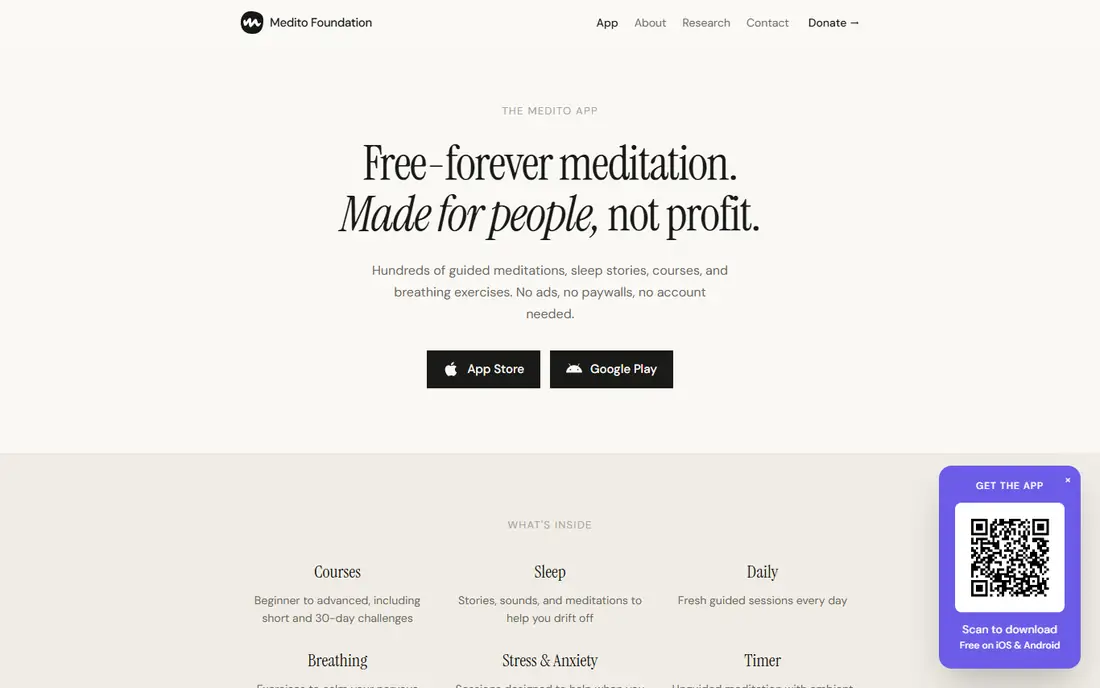
Medito is a nonprofit meditation app that offers its full library for free, with no subscription and no locked content. Courses cover beginner meditation, sleep, stress, and daily practice, with a calm, straightforward style that suits users who want guidance without upsells. The app is maintained by a nonprofit foundation, and donations are optional rather than required for access.
The library is smaller than Insight Timer or Calm, and features such as live sessions, extensive music, and personalized plans are limited or absent. That simplicity is also a strength: Medito opens, plays a session, and gets out of the way. For a user who wants a free, honest meditation app with no commercial pressure, Medito is an excellent choice, and it pairs well with a free library app such as Insight Timer for variety.
What we like- Completely free with no paywall
- Courses for beginners, sleep, and stress
- Nonprofit model
Watch out for- Smaller library and fewer features than paid apps
- No live sessions comparable to Insight Timer
How we chose
We compared vendor pricing pages, app store listings, documentation, and public reviews, keeping only apps that are currently available and genuinely built for mindfulness or meditation. Each app was judged on who it fits, teaching quality, library size, free tier, sleep content, and price, with extra weight on what the free tier actually allows. Prices were checked in October 2026, and any price reported inconsistently across sources is marked as See website. These apps support everyday mindfulness practice and are not a substitute for professional care.
Fitting mindfulness into a real day
The best mindfulness app is the one that gets used, and that usually means the shortest session that fits the day, not the longest course on offer. Ten minutes in the morning, a short breathing session before a stressful meeting, or a sleep story at night all count as practice, and consistency matters more than session length. Pick a time that already exists, such as after waking or before bed, and attach the session to it rather than relying on willpower alone.
Choosing between structure and variety
Beginners usually do better with structure: Headspace courses, Balance plans, or Smiling Mind programs give a clear next step. Experienced meditators usually prefer variety or silence: Insight Timer offers both, while Medito and Waking Up serve users who know what they want. Sleep-focused users should start with Calm, and skeptics should start with Ten Percent Happier. Trying two free options for a week each, such as Smiling Mind and Insight Timer, is a low-cost way to learn which style fits before paying.
A note on wellbeing
Mindfulness apps can support calm, focus, and sleep, but they cannot diagnose or treat anxiety, depression, insomnia, or any other health condition. If low mood, anxiety, or sleep problems persist, or if meditation brings up distress, speaking with a qualified health professional is the right step. Free apps such as Smiling Mind and Medito can still support daily practice alongside professional care, but they do not replace it.
Frequently asked questions
What is the best mindfulness app for beginners?
Headspace is the best structured starting point, because its Basics course teaches meditation in order, in short sessions. Smiling Mind and Medito offer free beginner courses that cover similar ground without a subscription. Beginners should pick one course and finish it before browsing a large library, since too much choice is the most common reason for quitting early.
Is Calm or Headspace better for sleep?
Calm is better for sleep, thanks to its large sleep story library, soundscapes, and bedtime music. Headspace also offers sleep content, including sleepcasts and wind-down sessions, but sleep is not its main strength. A listener whose main goal is falling asleep should try Calm first, and check whether its free tier covers enough bedtime content before paying.
Are there good free mindfulness apps?
Yes. Smiling Mind and Medito are completely free, with no paywall, and Insight Timer offers a huge free library with ads. Those three apps cover beginner courses, sleep, stress, and silent practice without a subscription. Paid apps add polish, personalization, and larger libraries, but they are not required for a regular practice.
How long should a mindfulness session be?
Ten minutes a day is a realistic and useful target for most beginners, and even five minutes counts when done regularly. Longer sessions suit experienced meditators, but forcing a long session early often leads to quitting. Most apps on this list offer sessions from three to thirty minutes, so length can grow naturally as the habit settles.
Can a mindfulness app help with anxiety?
Mindfulness practice can support calm and help some people manage everyday stress, and many apps include courses for anxiety and stress. Apps cannot treat an anxiety disorder, and they are not a replacement for therapy or medical care. Anyone experiencing persistent anxiety should speak with a qualified professional, and can use an app as a complement to that care, not as a substitute.
Sources we checked (8)
- https://www.headspace.com
- https://www.calm.com
- https://insighttimer.com
- https://www.balanceapp.com
- https://www.wakingup.com
- https://www.tenpercent.com
- https://www.smilingmind.com.au
- https://medito.app
Is your product missing or out of date?
We review this list regularly. Vendors can request a listing, send updated pricing or ask about featured placement.

Shihab Mia · Founder, Rankite
Shihab has 5+ years in B2B and SaaS SEO. He writes Rankite's software buying guides from pricing pages, documentation and public user reviews. More about Shihab.