How we make this list: we compare pricing pages, product documentation and public user reviews. Ratings come from G2, Capterra or Trustpilot, with the date we checked them.
Key takeaways
- Google Lens is the best free starting point for a quick photo match, but it gives no reliable price on its own.
- WorthPoint is the deepest source for past auction prices, and it suits regular buyers and sellers who can justify a monthly subscription.
- ValueMyStuff is the clearest route to a human expert valuation, with a per-item fee instead of a subscription.
- No photo app can authenticate an item from pictures alone, so valuable or unusual pieces still need expert review.
Quick comparison
| Tool | Best for | Starting price | Free plan |
|---|
 Google Lens | Quick free photo identification | Free | Yes |
 WorthPoint | Auction price research | $29.99 per month | No |
 ValueMyStuff | Expert valuations per item | From $10 per valuation | No |
 Lens AI | Structured photo identification | See website | Yes |
 eBay | Current resale prices from sold listings | Free | Yes |
 LiveAuctioneers | Watching live and past auctions | Free to browse | Yes |
 Kovels | Price guides and collector education | See website | Free trial |
 Barnebys | Searching many auction houses at once | Free to browse | Yes |
 1stDibs | High-end design and antiques listings | Free to browse | Yes |
Is your product missing or out of date?
We review this list regularly. Vendors can request a listing, send updated pricing or ask about featured placement.
The best apps for identifying antiques
Starting priceFree
Free planYes
Google Lens belongs first in almost any identification workflow because it costs nothing and answers the first question fast, which is what an object might be. Point it at a vase, a chair or a hallmark, and it returns visually similar items, listings and pages that may name the maker or pattern. That clue often turns a mystery object into a searchable term.
The limits are just as clear. Lens matches appearance, not authenticity, so a modern copy can look identical in a photo to an older original. It also gives no price, and many results are retail listings rather than sold prices. Use Lens to get a name and a direction, then confirm value with auction records or an expert.
What we like- Free and widely available
- Matches photos to similar items across the web
- Useful for maker marks and labels
Watch out for- Gives no price estimate
- Results include lookalikes and reproductions
- Needs clear, well-lit photos
Starting price$29.99 per month
Free planNo
WorthPoint is the research tool serious collectors and resellers reach for after a first photo match. Its price guide draws on auction houses and marketplaces, showing what comparable items actually sold for, rather than what sellers are asking today. The marks library helps with pottery, silver and other items where a small stamp carries most of the identification.
The subscription is the main decision. At $29.99 per month, it pays for itself quickly for a regular dealer and slowly, if at all, for someone with one item to check. Search results also need judgment, since condition, size and provenance change value a lot. For frequent buying and selling, though, few sources go as deep.
What we like- Large archive of realized auction prices
- Marks and logos library
- Mobile app for use at sales
Watch out for- Subscription only, with no free tier
- Older sales may not reflect current demand
- Learning the search tools takes time
Starting priceFrom $10 per valuation
Free planNo
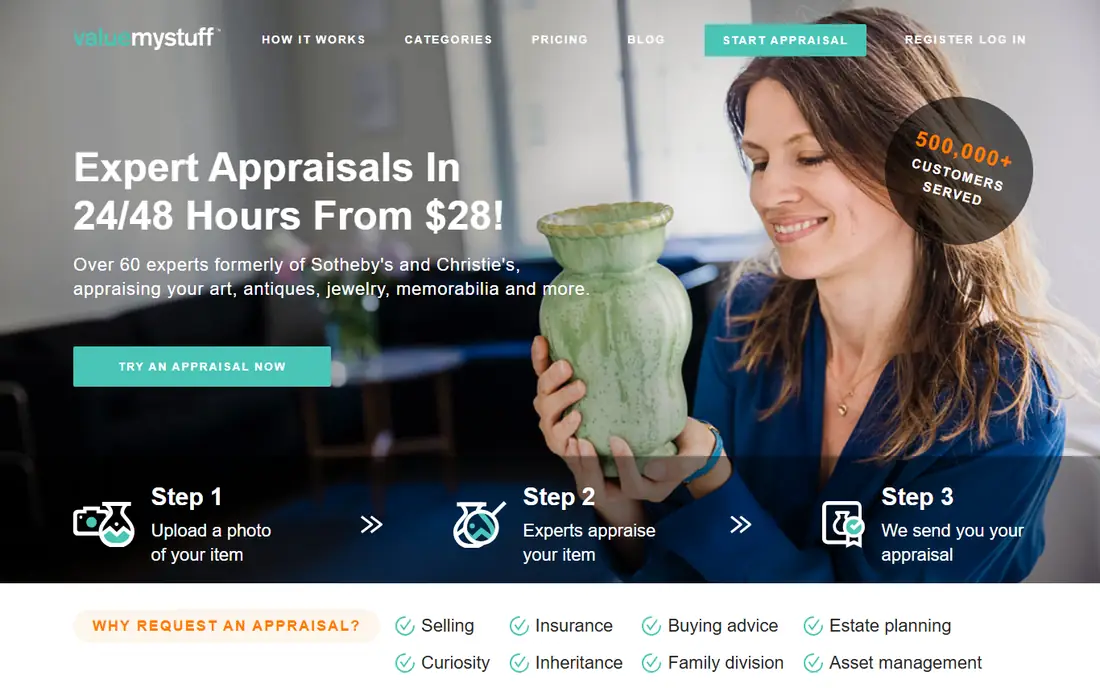
ValueMyStuff fills the gap between a free photo match and a formal appraisal. You upload photos and a description, and a specialist from an auction background returns a written valuation with an auction value and an insurance value. That human step catches details that photo matching misses, such as a replaced part or a less common variant.
The fee model suits occasional use. Paying from $10 per valuation is easy to justify for a single inherited piece, and hard to justify for fifty flea market finds. Take clear photos of the whole item, the base, any marks and any damage, because the expert can only judge what the photos show. For insurance or estate decisions, keep the PDF report with your records.
What we like- Human experts review photos and details
- Valuation report includes auction and insurance values
- No subscription required
Watch out for- Per-item fee adds up for a large collection
- Turnaround is 24 to 48 hours, not instant
- Photos must be detailed to get a useful result
Starting priceSee website
Free planYes

Lens AI takes a different approach from a plain image search. It scans a photo and returns a structured card with a likely name, visible traits and possible alternatives, and you can ask follow-up questions about the same image. That structure helps when you have no idea what to call an object, since the card gives you terms to search further.
It is a general identification app, not a specialist antiques database, so it will not replace WorthPoint for prices or ValueMyStuff for expert judgment. The free plan also caps daily scans, which matters if you are working through a whole estate in one weekend. Use it as a smart first step, then verify with sales data.
What we like- Returns a structured identification card for each photo
- Saved scan history
- Follow-up questions on the same image
Watch out for- General identification, not an antiques archive
- Free plan has a daily scan cap
- Needs an internet connection
#5eBay
Best for: Current resale prices from sold listings1.2/5 on
Trustpilot (19,286 reviews, checked Oct 2026)
Visit ebay.com
Starting priceFree
Free planYes
eBay is less an identification app and more a reality check on price. Once you have a likely maker and model, filter to sold listings to see recent completed sales for comparable items. That current market evidence is often more useful than an old price guide, especially for twentieth-century collectibles where demand shifts fast.
The trap is reading active listings as values. A seller can ask any price, and unsold listings prove nothing. Compare sold items with the same condition, size and markings, and ignore outliers. eBay also helps with identification itself, since detailed listings often show marks and measurements that confirm your match.
What we like- Sold listings show what buyers actually paid
- Huge range of categories
- Free to search
Watch out for- Asking prices mislead if you ignore the sold filter
- Condition varies widely
- Fees apply if you sell
Starting priceFree to browse
Free planYes
LiveAuctioneers gathers auctions from many houses, so a collector can watch sales and check past results without visiting dozens of sites. For furniture, art and decorative objects, past results from named auction houses carry weight, because the catalog descriptions are usually detailed and the prices are realized prices.
Everyday flea market goods are less well covered, since the platform leans toward higher-value auctions. That makes it a complement to eBay rather than a replacement. Use it to track a category over time, set alerts for a maker you collect, and learn how condition notes in catalogs affect the final price.
What we like- Access to many auction houses in one place
- Past results give price evidence
- Alerts for upcoming sales
Watch out for- High-end focus means everyday items are thin
- Buyer fees apply at auction
- Browsing is free but bidding needs an account
Starting priceSee website
Free planFree trial
Kovels has guided collectors for decades, and its online price guides still cover a wide range of antiques and collectibles. Beyond prices, the site teaches how to read marks, spot common reproductions and understand periods and styles. That education matters, because identification skill grows faster than any single app can replace.
Full access sits behind a subscription, with a free trial to test it first. Prices in a guide are a starting point, not a sale guarantee, so pair Kovels with sold listings for anything you plan to sell soon. Beginners who want to learn a category properly will get more from Kovels than from a photo scanner alone.
What we like- Long-running price guides across many categories
- Educational articles on marks and fakes
- Trusted name among collectors
Watch out for- Subscription needed for full access
- Interface feels dated next to newer apps
- Price data needs cross-checking with recent sales
Starting priceFree to browse
Free planYes
Barnebys works as a search engine for the auction world. One search can surface lots from many houses and dealers, which saves hours of checking sites one by one. For art, design and higher-value antiques, that breadth reveals comparable pieces that a single marketplace would miss.
It does not identify an item from a photo, so you need a name, maker or category first. Coverage also varies, with stronger results in art and design than in everyday collectibles. Use Barnebys after a photo tool has given you a lead, and treat its results as price evidence to weigh alongside eBay and WorthPoint.
What we like- Searches auctions and dealers worldwide
- Useful for art and design
- Free to browse realized prices
Watch out for- Coverage varies by region and category
- Not a photo identification tool
- Some listings lead to other sites
Starting priceFree to browse
Free planYes
1stDibs is a marketplace for high-end furniture, art, jewelry and design, sold through vetted dealers. Browsing it teaches a lot about periods, makers and quality levels, because listings include detailed photos and descriptions. When an unknown chair resembles a known design, 1stDibs often shows the closest high-end version.
Asking prices here are retail prices, not auction results, so they overstate what a private seller would receive. Use 1stDibs to identify and to understand the top end of a category, then check sold listings for a realistic value. For mid-century design and fine antiques, it remains one of the clearest visual references available.
What we like- Strong catalog of vetted dealers
- Detailed photos and descriptions
- Good for learning design periods
Watch out for- Retail asking prices run high
- Not a source for sold prices
- Everyday antiques are less common
How we chose
We compared vendor pricing pages, app store listings and help pages, then checked public reviews and collector discussion for recurring strengths and limits. We kept only tools that exist today, are available to US users, and genuinely help identify antiques or value them, rather than generic shopping apps. We did not claim hands-on testing, and we treated every price as an estimate to confirm, since photo tools cannot authenticate an object and auction prices depend on condition.
Reading a result like a collector
Start with the photo, not the price. Photograph the whole item in natural light, then the base, the back, any marks, labels and damage. A photo tool works far better with those detail shots than with a single distant image, and an expert valuation depends on them too. Note measurements, materials and anything you know about where the item came from.
Check three kinds of evidence before you act
First, confirm the identification with a second source, such as a marks guide or a detailed dealer listing. Second, check sold prices, not asking prices, for items in similar condition. Third, consider condition honestly, since chips, repairs and replaced parts can cut value sharply. If the three sources disagree, trust the most specific match and seek a human opinion before selling or insuring.
Frequently asked questions
Can an app tell me exactly what my antique is worth?
No app can give an exact value from photos alone. Photo tools suggest an identification, and sales records show what similar items sold for, but condition, authenticity and provenance still affect the final figure. Treat app results as a range and a starting point for research.
What is the best free app for identifying antiques?
Google Lens is the best free starting point, because it is free, fast and matches photos across the web. Lens AI adds structured results and a saved history, with a daily cap on free scans. Pair either one with eBay sold listings for a price check at no cost.
Is WorthPoint worth paying for?
WorthPoint is worth paying for if you buy and sell regularly, since its auction archive goes deeper than free sources. For a single item, a per-item valuation from ValueMyStuff usually costs less and gives a human judgment. Cancel or pause the subscription in months when you are not researching.
How do I photograph an antique for identification?
Use natural light and a plain background. Photograph the whole item from the front and side, then close-ups of marks, labels, joints, the base and any damage. Include a ruler or a common object for scale if size is unclear, and avoid flash, which washes out marks.
Should I get a formal appraisal instead of using an app?
A formal appraisal is the right step for insurance, estate settlement, tax or a high-value sale, since it is a written, signed document from a qualified appraiser. Apps and online valuations help with everyday buying and selling decisions, but they do not replace a formal appraisal for legal or insurance purposes.
How can I spot a reproduction?
Compare marks, materials, construction and wear with known originals in guides and dealer listings. Reproductions often show overly uniform aging, modern screws or finishes, and marks that are slightly off in font or placement. When doubt remains, ask a specialist in that category before paying a premium price.
Sources we checked (9)
- https://lens.google.com
- https://www.worthpoint.com
- https://www.valuemystuff.com
- https://lensapp.io
- https://www.ebay.com
- https://www.liveauctioneers.com
- https://www.kovels.com
- https://www.barnebys.com
- https://www.1stdibs.com
Is your product missing or out of date?
We review this list regularly. Vendors can request a listing, send updated pricing or ask about featured placement.

Shihab Mia · Founder, Rankite
Shihab has 5+ years in B2B and SaaS SEO. He writes Rankite's software buying guides from pricing pages, documentation and public user reviews. More about Shihab.