How we make this list: we compare pricing pages, product documentation and public user reviews. Ratings come from G2, Capterra or Trustpilot, with the date we checked them.
Key takeaways
- Card Ladder is the default for sports card price tracking with over 100 million sales.
- CollX and Ludex scan a card with the camera and return a value in seconds.
- 130point is the free, no-frills option for checking eBay sold listings fast.
- Market Movers starts at $9.99 and adds deal identification and index views.
- Scanner estimates blend grades and lag the market, so check recent sold listings before selling.
Quick comparison
| Tool | Best for | Starting price | Free plan |
|---|
 Card Ladder | Sales history and tracking | Free; Pro from $20 per month | Yes |
 Market Movers | Deals and market indexes | From $9.99 per month | Free trial |
 CollX | Camera scanning | Free; Pro from $7.99 per month | Yes |
 Ludex | Fast scanning and eBay listing | Free | Yes |
 130point | Free sold-listing checks | Free | Yes |
 PSA | Graded card prices | Free | Yes |
 Beckett | Price guides and grading | See website | See website |
 eBay | Sold listings direct | Free | Yes |
Is your product missing or out of date?
We review this list regularly. Vendors can request a listing, send updated pricing or ask about featured placement.
The best apps for sports card values
Starting priceFree; Pro from $20 per month
Free planYes
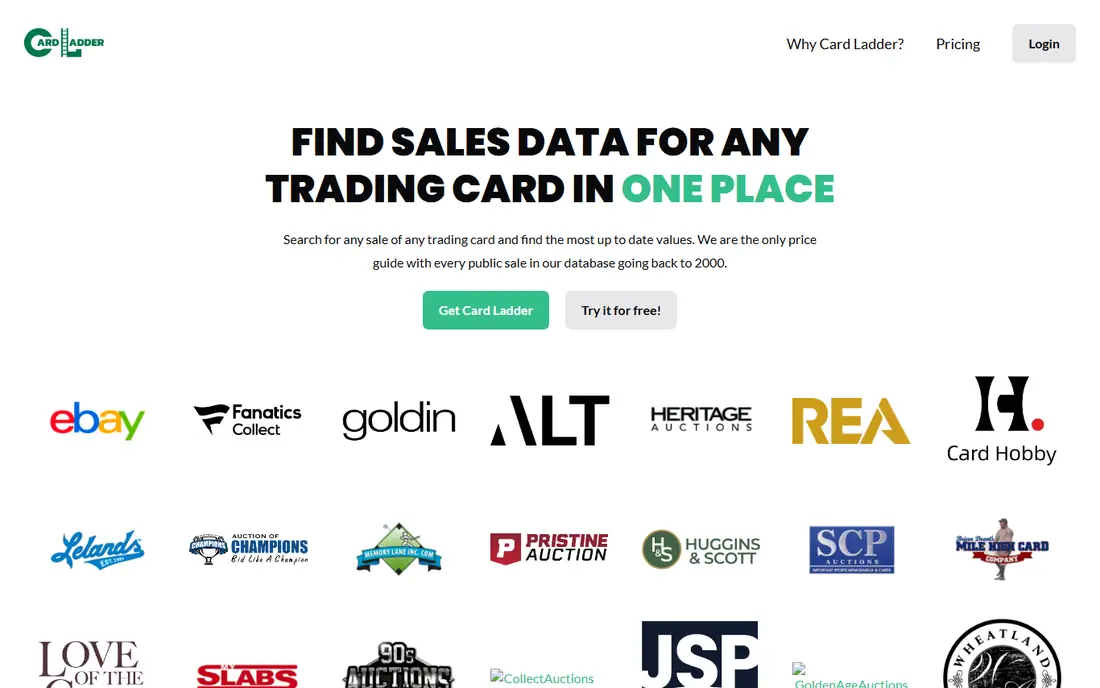
Card Ladder has become the default for sports card price tracking. It aggregates sold data across major marketplaces and shows trend lines, which matters because a card's last sale from four months ago may be irrelevant if the player just had a breakout season or got traded. Collection tracking tallies portfolio value, and daily hobby news and sales recaps keep collectors current.
Pro costs $20 a month and holds the deepest analytics. For a collector or seller who tracks values seriously, Card Ladder is the reference database other tools compare against.
What we like- Over 100 million sales across every category
- Trend lines and analytics
- Collection tracking
- Daily hobby news
Watch out for- Pro at $20 a month
- Deepest features sit behind Pro
- Data-heavy interface for casual users
Starting priceFrom $9.99 per month
Free planFree trial
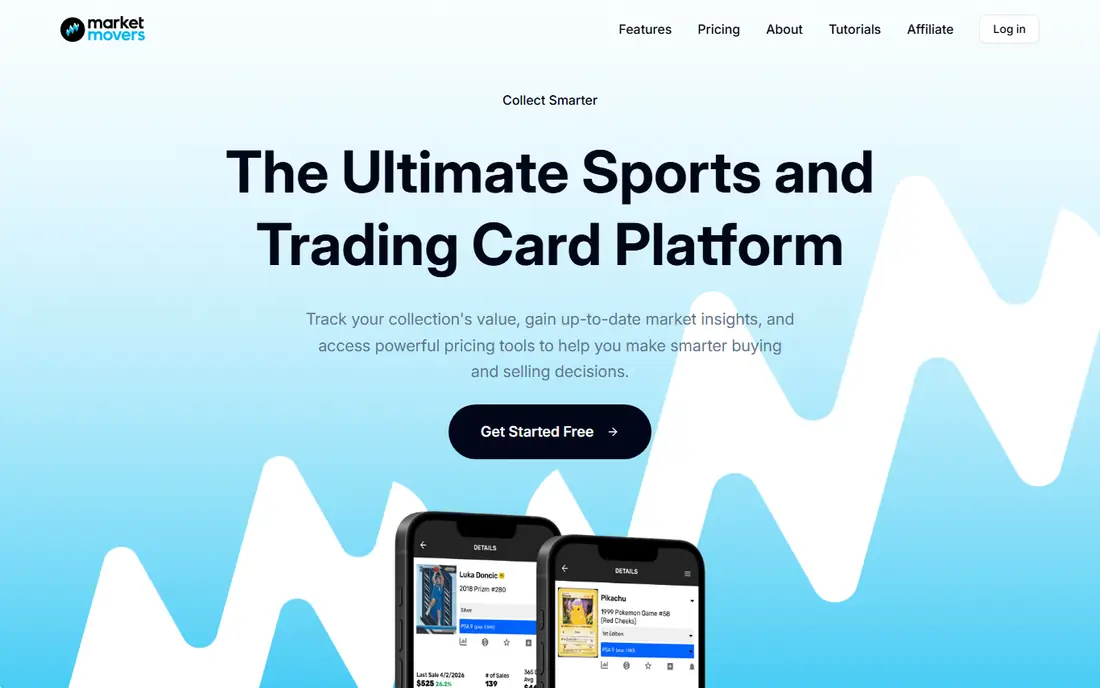
Market Movers offers tiered plans starting at $9.99, with deal identification and market-wide index views that help sellers spot underpriced cards and track whole segments. Sales history across marketplaces supports pricing decisions, and index views show whether a player, set, or category is rising or falling overall.
Full features need paid tiers, and the depth of analysis varies by plan. For a seller who hunts deals rather than just tracking a collection, Market Movers adds the market-wide view Card Ladder users often pair it with.
What we like- Tiered plans with deal identification
- Market-wide index views
- Sales history across marketplaces
Watch out for- Paid plans needed for full features
- Analysis varies by tier
- Smaller community than Card Ladder
Starting priceFree; Pro from $7.99 per month
Free planYes
CollX answers the question "what is it worth" with a camera scan. Point the phone at a card and the app identifies MLB, NFL, NBA, and NHL rookies and inserts in seconds, drawing on a database of over 7 million cards. Bulk scanning processes dozens of commons fast, and Pro at $7.99 a month adds 30, 60, and 90-day charts plus comp history.
Limits matter: the free tier caps scans at 20 a month, values blend raw, PSA 9, and PSA 10 into one number rather than splitting by grade, and accuracy drops on rainbows, low-numbered refractors, and oddball autos. CollX also skips PSA, BGS, and SGC population reports, so scarcity context is missing. For quick identification and ballpark values, CollX is the fastest scanner here.
What we like- Scan identifies cards in seconds
- 7 million+ card database
- Bulk scanning
- Price history charts on Pro
Watch out for- Free tier caps scans at 20 a month
- Values blend grades into one number
- Weaker on rare parallels and oddball autos
Starting priceFree
Free planYes
Ludex is the fastest and most accurate sports and trading card scanner app for many collectors. Snap a photo and Ludex returns set, year, parallel type, and pricing pulled from recent marketplace sales, covering baseball, football, basketball, hockey, soccer, and trading card games. The free tier includes unlimited scans with no credit card required, which beats CollX free limits.
Beyond scanning, Ludex organizes collections into binders and decks, tracks total portfolio value, and prefills eBay titles, descriptions, and categories from scan data. Portfolio save limits on the free plan feel tight for large collections, and eBay listing limits apply and are US only. For a collector who scans often and sells on eBay, Ludex is the best free scanner.
What we like- Unlimited scans on the free tier
- Identifies parallels and variations
- Real-time pricing from marketplace sales
- EBay listing prefills
Watch out for- Portfolio save limits on the free plan
- EBay listing limits apply and are US only
- Values refresh with marketplace data lags
Starting priceFree
Free planYes
130point remains the free, no-frills option most resellers keep bookmarked. It pulls eBay sold listings and some other auction sources into a searchable database, and it is often faster for a quick gut-check price than logging into a paid tool. A practical workflow starts here: pull the last ten sold comps, cross-check the trend on Card Ladder, and price 5% to 10% below the median for speed or at the median for full value.
It computes no price itself, so users must read comps and judge condition and grade themselves. For a free reality check before any sale, 130point is essential.
What we like- Free
- Pulls eBay sold listings plus other auction sites
- Fast gut-check pricing
- No account needed for basics
Watch out for- Computes no price itself
- Interface is plain
- Coverage varies by auction house
Starting priceFree
Free planYes
PSA, the largest card grader, offers a free app with price estimates and an auction prices database covering over 5 million PSA-graded results. Population reports show how many copies exist at each grade, which gives the scarcity context CollX lacks. For a collector holding slabs, PSA data is the reference for what graded cards actually sell for.
Coverage is PSA-graded cards only, so raw cards and other graders need other tools. For graded collections, PSA is the authoritative free price check.
What we like- Free app with price estimates
- Auction prices list over 5 million PSA-graded results
- Population reports for scarcity
Watch out for- Covers PSA-graded cards only
- Estimates blend sales
- Grading submission costs extra
Starting priceSee website
Free planSee website
Beckett has published card price guides for decades and now pairs guides with grading services and market data. Collectors trust Beckett guides for established cards, and grading through Beckett gives an alternative to PSA with its own population data. Coverage spans sports and gaming cards.
Pricing varies by product and some features need subscriptions, and printed-style guides lag fast-moving markets where a player's value changes weekly. For a collector who values guide tradition alongside modern sales data, Beckett remains a trusted name.
What we like- Long-running price guides
- Grading services
- Market data across sports and gaming cards
Watch out for- Pricing varies by product
- Guides lag fast-moving markets
- Some features need subscriptions
Starting priceFree
Free planYes
eBay is the source most pricing tools read from, so going direct removes the middleman. The sold listings filter shows real transaction prices, and grade and condition filters narrow comps to cards like yours. Selling directly from the same account closes the loop from valuation to sale.
There is no portfolio tracking, and sold data needs manual reading to separate auctions from best-offer sales and to spot outliers. Selling fees apply, and buyers should watch for fakes. For the final price check before listing, eBay sold listings are the ground truth every other tool approximates.
What we like- Largest sold-listing source
- Sold filter shows real transaction prices
- Grade and condition filters
- Direct selling
Watch out for- No portfolio tracking
- Sold data needs manual reading
- Fees on sales
- Fakes and shill bidding need care
How we chose
We compared apps on data sources, scanning speed, grade handling, portfolio tracking, and pricing, using vendor pages and published comparisons from 2026. We favored tools US collectors can use today with a distinct strength. We did not claim hands-on testing, and where prices varied by tier we quoted the standard figure or wrote See website. Card values change fast with player news and market swings, so treat every figure as a snapshot, not a guarantee.
How to pick the right app for sports card values
Start with how you collect. Scanners like CollX and Ludex suit collectors who buy raw cards at shows and shops and need instant identification. Trackers like Card Ladder suit collectors managing a portfolio and watching trends. Sellers should build a workflow: scan for identification, check 130point and eBay sold listings for recent comps, cross-check the trend on Card Ladder, and price 5% to 10% below the median for speed.
Then check grade handling. Raw, PSA 9, and PSA 10 prices differ hugely, so a tool that blends grades into one number misleads on valuable cards. For anything over $100, check grade-specific comps on PSA or eBay sold listings rather than trusting a scanner estimate. Population reports add scarcity context: a card with 50 PSA 10 copies behaves differently from one with 5,000.
Also set a re-price rule. If a card has not moved in 14 days, drop the price rather than letting it sit while capital stays tied up. Watch for market events: trades, injuries, and breakout games move prices within hours, while scanner values refresh weekly on some tools and miss intraday spikes. Finally, keep records for taxes: card sales are generally taxable income, so track purchase prices and sale proceeds across the year.
Common mistakes lose money. New sellers price from asking prices instead of sold prices, which overstates value, or trust a single scanner number without checking comps. Others ignore condition: centering, corners, edges, and surface change value sharply, so photograph cards well and grade honestly. Use two sources for every card you sell, and treat any single estimate as a starting point, not a verdict.
Frequently asked questions
What is the best app for sports card values overall?
Card Ladder for tracking and sales history, CollX or Ludex for scanning, and 130point plus eBay sold listings for free comp checks. Most serious collectors use two or three together.
Are scanner app values accurate?
Roughly, not exactly. Scanner values blend grades and refresh weekly on some tools, so they run 15% to 30% below or above recent sold averages. Check grade-specific sold listings before selling.
Is Card Ladder worth $20 a month?
For serious collectors and sellers tracking trends and portfolios, yes. Casual collectors can start free and use 130point and eBay sold listings for occasional checks.
What is the best free sports card value app?
Ludex, for unlimited free scans, or 130point for free sold-listing checks. CollX free caps scans at 20 a month, while PSA app is free for graded cards.
How do I price a card to sell fast?
Price 5% to 10% below the median of recent sold listings for the same card, grade, and condition. Re-price after 14 days if it has not moved.
Do I need to grade a card to know its value?
No, but grading changes value sharply. A PSA 10 can sell for several times a raw copy, so check grade-specific comps and population reports for valuable cards.
Sources we checked (8)
- https://cardladder.com
- https://www.marketmoversapp.com
- https://collx.com
- https://ludex.com
- https://130point.com
- https://www.psacard.com
- https://www.beckett.com
- https://www.ebay.com
Is your product missing or out of date?
We review this list regularly. Vendors can request a listing, send updated pricing or ask about featured placement.

Shihab Mia · Founder, Rankite
Shihab has 5+ years in B2B and SaaS SEO. He writes Rankite's software buying guides from pricing pages, documentation and public user reviews. More about Shihab.