How we make this list: we compare pricing pages, product documentation and public user reviews. Ratings come from G2, Capterra or Trustpilot, with the date we checked them.
Stoplight is the best API governance platform for most teams in 2026. It pairs a visual OpenAPI editor with Spectral linting, shared style guides, mocks and hosted docs in one place. SwaggerHub suits large teams that already work in the SmartBear stack. Postman suits teams that want governance inside a tool they already use every day.
Key takeaways
- Stoplight leads for design-first governance, with style guides, linting and mocks in one workflow.
- SwaggerHub and Postman suit large teams, but their strongest governance controls sit on higher priced plans.
- Apidog and Bump.sh give small teams real governance at a lower entry price.
- Gravitee and Kong Konnect add governance to a wider API platform, so they suit teams that also need a gateway.
- Zuplo suits small teams that publish a few APIs and want a portal with usage based pricing.
Start with where your API specs live today and who must follow the rules. A platform works when designers, developers and reviewers all use the same spec as the source of truth. If specs live in scattered files, pick a tool with a catalog and Git sync. Ask who approves an exception. Ask how a breaking change is blocked before merge. The answers point to the features that matter.
What governance features matter most?
Design standards matter most, because they shape every API before code is written. Look for shared style guides, OpenAPI linting with clear errors, and templates that new APIs must follow. Breaking change detection comes next. It should compare a new spec with the last published version and flag removed fields, changed types and new required inputs. A catalog matters when you run more than ten APIs. Versioning and changelogs matter for consumers.
How much should API governance cost?
Cost depends on seats, APIs and traffic, so compare the same team size on every tool. A small team of five can start near 45 dollars a month on Stoplight Basic or 45 dollars a month on Apidog Basic for five seats. A team of ten on Postman Team pays about 190 dollars a month. A team of ten on Apidog Basic pays about 90 dollars a month. Enterprise platforms cost far more. Gravitee Planet starts at 2,500 dollars a month. Do not judge a tool by its lowest price alone. Check whether linting, breaking change checks, SSO and audit logs are in that plan or in a higher tier.
| Tool |
Starting price |
Free plan |
Best for |
Breaking change detection |
API catalog |
| Stoplight |
44 dollars per month, billed annually |
Yes, 1 user and 1 project |
Design-first teams |
Yes, with Spectral rules and version diffs |
Yes |
| SwaggerHub |
Quote |
Yes, limited |
SmartBear and OpenAPI teams |
Yes, through version comparison |
Yes |
| Postman |
19 dollars per user per month, Team, billed annually |
Yes, 1 user |
Teams already using Postman |
Yes, on Enterprise governance rules |
Yes, on Enterprise |
| Apidog |
9 dollars per user per month, Basic, billed annually |
Yes, up to 4 users |
Small teams on a budget |
Yes, through spec comparison |
Yes |
| Bump.sh |
50 dollars per month, Basic |
No, 14 day trial on Pro |
Docs and changelog driven teams |
Yes, diff on every plan |
Yes, as a docs hub |
| Gravitee |
2,500 dollars per month, Planet |
Yes, open source edition |
Platform teams with gateways |
Yes, through lifecycle and version controls |
Yes |
| Kong Konnect |
25 dollars per month per serverless control plane |
Yes, 30 day trial |
Kong gateway teams |
Yes, through versioning and lifecycle checks |
Yes |
| Zuplo |
25 dollars per month, Builder |
Yes, 100,000 requests per month |
Small API publishers |
Limited, through versioned docs and deprecation |
Yes, as a portal |
Worked cost example
Take a team of ten API designers and developers who publish 20 APIs. Stoplight Startup at 113 dollars a month covers eight users, so add two seats and the monthly total stays near 140 dollars. Apidog Basic for ten seats costs 90 dollars a month. Postman Team for ten seats costs 190 dollars a month. Bump.sh Pro at 120 dollars a month covers 30 API docs and five internal users. Gravitee Planet at 2,500 dollars a month costs far more, but it also covers gateways, portals and modules. Price the seats and the APIs you will actually run, then check which governance features are in that plan.
Decision steps
First, list your APIs and their owners. Second, write down five rules every API must follow, such as naming, versioning, auth and error format. Third, test each shortlisted tool against those five rules with a real spec. Fourth, open a pull request that breaks one rule and check whether the tool blocks it or only warns. Fifth, check the price for your real seat count and API count. Pick the tool that passes the test on the plan you can afford.
Quick comparison
| Tool | Best for | Starting price | Free plan |
|---|
 Stoplight | Design-first teams that want style guides, linting, mocks and docs in one place | 44 dollars per month, billed annually, Basic plan, first 3 users included | Yes, 1 user and 1 project |
 SwaggerHub | Large teams that design APIs in OpenAPI and already use SmartBear tools | quote | Yes, limited to 1 designer on the free tier |
 Postman | Teams that already use Postman daily and want governance in the same workspace | 19 dollars per user per month, Team plan, billed annually | Yes, 1 user only since 1 March 2026 |
 Apidog | Small teams that want design, testing, mocks and docs in one low cost workspace | 9 dollars per user per month, Basic plan, billed annually | Yes, up to 4 users with core features |
 Bump.sh | Teams that publish API docs and need clear changelogs and breaking change alerts | 50 dollars per month, Basic plan | No, 14 day free trial on Pro |
 Gravitee | Platform teams that need governance plus a gateway, portal and event support | 2,500 dollars per month, Planet plan | Yes, open source Community Edition under Apache 2.0 |
 Kong Konnect | Teams that run Kong Gateway and want one control plane for governance and traffic | 25 dollars per month per serverless control plane, Konnect Plus | Yes, 30 day free trial with Enterprise features |
 Zuplo | Small teams that publish a few APIs and want a portal with simple usage pricing | 25 dollars per month, Builder plan | Yes, 100,000 requests per month |
Is your product missing or out of date?
We review this list regularly. Vendors can request a listing, send updated pricing or ask about featured placement.
#1Stoplight
Best for: Design-first teams that want style guides, linting, mocks and docs in one place4.4/5 on
G2 (341 reviews, checked Oct 2026)
Visit stoplight.io
Starting price44 dollars per month, billed annually, Basic plan, first 3 users included
Free planYes, 1 user and 1 project
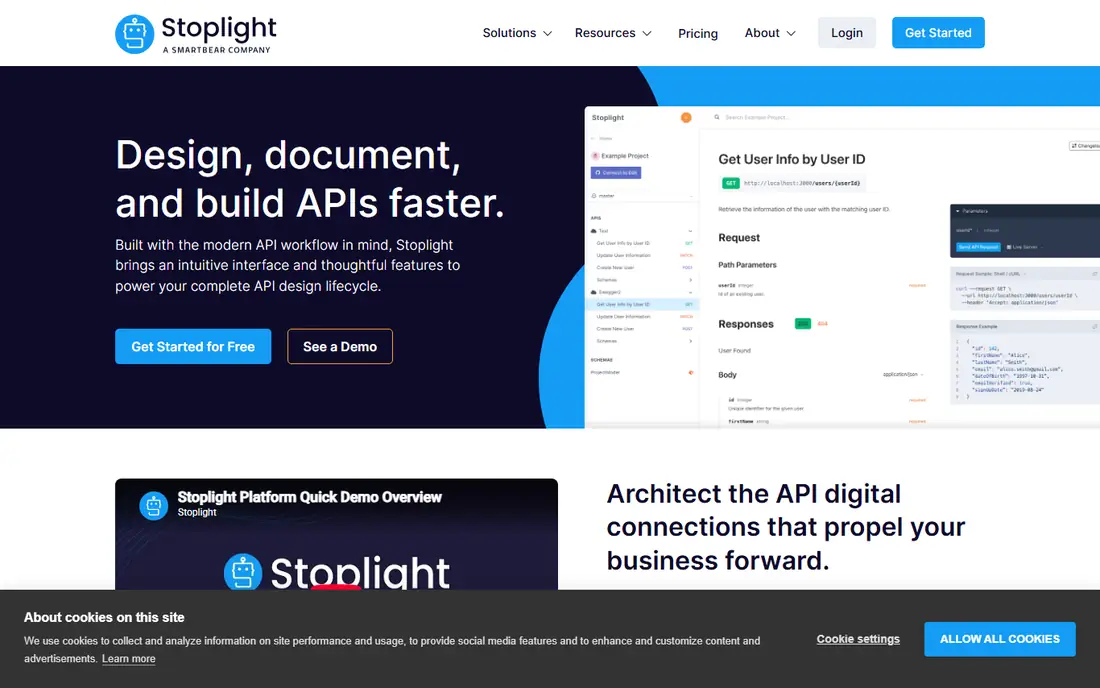
Stoplight is the clearest pick for design-first governance. The editor lets a designer shape an API contract before code starts, and Spectral rules check naming, versioning and structure as the spec changes. Teams can share one style guide across projects, so new APIs start from the same rules. The price is third-party reported from the vendor pricing page, checked 11 Nov 2026. SmartBear owns Stoplight, and the hosted platform is still sold and supported, even though the desktop editor is dormant.
What we like- Strong visual OpenAPI editor
- Spectral linting and shared style guides
- Mock servers and hosted docs
- Git based collaboration
Watch out for- The desktop Studio app stopped receiving updates in early 2024, so teams should use Studio Web
- Key governance controls such as shared style guides need Pro Team
- Per user costs rise as the team grows
#2
SwaggerHub
Best for: Large teams that design APIs in OpenAPI and already use SmartBear tools
Visit swagger.io
Starting pricequote
Free planYes, limited to 1 designer on the free tier
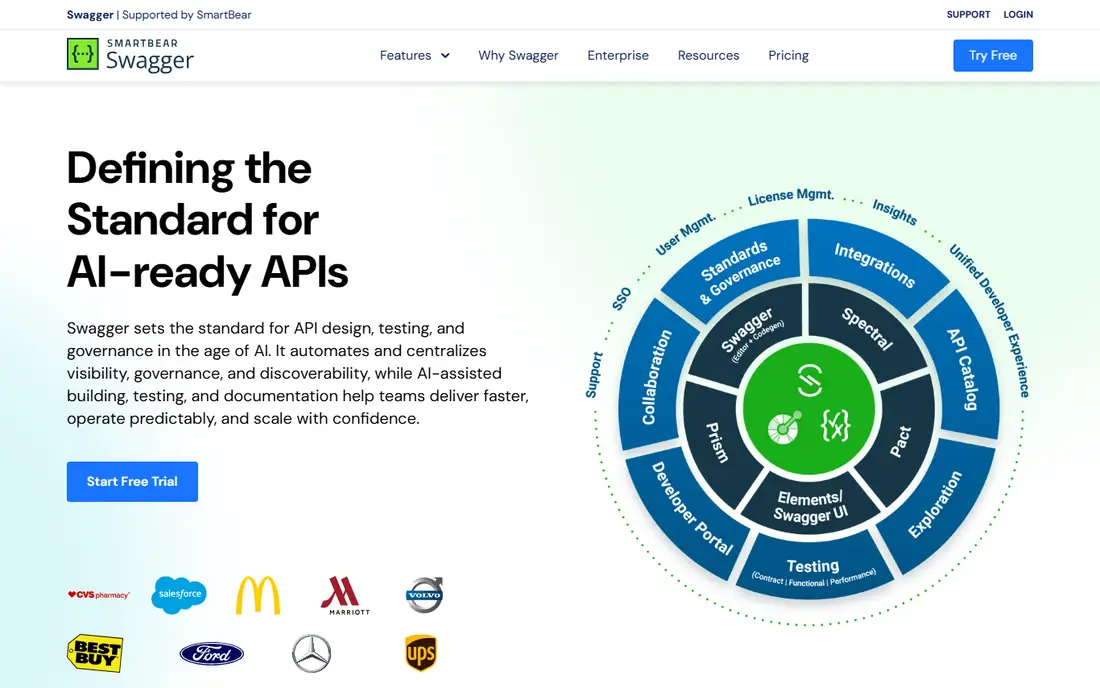
SwaggerHub gives teams a single place to design, version and publish OpenAPI specs. Editors can work on the same spec, leave comments and track versions before an API goes live. The platform enforces a shared design process, which helps large teams keep naming and structure consistent. It also connects to source control and CI tools, so a spec change can flow into builds and docs. The trade off is price clarity. SmartBear now sells Swagger through its admin and quote process, and third-party sources disagree on the exact per user rate. Treat the price as quote only and ask for a written quote for your seat count.
What we like- Built for OpenAPI design and docs
- Strong versioning and collaboration
- Wide integrations with source control and CI tools
- Familiar to teams that already use Swagger
Watch out for- The vendor does not publish a simple list price, so buyers must request a quote
- Third-party reports put Team near 75 to 90 dollars per user per month, which rises fast for large teams
- Advanced governance controls sit on higher tiers
#3Postman
Best for: Teams that already use Postman daily and want governance in the same workspace4.6/5 on
G2 (1,795 reviews, checked Oct 2026)
Visit postman.com
Starting price19 dollars per user per month, Team plan, billed annually
Free planYes, 1 user only since 1 March 2026
Postman is a practical pick when the team already lives in Postman. Collections, specs, tests and docs sit in shared workspaces, so a governance rule can reach the people who write and test APIs. Enterprise adds governance rules, the API catalog, private API network and audit logs. That is the plan most buyers need for real governance, and it costs 49 dollars per user per month on annual billing. Team at 19 dollars per user per month covers collaboration and basic roles, but it lacks the full governance set. Prices were checked on the vendor pricing page, 11 Nov 2026, through published pricing summaries dated September and October 2026. Budget for Enterprise if governance is the main goal.
What we like- Huge user base and familiar client
- API catalog and governance rules on Enterprise
- Strong testing, mocks and docs
- Wide integrations
Watch out for- The free plan now covers one user and cannot create a team, so small teams must pay
- Governance rules, the API catalog and audit logs sit on Enterprise at 49 dollars per user per month
- SSO needs a paid add-on on Team
#4Apidog
Best for: Small teams that want design, testing, mocks and docs in one low cost workspace4.8/5 on
G2 (231 reviews, checked Oct 2026)
Visit apidog.com
Starting price9 dollars per user per month, Basic plan, billed annually
Free planYes, up to 4 users with core features
Apidog suits teams that need shared API work without a large bill. The free plan covers four people with live co-editing, which Postman no longer offers. Basic at 9 dollars per user per month adds unlimited team members, more projects and longer change history. Professional at 18 dollars per user per month adds more controls, and Enterprise at 27 dollars per user per month adds SSO, SCIM and on premises options. Design, testing, mocks and docs live in one workspace, so a spec change flows into tests and published docs without extra tools. Governance is practical rather than deep. Prices were checked on the vendor pricing page, 11 Nov 2026, through published pricing summaries dated September and October 2026.
What we like- Low entry price
- Free plan covers up to four users
- Design, debugging, mocking, testing and docs in one app
- Clear per seat pricing
Watch out for- Governance controls are lighter than Stoplight or SwaggerHub, with fewer shared style guide controls
- Enterprise controls such as SAML SSO and SCIM sit on Enterprise at 27 dollars per user per month
- Smaller ecosystem than Postman
#5Bump.sh
Best for: Teams that publish API docs and need clear changelogs and breaking change alerts4.9/5 on
G2 (4 reviews, checked Oct 2026)
Visit bump.sh
Starting price50 dollars per month, Basic plan
Free planNo, 14 day free trial on Pro
Bump.sh replaces Optic in this list. Optic was archived on 12 January 2026 and its site no longer resolves, so it should not be bought as a live platform. Bump.sh covers the same core need in a hosted form. It publishes OpenAPI and AsyncAPI docs, compares each new version with the last, flags breaking changes and writes a changelog. The CLI can fail a pull request that breaks consumers. Basic at 50 dollars per month covers 10 API docs and three internal users. Pro at 120 dollars per month covers 30 API docs, the API Explorer, diff, changelog, branches and rollback. The price is third-party reported from the vendor pricing page, checked 11 Nov 2026.
What we like- Automatic diff and breaking change detection
- Automatic changelog on Pro
- Supports OpenAPI and AsyncAPI
- Clean hosted docs and custom domains
Watch out for- No free plan, so every team pays from day one
- The automatic changelog and API Explorer sit on Pro at 120 dollars per month
- It is a docs and change platform, not a full design editor
#6Gravitee
Best for: Platform teams that need governance plus a gateway, portal and event support4.7/5 on
G2 (41 reviews, checked Oct 2026)
Visit gravitee.io
Starting price2,500 dollars per month, Planet plan
Free planYes, open source Community Edition under Apache 2.0
Gravitee suits teams that govern APIs as part of a wider platform. The catalog lists APIs, owners and versions. Plans and products control who can use each API. Policies enforce auth, rate limits and access rules at the gateway. The open source edition is free to self host, which helps teams test the platform before they pay. Planet at 2,500 dollars a month includes unlimited users, one production gateway, one non-production gateway and one module. Galaxy and Universe use custom pricing and add gateways, modules and support. Prices were checked on the vendor pricing page, 11 Nov 2026.
What we like- Full lifecycle API management with gateway, portal and catalog
- Open source edition for self hosting
- Fixed pricing per gateway, not per call
- Supports REST, GraphQL, gRPC and event streams
Watch out for- Planet at 2,500 dollars a month is far above the design only tools in this list
- The platform is large and needs skilled staff to run
- Governance features are spread across modules, so setup takes time
#7
Kong Konnect
Best for: Teams that run Kong Gateway and want one control plane for governance and traffic
Visit konghq.com
Starting price25 dollars per month per serverless control plane, Konnect Plus
Free planYes, 30 day free trial with Enterprise features
Kong Konnect adds governance to the Kong gateway stack. The control plane lists services, versions and owners in a catalog. The developer portal publishes docs and controls access. Policies and plugins enforce standards at runtime. Plus starts at 25 dollars a month per serverless control plane, with hybrid at 200 dollars and dedicated cloud gateways at 500 dollars per control plane. One million requests are included, then extra requests cost 200 dollars per million. Published APIs cost 20 dollars a month each for the first ten. Enterprise is quote only and adds SSO, audit logs and unlimited portals. Prices were checked on the vendor pricing page, 11 Nov 2026, through published pricing summaries dated September and October 2026.
What we like- Hosted control plane for all Kong gateways
- Service catalog, developer portal and analytics in one console
- Published usage rates for Plus
- Open source gateway for self hosting
Watch out for- Billing is complex, with charges for control planes, requests, portals, published APIs and AI models
- Plus caps at 10 million requests a month and five AI models, with no SSO or audit logs
- Enterprise is quote only
#8Zuplo
Best for: Small teams that publish a few APIs and want a portal with simple usage pricing4.8/5 on
G2 (41 reviews, checked Oct 2026)
Visit zuplo.com
Starting price25 dollars per month, Builder plan
Free planYes, 100,000 requests per month
Zuplo is the lightest platform in this list, and that is its strength for small publishers. The free plan covers 100,000 requests a month with a portal, API keys and edge deployment. Builder at 25 dollars a month adds custom domains and pay as you go scaling. Enterprise starts at 1,000 dollars a month on annual contracts and adds SSO, RBAC, audit logs and higher SLAs. Governance here means versioned docs, deprecation notes and access control through the portal, not deep linting rules. Teams with strict design standards should pair Zuplo with a linting step in CI or pick Stoplight instead. Prices were checked on the vendor pricing page, 11 Nov 2026, through published pricing summaries dated September 2026.
What we like- Simple usage based pricing
- Developer portal included on every plan
- Unlimited environments and API keys
- Edge deployment in more than 300 locations
Watch out for- Governance is lighter than the design first tools, with limited style guide and linting controls
- Breaking change detection is not a core feature
- Higher tiers use custom pricing from 1,000 dollars a month
Frequently asked questions
Which API governance platform is best for a small team?
Apidog is the best value for a small team, because its free plan covers four users and Basic costs 9 dollars per user per month. Bump.sh suits a team that publishes docs and needs changelogs, at 50 dollars a month for Basic. Stoplight Basic at 44 dollars a month suits a design led team of three.
What is the difference between API governance and API management?
API governance sets the rules for how APIs are designed, named, versioned and changed. API management runs the APIs, with gateways, auth, rate limits and portals. Governance happens before and during design. Management happens at runtime. Many platforms cover both, but check which side is stronger.
How do I enforce API design standards across teams?
Start with a written style guide that covers naming, versioning, auth, errors and pagination. Put the rules in a linting tool such as Spectral or the linting built into Stoplight or SwaggerHub. Run the checks in CI so a pull request fails when it breaks a rule. Rules that are not checked in CI are only advice.
Can I detect breaking changes before I publish an API?
Yes, if your tool compares the new spec with the last published version. Stoplight, Bump.sh, SwaggerHub and Postman Enterprise all offer version comparison or breaking change checks. The check should flag removed endpoints, removed fields, changed types and new required inputs. Put the check in CI and block the merge when it fails.
Is Optic still a good choice for breaking change detection in 2026?
No, Optic is not a good choice for new projects in 2026. Its GitHub repo was archived on 12 January 2026, its last release was in August 2025, and its site no longer resolves. The code is still open source, but it has no support and no security patches. Use Bump.sh, oasdiff or the diff features in Stoplight or SwaggerHub instead.
Sources we checked (9)
- https://stoplight.io/pricing
- https://swagger.io/tools/swaggerhub/
- https://www.postman.com/pricing/
- https://apidog.com/pricing/
- https://bump.sh/pricing
- https://www.gravitee.io/pricing
- https://konghq.com/pricing
- https://zuplo.com/
- https://dev.to/deepaksatyam/optic-is-dead-a-2026-migration-guide-for-openapi-breaking-changes-4go2
Is your product missing or out of date?
We review this list regularly. Vendors can request a listing, send updated pricing or ask about featured placement.

Shihab Mia · Founder, Rankite
Shihab has 5+ years in B2B and SaaS SEO. He writes Rankite's software buying guides from pricing pages, documentation and public user reviews. More about Shihab.