How we make this list: we compare pricing pages, product documentation and public user reviews. Ratings come from G2, Capterra or Trustpilot, with the date we checked them.
Key takeaways
- Postman remains the enterprise default, but since March 2026 its free plan covers one user and the first shareable team plan costs 19 dollars per user per month.
- Bruno is the developer favourite for a reason: the client is free and open source, and collections live as plain files in your Git repository.
- Apidog at 9 dollars per user is the closest full platform alternative, with design, testing, mocks, and docs in one workspace and a free plan for four.
- The real choice is where the work lives: a vendor cloud workspace, your Git repo, or your own server, and that decision outlasts any feature list.
Quick comparison
| Tool | Best for | Starting price | Free plan |
|---|
 Postman | Enterprise API platform and governance | $19 per user per month | Yes |
 Apidog | Full lifecycle platform at half the seat price | $9 per user per month | Yes |
 Bruno | Git native, offline first API client | Free | Yes |
 Insomnia | Protocol breadth from the Kong team | $12 per user per month | Yes |
 Hoppscotch | Instant browser based testing | Free | Yes |
 HTTPie | Terminal first API work | Free | Yes |
 Thunder Client | API testing inside VS Code | $3 per user per month | Yes |
Is your product missing or out of date?
We review this list regularly. Vendors can request a listing, send updated pricing or ask about featured placement.
#1Postman
Best for: Enterprise API platform and governance4.6/5 on
G2 (1,795 reviews, checked Oct 2026)
Visit postman.com
Starting price$19 per user per month
Free planYes
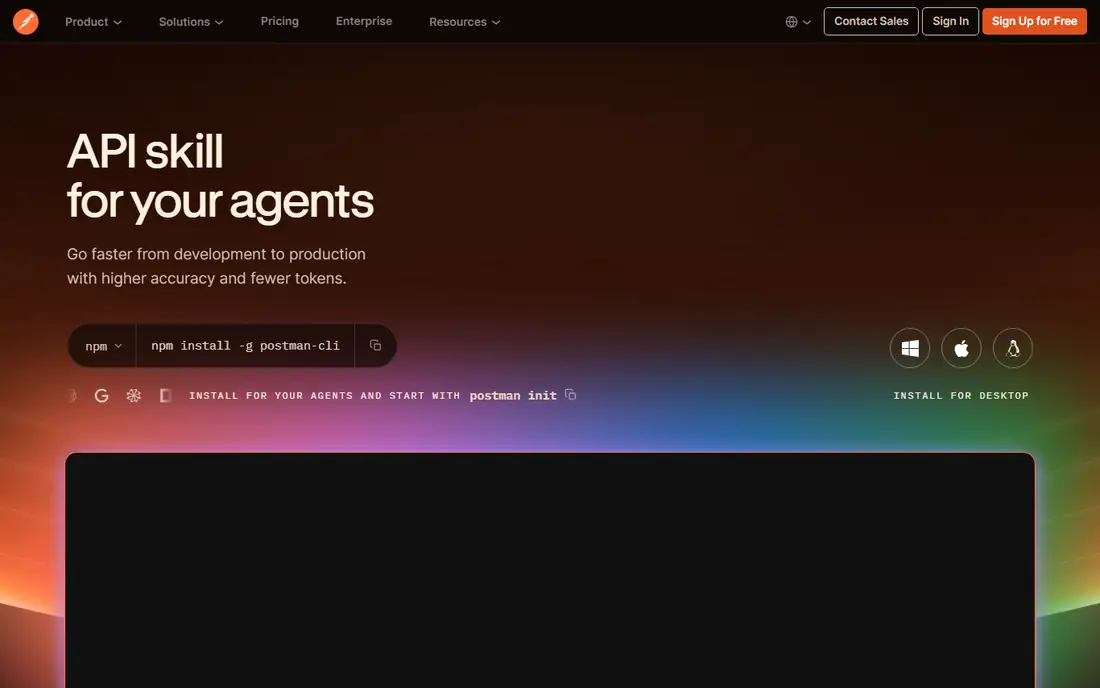
What we like- Postman is still the most complete API platform: design and collections, testing with the Newman CLI runner in CI, hosted mock servers, monitors, published documentation, governance controls, and the public API Network where thousands of companies publish their APIs. Collection runs and mocks are unlimited across paid tiers, so the bill is purely seats and controls. For an enterprise with API standards to enforce, nothing else is as finished.
Watch out for- The 2026 free plan covers one user only, so the famous free Postman is now a solo product, and team sharing starts at 19 dollars per user per month with Enterprise at 49 dollars. Your collections live in Postman's cloud under its data terms, which security teams at regulated companies question. The platform's breadth also makes it heavy for developers who only want to send a request and read a response.
#2Apidog
Best for: Full lifecycle platform at half the seat price4.8/5 on
G2 (231 reviews, checked Oct 2026)
Visit apidog.com
Starting price$9 per user per month
Free planYes
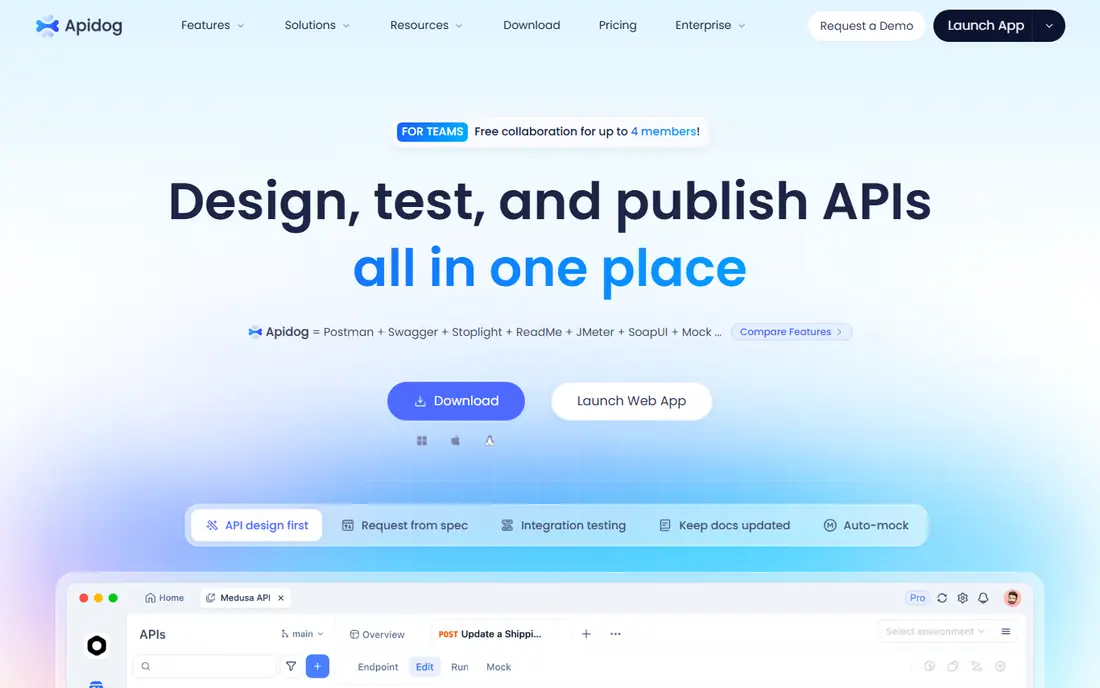
What we like- Apidog rebuilds the Postman platform shape at half the price: spec first design where the mock, the schema assertions, and the documentation all update from one definition, real time co editing, sprint branches, and automated testing with database steps. Its free plan covers a team of up to four with unlimited runs and mocks, and Basic at 9 dollars per user per month is the cheapest full platform seat here. Postman collections import with their scripts intact.
Watch out for- Every seat is billed once you pass four users, so costs scale linearly with the whole team including light users. Apidog lacks Postman's public network and multi region monitor footprint. As a younger company, its enterprise track record is shorter, which procurement teams weigh for platform commitments.
#3Bruno
Best for: Git native, offline first API client4.5/5 on
G2 (9 reviews, checked Oct 2026)
Visit usebruno.com
Starting priceFree
Free planYes
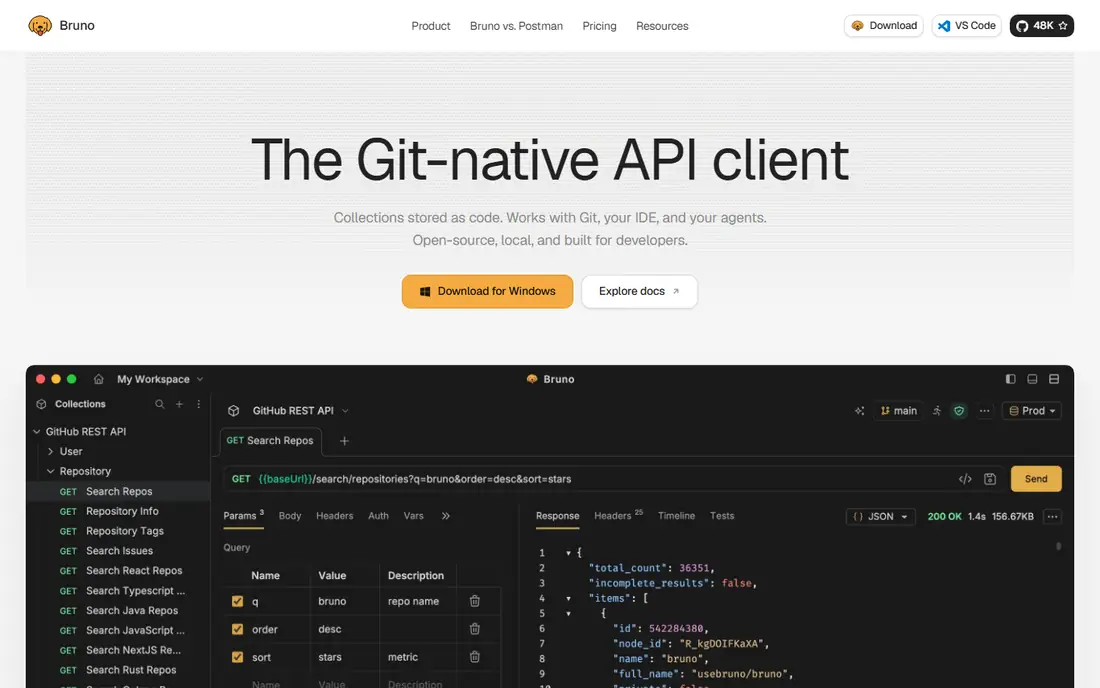
What we like- Bruno is the open source answer to cloud lock in: collections are plain text .bru files stored in your repository, the MIT licensed client is free with no account and works fully offline, and collaboration is simply your existing Git workflow with reviews and history included. Pro at 6 dollars per user per month adds in app Git and an unlimited runner. For all engineer teams, Bruno's answer to where the collection lives is the cleanest in the industry.
Watch out for- There is no hosted mock server, no published docs site, and no live co editing
- Sharing means Git, which excludes product managers and QA staff who do not live there. Free tier limits include capped OpenAPI syncs and public repo only Git integration in the app. Support is a small company and community rather than an enterprise vendor.
#4Insomnia
Best for: Protocol breadth from the Kong team4.4/5 on
G2 (21 reviews, checked Oct 2026)
Visit insomnia.rest
Starting price$12 per user per month
Free planYes
What we like- Insomnia, built by Kong and open source under Apache 2.0, covers REST, GraphQL, gRPC, WebSocket, and SSE in a mature desktop client, with design first OpenAPI editing and the Inso CLI for CI. Storage is your choice: local only, Git Sync, or Kong's cloud with end to end encryption, and the free Essentials tier includes Git Sync for three users. Pro at 12 dollars per user per month removes the limits, and Kong publishes a Postman migration guide for switchers.
Watch out for- Enterprise at 45 dollars per user closes much of the price gap with Postman for large teams. Insomnia's mock tooling caps free usage at 1,000 requests a month. Its governance and documentation publishing are thinner than the full platforms, so it stays a client first product.
Starting priceFree
Free planYes
What we like- Hoppscotch runs in a browser tab in seconds: REST, GraphQL, WebSocket, SSE, and MQTT support, team workspaces on the free plan with no stated caps on collections or requests, and an Organization tier at 6 dollars per user per month for admin controls and support. It is MIT licensed and self hostable, so a team can move it onto its own infrastructure. For quick endpoint checks and shared team collections at no cost, it is hard to beat.
Watch out for- Testing localhost services needs its desktop app or browser extension, a small friction that surprises new users. Documentation publishing and scenario testing with database steps trail Apidog and Postman. Browser storage as the default home for collections makes some teams insist on the self hosted route, which then needs maintaining.
Starting priceFree
Free planYes
What we like- HTTPie made command line HTTP humane, and its free open source CLI remains the fastest way to explore an API from a terminal: readable syntax, formatted and coloured JSON output, sessions, and scripting friendly behaviour that pipes into the rest of a shell workflow. A desktop app exists for those who want the same feel in a window. For developers who live in the terminal, nothing here is quicker for a single request.
Watch out for- HTTPie is a client, not a platform: no team workspaces, mocks, design tools, or managed test suites, so organisations pair it with something else for the shared layer. It covers HTTP APIs rather than the gRPC and streaming breadth of Insomnia. The desktop app is a paid product, and the free story is the CLI alone.
Starting price$3 per user per month
Free planYes
What we like- Thunder Client puts a capable API client inside VS Code, where many developers already spend their day: collections, environments, and tests without a second application, with a free tier for basic use and paid plans from 3 dollars per user per month adding Git storage, more protocols including gRPC and WebSocket, and a CLI runner. Business at 7 dollars stays far below platform pricing. For editor centric teams it removes a whole tool from the stack.
Watch out for- The free tier is metered and limited to one user, and several protocols sit behind the paywall. It inherits VS Code's limits as a host, so heavy platform duties such as hosted mocks and public docs are not its game. Data lives in extension storage unless you pay for Git sync, which needs the same discipline as Bruno without Bruno's files first design.
How we chose
We covered the three shapes of the 2026 market: enterprise platform, value platform, and files first open source clients, plus the specialists for browser, terminal, and editor workflows. Pricing was standardised to the first team capable plan per user per month on annual billing, using vendor pages and September 2026 per seat comparisons, because free tier shapes changed this year and headline prices mislead. We tested claims about collection storage carefully, since where API data and secrets live is a security decision, not a preference.
Decide the storage question first, because it is the one you cannot easily reverse. If your security model says API collections and credentials stay in your repository under your access controls, Bruno is the answer and the platform debate ends. If your organisation wants a governed, hosted API programme with public documentation and monitoring, Postman or Apidog are the realistic pair, separated mainly by seat price and maturity. Mixed teams, engineers plus QA plus product, need the shared workspace camp, since Git only collaboration quietly excludes everyone else.
Then count the whole team honestly. Platform pricing bills every seat, so a 40 person engineering organisation pays 40 seats even if half send one request a week; the open source clients make those seats free and charge only for convenience features. Pilot the migration before committing: import your largest real collection, run it in CI through the tool's CLI, and test how secrets are handled, because secrets handling is where these products differ most and fail worst. Prices are October 2026 published figures.
Frequently asked questions
Is Postman still free?
For one person, yes: the free plan covers a single user with unlimited collection runs and mocks. Teams lost free sharing in the March 2026 reset, and the first plan a team can share is Team at 19 dollars per user per month on annual billing. That change, more than any feature, is what pushed small teams toward Bruno, Hoppscotch, and Apidog this year.
Which tool keeps my API collections in Git?
Bruno, by design: collections are plain text files in your repository, reviewed and versioned like code. Insomnia offers Git Sync as one of its storage modes, and Thunder Client adds Git storage on paid plans. The platform tools, Postman and Apidog, can export to files but their living workspace is the vendor cloud, which is the trade their governance features are built on.
What is the cheapest way to equip a ten person team?
Bruno at zero for the client, or Hoppscotch free in the browser, if the team is all engineers and comfortable with Git or browser storage. The cheapest full platform is Apidog Basic at 9 dollars per user per month, 1,080 dollars a year for ten, against 2,280 dollars for Postman Team. Insomnia Pro at 12 dollars sits between them with stronger protocol coverage.
Do these tools support GraphQL and gRPC, or only REST?
Postman, Apidog, Insomnia, Bruno, and Hoppscotch all cover GraphQL, and most cover gRPC and WebSocket as well; Insomnia's protocol breadth is its headline strength. HTTPie is an HTTP tool. Thunder Client gates several protocols behind paid tiers. If your APIs are event driven or streaming heavy, verify the exact protocol support of your finalists against your own services during the pilot.
How should API keys and secrets be handled in these tools?
Never inside shared collections as plain text. Use environment variables with local secret storage, the tool's vault or encrypted sync where offered, and CI secrets in your pipeline rather than exported files. Files first tools such as Bruno keep secrets out of Git only if the team uses its environment file conventions properly, so set the rule on day one and audit the repository for committed keys.
Sources we checked (0)
Is your product missing or out of date?
We review this list regularly. Vendors can request a listing, send updated pricing or ask about featured placement.

Shihab Mia · Founder, Rankite
Shihab has 5+ years in B2B and SaaS SEO. He writes Rankite's software buying guides from pricing pages, documentation and public user reviews. More about Shihab.