How we make this list: we compare pricing pages, product documentation and public user reviews. Ratings come from G2, Capterra or Trustpilot, with the date we checked them.
Key takeaways
- The best alternatives to Facebook Groups in 2026 are led by Circle for paid communities, Mighty Networks for mobile engagement, and Skool for simplicity.
- Facebook Groups offer massive reach and zero cost, but you own no data, have no real monetization tools, and face algorithm and rule changes.
- Free options like Discord and self hosted Discourse cost nothing but time, while paid creator platforms start around 79 to 99 dollars per month.
- Picking Discord as your hub because it is free can backfire later, when you want to charge, export, or search years of conversations.
- Most serious community businesses treat Facebook as a discovery outpost, not the home base, and build their owned community elsewhere.
Quick comparison
| Tool | Best for | Starting price | Free plan |
|---|
 Circle | Paid membership communities | $89 per month | No |
 Mighty Networks | Mobile first communities | $79 per month | No |
 Skool | Simple paid communities | $9 per month | No |
 Discord | Free real time chat | See website | Yes |
 Discourse | Forum discussions | See website | Yes |
 Slack | Professional groups | See website | Yes |
 Telegram | Large public groups | See website | Yes |
 Heartbeat | Budget cohort communities | $40 per month | No |
Is your product missing or out of date?
We review this list regularly. Vendors can request a listing, send updated pricing or ask about featured placement.
The best alternatives to Facebook Groups
#1Circle
Best for: Paid membership communities4.5/5 on
G2 (544 reviews, checked Oct 2026)
Visit circle.so
Starting price$89 per month
Free planNo
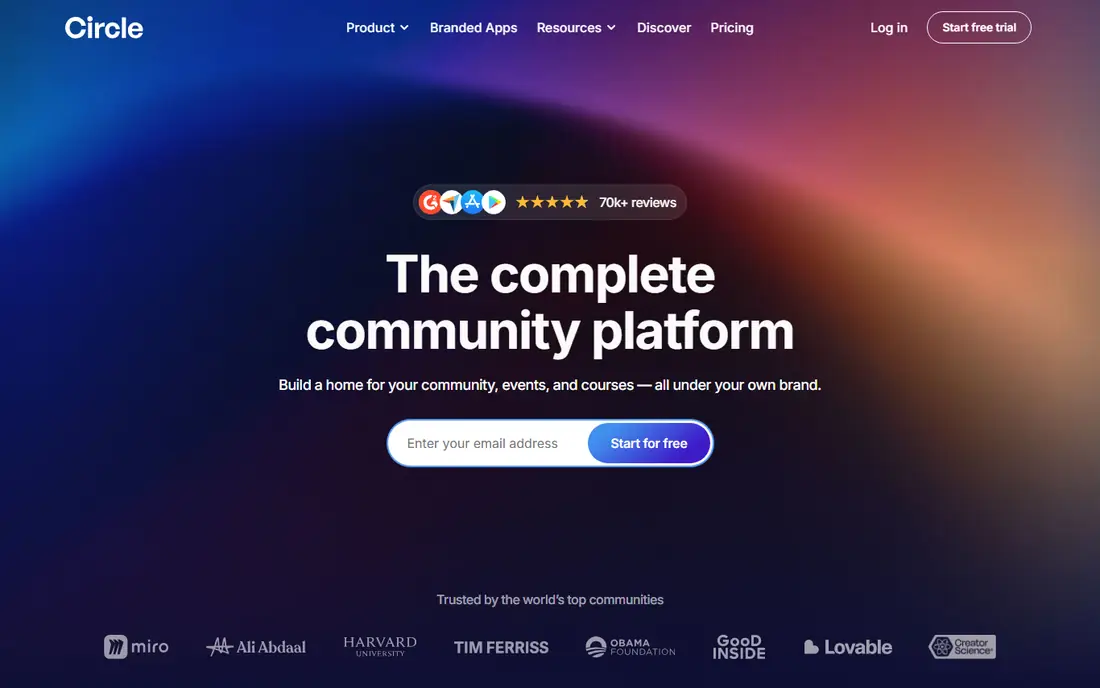
Circle is the strongest all around choice for paid membership communities, thanks to its polish, automation, and expanding all in one feature set. It combines discussion spaces, courses, live events, and payments in one hosted platform, with unlimited members on paid plans. The Professional plan starts at 89 dollars per month on annual billing, with a 2 percent transaction fee on sales.
The limits are fees and cost. Lower plans take a cut of sales, and custom branded apps sit on higher tiers. For a creator or business building a paid community as a real product, Circle is the best overall platform available today.
What we like- Clean interface
- Spaces, courses, and events in one place
- Workflows and automations
Watch out for- Transaction fees on lower plans
- No free plan
- Custom apps cost extra
Starting price$79 per month
Free planNo
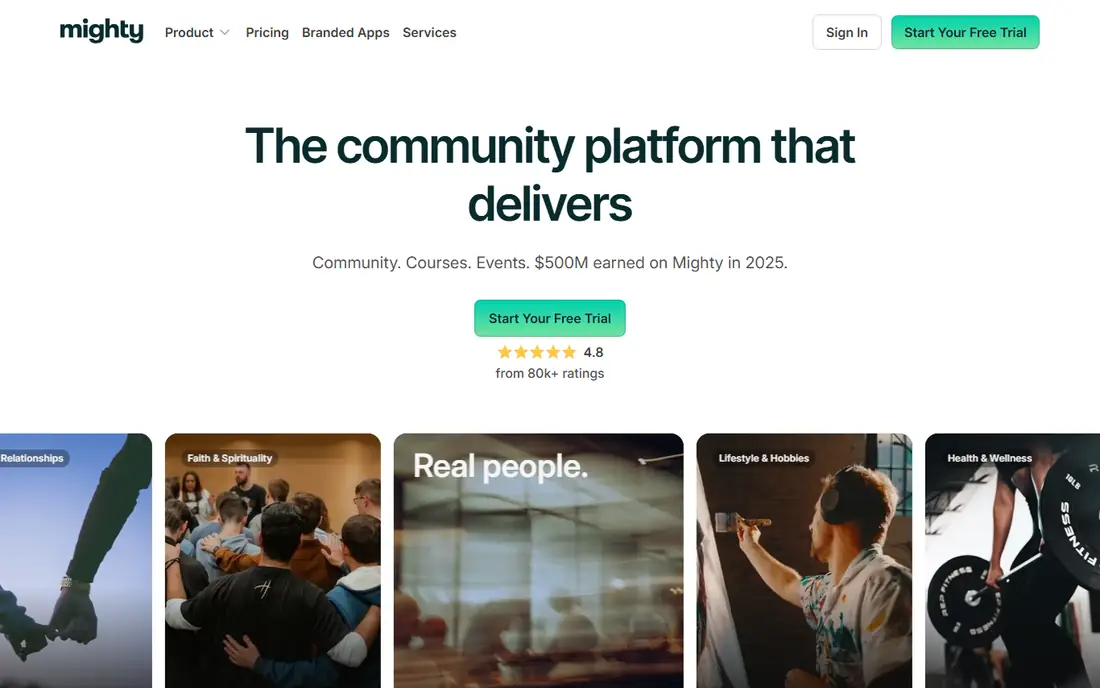
Mighty Networks is the better pick when mobile engagement and structured programs matter most, with strong native mobile apps, courses, challenges, and events built into the community. The Launch plan starts at 79 dollars per month on annual billing, with a 2 percent transaction fee, and higher tiers add branded apps and deeper integrations.
The limits are fees and complexity. Pricing tiers and transaction fees need careful reading, and the interface is busier than Circle. For communities that live on daily mobile engagement, Mighty Networks leads the field.
What we like- Strong native mobile apps
- Courses and events inside the community
- High engagement
Watch out for- Transaction fees on lower plans
- Pricing tiers can confuse
- Less clean than Circle
Starting price$9 per month
Free planNo
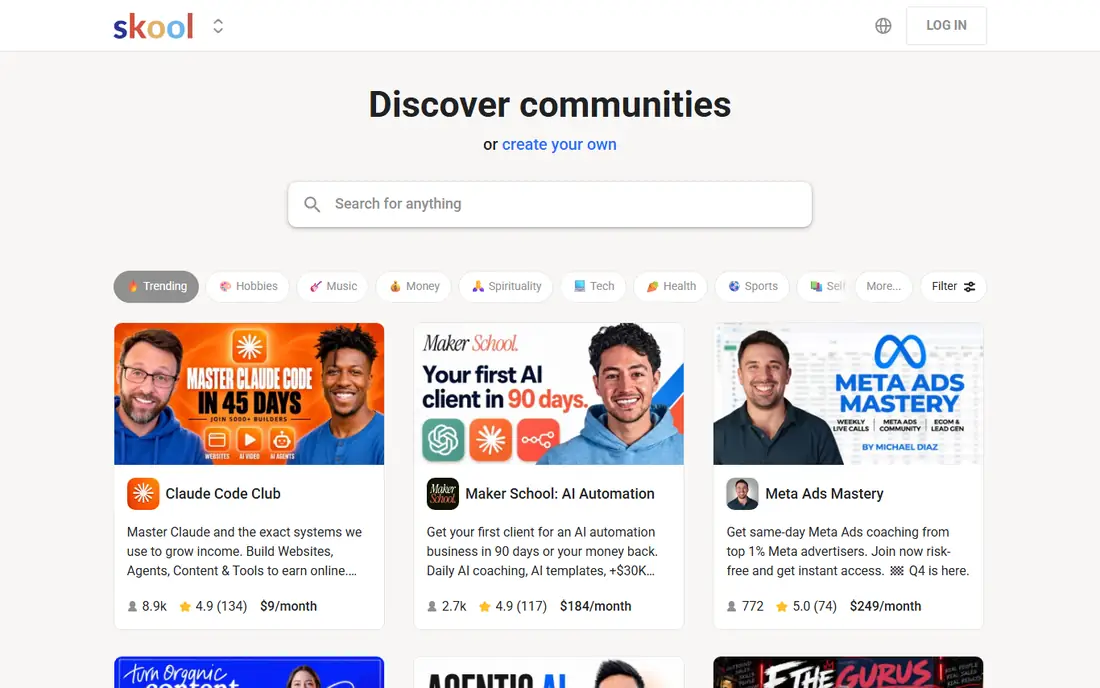
Skool wins on simplicity for coaches and creators just starting out, with one feed, a classroom, a calendar, and gamification through points and levels. The Hobby plan costs 9 dollars per month but takes a 10 percent transaction fee, while Pro costs 99 dollars per month with a 2.9 percent fee and unlimited members, courses, and videos.
The limits are fees and depth. Hobby is the right answer for a community earning under about 12,600 dollars a year, and the wrong one above it, since Pro costs less in total despite a much higher entry price. Skool also offers fewer features than Circle or Mighty Networks. For a simple paid community, Skool is the easiest start.
What we like- Very simple setup
- Gamification with points and levels
- Built in payments
Watch out for- Hobby plan takes 10 percent
- Fewer features than Circle
- Discovery directory is public
#4Discord
Best for: Free real time chat4.6/5 on
G2 (43 reviews, checked Oct 2026)
Visit discord.com
Starting priceSee website
Free planYes
Discord is free and excellent for real time chat communities, with text channels, voice rooms, video, and streaming in one place. It is familiar to younger members and costs nothing to start, which makes it popular for gaming, hobby, and fan communities.
The limits are ownership and monetization. Discord gives you less control over data and branding, monetization runs through server subscriptions and bots, and searching or exporting years of conversations is painful. For a free chat community, Discord is great, but for a paid community business, it is a weak home base.
What we like- Free
- Excellent real time chat and voice
- Familiar to younger members
Watch out for- Hard to monetize
- Poor search and export
- No real course structure
Starting priceSee website
Free planYes
Discourse is an open source forum platform that excels at structured discussion, questions and answers, and long lived knowledge. It is free if you self host it, and hosted plans start with a free tier and a Pro plan at 100 dollars per month with unlimited members. Self hosting gives full data ownership and control.
The limits are skill and format. Self hosting needs technical work, and Discourse suits forum discussion better than real time chat. For a community built around searchable knowledge and discussion, Discourse is the best open option.
What we like- Open source
- Excellent forum search
- Full data ownership when self hosted
Watch out for- Needs technical skill to self host
- Hosted plans start at 100 dollars
- Less chat focused
#6Slack
Best for: Professional groups4.5/5 on
G2 (39,944 reviews, checked Oct 2026)
Visit slack.com
Starting priceSee website
Free planYes
Slack is the default chat tool for professional teams, with channels, huddles, external messaging, and thousands of app integrations. The free plan works for small groups, while Pro costs 8.75 dollars per user per month on monthly billing.
The limits are cost and fit. Per user pricing grows fast with member count, and Slack is built for work teams, not public communities. For a professional or internal group that already lives in Slack, it is a natural choice, but it is a poor fit for a large public community.
What we like- Familiar to professionals
- Strong app integrations
- Channels and huddles
Watch out for- Per user pricing gets expensive
- Message history limits on free plan
- Not built for public communities
Starting priceSee website
Free planYes
Telegram is free and supports very large public groups and channels, with fast mobile apps and broad global reach. It suits public communities, news channels, and large interest groups that need to reach many members at once.
The limits are structure and monetization. Telegram groups lack the courses, payments, and structured discussion of paid platforms, and monetization needs third party bots. For a large, free, public group, Telegram is a strong option for most communities.
What we like- Free
- Huge group capacity
- Fast mobile apps
Watch out for- Weak moderation tools
- Monetization needs bots
- Less structured than forums
#8Heartbeat
Best for: Budget cohort communities4.8/5 on
G2 (31 reviews, checked Oct 2026)
Visit heartbeat.chat
Starting price$40 per month
Free planNo
Heartbeat suits coaches running cohort based and learning led communities on a budget, with threads, chat channels, direct messages, voice and video rooms, courses, and events. The Build plan starts at 40 dollars per month on annual billing, with a 5 percent transaction fee, and Grow costs 124 dollars per month.
The limits are scale and polish. Heartbeat has a smaller ecosystem than Circle or Mighty Networks, and its interface is less polished. For a budget conscious coach who needs courses and community in one place, Heartbeat offers strong value.
What we like- Lower price than Circle
- Threads, chat, and courses
- Events with calendar sync
Watch out for- Smaller ecosystem
- 5 percent fee on Build plan
- Less polished than leaders
How we chose
We ranked platforms by data ownership, monetization, community features, mobile experience, and price, favoring platforms that let owners charge, export data, and brand their community. We gave extra weight to paid community features, since most people leaving Facebook Groups want to build a business, not only a chat room. We also weighed total cost, including transaction fees, not only the monthly subscription. Finally, we checked moderation tools, since a growing community needs spam control, member approval, and clear rules, and a platform with weak moderation turns toxic fast no matter how good its other features look.
Buying guide
Start by deciding whether your community is free or paid. Free communities can live well on Discord, Telegram, or Discourse, while paid communities need Circle, Mighty Networks, Skool, or Heartbeat for payments and gated access. Mixing the two goals on one platform usually fails, since free members expect open access and paying members expect exclusive value, and one space rarely serves both well.
Next, check data ownership and exit options before you invest months building. Ask what you can export, in what format, and what happens to member subscriptions if you leave. A platform that locks your member list is a risk, not a home.
Finally, test the member experience on a phone. Most members join from mobile, so a platform with a weak mobile app will see lower engagement no matter how good its desktop version looks. Invite a small test group, run a week of activity, and measure how many members actually return.
Also plan your migration before you announce it. Moving a community means moving people, not only posts, so give members a clear reason to follow you, a simple join link, and a welcome post that explains what changes and what stays the same. Expect some members to stay behind on Facebook, and treat the move as a gradual shift over weeks, not a single announcement that everyone must follow at once.
Frequently asked questions
Why leave Facebook Groups at all?
Facebook Groups are free and large, but you own no data, cannot monetize cleanly, and Facebook's algorithm controls reach. Serious community businesses need ownership and reliable income, which Facebook does not offer.
Can I build a community for free?
Yes. Discord is free for real time chat, and Discourse is free if you self host it. The trade off is monetization and ownership: free platforms give you less control over data, branding, and revenue.
What is the best platform for a paid community?
For most paid membership communities, Circle is the strongest all around choice. Mighty Networks suits mobile first communities, and Skool suits coaches who want simplicity.
How much does a community platform cost?
Paid creator platforms start around 79 to 99 dollars per month for Circle and Mighty Networks, while Skool starts at 9 dollars per month with a higher transaction fee. Enterprise platforms run into the hundreds or thousands per month.
Should I keep my Facebook Group too?
Yes, as a discovery outpost. Keep a free Facebook Group to attract new members, and move your paying members to your owned platform where you control data, pricing, and reach.
Sources we checked (0)
Is your product missing or out of date?
We review this list regularly. Vendors can request a listing, send updated pricing or ask about featured placement.

Shihab Mia · Founder, Rankite
Shihab has 5+ years in B2B and SaaS SEO. He writes Rankite's software buying guides from pricing pages, documentation and public user reviews. More about Shihab.