How we make this list: we compare pricing pages, product documentation and public user reviews. Ratings come from G2, Capterra or Trustpilot, with the date we checked them.
Key takeaways
- This article is general information, not financial advice, and AI signals do not guarantee returns: beginners can lose money fast, especially with borrowed money.
- Trade Ideas with Holly AI is the best active-trading pick for beginners who want an AI scanner, starting free with paid plans near $84 per month.
- Composer is the best no-code strategy builder, letting beginners automate rules without writing code, at about $32 per month billed annually.
- Alpaca is the best free API-first broker for tech-savvy beginners, with $0 commissions and free paper trading.
- Start with paper trading and small amounts, and never trade money you cannot afford to lose.
Quick comparison
| Tool | Best for | Starting price | Free plan |
|---|
 Trade Ideas | AI scanning for active beginners | Free | Yes |
 Tickeron | AI trend prediction | Free | Yes |
 Composer | No-code automated strategies | $32 per month | Yes |
 Alpaca | Free API-first broker | Free | Yes |
 Magnifi | Natural language investing | Free | Yes |
 Danelfin | AI stock scoring | Free | Yes |
 eToro | Social learning and virtual trading | Free | Yes |
 TradeStation | Backtesting and automation | Free | Yes |
Is your product missing or out of date?
We review this list regularly. Vendors can request a listing, send updated pricing or ask about featured placement.
Starting priceFree
Free planYes
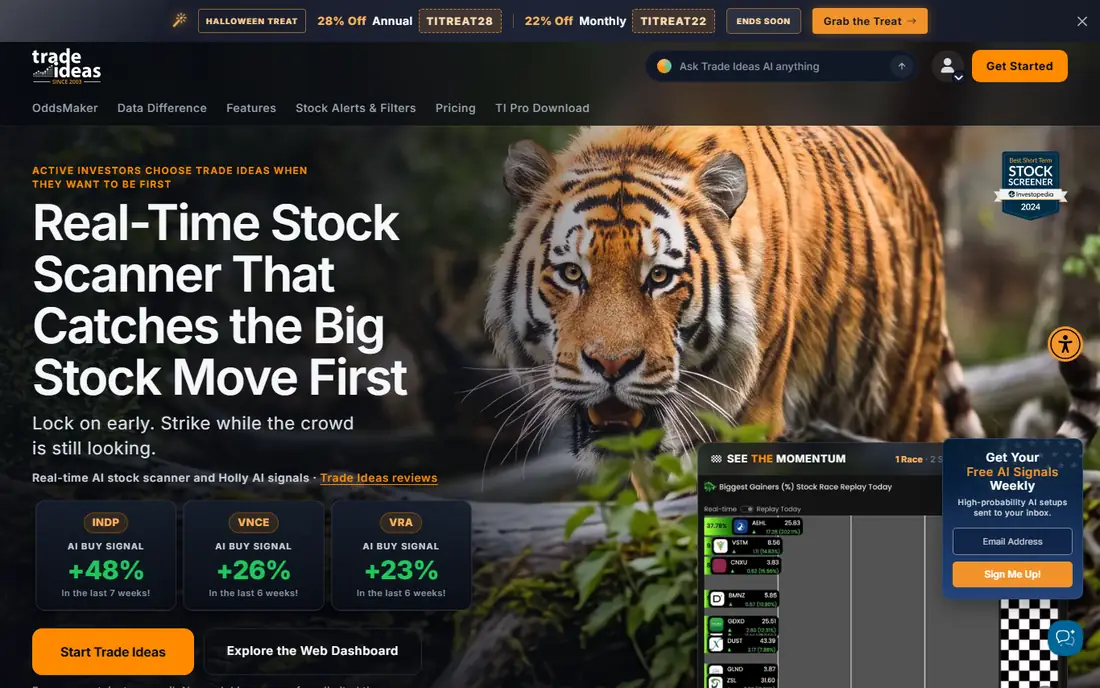
Trade Ideas suits active beginners who want an AI scanner rather than a black-box autopilot. Its Holly AI scanner finds setups in real time, explains the reasoning behind each idea, and lets beginners watch how signals behave before risking money. That learning loop matters more than any single signal.
Paid plans run near $84 per month in guides, and active trading needs screen time that passive investors may not want. AI signals still lose money in choppy markets, so paper trade first. For beginners who want to learn active trading with AI help, Trade Ideas is the best pick.
What we like- Holly AI scanner finds setups in real time
- Free tier for basic scanning
- Strong for active beginners learning to read signals
Watch out for- Paid plans near $84 per month in guides
- Active trading needs screen time
- AI signals still lose money in choppy markets
Starting priceFree
Free planYes
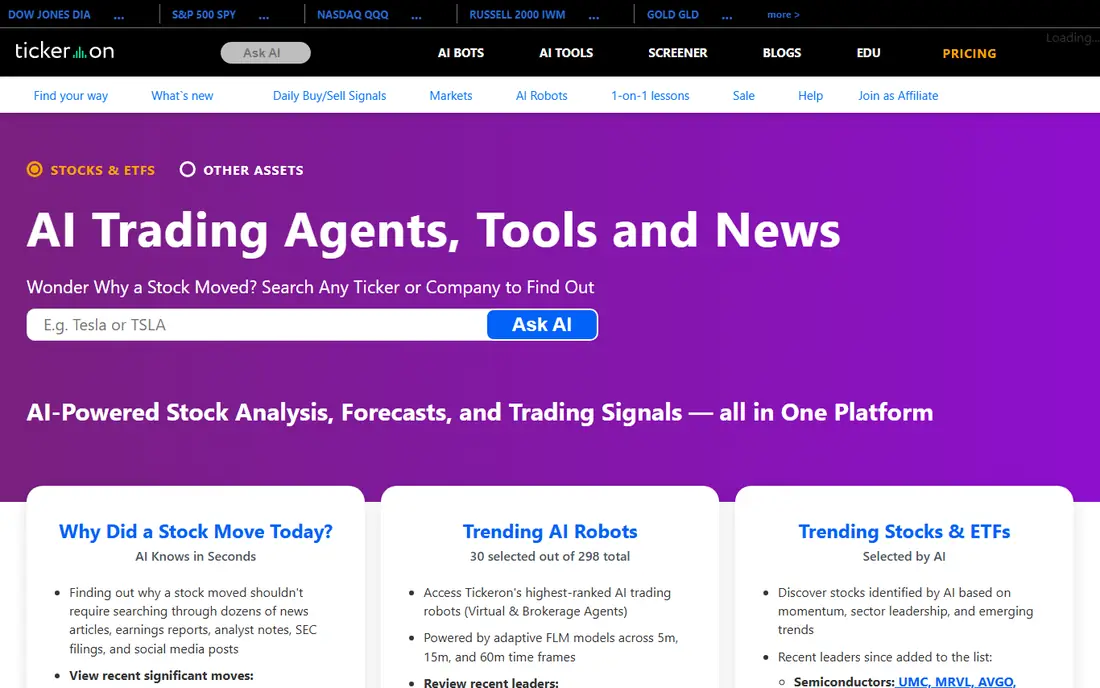
Tickeron suits pattern-focused learners who want AI trend prediction bots that flag likely moves in stocks, ETFs, and crypto. Its bots explain the patterns they detect, which helps beginners learn technical analysis while watching real signals.
Predictions are probabilities, not guarantees, and beginners may over-trust bot signals, especially after a winning streak. Paid plans run near $37 per month in guides. For learners who want to study patterns with AI guidance, Tickeron is a strong pick.
What we like- AI trend prediction bots for pattern-focused learners
- Free tier for basic use
- Paid plans near $37 per month in guides
Watch out for- Pattern predictions are probabilities, not guarantees
- Paid features add up
- Beginners may over-trust bot signals
Starting price$32 per month
Free planYes
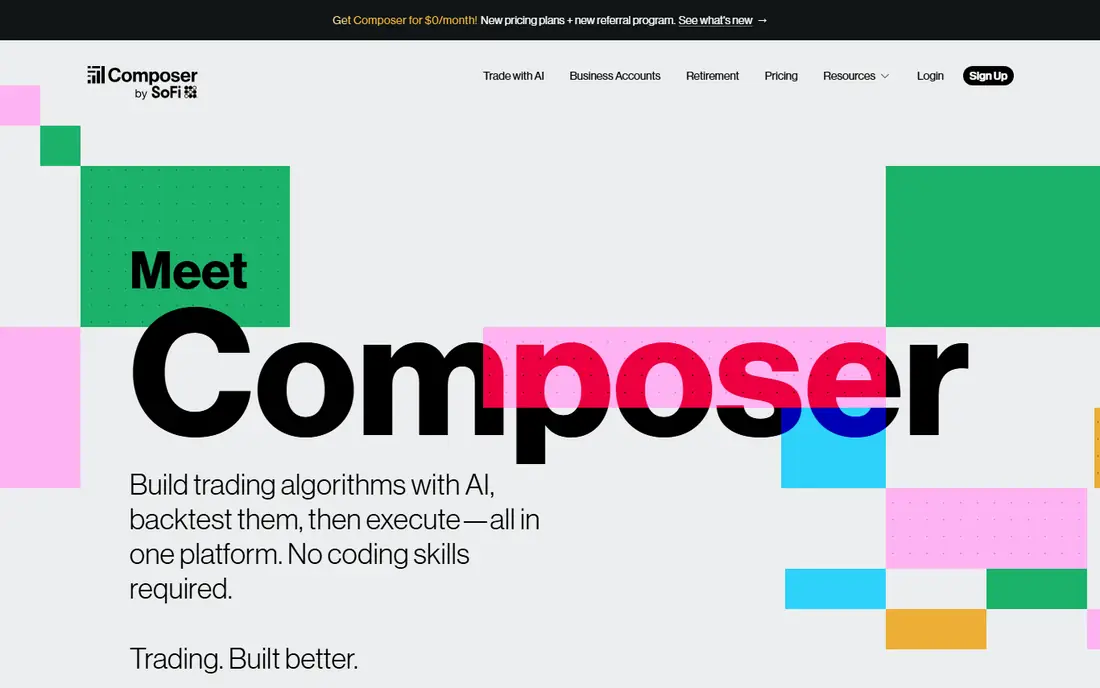
Composer lets beginners build automated strategies without code, using a visual editor to combine rules such as momentum, value, and rebalancing, then backtest them before trading real money. That no-code path makes systematic investing accessible to people who cannot program.
Guides conflict on price, listing $32 per month billed annually in one source and $19 in another, so confirm the current figure before subscribing. Automation does not remove market risk, and strategies still need monitoring. For no-code automated investing, Composer is the best pick.
What we like- Automated strategies without code
- Free build and backtest tier
- Visual strategy editor for beginners
Watch out for- Trading Pass near $32 per month billed annually in guides, though some guides list $19
- Automation does not remove market risk
- Strategies need monitoring
Starting priceFree
Free planYes
Alpaca is the best free API-first broker for tech-savvy beginners. Its API and paper trading cost nothing, with $0 commissions for retail in guides, which lets beginners build and test automated strategies with real market data before risking capital.
The API-first design needs coding skill, and full market data costs $99 per month on Algo Trader Plus in guides, though the basic feed is free with limits. For beginners who can code and want to automate cheaply, Alpaca is unmatched.
What we like- Free API and paper trading with $0 commissions for retail in guides
- API-first design for automation
- Good for tech-savvy beginners
Watch out for- API-first design needs coding skill
- Full market data costs $99 per month on Algo Trader Plus in guides
- No hand-holding for non-coders
Starting priceFree
Free planYes
Magnifi lets beginners search for investments in plain language, asking questions such as which stocks fit a theme or a risk level, and receiving AI-curated answers with reasoning. That conversational approach lowers the barrier for people who find screeners intimidating.
AI search answers need independent verification, since models can miss risks or overweight recent winners. Paid plans run near $14 per month in guides. For beginners who want to explore investing by asking questions, Magnifi is the most approachable pick.
What we like- Conversational AI search for investments
- Free tier for basic use
- Paid plans near $14 per month in guides
Watch out for- AI search answers need independent verification
- Paid features add up
- Not a full broker for every market
Starting priceFree
Free planYes
Danelfin suits research-focused beginners who want AI scoring of 900-plus stocks, with each stock receiving a probability-based score and an explanation of what drives it. That research-first design helps beginners compare stocks on a consistent basis rather than chasing headlines.
Scores are models, not predictions, and beginners may treat high scores as buy signals, which they are not. Paid plans run near $24 per month in guides. For research-led beginners who want a scoring system to study, Danelfin is the best pick.
What we like- AI scoring of 900-plus stocks in guides
- Free tier for basic use
- Paid plans near $24 per month in guides
- Research-focused design
Watch out for- Scores are models, not predictions
- Beginners may treat high scores as buy signals
- Coverage limited to scored stocks
#7eToro
Best for: Social learning and virtual trading3.6/5 on
G2 (27 reviews, checked Oct 2026)
Visit etoro.com
Starting priceFree
Free planYes
eToro combines stocks, ETFs, crypto, social feeds, and copy-trading tools, with a virtual portfolio funded with $100,000 in guides for learning without risk. Its community of 40-plus million users lets beginners observe how other investors behave before committing real money.
Copy trading does not remove risk: the selected investor can change strategy, take concentrated positions, or suffer losses after strong performance. Fee analysis needs care, since currency conversion, crypto transactions, and withdrawals carry separate costs, and borrowed-money positions may be contracts for difference rather than owned assets. For social learning with a large virtual account, eToro is the best pick, provided beginners avoid CFDs and copy trading until the risks are understood.
What we like- Virtual portfolio funded with $100,000 in guides
- Fractional stock investing from $10
- Social feeds for learning from other investors
Watch out for- Copy trading does not remove risk, and copied investors can change strategy or lose after strong runs
- Currency conversion, crypto, and withdrawal fees apply
- Borrowed-money trades may be CFDs
Starting priceFree
Free planYes
TradeStation comes closest to giving retail investors the same execution environment as professional traders, with backtesting, custom indicators, and automated strategies through EasyLanguage scripting. Its integration with Claude lets traders connect a brokerage account directly to the AI to fetch live quotes, preview orders, and analyze portfolio risk using plain-language prompts.
The learning curve is steeper than rivals, and guides list a $35 annual IRA fee, a $50 IRA termination fee, and a $10 monthly inactivity fee, with no fractional shares. For beginners who want to test ideas before trading them, TradeStation backtesting is the best in this list.
What we like- Free platform with $0 stock and ETF commissions on TS SELECT in guides
- Extensive backtesting and EasyLanguage scripting
- Claude AI integration for quotes and risk analysis
Watch out for- Steeper learning curve than rivals
- $35 annual IRA fee and $50 IRA termination fee in guides
- Inactivity fee of $10 per month in guides
- No fractional shares in guides
How we chose
We started from what AI trading platforms must do well for beginners: explain their signals, offer paper trading, and keep fees transparent. We compared vendor pages and current 2026 guides, and we favored tools with free tiers, clear pricing, and honest risk disclosure. We left out tools that promise guaranteed returns, tools with undisclosed fees, and tools whose AI features could not be traced. Prices here come from 2026 guides and vendor pages, and they vary by plan and region, so check the pricing page before you pay. This article is general information, not financial advice, and it does not recommend any specific security or strategy. AI signals do not guarantee returns, and beginners can lose money fast, especially with borrowed money, margin, or crypto.
How to start with AI trading safely
Start with education and paper trading, not real money. The goal in the first months is learning how signals behave, not profit, since most beginners lose money when they trade real capital before understanding risk.
Paper trade first, then go small
Use paper trading on Alpaca, TradeStation, or eToro virtual portfolio to test strategies for at least a month, tracking wins, losses, and drawdowns honestly. When you move to real money, start with amounts you can afford to lose completely, and avoid margin and borrowed money until you understand how losses multiply.
Never trust a signal blindly
Every AI signal is a probability, not a promise, and models trained on past data can fail when markets change. Verify signals against fundamentals, check position sizing, and set stop losses before entering any trade. If a platform promises guaranteed returns, leave immediately, since that promise itself is a warning sign.
Watch the real costs
Commissions may be $0, but spreads, data fees, payment processing, currency conversion, and inactivity fees still cost money. Alpaca full data costs $99 per month on one tier, TradeStation charges IRA and inactivity fees in guides, and eToro conversion and withdrawal fees add up. Model total costs on your real trading frequency before choosing.
Frequently asked questions
What is the best AI trading platform for beginners?
Trade Ideas for active scanning, Composer for no-code automated strategies, and Alpaca for free API trading. eToro suits social learning with its $100,000 virtual portfolio, while TradeStation suits beginners who want serious backtesting.
Can AI trading guarantee profits?
No. AI signals do not guarantee returns, and beginners can lose money fast, especially with borrowed money. Models find patterns in past data, but markets change, and no platform can promise future results. Treat every signal as a probability to verify, not a certainty to follow.
How much money do I need to start AI trading?
Many platforms offer $0 minimum deposits and fractional shares from $5 to $10, but starting small is wiser than starting with a large sum. Paper trade first, then risk only money you can afford to lose completely.
Is copy trading safe for beginners?
Copy trading does not remove risk. The investor you copy can change strategy, take concentrated positions, or lose money after strong performance, and borrowed-money copy trades may be CFDs rather than owned assets. Learn the risks before copying anyone.
Do I need to know coding to use AI trading platforms?
No, not for most tools here. Composer, Trade Ideas, Tickeron, Magnifi, and Danelfin work without code, while Alpaca suits coders who want API automation. TradeStation EasyLanguage helps for custom strategies but is optional for basic use.
Sources we checked (8)
- https://www.trade-ideas.com
- https://www.tickeron.com
- https://www.composer.trade
- https://alpaca.markets
- https://magnifi.com
- https://www.danelfin.com
- https://www.etoro.com
- https://www.tradestation.com
Is your product missing or out of date?
We review this list regularly. Vendors can request a listing, send updated pricing or ask about featured placement.

Shihab Mia · Founder, Rankite
Shihab has 5+ years in B2B and SaaS SEO. He writes Rankite's software buying guides from pricing pages, documentation and public user reviews. More about Shihab.