How we make this list: we compare pricing pages, product documentation and public user reviews. Ratings come from G2, Capterra or Trustpilot, with the date we checked them.
Key takeaways
- Profound, Otterly, and Peec AI suit brands that want dedicated AI search visibility tracking across ChatGPT, Gemini, Perplexity, and other answer engines.
- Brandlight and Evertune suit teams that want brand monitoring plus content recommendations for AI search.
- Goodie suits teams that want AI visibility tracking with content gap analysis built in.
- Semrush and Ahrefs suit teams that already use their SEO suites and want AI visibility added to familiar workflows.
- AI search visibility is new and fast-changing, so treat prompt coverage, citation tracking, and source data as more important than headline scores.
Quick comparison
| Tool | Best for | Starting price | Free plan |
|---|
 Profound | Dedicated AI visibility tracking | See website | No |
 Otterly | AI search monitoring | See website | No |
 Peec AI | AI visibility analytics | See website | No |
 Brandlight | Brand monitoring for AI search | See website | No |
 Evertune | AI search brand tracking | See website | No |
 Goodie | Visibility plus content gaps | See website | No |
 Semrush | AI visibility inside SEO suite | See website | No |
 Ahrefs | Brand radar inside SEO suite | See website | No |
Is your product missing or out of date?
We review this list regularly. Vendors can request a listing, send updated pricing or ask about featured placement.
#1Profound
Best for: Dedicated AI visibility tracking4.6/5 on
G2 (640 reviews, checked Oct 2026)
Visit tryprofound.com
Starting priceSee website
Free planNo
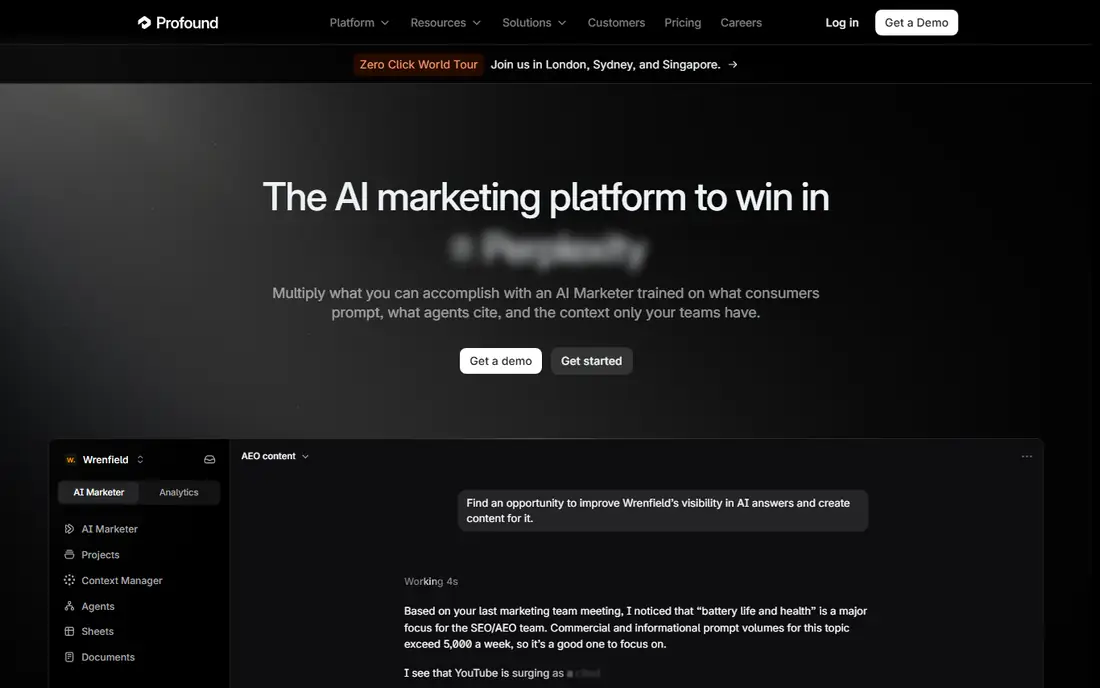
Profound suits brands that want dedicated tracking of how AI answer engines mention, cite, and recommend their products. It monitors prompts across ChatGPT, Gemini, Perplexity, and other engines, showing which sources AI answers cite and how brand visibility changes over time. Conversation-level tracking helps teams see the exact questions that trigger brand mentions.
Pricing sits at the premium end, and AI search methods still vary across vendors, so scores differ between tools. Profound works best for brands that treat AI search as a core channel and need detailed citation data. For dedicated AI visibility tracking, it is the most focused tool available.
What we like- Tracks major AI answer engines
- Citation and source analysis
- Conversation tracking
Watch out for- Premium pricing
- New category means methods vary
Starting priceSee website
Free planNo
Otterly suits teams that want straightforward AI search monitoring without a large platform. It tracks brand mentions and link citations across major AI engines, with weekly reports that show visibility trends and competitor comparisons. That simplicity helps small marketing teams start AI visibility work quickly.
Its feature set is smaller than Profound, and pricing at scale is custom, which slows comparison. Otterly works best for teams that want core AI tracking plus clear reports, not deep conversation analytics. For simple AI search monitoring, it is a practical pick.
What we like- Tracks ChatGPT, Gemini, and Perplexity
- Link citations
- Weekly reports
Watch out for- Smaller feature set than Profound
- Pricing is custom at scale
#3Peec AI
Best for: AI visibility analytics4.7/5 on
G2 (21 reviews, checked Oct 2026)
Visit peec.ai
Starting priceSee website
Free planNo
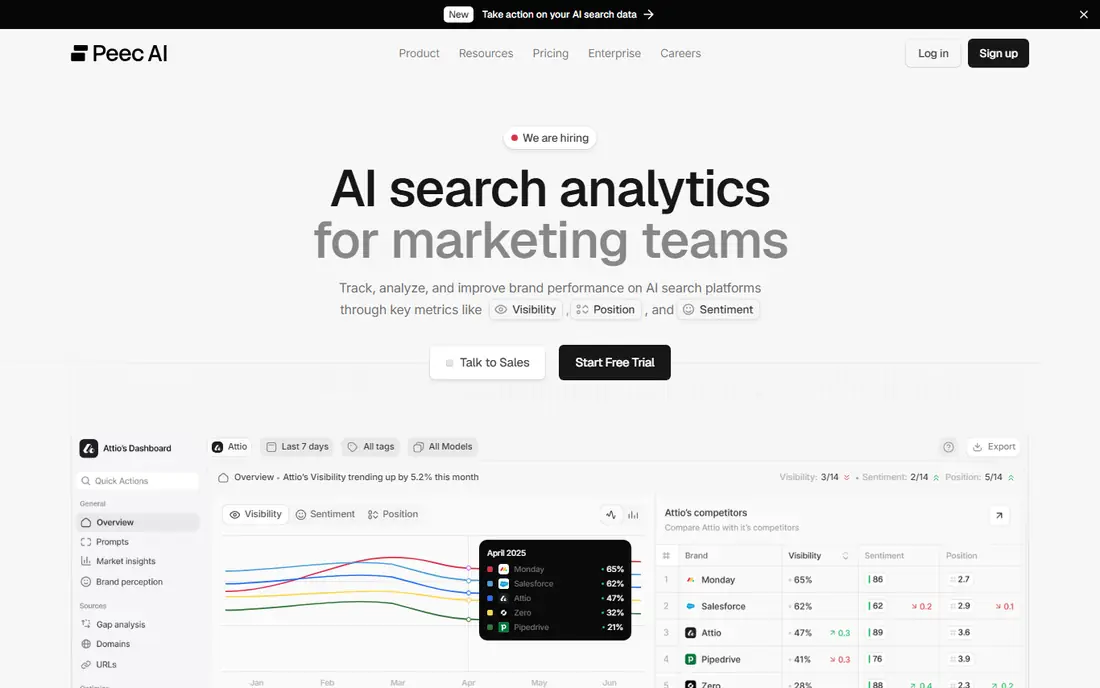
Peec AI suits teams that want AI visibility analytics with share-of-voice views across engines and competitors. Its prompt tracking shows how often AI answers mention your brand versus rivals, and its analytics help teams spot which topics drive visibility. That competitive view suits brands in crowded markets where AI recommendations decide shortlists.
As a newer vendor, its methods still evolve, and prompt coverage should be checked against your real buyer questions. Peec works best for teams that want competitive AI analytics with clear share-of-voice reporting. For AI visibility analytics, it is a strong option.
What we like- Prompt tracking across engines
- Share of voice
- Competitor comparisons
Watch out for- Newer vendor
- Methods still evolving
Starting priceSee website
Free planNo
Brandlight suits teams that want brand monitoring plus recommendations for improving AI search presence. It tracks how AI engines present your brand, flags sentiment and accuracy issues, and recommends content changes that could improve citations. Trend alerts help teams react when AI answers shift after model updates or news events.
Pricing is premium, and the category is new, so methods and coverage vary. Brandlight works best for brands that want monitoring plus action guidance, not just scores. For brand monitoring with recommendations, it stands out.
What we like- Brand monitoring across AI engines
- Content recommendations
- Trend alerts
Watch out for- Premium pricing
- Newer category
Starting priceSee website
Free planNo
Evertune suits teams and agencies that want AI search brand tracking with prompt libraries for common buyer questions. Its tracking covers major AI engines, and agency support helps firms manage visibility for several clients from one account. Prompt libraries speed setup for teams that do not know which questions to track first.
As a newer vendor, its track record is shorter than Semrush or Ahrefs, and pricing is custom. Evertune works best for agencies and brands that want guided setup plus multi-client tracking. For agency-friendly AI brand tracking, it is a solid choice.
What we like- Brand tracking across AI engines
- Prompt libraries
- Agency support
Watch out for- Newer vendor
- Pricing is custom
Starting priceSee website
Free planNo
Goodie suits teams that want AI visibility tracking tied to content gaps, so they know which pages to create or update. It tracks brand mentions across AI engines, benchmarks competitors, and highlights topics where rivals appear but you do not. That gap view turns visibility data into a content plan, which suits content teams directly.
As a newer vendor, feature depth varies by plan, so check gap analysis limits before buying. Goodie works best for content teams that want visibility data plus clear next steps. For visibility plus content gaps, it is a useful pick.
What we like- AI visibility tracking
- Content gap analysis
- Competitor benchmarking
Watch out for- Newer vendor
- Feature depth varies by plan
#7Semrush
Best for: AI visibility inside SEO suite4.4/5 on
G2 (4,035 reviews, checked Oct 2026)
Visit semrush.com
Starting priceSee website
Free planNo
Semrush suits teams that already use Semrush for SEO and want AI visibility inside the same account. Its AI toolkit tracks brand mentions in AI answers alongside traditional rankings, keyword research, and site audits, which keeps all search data in one place. Familiar workflows help teams adopt AI tracking without learning a new platform.
AI features are newer than dedicated tools like Profound, so depth may lag on citation analysis. Semrush works best for SEO teams that want AI visibility as an extension of existing work. For suite-based AI visibility, it is the most complete option.
What we like- AI toolkit inside full SEO suite
- Large keyword data
- Familiar workflows
Watch out for- AI features are newer
- Suite pricing is higher
#8Ahrefs
Best for: Brand radar inside SEO suite4.5/5 on
G2 (717 reviews, checked Oct 2026)
Visit ahrefs.com
Starting priceSee website
Free planNo
Ahrefs suits teams that already use Ahrefs and want AI brand mentions tracked alongside backlinks and keywords. Its Brand Radar monitors AI engine mentions and web mentions together, which helps teams see how traditional and AI visibility connect. Strong keyword and backlink data support content decisions behind visibility changes.
AI features are newer than dedicated vendors, and suite pricing runs higher than single-purpose tools. Ahrefs works best for SEO teams that want AI mentions inside a familiar, data-rich suite. For suite-based brand tracking, it rounds out this list well.
What we like- Brand Radar tracks AI mentions
- Strong backlink and keyword data
- Familiar suite
Watch out for- AI features are newer
- Pricing is higher
How we chose
We compared AI visibility tools on engine coverage, prompt tracking, citation data, competitor comparison, and content guidance, using vendor pages, product documentation, and public user experience. The reference buyer was a brand team tracking product visibility in AI answers, so engine coverage and citation transparency mattered most. Methods were treated as evolving, since the category is new and vendors measure visibility differently. Score differences between vendors were treated as method differences, not as proof that one brand is truly more visible. That caution matters most when comparing vendors on different prompt sets. Prompt coverage was checked against real buyer questions, not generic topics. Reporting clarity was compared for non-technical stakeholders. Alert quality was compared for visibility drops. Historical trend depth was checked for quarterly reviews.
Start from your buyer questions
List the questions buyers ask before choosing your product, then verify each tool tracks those exact prompts. Generic prompt libraries miss the specific questions that decide purchases. Interview sales teams for actual buyer phrasing, since marketing language differs from buyer language. Include follow-up questions, since buyers ask chains of questions during research. Update the prompt list when products or buyer concerns change. Include questions about competitors, since comparison prompts shape shortlists. Include questions about implementation, since setup effort affects decisions. Buyer language changes with market trends, so refresh the list from support tickets regularly. Add pricing questions, since cost queries dominate late-stage buyer research. Include questions about integrations, since compatibility concerns decide many purchases. Add questions about support quality, since buyers weigh service heavily for complex products. Include regional phrasing variants, since buyers in different markets word the same question differently. Review the prompt list with sales monthly for freshness. Interview sales and support teams for actual buyer phrasing, since marketing language differs from buyer language. Update the prompt list quarterly as products and buyer concerns change. Include comparison questions, since buyers often ask tools to compare rivals directly. Include pricing questions, since cost often decides shortlists. Include support questions, since service quality shapes decisions.
Compare citation data, not just scores
Ask each vendor which sources AI answers cite for your brand, since citations reveal whether your content, reviews, or rivals drive mentions. Scores without source data hide the work needed to improve. Check whether cited sources are pages you control or third-party pages you can influence. Prioritize fixing inaccurate citations first, since wrong facts in AI answers mislead buyers directly. Track citation changes monthly, since source rankings shift with content updates. Share citation reports with content teams for action. Review competitor citations for content ideas. Audit citations after major site changes.
Trial two tools on the same prompts
Run a short trial with two tools on identical prompts and compare mentions, citations, and competitor rankings. Differences reveal method gaps before you commit to a year-long contract. Use the same prompt list and time window for both trials, since AI answers change daily. Document trial results for procurement review before signing. Share trial findings with content teams, since they act on visibility data daily. Re-run trials after major model updates. Compare trial costs per tracked prompt. A documented trial protects the budget decision if results disappoint later. Document trial limitations for stakeholders.
Frequently asked questions
What is AI search visibility?
AI search visibility measures how often AI answer engines like ChatGPT, Gemini, and Perplexity mention, recommend, or cite your brand when users ask relevant questions. It differs from traditional rankings, since AI answers synthesize sources rather than listing links.
How do AI visibility tools work?
They send tracked prompts to AI engines, record brand mentions and citations in answers, and report visibility trends over time. Methods vary by vendor, so prompt selection and engine coverage shape results heavily.
Can I improve AI visibility with content alone?
Content helps, since AI answers cite clear, factual, well-structured pages, but reviews, listings, and third-party coverage also shape citations. Improve product pages, FAQs, and review presence together for best results.
Are AI visibility scores comparable across tools?
No, vendors use different prompts, engines, and scoring methods, so scores differ between tools. Compare trends within one tool over time, and use trials to compare tools on identical prompts.
Should small businesses buy AI visibility tools?
Small businesses with strong AI search traffic should trial a focused tool like Otterly or Peec AI, while others can start with free prompt checks in AI engines. Buy when AI answers clearly influence your buyer journey.
Sources we checked (8)
- https://www.tryprofound.com
- https://otterly.ai
- https://peec.ai
- https://brandlight.ai
- https://www.evertune.ai
- https://www.goodie.ai
- https://www.semrush.com
- https://ahrefs.com
Is your product missing or out of date?
We review this list regularly. Vendors can request a listing, send updated pricing or ask about featured placement.

Shihab Mia · Founder, Rankite
Shihab has 5+ years in B2B and SaaS SEO. He writes Rankite's software buying guides from pricing pages, documentation and public user reviews. More about Shihab.