How we make this list: we compare pricing pages, product documentation and public user reviews. Rankite is independent; if a vendor ever pays for a featured spot, that listing is clearly labeled Partner.

Key takeaways
- Datarails, Cube, and Vena bring AI-powered planning to Excel-native finance teams that refuse to give up spreadsheets.
- Pigment, Anaplan, and Drivetrain serve larger or faster-growing companies with modeling power and AI-assisted forecasting.
- Abacum targets mid-market finance teams that want collaborative planning without enterprise complexity.
- Planful suits established FP&A functions modernizing from legacy planning tools.
- The real AI value is in anomaly detection, driver-based forecasting, and narrative generation, not chatbots bolted onto dashboards.
The month-end close is not where finance creates value
Ask a CFO what the FP&A team spends its time on and the honest answer is depressing: collecting data, reconciling versions, and formatting reports. The analysis that actually guides decisions gets whatever hours are left. This is the problem AI planning software attacks. Not by replacing finance people, but by removing the mechanical work that keeps them from being analysts.
The current generation of FP&A tools uses AI in three places that matter. First, forecasting: models that learn from your actuals and suggest driver-based projections instead of last-year-plus-three-percent. Second, anomaly detection: flagging the variance that deserves attention instead of making humans hunt through every line. Third, reporting: generating narrative explanations of what changed and why, in language a budget owner can understand.
We compared eight platforms bringing AI to planning, budgeting, and forecasting. They differ in who they serve, from Excel-loyal SMB finance teams to global enterprises, and in how deeply AI runs through the product versus sitting on top.
Quick comparison
| Tool | Best for | Starting price | Free plan |
|---|
 Datarails Datarails | Excel-based FP&A with automation | See website | No |
 Cube Cube | Collaborative planning for SMBs | See website | No |
 Anaplan Anaplan | Enterprise connected planning | See website | No |
 Pigment Pigment | Flexible planning for growing companies | See website | No |
 Drivetrain Drivetrain | AI-native planning and insights | See website | Free trial |
 Abacum Abacum | Mid-market collaborative FP&A | See website | No |
 Planful Planful | Modernizing established FP&A teams | See website | No |
 Vena Vena | Excel-native planning at scale | See website | No |
Is your product missing or out of date?
We review this list regularly. Vendors can request a listing, send updated pricing or ask about featured placement.
The best AI software for FP&A in 2026
Starting priceSee website
Free planNo
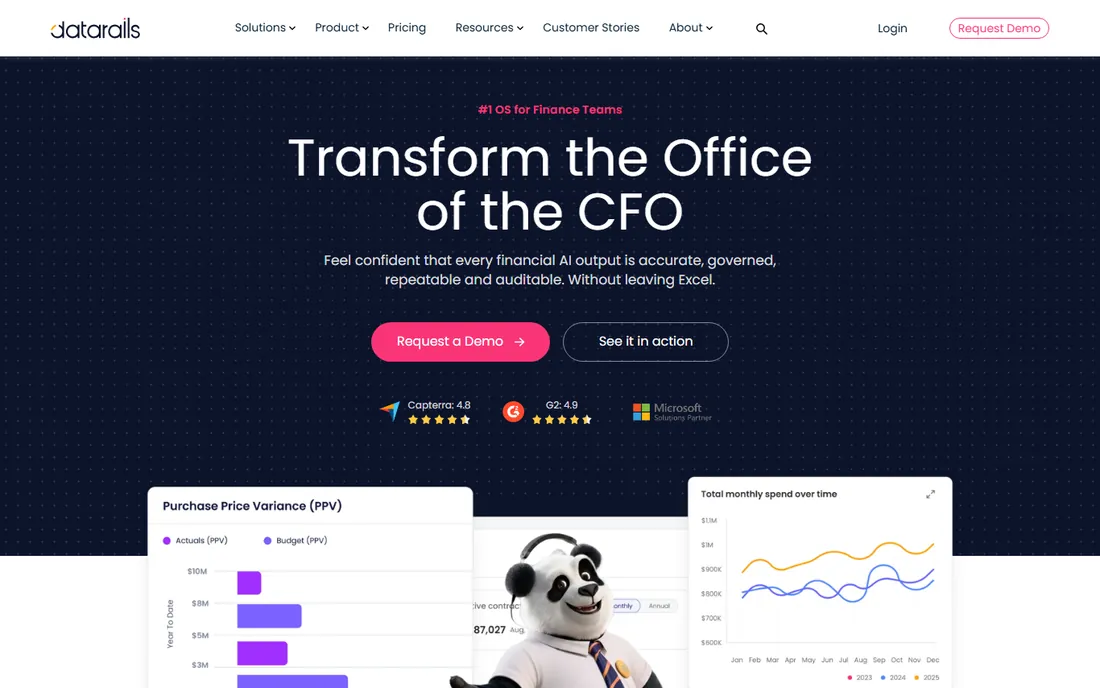
Datarails understands a truth about finance teams: they are not giving up Excel. Instead of forcing a new interface, Datarails keeps spreadsheets as the front end while automating everything painful behind them: data consolidation, version control, and report distribution. The AI layer adds variance analysis and insights on top of the numbers finance already trusts.
For SMB and mid-market teams running planning in scattered workbooks, the consolidation alone justifies the cost. The AI features focus on practical wins like automated commentary and anomaly flags rather than grand promises. If your team lives in Excel and your close process involves too much copy-paste, Datarails meets you where you are.
What we like- Keeps Excel as the interface, Automates consolidation and reporting, AI insights on variances, Strong for SMB and mid-market
Watch out for- Excel dependence limits some modeling, Pricing not published, Advanced scenarios need training
Starting priceSee website
Free planNo
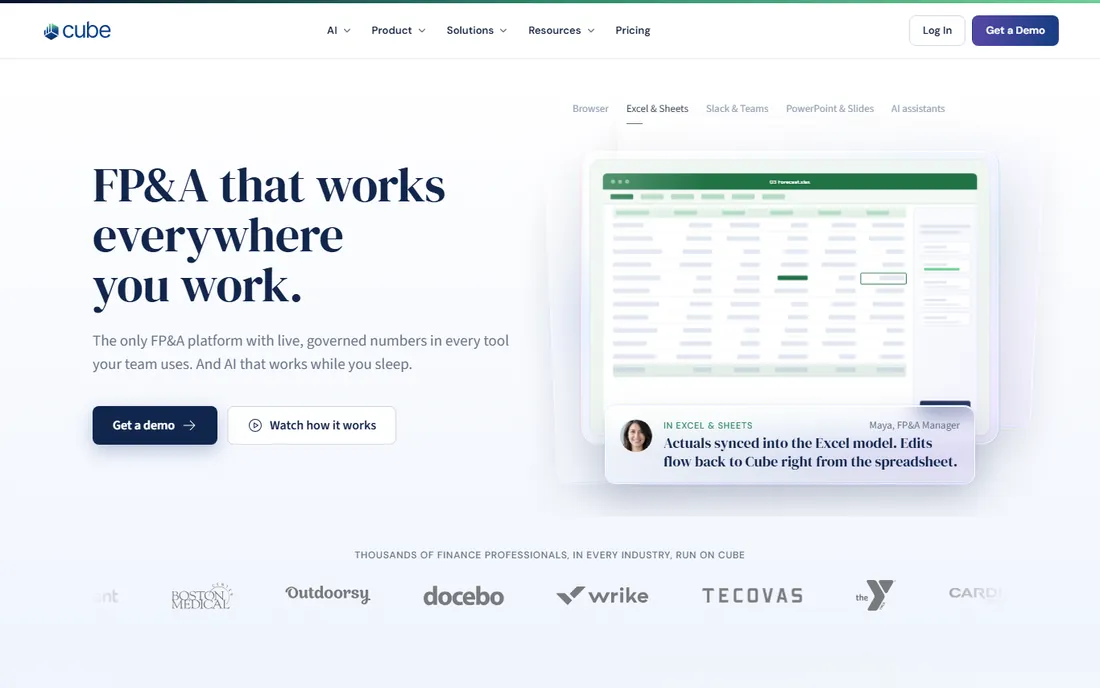
Cube targets the companies that outgrew spreadsheet chaos but are not ready for enterprise planning suites. Implementation takes weeks rather than quarters, the interface feels familiar to finance users, and collaboration features let budget owners participate without breaking the model. It is the pragmatic middle ground.
The AI capabilities are lighter than some competitors, focused on assisted forecasting and insights rather than deep machine learning. For a growing company hiring its first FP&A leader, Cube provides structure without the enterprise overhead. It is the right size for the problem most mid-market companies actually have.
What we like- Fast implementation, Spreadsheet-like interface, Good collaboration features, Sensible mid-market pricing
Watch out for- Less modeling depth than enterprise tools, Newer vendor, Limited advanced AI features
Starting priceSee website
Free planNo
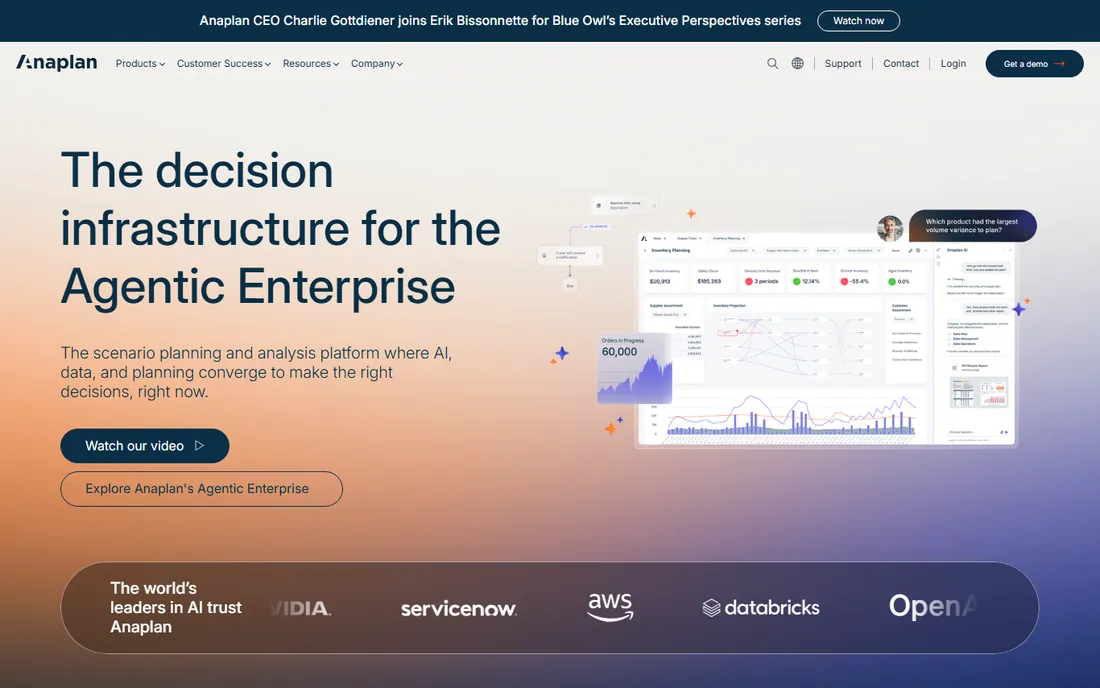
Anaplan is the enterprise standard for connected planning, linking finance, sales, supply chain, and workforce plans in one model. The calculation engine handles complexity that breaks lesser tools, and the AI additions bring predictive forecasting and intelligent recommendations to the planning process. When a global company needs every department planning from the same assumptions, Anaplan is the usual answer.
The cost is real in both money and expertise. Anaplan needs trained model builders, implementations run long, and the platform rewards organizations that invest in it properly. This is not a tool you buy casually. But for complex enterprises where planning is a competitive function, nothing else matches the modeling power.
What we like- Powerful connected planning engine, Scales to global enterprises, Rich modeling capabilities, Extensive partner ecosystem
Watch out for- Expensive and complex, Needs trained model builders, Implementation is a project
Starting priceSee website
Free planNo
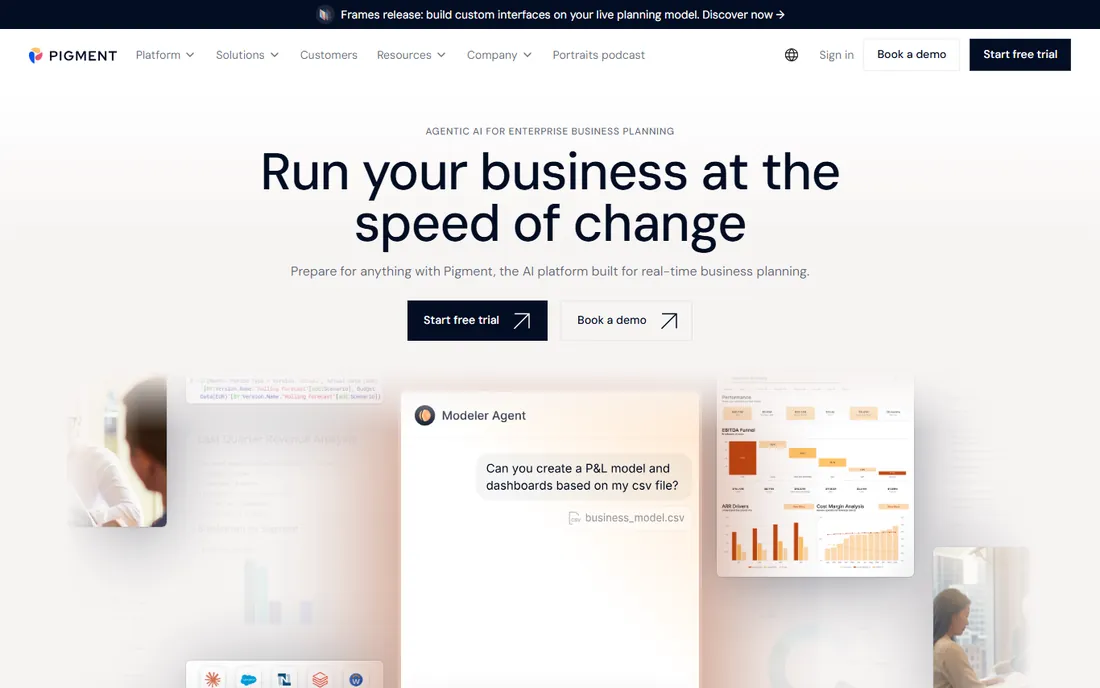
Pigment positions itself as the modern alternative to legacy planning: powerful modeling with an interface business users actually enjoy. The visualization is a cut above, which matters because plans that nobody can read do not drive decisions. AI features assist with forecasting and scenario analysis, and the platform handles the complexity of fast-growing companies well.
It competes directly with Anaplan for enterprise deals while also serving the upper mid-market. The ecosystem of partners and trained practitioners is smaller, which can affect implementation. But for companies choosing a planning platform for the next decade, Pigment's combination of power and usability is compelling.
What we like- Modern, flexible modeling, Good visualization, Appeals to business users, Strong growth momentum
Watch out for- Enterprise pricing for smaller teams, Younger platform than Anaplan, Ecosystem still building
Starting priceSee website
Free planFree trial
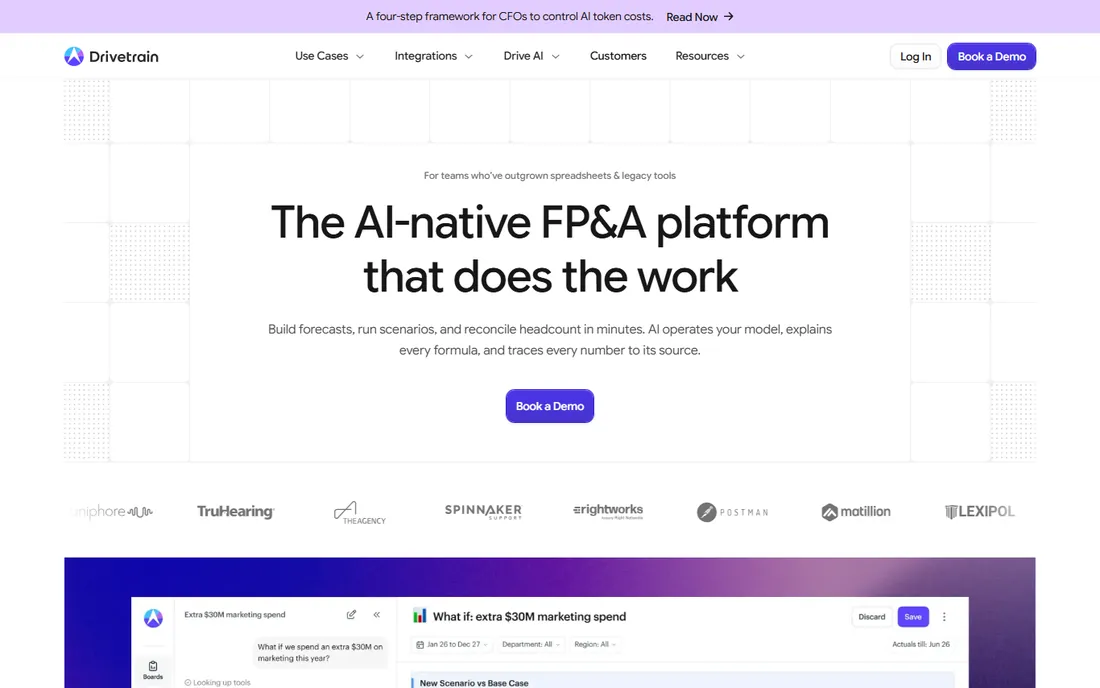
Drivetrain was built with AI as a foundation rather than a feature, which shows in how the product works. Forecasting, variance analysis, and insights feel integrated instead of bolted on. The platform connects to your data sources, builds driver-based models, and surfaces what changed and why without manual digging. Implementation is measured in weeks.
As a newer vendor, Drivetrain lacks the track record and ecosystem of the established players. But the AI-native approach is where the category is heading, and the free trial makes it easy to test against your actual data. For finance teams that want to see what modern AI planning feels like, Drivetrain is the most direct experience.
What we like- AI built into the core, Fast time to value, Good integrations, Free trial available
Watch out for- Newer brand, Smaller customer base, Depth less than enterprise suites
Starting priceSee website
Free planNo
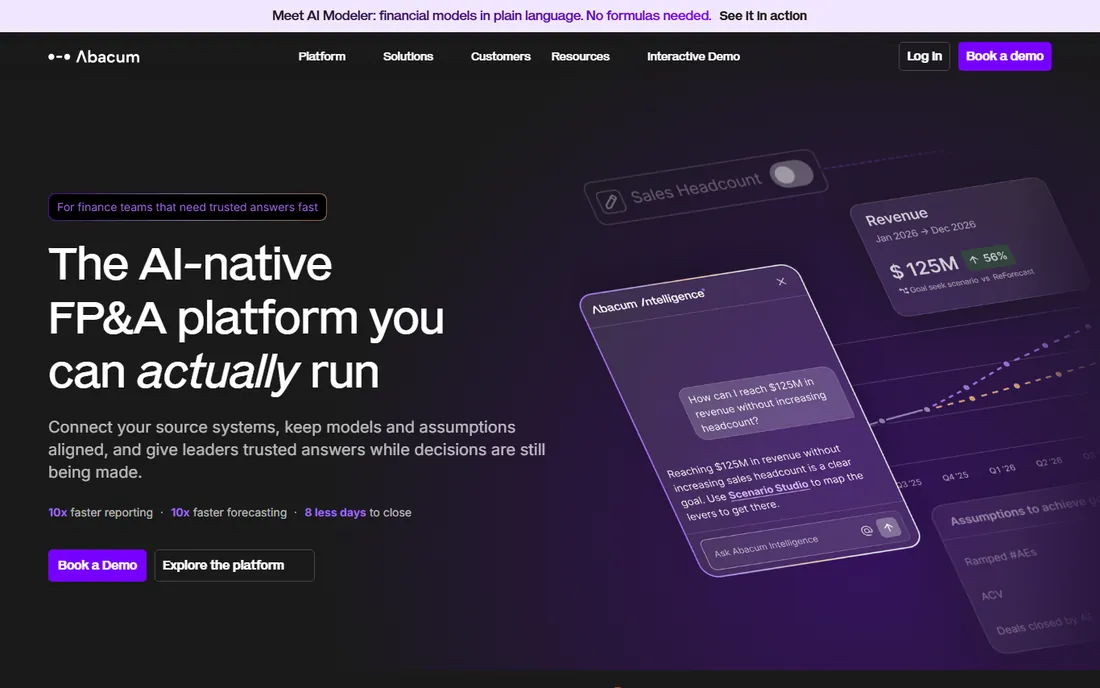
Abacum serves the mid-market finance teams that enterprise tools overlook and SMB tools underserve. The platform automates reporting and reconciliation, supports collaborative budgeting with non-finance stakeholders, and adds AI-assisted forecasting. The design assumes a lean finance team that needs force multiplication, not headcount.
Pricing is aimed at the mid-market rather than the enterprise, which makes it accessible to companies that could never justify Anaplan. The trade-off is depth: very complex modeling scenarios may hit limits. But for the core FP&A job of planning, forecasting, and reporting at a growing company, Abacum hits the sweet spot.
What we like- Built for mid-market finance teams, Strong collaboration workflows, Good automation, Sensible pricing
Watch out for- Less enterprise depth, Newer vendor, Limited brand recognition
Starting priceSee website
Free planNo
Planful (formerly Host Analytics) is the established player for finance teams modernizing from legacy tools or spreadsheet sprawl. The platform covers budgeting, forecasting, consolidation, and reporting with the reliability that comes from years in the market. AI features have been added steadily, focusing on predictive forecasting and intelligent planning assistance.
It lacks the visual polish of Pigment or the AI-native feel of Drivetrain, but it compensates with depth and dependability. The customer base includes many long-tenured users, which says something about satisfaction. For an FP&A leader who values proven over shiny, Planful is the safe pair of hands.
What we like- Mature, proven platform, Good financial consolidation, Strong customer base, Continuous product investment
Watch out for- Interface less modern than newer rivals, Implementation takes time, Pricing not published
Starting priceSee website
Free planNo
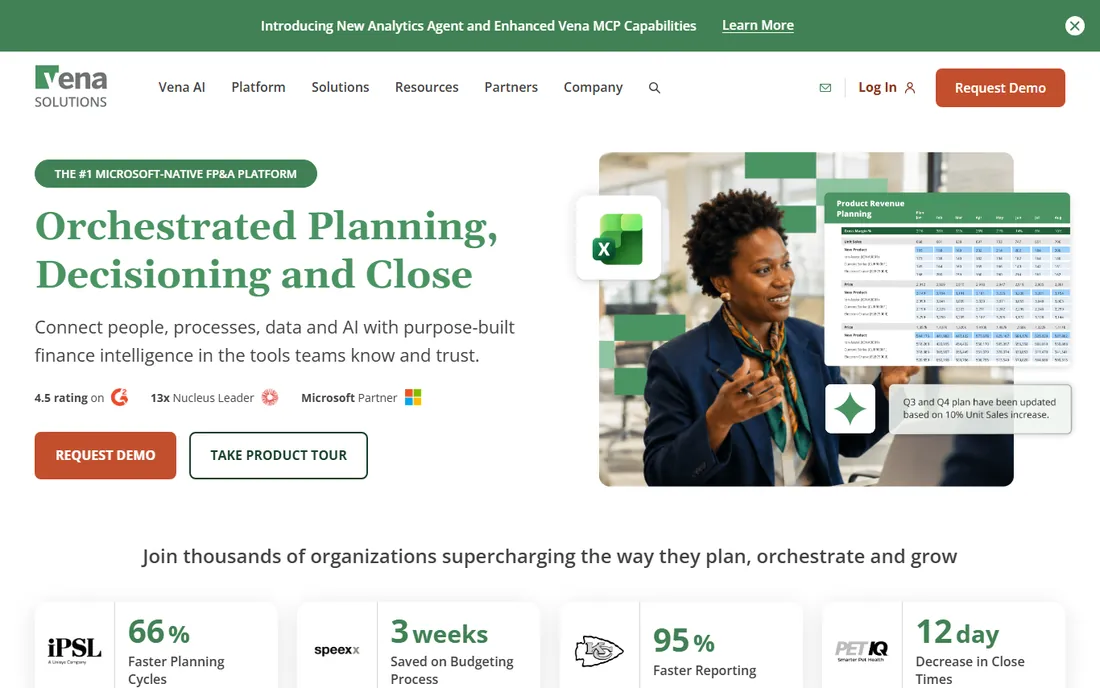
Vena takes the Excel-native approach further upmarket than Datarails, serving large finance teams that need controlled, auditable planning without abandoning spreadsheets. The platform adds workflow, version control, and a central database behind the Excel interface, with AI features for insights and forecasting. Audit trails and controls suit regulated industries.
The Excel dependence that makes adoption easy can also constrain advanced modeling compared to purpose-built engines. But for organizations where Excel is entrenched and change management matters more than theoretical power, Vena proves that the spreadsheet was never the problem. The chaos around it was.
What we like- Deep Excel integration, Scales to large finance teams, Good workflow and audit trails, Strong for regulated industries
Watch out for- Excel-centric model has limits, Implementation complexity, Pricing not published
How we chose
We focused on platforms where AI does real planning work: forecasting, anomaly detection, and insight generation. Marketing claims about AI were discounted heavily; we looked for specific capabilities and customer evidence. Every tool here serves working FP&A teams, not just data scientists.
We covered the range from Excel-native tools for smaller teams to enterprise planning suites, because FP&A software is bought by companies at very different stages. A startup's first planning tool and a multinational's connected planning platform are different products, and the list reflects that. Pricing transparency was noted but not decisive, since this category almost universally sells through quotes.
Start with your team's reality, not the AI hype. If your finance team runs on Excel and trusts it, Datarails, Cube, or Vena will get adopted while a rip-and-replace platform gathers dust. If you have dedicated FP&A staff and complex models, Anaplan, Pigment, or Planful earn their keep. The best AI in the world is worthless in a tool nobody opens.
Then ask what the AI actually does with your data. Request a demo on your own numbers, not the vendor's polished dataset. Watch whether the forecasting handles your seasonality, whether anomaly detection finds things your team missed, and whether the generated narratives read like something you would send to a budget owner. Vague promises about "AI-powered insights" should trigger specific questions.
Finally, count the total cost of ownership. Implementation services, training, and the internal time to maintain models often exceed the subscription. A cheaper platform that needs consultants for every change costs more than a pricier one your team can run. Ask reference customers what they spend beyond the license.
Frequently asked questions
What does AI actually do in FP&A software?
The useful applications are forecasting from historical patterns, detecting anomalies and variances worth investigating, and generating narrative explanations of results. Less useful are chatbots that query your data; they demo well but rarely change how finance works.
Will AI replace FP&A analysts?
No. It removes the mechanical work of data gathering and report formatting, which frees analysts for the judgment work AI cannot do: understanding the business context behind the numbers and advising decision-makers. Teams that adopt these tools tend to become more influential, not smaller.
Do I need to leave Excel to use modern FP&A software?
Not necessarily. Datarails, Cube, and Vena keep Excel or a spreadsheet-like interface as the primary experience. Anaplan, Pigment, and others use their own modeling environments, which offer more power at the cost of retraining.
How long does FP&A software take to implement?
SMB-focused tools like Cube and Drivetrain typically go live in weeks. Mid-market platforms take one to three months. Enterprise suites like Anaplan can take six months or more for complex global deployments. Data quality is usually the bottleneck, not the software.
What should AI forecasting be able to handle?
At minimum, your seasonality, known business drivers, and the ability to compare AI-generated forecasts against your team's judgment. Be wary of black-box forecasts you cannot explain to a CFO; the best tools show their assumptions and let finance adjust them.
Sources we checked (8)
- https://www.datarails.com/
- https://www.cubesoftware.com/
- https://www.anaplan.com/
- https://www.pigment.com/
- https://drivetrain.ai/
- https://www.abacum.ai/
- https://planful.com/
- https://www.venasolutions.com/
Is your product missing or out of date?
We review this list regularly. Vendors can request a listing, send updated pricing or ask about featured placement.

Shihab Mia · Founder, Rankite
Shihab has spent more than a decade helping SaaS and e-commerce brands grow through search. He writes Rankite's software buying guides from pricing pages, documentation and public user reviews. More about Shihab.