How we make this list: we compare pricing pages, product documentation and public user reviews. Rankite is independent; if a vendor ever pays for a featured spot, that listing is clearly labeled Partner.
Key takeaways
- Best overall: LLMrefs, ideal for small brands that only need LLM mention tracking: focused on LLM referral and mention tracking.
- On price transparency, LLMrefs stands out at $79 per month, which makes budgeting straightforward.
- Rankscale suits teams that want simple AI visibility metrics, while Writesonic fits content teams that want tracking next to writing tools.
- Shortlist two or three tools and trial each with real work before signing anything longer than monthly.
- Nightwatch is worth a look as a specialist alternative if the mainstream picks do not fit your workflow.
Quick comparison
| Tool | Best for | Starting price | Free plan |
|---|
 LLMrefs LLMrefs | Small brands that only need LLM mention tracking | $79 per month | No |
 Rankscale Rankscale | Teams that want simple AI visibility metrics | See website | No |
 Writesonic Writesonic | Content teams that want tracking next to writing tools | See website | No |
 Peec AI Peec AI | Marketers who want readable AI visibility reports | See website | No |
 Scrunch Scrunch | Content teams that want monitoring plus publishing guidance | See website | No |
 Ahrefs Ahrefs | SEO teams that want AI metrics inside their existing toolkit | Brand Radar custom prompts from $50 per month; AI Visibility Index from $199 per month | No |
 Semrush Semrush | Agencies that want AI data next to PPC and SEO reports | See website | No |
 SE Ranking SE Ranking | Agencies that want AI tracking with transparent pricing | From $103.20 per month; AI Search add-on from $71.20 per month | No |
 Nightwatch Nightwatch | Agencies that live in rank tracking reports | 99 euros per month (79 euros billed yearly) | No |
Is your product missing or out of date?
We review this list regularly. Vendors can request a listing, send updated pricing or ask about featured placement.
The Best AI Search Visibility Checking Software
#1
LLMrefs
Best for: Small brands that only need LLM mention tracking
Visit llmrefs.com
Starting price$79 per month
Free planNo
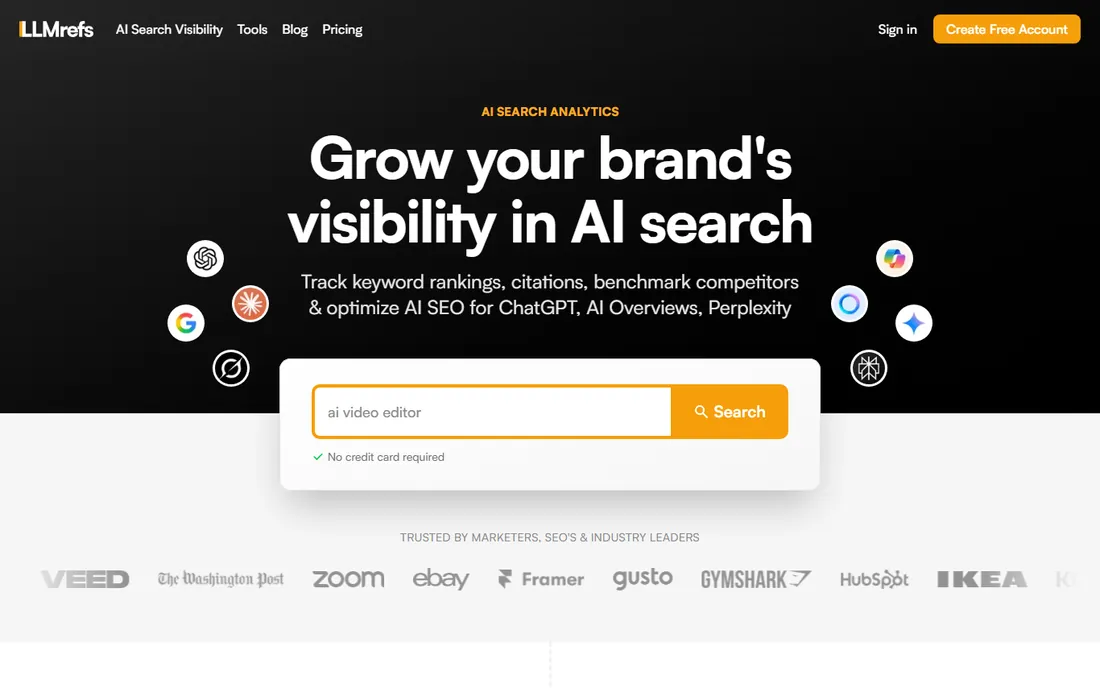
Small brands that only care about LLM mentions can skip the suites and use LLMrefs. The $79 flat monthly price buys dedicated mention tracking across language models, presented without the surrounding complexity of an SEO platform. It is a specialist tool at a generalist price point.
Simplicity drives the experience. You see where your brand gets referenced, how often, and whether the trend is moving your way. Reports stay readable for non-technical stakeholders.
Expect fewer integrations and less depth than bigger names. LLMrefs is early in its journey, so buyers should trial it against their specific needs. For the narrow job it does, though, it is priced to try.
What we like- Focused on LLM referral and mention tracking
- Simple setup with clear flat pricing
- No bloat from unrelated SEO features
Watch out for- Newer vendor with a smaller feature set
- Limited third-party integrations
Starting priceSee website
Free planNo
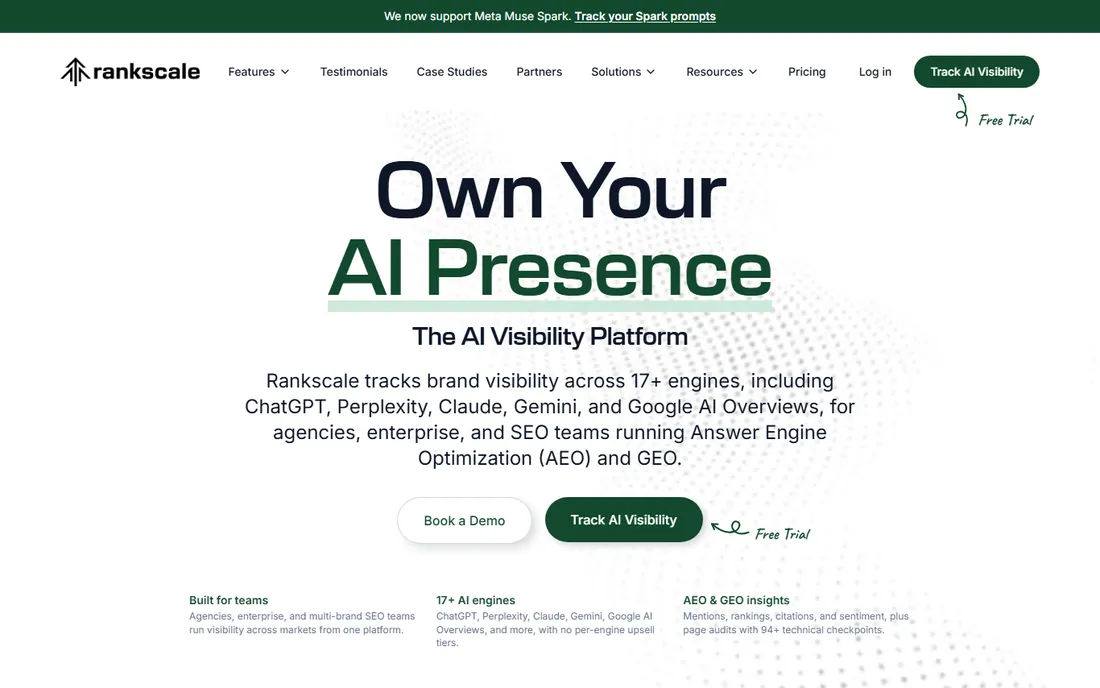
Rankscale covers the core job: monitor where your brand appears in AI answers and track the trend. The platform is purpose-built for AI visibility, so every screen serves that goal rather than splitting attention with legacy SEO features. Metrics stay plain and report-friendly.
Quick setup means you start accumulating trend data within days, not weeks. For teams under pressure to show AI search progress, that speed matters.
Pricing is not clearly published and the vendor is less proven than the big names. Those are fair cautions. But if you want a straightforward AI visibility tracker without enterprise complexity, Rankscale belongs in the evaluation.
What we like- Purpose-built for AI visibility measurement
- Metrics simple enough for monthly reporting
- Quick onboarding
Watch out for- Pricing information is limited
- Smaller review footprint than established tools
Starting priceSee website
Free planNo
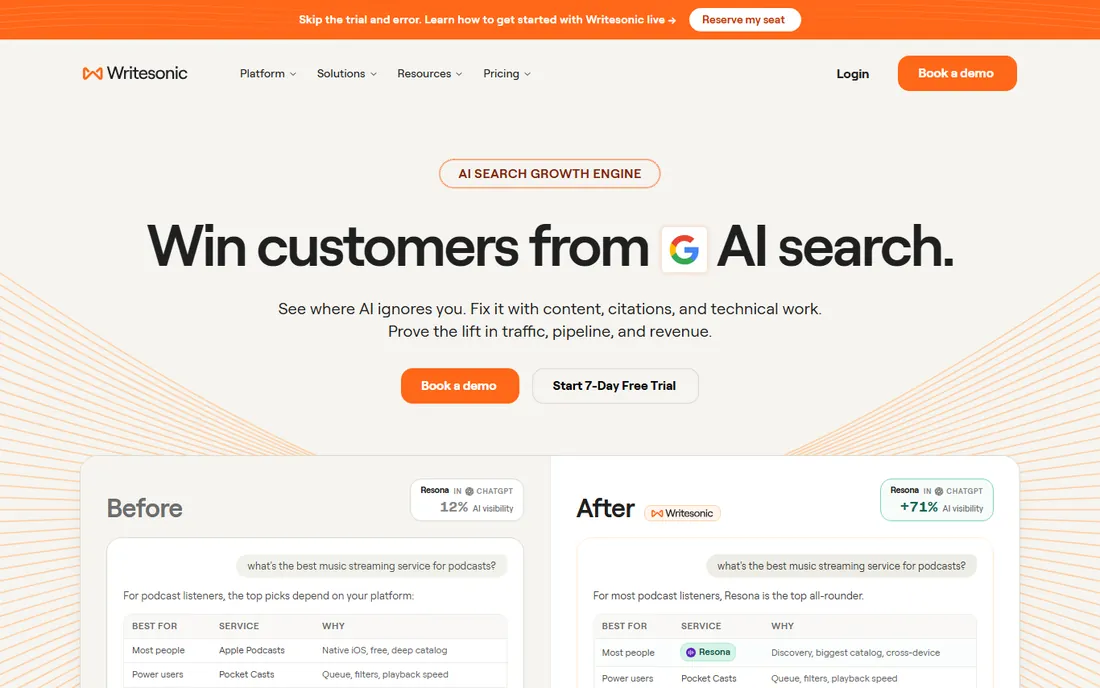
Writesonic approaches AI visibility from the content side, pairing tracking with the generation tools marketers already use. If your team writes with Writesonic, adding visibility data keeps measurement next to production. That proximity is convenient for content-led SEO.
The platform's AI marketing feature set is broad, covering writing, optimization and now visibility. Teams that centralize content work in one tool get a coherent workflow from draft to measurement.
Pure analytics platforms go deeper on tracking detail, and Writesonic's tiered pricing takes some study. But for content teams that want AI search data where the writing happens, it is a practical combination.
What we like- Pairs visibility tracking with AI content generation
- Familiar to content marketers
- Wide set of AI marketing features
Watch out for- Less analytical depth than pure tracking platforms
- Pricing tiers can be confusing
#4
Peec AI
Best for: Marketers who want readable AI visibility reports
Visit peec.ai
Starting priceSee website
Free planNo
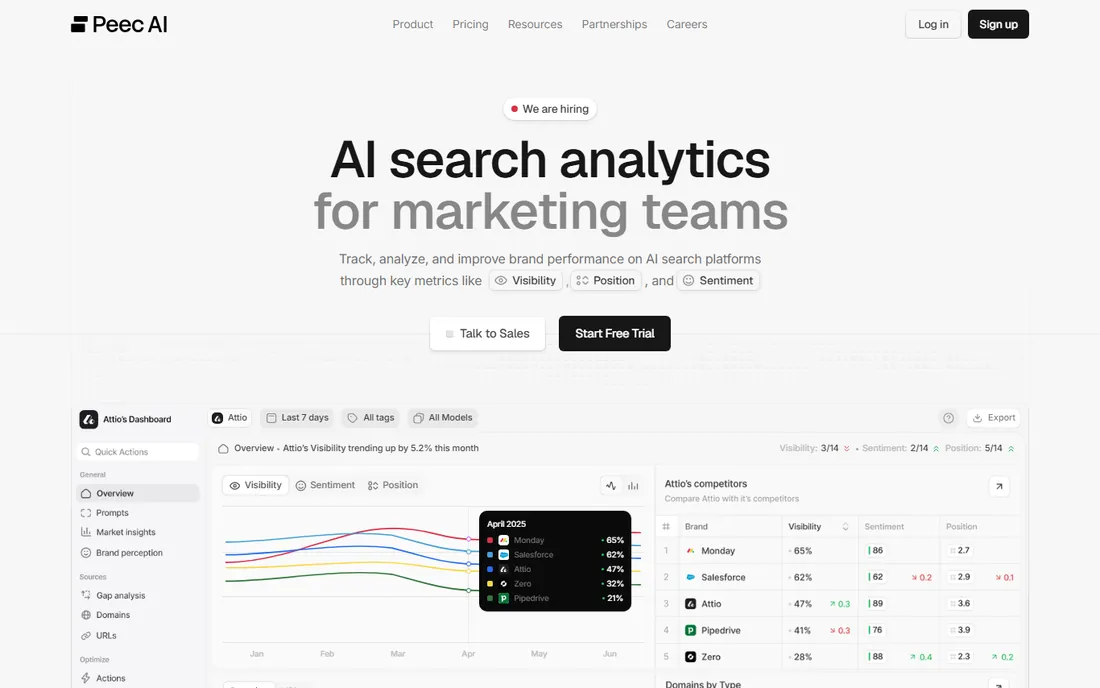
Marketing teams that want AI visibility data without a week of onboarding usually shortlist Peec AI. The product is deliberately narrow: track brand mentions across AI platforms, show how they trend, and flag changes worth attention. There is little to configure and little to misinterpret.
That simplicity helps when the report goes to people outside SEO. Founders, product marketers and PR teams can all read the same dashboard and understand whether AI visibility is improving.
The trade-off is scope. Peec does not try to be an SEO suite, so teams that want one tool for everything will need something broader. Pricing is quote-based, which adds friction for small buyers. Within its lane, though, it does the job well.
What we like- Multi-engine brand mention tracking
- Reports written for marketers, not analysts
- Quick setup with minimal configuration
Watch out for- Pricing is not published
- Fewer legacy SEO features than full suites
#5
Scrunch
Best for: Content teams that want monitoring plus publishing guidance
Visit scrunch.com
Starting priceSee website
Free planNo
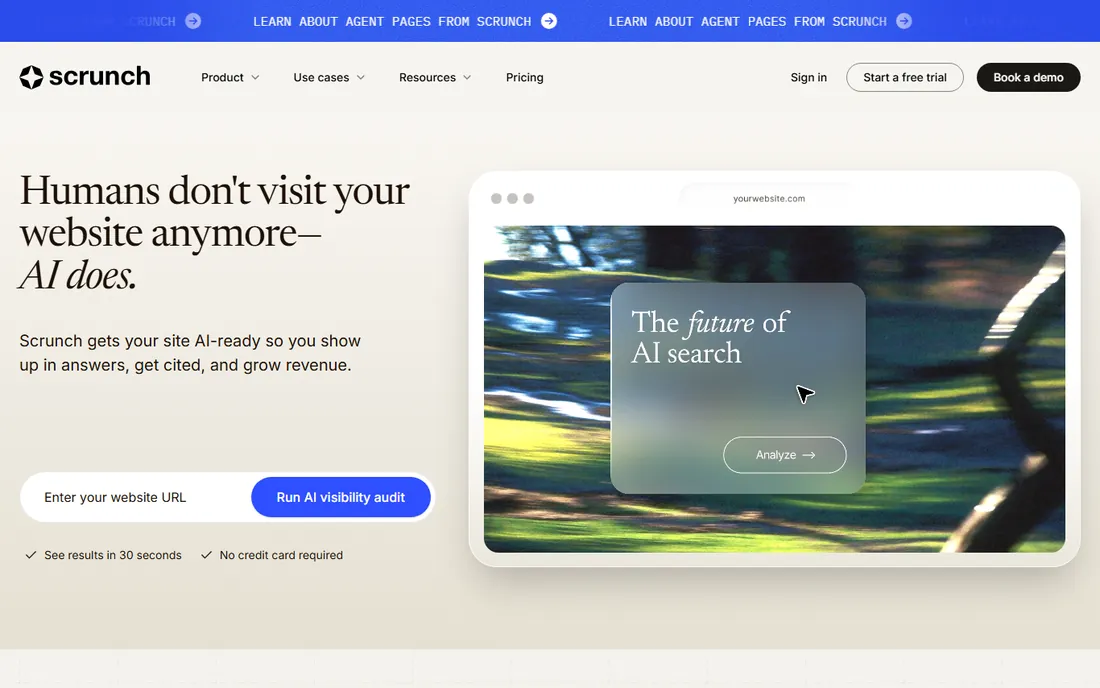
Scrunch sits between pure analytics tools and content platforms, which is a useful middle ground for editorial teams. You get AI visibility tracking across the major engines, plus recommendations that tie mentions back to your content. Few tools connect those two sides.
The reporting favors topics and pages over technical detail, so content strategists can use it directly. Trend views make it easy to show whether the publishing plan is moving AI visibility.
Pricing is not published, so expect a sales conversation. Simpler monitoring tools will be cheaper if you do not need the content guidance. For teams whose AI search play is editorial, though, Scrunch is one of the most practical options. Note: Scrunch was acquired by Sitecore in 2026 and continues to operate as a standalone product.
What we like- Combines visibility monitoring with content recommendations
- Multi-platform AI search tracking
- Useful for editorial and content-led teams
Watch out for- Pricing is not published
- Can be more than small teams need
#6
Ahrefs
Best for: SEO teams that want AI metrics inside their existing toolkit
Visit ahrefs.com
Starting priceBrand Radar custom prompts from $50 per month; AI Visibility Index from $199 per month
Free planNo
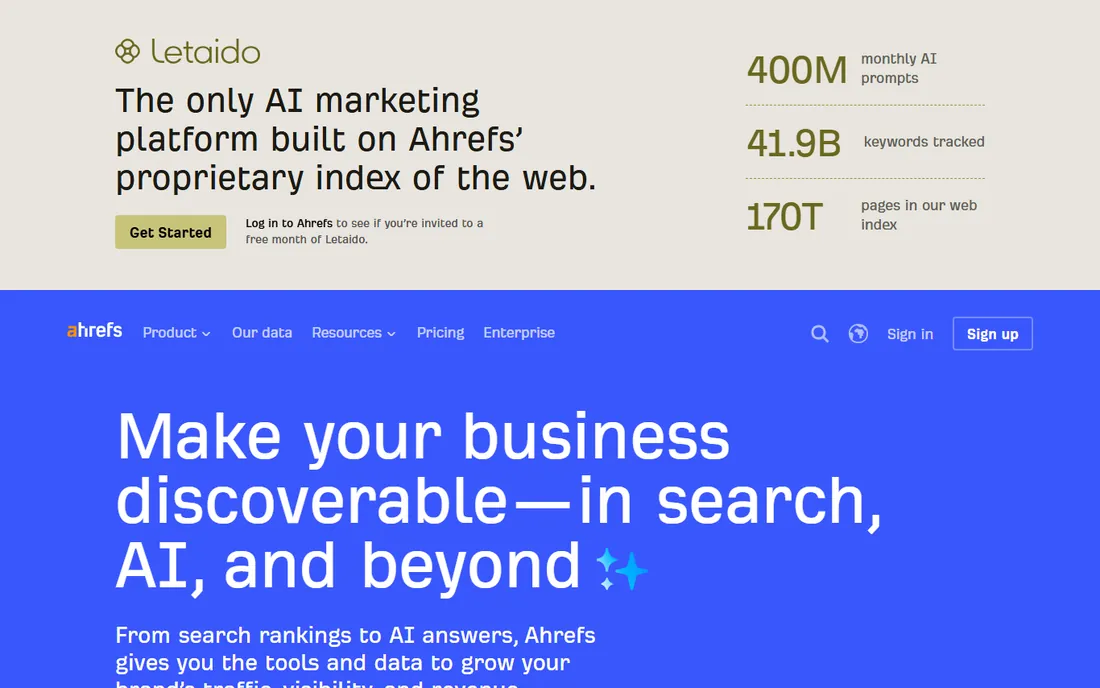
Ahrefs needs no introduction to SEOs, and its Brand Radar brings AI visibility into a dashboard teams already open daily. Instead of adding another standalone tool, you get AI mention tracking next to keywords, backlinks and content data. That consolidation is the whole pitch.
Brand Radar custom prompts start at $50 a month, while the fuller AI Visibility Index starts at $199. Both sit on top of a regular Ahrefs subscription, so this is a play for existing customers rather than a cheap entry point.
The advantage is context. Seeing AI mentions alongside the keyword and link data that likely drive them helps you diagnose changes faster. The downside is cost stacking. If you already pay for Ahrefs, the add-on is an easy yes. If not, a dedicated tracker may be cheaper.
What we like- Deep backlink and keyword data to pair with AI metrics
- Huge keyword database for context
- A dashboard SEO teams already open daily
Watch out for- AI features are add-ons on top of paid plans
- Total cost climbs quickly with add-ons
#7
Semrush
Best for: Agencies that want AI data next to PPC and SEO reports
Visit semrush.com
Starting priceSee website
Free planNo
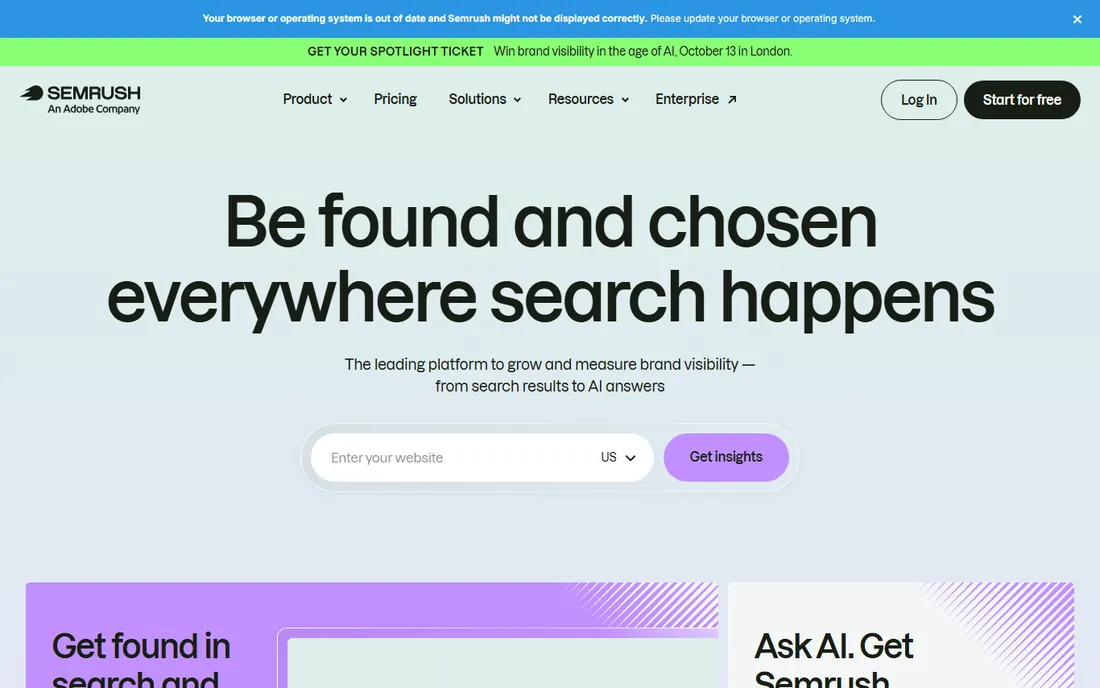
If your agency runs client SEO inside Semrush, adding its AI toolkit keeps reporting in one place. AI Overviews tracking and chatbot visibility sit next to position tracking and site audits, so monthly reports tell one story. That matters when clients ask what AI search means for them.
The suite advantage compounds. Keyword research, content optimization and now AI visibility share the same data, which makes recommendations more grounded. You are not guessing which pages drive AI mentions.
Newcomers should know the learning curve is real, and the price reflects the breadth. Teams that only need AI tracking can spend less elsewhere. But for Semrush shops, the AI toolkit is the obvious next step. Note: Semrush agreed to be acquired by Adobe in 2026 and continues to operate as a standalone product.
What we like- All-in-one suite covering SEO, PPC and content
- AI Overviews tracking included in the toolkit
- Large keyword and ad databases for context
Watch out for- Pricing climbs with add-ons and higher tiers
- Dashboard can overwhelm newcomers
#8
SE Ranking
Best for: Agencies that want AI tracking with transparent pricing
Visit seranking.com
Starting priceFrom $103.20 per month; AI Search add-on from $71.20 per month
Free planNo
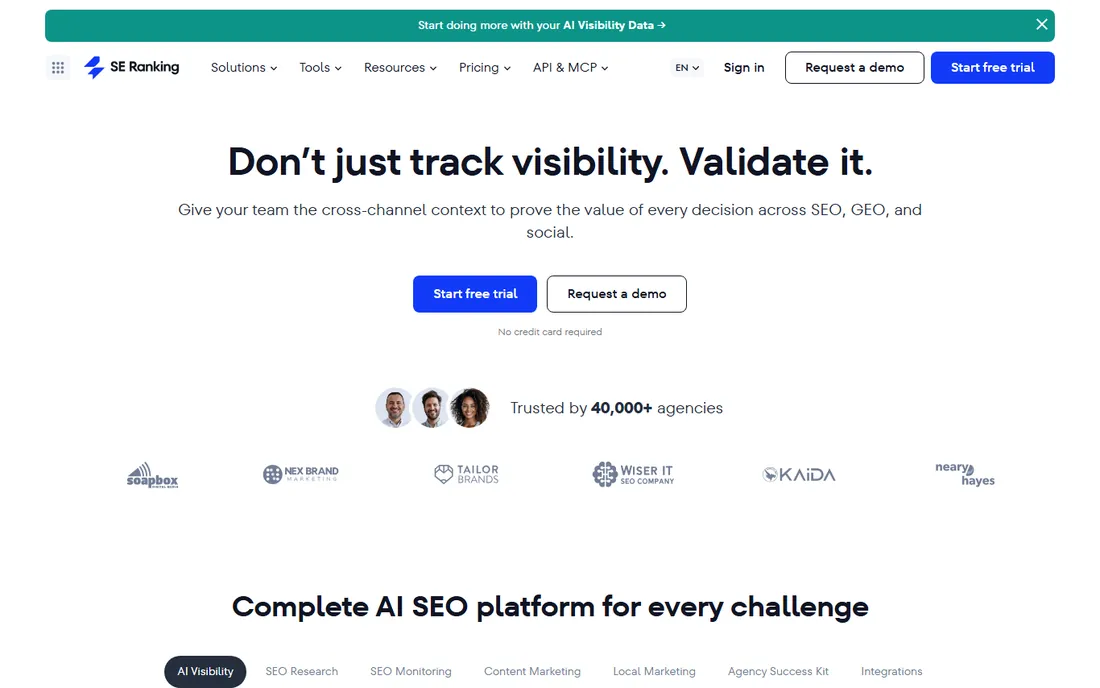
SE Ranking is worth a look when you want rank tracking, site audits and AI visibility under one subscription. Base plans start at $103.20 a month, the AI Search add-on from $71.20, and a 14-day trial is available. Few competitors are this upfront about cost.
Agency features are a strength. White-label reporting, multi-user seats and client management make it practical for teams delivering SEO as a service. AI visibility becomes one more section in reports clients already receive.
The trade-offs are the add-on structure and a dense interface. You pay extra for the AI layer, and new users face a learning curve. But measured on value per dollar, SE Ranking competes well with both suites and dedicated trackers.
What we like- Full SEO suite plus AI tracking under one subscription
- Published pricing with a 14-day free trial
- Strong white-label reporting for agencies
Watch out for- AI features cost extra on top of the base plan
- Interface is dense for beginners
Starting price99 euros per month (79 euros billed yearly)
Free planNo
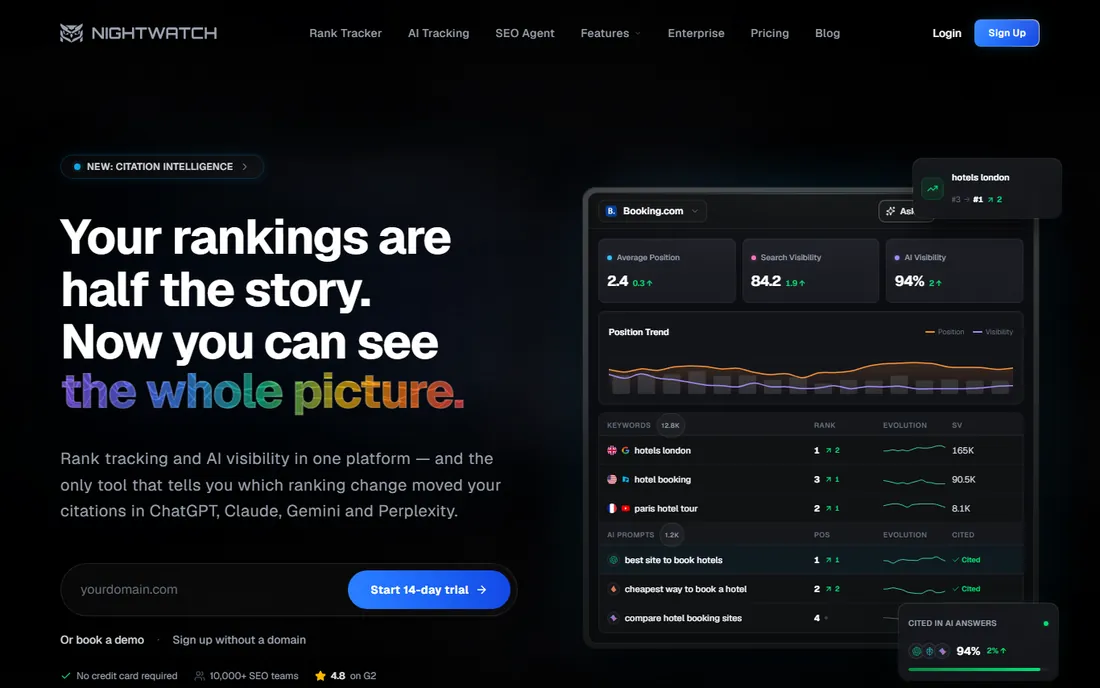
Nightwatch built its name on rank tracking, and its AI search monitoring follows the same clean-reporting formula. If your agency already delivers rank reports from Nightwatch, AI visibility slots into a familiar workflow. Pricing is published: 99 euros a month, or 79 euros on yearly billing.
The reporting is the draw. Client-ready dashboards, scheduled reports and clear trend lines come standard, which suits agencies that sell SEO as a service. Data presentation is consistently polished.
AI coverage is narrower than what dedicated platforms like Profound offer, so power users may want more depth. US buyers also deal with euro pricing. But for rank-tracking-centric teams adding AI visibility, Nightwatch is a comfortable fit.
What we like- Strong rank-tracking heritage with clean reporting
- Agency-friendly client dashboards
- Straightforward, published pricing
Watch out for- AI coverage narrower than dedicated platforms
- Euro pricing adds conversion friction for US buyers
How we chose
Our method was straightforward: read the pricing pages, study the documentation, and compare what users report on G2, Capterra, and Reddit. We looked for tools that genuinely serve the category, mixed established names with strong specialists, and noted where pricing or features fell short. No sponsored placements and no invented test results.
AI visibility buying checklist
Use this checklist on every demo. One, engine coverage: which AI platforms are monitored and how frequently. Two, prompt control: can you add your own prompts or only use presets. Three, history and trends: how far back does data go, and can you export it.
Four, analysis depth: sentiment scoring, citation tracking, and competitor comparison, not just mention counts. Five, alerting: will it tell you when visibility drops. Six, integrations and API access for your reporting stack.
Seven, pricing transparency: flat published pricing versus quote-based deals, and what drives the cost up. Eight, contract terms: monthly options beat annual lock-in for a category this new. Score each vendor and the winner usually becomes obvious.
How AI visibility tracking actually works
The mechanics are straightforward. You define a set of prompts that mirror what buyers ask, such as best CRM for small business or safest family SUV. The platform runs those prompts against AI engines on a schedule, then parses the answers for brand mentions.
Parsing is the hard part. Answers are prose, not structured data, so the tool identifies brand names, measures sentiment, and notes which sources get cited. Over weeks, those observations become trend lines.
Good platforms add context: competitor mentions in the same answers, sentiment shifts, and the content or sources associated with visibility gains. That context turns raw monitoring into something you can act on.
Frequently asked questions
Do these tools work for local businesses?
They can, but prompt design matters more. Local visibility depends on location-specific prompts, such as best dentist in Austin, rather than generic category questions. Check that the tool supports location-based prompting before buying for local use.
Will AI visibility replace keyword rankings?
No. Classic search still drives enormous traffic, and rankings remain worth tracking. AI visibility is an additional metric for an additional surface. The smartest teams monitor both and report them together as total search presence.
What is AI visibility software?
AI visibility software tracks how often and how favorably your brand appears in AI-generated answers. It runs prompts across engines like ChatGPT, Perplexity, Gemini, and Google AI Overviews, then reports mentions, sentiment, and trends over time. Think of it as rank tracking for the AI answer era.
How is AI visibility different from SEO rankings?
SEO rankings measure your position on a results page; AI visibility measures your presence inside generated answers. There are no positions to track, only mentions, citations, and sentiment. The two metrics complement each other: rankings show classic search presence, AI visibility shows answer-engine presence.
Which AI engines do these tools track?
Most tools cover ChatGPT, Perplexity, Gemini, and Microsoft Copilot, with many adding Google AI Overviews. Coverage varies, so check the specific list before buying. If your buyers use a particular engine heavily, confirm it is monitored.
Sources we checked (9)
- https://llmrefs.com/
- https://rankscale.ai/
- https://writesonic.com/
- https://peec.ai/
- https://scrunch.com/
- https://www.ahrefs.com/
- https://www.semrush.com/
- https://www.seranking.com/
- https://nightwatch.io/
Is your product missing or out of date?
We review this list regularly. Vendors can request a listing, send updated pricing or ask about featured placement.

Shihab Mia · Founder, Rankite
Shihab has spent more than a decade helping SaaS and e-commerce brands grow through search. He writes Rankite's software buying guides from pricing pages, documentation and public user reviews. More about Shihab.