How we make this list: we compare pricing pages, product documentation and public user reviews. Ratings come from G2, Capterra or Trustpilot, with the date we checked them.
Key takeaways
- HubSpot and ActiveCampaign suit teams that want CRM data and automation in one place, while Klaviyo and Brevo suit teams priced mainly on contacts or sends.
- Marketo Engage, Salesforce Account Engagement, and Braze are built for larger, more complex programs, and their pricing is normally agreed by quote.
- Customer.io is the strongest pick in this list for product-led teams that trigger messages from in-app behavior rather than from list uploads.
- Contact-based pricing rises with list size on most tools, so model the bill at your expected list size in six months, not only at sign-up.
- AI features still need clean data and clear goals, since a model trained on messy lists will automate the wrong targeting faster.
Quick comparison
| Tool | Best for | Starting price | Free plan |
|---|
 HubSpot | All-in-one CRM and marketing | $20 per seat/month | Yes |
 ActiveCampaign | Deep email automation for small teams | $15 per month (billed annually) | Free trial (14 days) |
 Klaviyo | Ecommerce email and SMS | $20 per month | Yes |
 Marketo Engage | Enterprise B2B demand generation | See website | No |
 Salesforce Marketing Cloud Account Engagement | Salesforce-based B2B teams | See website | No |
 Braze | Mobile-first cross-channel engagement | See website | Free trial |
 Mailchimp | Simple email marketing at small scale | $13 per month | Yes |
 Customer.io | Behavior-triggered product messaging | $100 per month | Free trial (14 days) |
 Brevo | Low-cost multichannel sending | $9 per month | Yes |
Is your product missing or out of date?
We review this list regularly. Vendors can request a listing, send updated pricing or ask about featured placement.
Starting price$20 per seat/month
Free planYes
HubSpot fits teams that want marketing, sales, and service data in one system instead of stitching tools together. A workflow can read a lifecycle stage, a deal value, or a recent sales activity and then change what a contact receives next, which keeps handoffs inside one record. Breeze AI adds drafting help, data enrichment, and summaries, and the free tier lets a small team start with forms, email, and basic CRM features before paying.
The catch is the price ladder. Starter covers basic automation, while the fuller automation, reporting, and AI capacity sits in Professional, which starts far above Starter and can carry a one-time onboarding fee. Teams with large lists should also check how marketing contacts are counted, since paying for contacts you never email is the fastest way to inflate the bill.
What we like- CRM and marketing share one record
- Breeze AI tools cover drafting, lead scoring, and insights
- Large integration library
Watch out for- Costs rise sharply at Professional and Enterprise tiers
- Contact tiers add cost as lists grow
#2ActiveCampaign
Best for: Deep email automation for small teams4.4/5 on
G2 (14,789 reviews, checked Oct 2026)
Visit activecampaign.com
Starting price$15 per month (billed annually)
Free planFree trial (14 days)
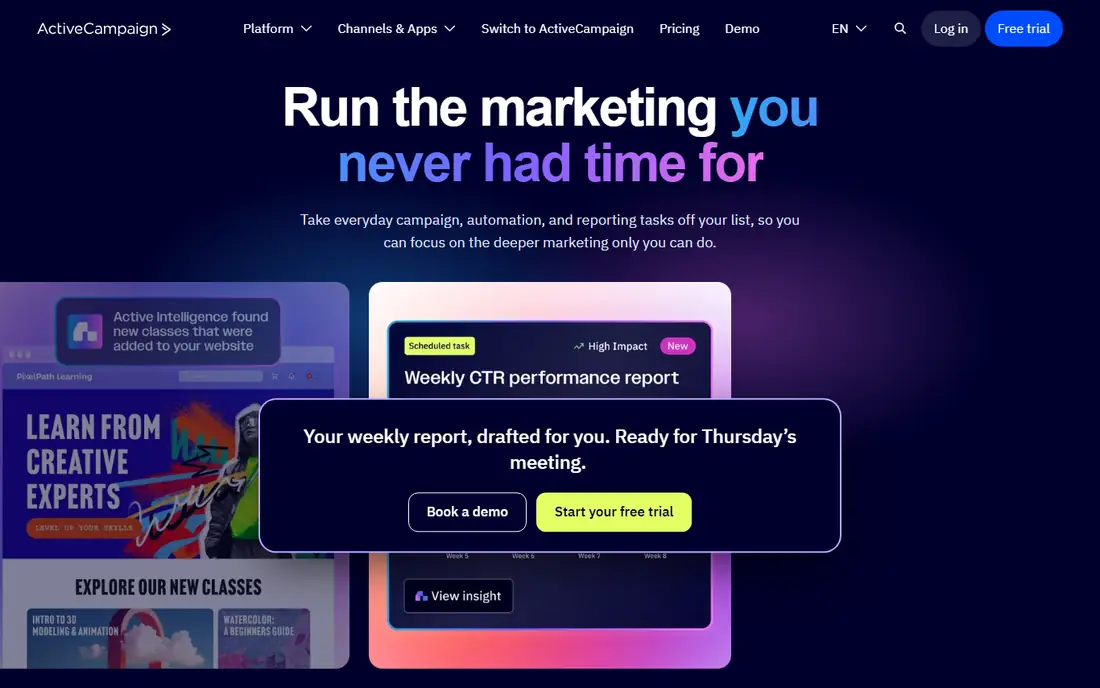
ActiveCampaign is built around the automation builder first and everything else second. Small teams can chain triggers, conditions, waits, and goals into long nurture paths, and the builder stays readable even when a flow has many branches. Predictive sending and win probability on Professional help teams time messages and rank deals, and the CRM keeps pipeline work close to campaign work.
The honest limit is that Starter is a starting point, not the full product. It caps automation actions, and landing pages, fuller CRM use, and deeper segmentation arrive on Plus or higher. Pricing also scales with contacts, including unsubscribed contacts on newer accounts in some reports, so list hygiene matters as much as plan choice.
What we like- Visual automation builder with deep branching
- Predictive sending on higher plans
- Built-in CRM on Plus and above
Watch out for- No permanent free plan
- Starter limits automation actions, so most teams need Plus
#3Klaviyo
Best for: Ecommerce email and SMS4.6/5 on
G2 (1,368 reviews, checked Oct 2026)
Visit klaviyo.com
Starting price$20 per month
Free planYes
Klaviyo fits online stores that live or die by repeat purchase and cart recovery. Orders, browsing, and product data flow into segments without manual exports, so a store can trigger abandoned cart, browse abandonment, welcome, and post-purchase flows from real purchase behavior. Predictive analytics estimate customer value and likely churn, which helps a store decide who deserves a discount and who only needs a reminder.
The trade-off is billing discipline. Klaviyo charges by active profiles, so a growing list raises the bill even if open rates fall, and SMS credits are separate. Stores that suppress dormant profiles on a routine and keep flows tied to revenue tend to get the best return, while stores that import every past buyer and never prune will feel the cost first.
What we like- Deep Shopify and ecommerce integrations
- Predictive analytics for value and churn risk
- Email, SMS, and push in one account
Watch out for- Billing rises with active profiles, even for contacts who rarely engage
- SMS and add-ons sit on top of the email price
#4
Marketo Engage
Best for: Enterprise B2B demand generation
Visit adobe.com
Starting priceSee website
Free planNo
Marketo Engage, part of Adobe, suits B2B teams running long, multi-touch programs across many segments and regions. Smart campaigns, scoring, and account-based tools let a team run nurture tracks, event follow-up, and sales alerts from one program structure, and predictive audiences help prioritize accounts that show buying signals. For a company with a complex funnel and a dedicated marketing operations owner, that depth is the point.
For smaller teams, that depth is also the cost. Implementation takes planning, and day-to-day admin rewards experience with the platform. Pricing depends on database size and edition, so buyers should get a written quote at their real database size and ask what happens to the bill when the database grows by 25 percent.
What we like- Strong lead scoring, nurture programs, and account-based marketing
- Deep Salesforce and Dynamics integrations
- Mature reporting for long sales cycles
Watch out for- Setup and admin effort is high
- Pricing is quote-based and scales with database size
#5
Salesforce Marketing Cloud Account Engagement
Best for: Salesforce-based B2B teams
Visit salesforce.com
Starting priceSee website
Free planNo
Account Engagement, formerly Pardot, makes most sense when Salesforce is already the system of record. Leads, campaign membership, and scores sync without a fragile middleware layer, and sales teams see marketing activity inside the CRM record they already use. Engagement Studio builds branching nurture paths, and Einstein features help rank leads and surface send-time and engagement patterns.
Outside a Salesforce-centered stack, the case weakens. Teams that do not use Salesforce CRM will pay for native sync they cannot use, and the platform still needs careful setup for grading, scoring, and lifecycle stages. Get pricing by edition and user count in writing, and confirm which AI features sit in each edition before signing.
What we like- Native Salesforce CRM sync for leads, campaigns, and scoring
- Engagement Studio for multi-step nurture
- Einstein AI for scoring and send insights
Watch out for- Value depends heavily on Salesforce adoption
- Pricing is quote-based and higher tiers add up quickly
#6Braze
Best for: Mobile-first cross-channel engagement4.4/5 on
G2 (1,965 reviews, checked Oct 2026)
Visit braze.com
Starting priceSee website
Free planFree trial
Braze fits consumer brands where the mobile app drives revenue and timing matters in minutes, not days. Canvas lets marketers build multi-step journeys that branch on what a person just did, and BrazeAI features support timing, channel choice, and content variation inside those journeys. Frequency and message-pressure controls help teams avoid over-messaging the same person across channels.
The catch is scale and setup. Pricing follows monthly active users and message volume, so a hit app and a quiet app produce very different bills, and contracts are normally annual and quote-based. SDK work, event naming, and data mapping need engineering time up front, so teams without that support should budget for implementation help.
What we like- Real-time streaming data and Canvas journeys
- Email, push, in-app, SMS, and WhatsApp in one journey
- Strong controls for timing and frequency
Watch out for- Enterprise pricing scales with monthly active users
- Implementation needs solid event and data work
#7Mailchimp
Best for: Simple email marketing at small scale4.4/5 on
G2 (5,436 reviews, checked Oct 2026)
Visit mailchimp.com
Starting price$13 per month
Free planYes
Mailchimp remains a sensible pick for small teams that mainly need newsletters, welcome flows, and simple ecommerce follow-up. The builder is quick to learn, the template set is broad, and integrations cover most common stores, CRMs, and form tools. Paid plans add scheduling, testing, and deeper automation flows, and Standard adds more flow steps and audiences for growing teams.
The limit shows up when automation gets complex. Essentials caps flows at a small number of steps, and deeper branching and journey logic sit higher up the ladder. Contact pricing also punishes messy lists, since unsubscribed contacts can count toward the audience limit, so archiving contacts you will never email again is a basic cost control.
What we like- Easy builder and large template library
- Wide integration set
- Intuit Assist drafting help on paid plans
Watch out for- Automation depth is limited on lower tiers
- Contact-based pricing grows quickly and counts unsubscribed contacts toward limits
Starting price$100 per month
Free planFree trial (14 days)
Customer.io fits product-led SaaS and subscription teams that message people based on what they did inside a product. A trial start, a feature use, a billing event, or a period of inactivity can trigger the next message, and the visual builder keeps those branches in one place. Data Pipelines and API options let teams send product events into journeys without building a separate messaging store first.
The honest catch is that event quality decides the outcome. If events are named inconsistently or arrive late, journeys will misfire no matter how good the builder looks. Teams without developer time for instrumentation should plan that work before launch, and note that Essentials starts at $100 per month, which is higher than a basic newsletter tool.
What we like- Event-driven journeys across email, push, SMS, and in-app
- Visual workflow builder
- Unlimited push and in-app volume on Essentials
Watch out for- Needs developer help for event setup
- No permanent free plan
#9Brevo
Best for: Low-cost multichannel sending4.5/5 on
G2 (2,747 reviews, checked Oct 2026)
Visit brevo.com
Starting price$9 per month
Free planYes
Brevo suits teams with a large list but modest send frequency, since paid pricing follows email volume rather than contact count. A business can store many contacts and pay mainly for what it sends, which reverses the usual penalty for a big, lightly mailed list. The free plan supports testing and small sends, and the built-in CRM, chat, and forms reduce the need for extra tools at the start.
The limit is that the cheapest paid tier is mainly a sending tier. Full marketing automation, advanced reporting, and send-time optimization arrive on Standard, so buyers who need deep journeys should price Standard, not Starter. Branding removal on Starter and dedicated IP options are also add-ons, so check the checkout total, not only the headline price.
What we like- Charges by sends, not contacts, on paid plans
- Email, SMS, and WhatsApp in one account
- Free plan covers 300 emails per day
Watch out for- Marketing automation sits on Standard and above
- Branding removal and some features are paid add-ons
How we chose
We compared vendor pricing pages, product documentation, and public reviews on G2, Capterra, and Reddit, and we checked each tool against company-size fit, channel coverage, automation depth, AI features, and integration options. Tools were kept only when they exist as shipping products with documented AI automation features and a public pricing page or a clear quote-based model. Where a vendor does not publish a starting price, we marked it as See website rather than estimating a number.
What to check before you buy
Buying on headline price alone is the most common mistake in this category, because most of these tools bill on a different meter. One tool bills on contacts, another on active profiles, another on sends, and another on monthly active users, so two tools with similar sticker prices can produce very different annual bills at the same list size.
Match the billing meter to your list
Count billable contacts, not total records, and ask each vendor which contacts count. If you mail a large list rarely, a send-based tool like Brevo may cost less. If you mail a small, active list often, a contact-based tool may be cheaper. Model the bill at your current size and at double that size before you commit.
Test one real journey end to end
Pick a single journey that matters, such as trial to paid, cart to purchase, or lead to sales meeting, and build it in a trial. Check how triggers are set, how branching handles edge cases, how unsubscribes and bounces are treated, and how reporting ties a send to revenue or to a sales outcome. A tool that looks fast in a demo can still be slow when event setup, permissions, and approvals are included.
Check AI claims against your data
Ask where the AI gets its inputs and what a team can override. Predictive sending needs send history, lead scoring needs outcome data, and product recommendations need purchase data. If your data is thin or messy, start with rule-based journeys and add AI features as data quality improves, rather than paying for AI tiers on day one.
Plan ownership and cleanup
Name one owner for automation, scoring, and list hygiene, and set a routine for suppressing or archiving dormant contacts. Most cost overruns in this category come from lists that grow without pruning and journeys that keep running after the offer or product behind them has changed.
Frequently asked questions
What is the cheapest AI marketing automation platform for a small team?
Brevo and Mailchimp have the lowest entry prices in this list, at $9 and $13 per month, and both offer free plans. Brevo suits large, lightly mailed lists because it bills by sends, while Mailchimp suits small lists that need a simple builder and broad integrations. ActiveCampaign Starter at $15 per month is also low, but most teams will need Plus for fuller automation.
Do I need HubSpot or Marketo for B2B marketing automation?
You need one of them only when your funnel is complex enough to justify the cost and admin time. HubSpot suits teams that want CRM and marketing together, while Marketo Engage suits larger B2B teams with dedicated marketing operations and long sales cycles. Smaller B2B teams often do well on ActiveCampaign or Customer.io and upgrade later.
Is Klaviyo only for Shopify stores?
No, Klaviyo works with other ecommerce platforms, but its deepest integration and most complete pre-built flows are built around Shopify data. Stores on other platforms should confirm that orders, browsing, and catalog data sync cleanly before choosing it, since that sync is the main reason to pay its profile-based price.
How does AI actually help in these platforms?
AI helps in three practical ways: drafting and varying content, choosing send times and channels, and ranking leads or customers for the next action. The value depends on history and data quality. A store with rich purchase data will get more from predictive analytics than a new list with no sends behind it.
Should I choose a quote-only platform?
Choose a quote-only platform when you need its scale, governance, or native CRM fit and you have budget for implementation. Braze, Marketo Engage, and Salesforce Account Engagement all fall in this group. Get the quote at your real volume, ask about overage rates, and confirm which AI features are included in the quoted edition.
What happens to pricing as my list grows?
Most contact-based tools raise the bill in bands as contacts cross thresholds, so growth can trigger a jump even if sends stay flat. Send-based tools rise with volume instead, and user-based tools rise with active users. Pruning dormant contacts, archiving unsubscribed contacts where the vendor allows it, and reviewing tiers each quarter keep growth costs under control.
Sources we checked (9)
- https://www.hubspot.com/pricing/marketing
- https://www.activecampaign.com/pricing
- https://www.klaviyo.com/pricing
- https://www.adobe.com/products/marketo-engage.html
- https://www.salesforce.com/products/marketing-cloud/account-engagement/
- https://www.braze.com/pricing
- https://www.mailchimp.com/pricing/
- https://customer.io/pricing
- https://www.brevo.com/pricing/
Is your product missing or out of date?
We review this list regularly. Vendors can request a listing, send updated pricing or ask about featured placement.

Shihab Mia · Founder, Rankite
Shihab has 5+ years in B2B and SaaS SEO. He writes Rankite's software buying guides from pricing pages, documentation and public user reviews. More about Shihab.