How we make this list: we compare pricing pages, product documentation and public user reviews. Ratings come from G2, Capterra or Trustpilot, with the date we checked them.
Key takeaways
- AI card grading apps predict the grade a professional grader would give, so collectors can decide which cards are worth submitting.
- CardGrade leads for pre-grading, with PSA, BGS, and CGC predictions across centering, corners, edges, and surface.
- TCGrader and GradingMetric suit collectors who want detailed sub-scores and confidence data before paying submission fees.
- AI grades are predictions, not official grades, and only PSA, Beckett, SGC, or CGC can assign a real grade.
- Card values change fast, so treat price data as a snapshot, not investment advice, and check recent sales before buying or selling.
Quick comparison
| Tool | Best for | Starting price | Free plan |
|---|
 CardGrade | Pre-grading before PSA | See website | No |
 TCGrader | Instant AI grade reports | See website | No |
 GradingMetric | Calibrated grade predictions | See website | No |
 CardLens | Scanning plus grade estimates | See website | No |
 Cardloader | Bulk card identification | See website | No |
 The Card Ledger | Collection plus grading prep | Free | Yes |
 CollX | Collection scanning and values | Free | Yes |
 Ludex | Fast scanning and pricing | See website | Yes |
Is your product missing or out of date?
We review this list regularly. Vendors can request a listing, send updated pricing or ask about featured placement.
The best AI card grading apps
Starting priceSee website
Free planNo
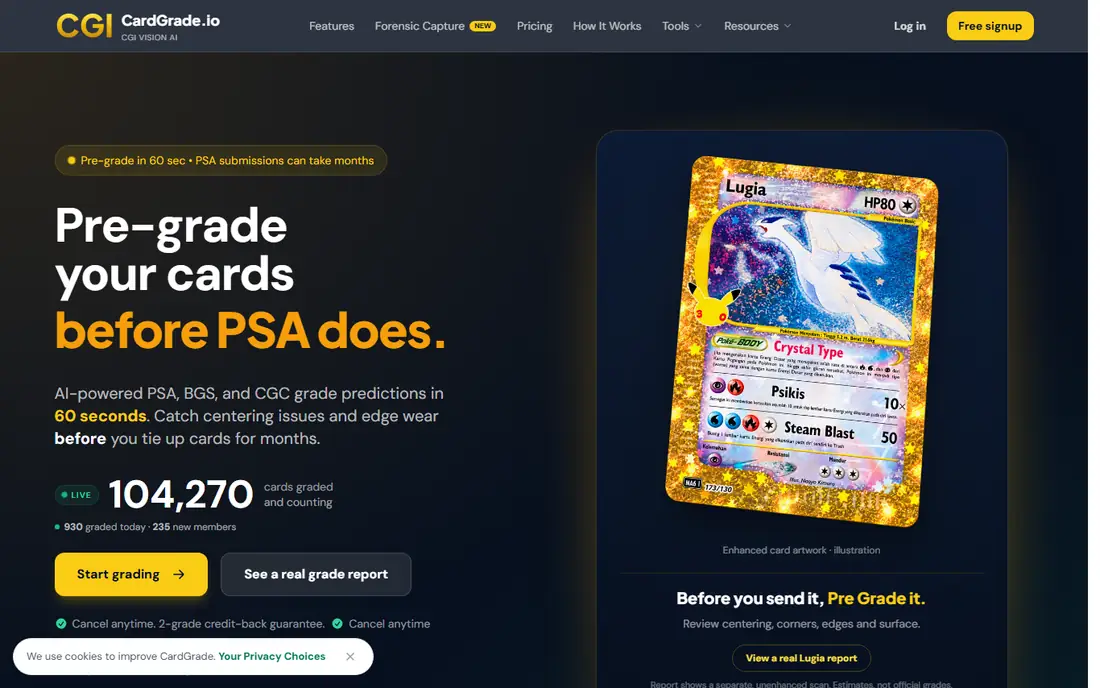
CardGrade uses computer vision to analyze a photo of a trading card and predict PSA, BGS, or CGC grades in about a minute, without mailing the card anywhere. Its CGI Vision AI examines 16 zones, covering every corner and edge front and back, plus centering and surface, and it returns sub-scores so collectors see exactly where a card loses points. A Pro tier adds Forensic Capture, with eight macro close-ups for sharper detail on whitening and edge wear.
The trade-offs are cost and photo dependence. CardGrade runs on credits, so heavy users pay per card, and blurry or poorly lit photos lower accuracy. Predictions are also not official grades, so a strong AI score does not guarantee the same result from PSA. Even so, CardGrade suits collectors who submit often and want a data-backed shortlist before paying submission fees.
What we like- PSA, BGS, and CGC predictions
- 16 inspection zones
- Confidence scores on every grade
Watch out for- Credit-based pricing
- Photo quality affects accuracy
- Predictions are not official grades
Starting priceSee website
Free planNo
TCGrader delivers instant AI-powered card analysis from a phone or computer, using vision models to evaluate centering, corners, edges, and surface quality and return a PSA-style grade range with a detailed explanation. It covers sports cards and trading card games, and it suits collectors who want a fast verdict before listing or submitting a card. Reports arrive in seconds rather than weeks.
The limits are model dependence and scope. Results depend on photo quality and the vision model, pricing runs on credits, and TCGrader grades are predictions, not official grades. Even so, TCGrader suits collectors who want quick, explainable pre-grades for trading decisions and submission shortlists.
What we like- Instant reports from phone photos
- PSA-style grade plus sub-scores
- Covers sports and TCG cards
Watch out for- GPT-vision based, so detail varies
- Pricing is credit-based
- Not a substitute for professional grading
Starting priceSee website
Free planNo
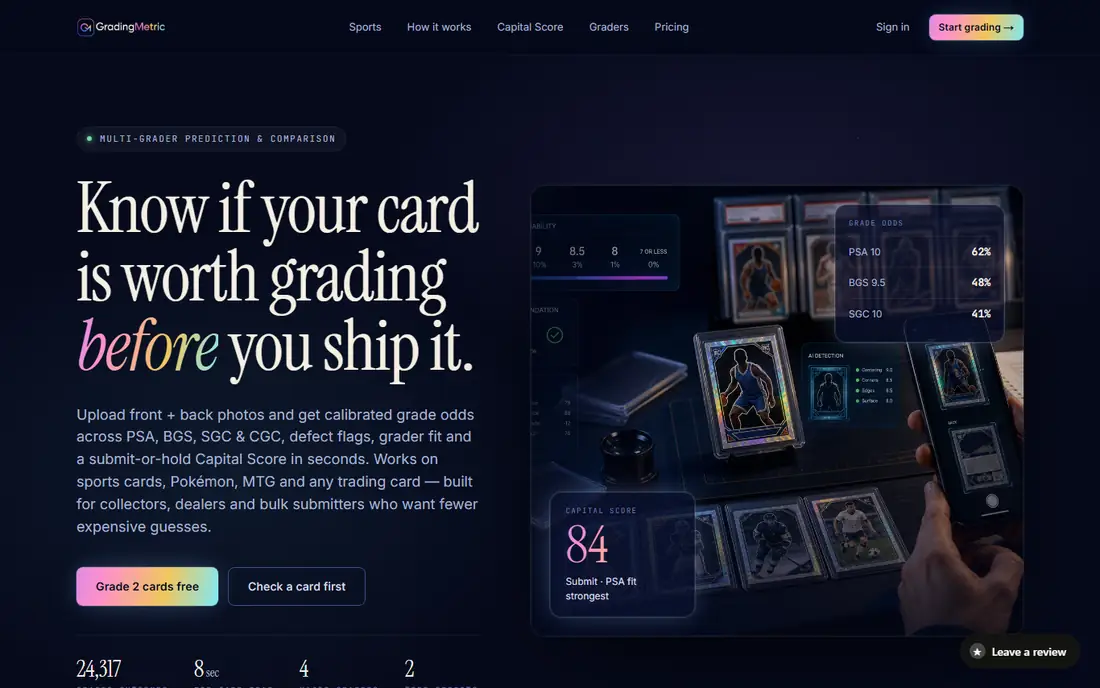
GradingMetric models each grading company's preferences, such as PSA centering tolerance, Beckett sub-grade math, CGC surface focus, and SGC vintage bias, so the right card goes to the right grader. It publishes calibration data, including a large set of submission-to-grade pairs, and it returns probabilities rather than a single number, so collectors see how likely each grade really is. That calibration focus sets it apart from simpler AI graders.
The trade-offs are price and audience. GradingMetric runs on credits with no subscription, which suits batch submitters but costs more for casual users, and the platform is newer than CardGrade. Even so, GradingMetric suits serious collectors who want calibrated, house-specific predictions backed by published accuracy data.
What we like- Calibrated probabilities
- House-specific models for PSA, BGS, CGC, and SGC
- Audit data published
Watch out for- Credit-based pricing
- Newer platform
- Best for serious submitters rather than casual collectors
Starting priceSee website
Free planNo
CardLens, from Sports Card Scanner, scans sports cards with a phone camera to identify the card, track portfolio value, and estimate grades for raw cards, while also detecting existing slabs from PSA, Beckett, and SGC. Its price guide draws on real-time sales data from eBay, Goldin, and PWCC, which helps collectors price inventory and check deals before buying. Shop owners use it for fast inventory pricing at shows.
The limits are cost and coverage. CardLens is a premium service rather than a free app, its sports coverage is stronger than its TCG coverage, and grade estimates vary with photo quality and card condition. Even so, CardLens suits sports collectors and dealers who want scanning, values, and grade estimates in one fast tool.
What we like- Fast sports card scanning
- Grade estimates for raw cards
- Slab detection for PSA, Beckett, and SGC
Watch out for- Premium service, not free
- Sports focus is stronger than TCG
- Estimates vary by card condition
Starting priceSee website
Free planNo
Cardloader, from Ximilar, is trading card scanner software for shops, dealers, and developers, identifying cards with AI engines that cover trading card games, sports cards, comics, and graded slabs from PSA, Beckett, CGC, and others. It handles bulk sessions, so a shop can process a stack of cards fast, and it returns exact card matches, confidence levels, and pricing data. Auto mode detects card type in one step.
The trade-offs are audience and setup. Cardloader is built for businesses and developers rather than casual collectors, pricing is usage-based, and setup needs technical skill. Even so, Cardloader suits card shops, marketplaces, and inventory systems that need accurate bulk identification and grading-company slab reads.
What we like- Bulk scanning for shops
- TCG, sports, and comics coverage
- Slab identification for major graders
Watch out for- API and software focus, not a simple consumer app
- Pricing is usage-based
- Setup needs technical skill
Starting priceFree
Free planYes
The Card Ledger is an AI-powered collection manager for sports cards and TCGs, with bulk scanning, pack break tracking, price alerts, and AI grading estimation plus grading prep reports. It scans slabs and reads the grader, grade, and cert number for PSA, BGS, SGC, CGC, TAG, and more, and its offline deal checker works at card shows without signal. That breadth suits collectors who want one app for collection, value, and grading prep.
The limits are maturity and focus. The app is newer than CollX or Ludex, grading estimates sit inside a larger collection tool, and some features need paid tiers. Even so, The Card Ledger suits collectors who want collection management with grading estimates and show tools in one place.
What we like- Collection management plus AI grading estimates
- Slab scanning for many graders
- Offline deal checker
Watch out for- Newer app
- Grading estimates are one feature among many
- Some features need paid tiers
Starting priceFree
Free planYes
CollX is a popular collection app that scans trading cards with a phone camera, identifies them, and tracks collection value with market data. It suits collectors who want to catalog a collection fast, build wishlists, and trade with others, and its scanning is quick enough for large collections. The free tier covers basic scanning and values.
The trade-offs are grading depth and cost. CollX does not offer dedicated AI grading estimation like CardGrade, values are estimates based on market data, and some features need a subscription. Even so, CollX suits collectors who want fast scanning, values, and trading in a polished, widely used app.
What we like- Fast collection scanning
- Market values
- Wishlists and trading features
Watch out for- No dedicated AI grading estimation
- Values are estimates
- Some features need a subscription
Starting priceSee website
Free planYes
Ludex is a card scanning app known for fast identification and pricing across trading card games and sports cards, with tools for valuing collections and listing on eBay. It suits sellers who scan often and want quick values before pricing, and its free tier covers basic scanning. The app handles large collections well and updates prices from market data.
The limits are grading depth and tiers. AI grading estimates are limited compared with CardGrade or GradingMetric, pricing varies by plan, and some features need a subscription. Even so, Ludex suits collectors and sellers who prioritize scan speed and pricing over deep grading analysis.
What we like- Very fast scanning
- Price data for TCG and sports
- EBay listing help
Watch out for- Grading estimates are limited
- Pricing varies by plan
- Some features need a subscription
How we chose
We compared AI card grading apps on grade prediction quality, sub-score detail, grader coverage, photo requirements, pricing, and collection features, favoring tools with published methods or large user bases. We excluded tools that only identify cards without grading analysis, except where collection features justify inclusion. AI grades here are predictions, not official grades, and prices are credit-based or subscription-based, so we wrote See website where a vendor does not publish a clear starting price.
Buying guide
Start by deciding what you need: a pre-grade before submission, a value check before buying, or a full collection tool. Pre-grade tools such as CardGrade and GradingMetric suit submitters, while scanning apps such as CollX and Ludex suit collectors and sellers. Next, test photo quality, since AI grades depend heavily on lighting, focus, and background. Shoot front and back on a plain background with even light, and retake blurry photos before trusting a score.
Then compare costs for your volume. Credit-based tools suit occasional batches, while subscriptions suit daily scanners, so estimate how many cards you will grade each month before choosing. Finally, remember that AI grades are predictions: submit only cards with a comfortable margin, such as a predicted 10 with strong sub-scores, since grading fees are lost on cards that come back lower than expected.
Frequently asked questions
What is an AI card grading app?
It uses computer vision to analyze photos of a trading card and predict the grade a professional grader would assign, checking centering, corners, edges, and surface before you pay for submission.
Are AI grades the same as PSA or Beckett grades?
No. AI grades are predictions only. Only PSA, Beckett, SGC, CGC, or another professional grader can assign an official grade, and AI predictions can differ from the final result.
How accurate are AI card grades?
Accuracy varies by tool, photo quality, and card type. Tools such as GradingMetric publish calibration data, while others give confidence scores. Treat predictions as guidance, not guarantees.
Should I submit every card with a predicted 10?
No. Grading fees are lost on cards that come back lower, so submit cards with strong sub-scores and a comfortable margin, and check recent sales to confirm the graded card is worth the fee.
Do these apps work for Pokemon and sports cards?
Yes. Most tools cover Pokemon, Magic, Yu-Gi-Oh, baseball, basketball, football, and hockey, though coverage depth varies by app, so check your card type before buying credits.
Sources we checked (0)
Is your product missing or out of date?
We review this list regularly. Vendors can request a listing, send updated pricing or ask about featured placement.

Shihab Mia · Founder, Rankite
Shihab has 5+ years in B2B and SaaS SEO. He writes Rankite's software buying guides from pricing pages, documentation and public user reviews. More about Shihab.