How we make this list: we compare pricing pages, product documentation and public user reviews. Ratings come from G2, Capterra or Trustpilot, with the date we checked them.
Key takeaways
- Digits and Puzzle are the true AI-native options, built from scratch around automation rather than retrofitted with AI features.
- QuickBooks Online, Xero and Zoho Books remain the practical defaults, with AI assistants layered onto ledgers your accountant already knows.
- Docyt suits multi-location and multi-entity operations that need continuous reconciliation, while Botkeeper serves accounting firms running many clients.
- Wave and Zoho Books both offer genuinely free plans, making them the cheapest way to start.
- Bench is the managed-service alternative: a real bookkeeper does the work, with software as the window into it.
Quick comparison
| Tool | Best for | Starting price | Free plan |
|---|
 Digits Digits | Businesses that want a ledger designed around AI from day one | See website | Free trial |
 QuickBooks Online QuickBooks Online | US small businesses that want AI on the ledger everyone knows | From $38/month | Free trial |
 Xero Xero | Businesses that want a clean ledger with strong AI assistance | From $25/month | Free trial |
 Zoho Books Zoho Books | Cost-conscious businesses that want capable AI-assisted accounting | From $15/org/month | Yes |
 Docyt Docyt | Multi-location and multi-entity businesses that need continuous accounting | From $99/entity/month | No |
 Botkeeper Botkeeper | Accounting firms that want AI capacity across many clients | See website | No |
 Puzzle Puzzle | Startups that want real-time financials without a finance team | See website | Free trial |
 Wave Wave | Freelancers and solopreneurs who need free, simple books | Free | Yes |
 Bench Bench | Owners who want a human bookkeeper to just handle it | From $199/month | No |
Is your product missing or out of date?
We review this list regularly. Vendors can request a listing, send updated pricing or ask about featured placement.
The best ai bookkeeping software
#1
Digits
Best for: Businesses that want a ledger designed around AI from day one
Visit digits.com
Starting priceSee website
Free planFree trial
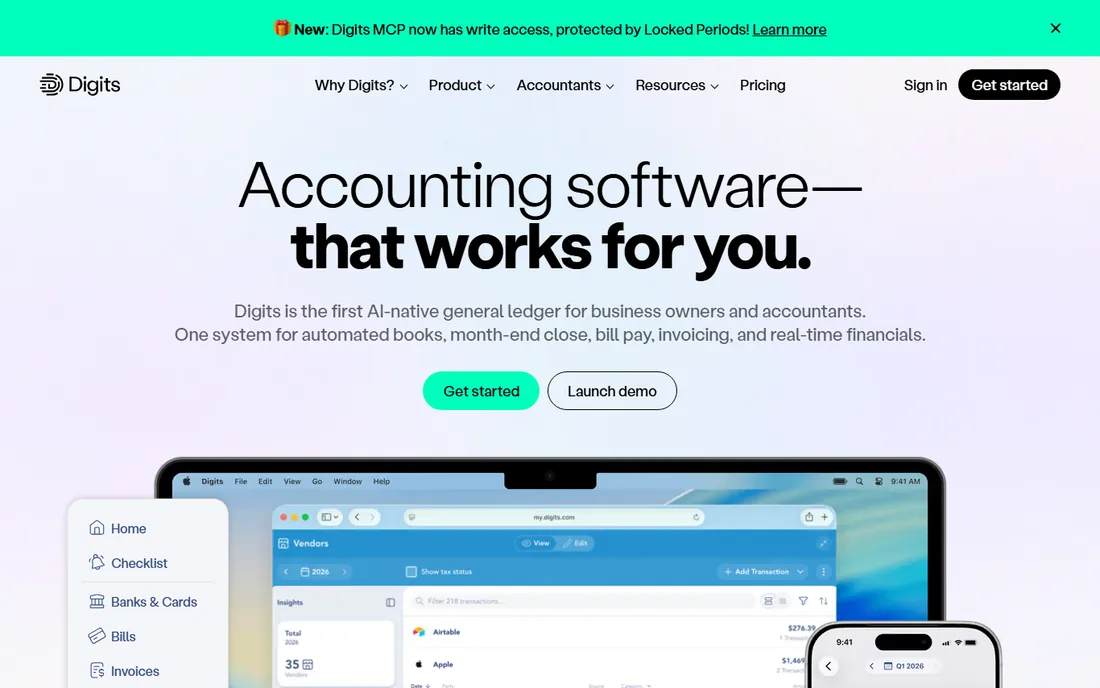
Digits is the closest thing to a clean-sheet rethink of accounting software. Instead of adding AI features to a traditional ledger, it built an Agentic General Ledger where AI agents categorize transactions, flag anomalies, reconcile accounts and draft the month-end close around the clock. The system learns your business patterns, so accuracy improves the longer you use it.
The day-to-day experience centers on live financials. Cash flow, burn, revenue and runway update continuously rather than at month-end, and you can build interactive reports without knowing accounting. AI bill pay automates accounts payable end to end, and bank-grade encryption with a SOC 2 posture covers the security side.
The honest catch is ecosystem maturity. Your accountant probably knows QuickBooks and Xero cold; Digits has an accounting firm directory, but the network is smaller. Pricing is also quote-based. It fits tech-forward businesses that want maximum automation and are comfortable with a newer platform.
What we like- Agentic general ledger automates categorization and reconciliation continuously
- Live KPIs like burn and runway with zero setup
- AI bill pay built in
Watch out for- Pricing is not published, so budgeting takes a sales conversation
- Newer platform with a smaller accountant network than incumbents
- Overkill for simple freelance books
Starting priceFrom $38/month
Free planFree trial
QuickBooks Online remains the default choice for American small businesses, and its AI layer, branded Intuit Intelligence, is genuinely useful rather than decorative. It learns your patterns, offers to automate recurring tasks like weekly reports, drafts invoices conversationally, sends prioritized payment reminders and builds forecasts grounded in your live data plus anonymized patterns from millions of businesses.
The practical advantage is ubiquity. Nearly every US accountant works in QuickBooks, payroll, payments, inventory and lending all live in the same ecosystem, and more than 800 integrations connect it to the rest of your stack. When something breaks, answers are a search away.
The trade-offs are familiar. Entry pricing starts at $38 a month and climbs fast with payroll and users, and the product carries years of accumulated complexity. The AI assists rather than replaces bookkeeping work. Choose it when compatibility with your accountant and the wider ecosystem matters most.
What we like- Intuit Intelligence automates recurring tasks and forecasts from live data
- The accountant ecosystem is unmatched
- 800-plus integrations
Watch out for- Pricing has crept up over the years
- The interface can feel cluttered
- AI features are helpful but less deep than AI-native rivals
#3
Xero
Best for: Businesses that want a clean ledger with strong AI assistance
Visit xero.com
Starting priceFrom $25/month
Free planFree trial
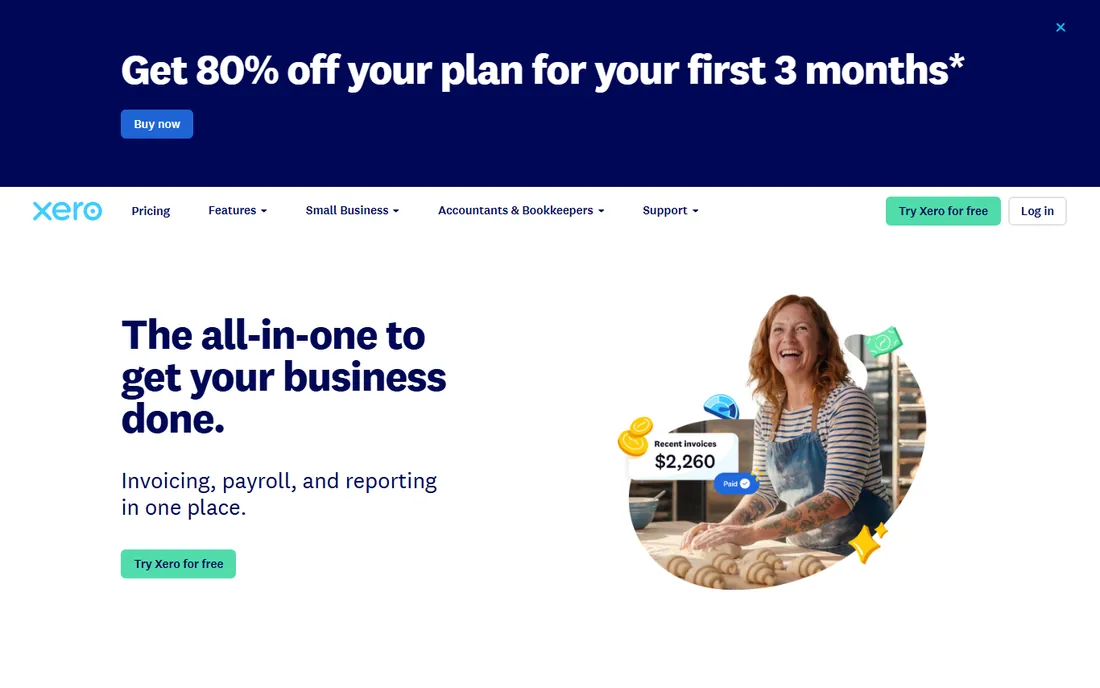
Xero has always been the cleaner, friendlier alternative to QuickBooks, and its AI push keeps that character. JAX, its AI superagent, answers plain-English questions about cash flow and profit trends, creates invoices and quotes from a chat in Xero, WhatsApp, SMS or email, and surfaces personalized insights based on your business. Smart document capture pulls bills and receipts straight into the ledger.
Plans start at $25 a month on Early, with Growing at $55 and Established at $90 adding auto-reconciliation, longer cash-flow forecasts, multi-currency and project tracking. The app ecosystem is enormous, and real-time reporting comes standard.
The honest limitations are the caps on the entry tier and US payroll, which is an add-on rather than built in. Xero suits businesses that want a modern ledger with genuinely helpful AI but are not ready to bet on a brand-new platform.
What we like- JAX AI superagent answers questions and creates invoices conversationally
- Smart document capture pulls bills in automatically
- 1,000-plus app integrations
Watch out for- Payroll costs extra in the US
- Entry plan caps invoices and bills
- AI depth trails the AI-native ledgers
#4
Zoho Books
Best for: Cost-conscious businesses that want capable AI-assisted accounting
Visit zoho.com
Starting priceFrom $15/org/month
Free planYes
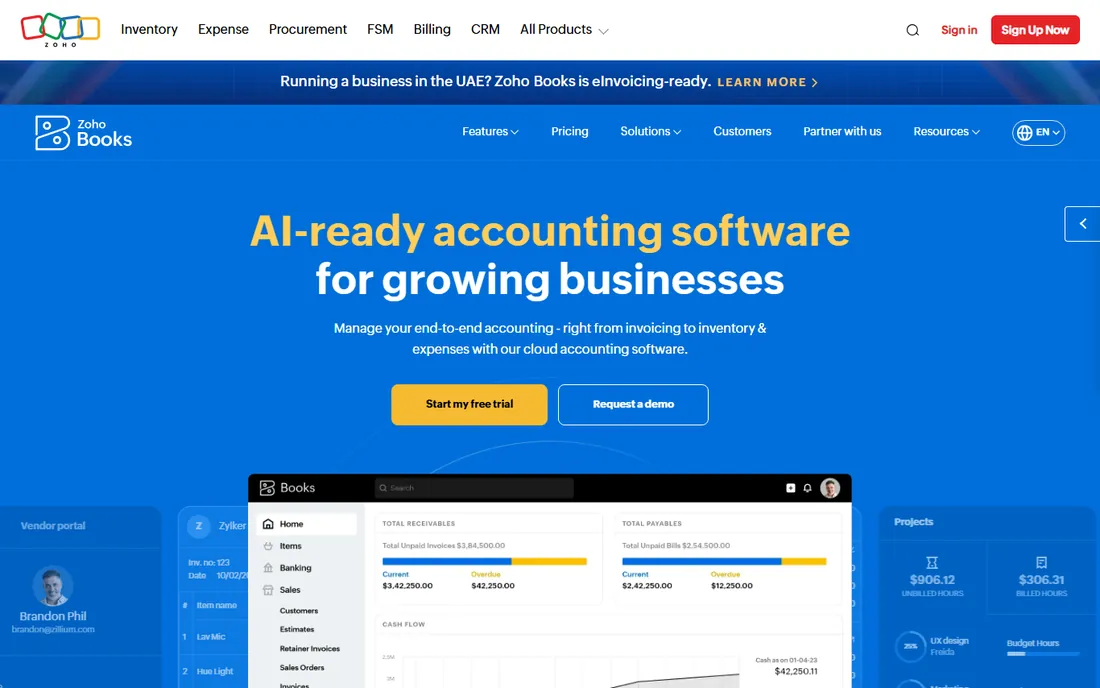
Zoho Books is the value champion that keeps getting better. Zia, its AI assistant, answers plain-English questions about your finances, spots anomalies early and automates payment collections. Workflow automation handles repetitive tasks, and the customization options for invoices, fields and reports go deeper than most tools at this price.
The pricing is the headline. A free plan covers solopreneurs and micro businesses, Standard starts at $15 per organization per month billed annually, and the ladder runs through Professional, Premium, Elite and Ultimate for growing complexity. Multi-currency, projects, inventory and timesheets are all in the mix.
The catch is fit. Zoho Books shines brightest alongside other Zoho apps, and the sheer breadth of features means a learning curve. But for a small business that wants real accounting software with AI help for the price of a few coffees, it is hard to beat.
What we like- Free plan for solopreneurs and micro businesses
- Zia AI spots anomalies and automates collections
- Deep customization and workflow automation
Watch out for- Best value inside the Zoho ecosystem
- The interface packs in features and takes learning
- Advanced inventory lives on pricier tiers
#5
Docyt
Best for: Multi-location and multi-entity businesses that need continuous accounting
Visit docyt.com
Starting priceFrom $99/entity/month
Free planNo

Docyt pushes AI bookkeeping further than anyone toward full autonomy. Its pitch is a zero-day close: AI reconciles revenue, banks and cards every day, so month-end becomes a review rather than a scramble. The platform claims 99 percent categorization accuracy with a human-in-the-loop model where the AI posts what it is sure of and flags the rest.
The architecture suits complexity. Multi-entity accounting with intercompany settlements, consolidation, payments, corporate cards, budgeting and forecasting all live on one ledger, with 500-plus integrations to POS, PMS, payroll and banking systems. It has concentrated on hospitality, restaurants, retail and franchises, where daily revenue reconciliation is the killer feature.
Pricing starts around $99 per entity per month, which is reasonable for one location and serious money for a portfolio. There is no free tier. It fits operators with multiple entities who will pay to never think about the close again.
What we like- AI-native ERP with daily soft-close instead of month-end scramble
- Multi-entity and intercompany accounting built in
- 99 percent categorization accuracy claimed
Watch out for- Priced per entity, so portfolios add up
- No free plan or trial
- Now focused on hospitality, retail, restaurants and franchises
#6
Botkeeper
Best for: Accounting firms that want AI capacity across many clients
Visit botkeeper.com
Starting priceSee website
Free planNo
Botkeeper solves a different problem from everything else on this list: capacity at accounting firms. Its AI automates the most manual bookkeeping work across a firm's entire client base, posting directly to the general ledger when confidence is high and surfacing the rest for human review. The company claims 97 percent accuracy on auto-posted entries.
The firm-friendly design shows everywhere. Pricing works at the practice level rather than per business, which costs far less than buying retail software for every client. White-glove onboarding, unlimited support, a resource library and training programs address the reality that firms, not just software, need to change.
Individual businesses cannot buy Botkeeper directly; it is sold to firms. And with no public pricing, you will need a sales conversation. If you run a firm drowning in monthly closes, it is purpose-built for you. If you are a business owner, ask your accountant whether they use it.
What we like- Purpose-built for firms, not retrofitted
- AI posts to the GL only at high confidence, humans review the rest
- Practice-level pricing beats per-client software costs
Watch out for- No public pricing
- Built for firms, so individual businesses cannot buy it directly
- Onboarding a firm onto a new platform takes real effort
#7
Puzzle
Best for: Startups that want real-time financials without a finance team
Visit puzzle.io
Starting priceSee website
Free planFree trial
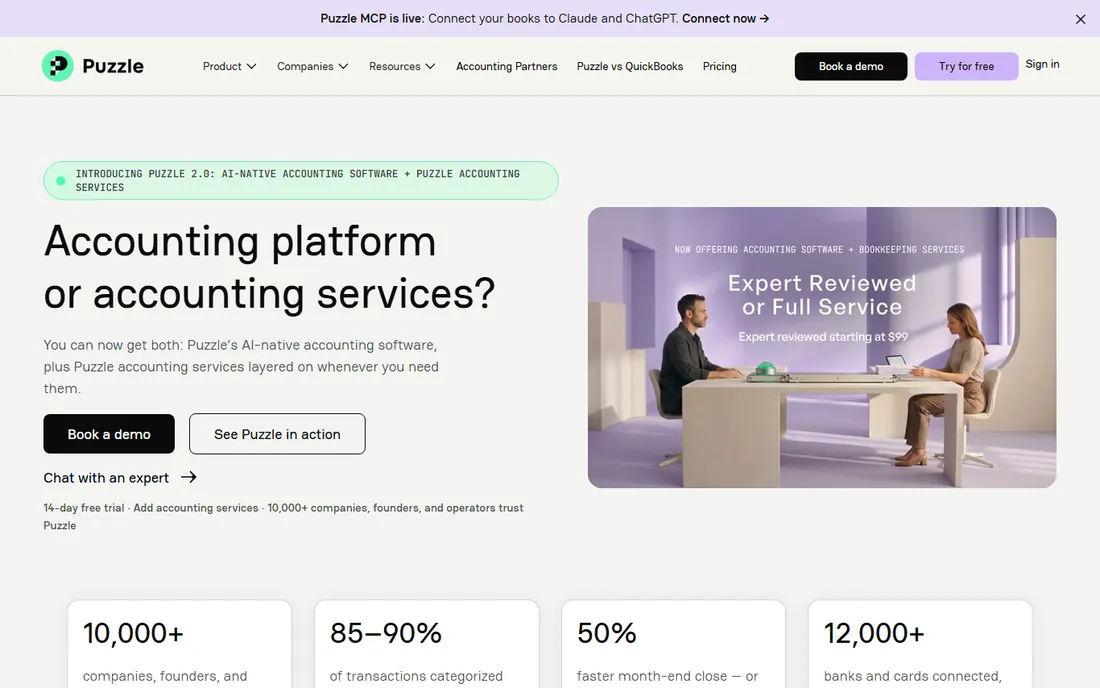
Puzzle was built for the way startups actually work. Connect your banks, cards and tools like Stripe, Mercury, Ramp, Brex and Gusto, and AI agents categorize transactions from day one with no rules to write, hitting up to 98 percent automation. Cash and accrual books run simultaneously, so founders see runway in the cash view and investors get proper accrual financials.
The real-time angle is the differentiator. Burn rate, runway and revenue recognition update continuously, and a chat interface answers plain-English questions like how cash is trending. Month-end close runs up to 50 percent faster because categorization and reconciliation happen during the month, not after it.
The honest caveats are pricing transparency and track record. Plan prices are not published, and as a young company Puzzle has less history than the incumbents. It fits startups and tech-forward small businesses that live in the modern fintech stack.
What we like- AI agents categorize up to 98 percent of transactions with no rules
- Cash and accrual books update daily with burn and runway
- Native Stripe, Mercury, Ramp and Gusto integrations
Watch out for- Pricing is not published
- Startup-focused, so traditional industries get less attention
- Young company with a shorter track record
#8
Wave
Best for: Freelancers and solopreneurs who need free, simple books
Visit waveapps.com
Starting priceFree
Free planYes
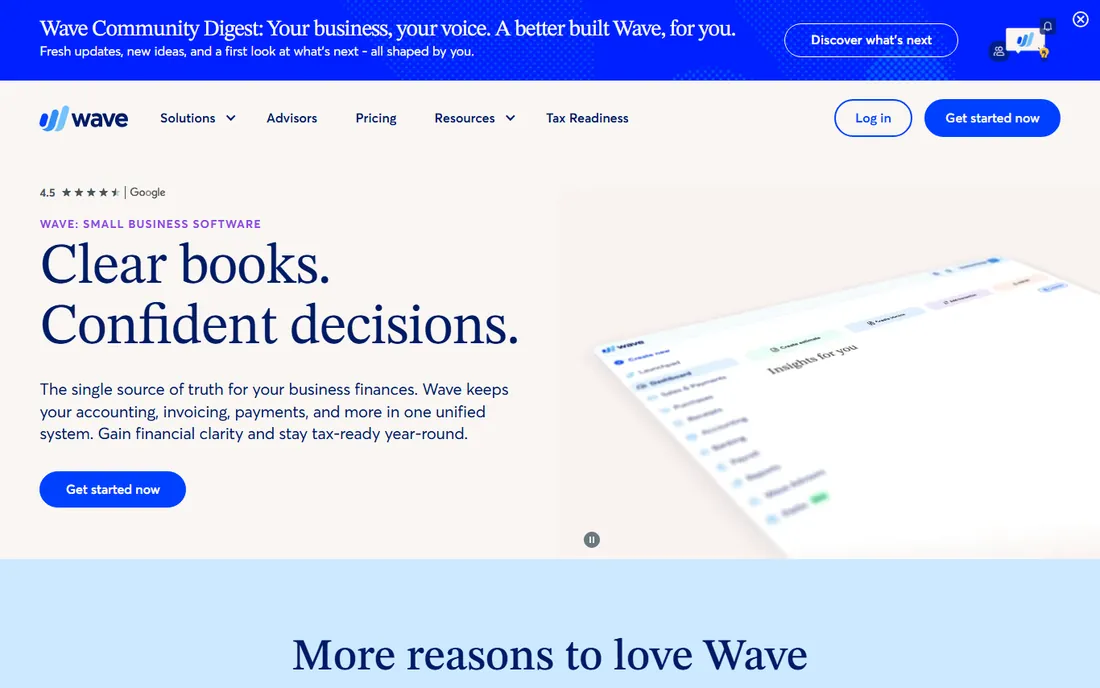
Wave is the rare product that is free where it counts. Accounting, invoicing and receipt scanning cost nothing, which makes it the natural starting point for freelancers, solopreneurs and micro businesses that need tidy books for tax time without a subscription.
The experience is deliberately non-technical. Wave is built for owners rather than accountants, with plain language, simple reports and a mobile app for invoicing on the go. When you outgrow the basics, payments processing, payroll and one-on-one help from Wave Advisors are available as paid add-ons.
The AI story is the thinnest here; Wave automates the basics but will not categorize intelligently or forecast like the leaders. It also tops out early on complexity. But free is free, and for simple books it remains the best value in the category.
What we like- Core accounting and invoicing are genuinely free
- Built for owners, not accountants, so it is easy to learn
- Payments, payroll and advisory available as add-ons
Watch out for- The lightest AI capabilities on this list
- No advanced inventory or multi-entity features
- Paid add-ons can narrow the price gap with rivals
#9
Bench
Best for: Owners who want a human bookkeeper to just handle it
Visit bench.co
Starting priceFrom $199/month
Free planNo
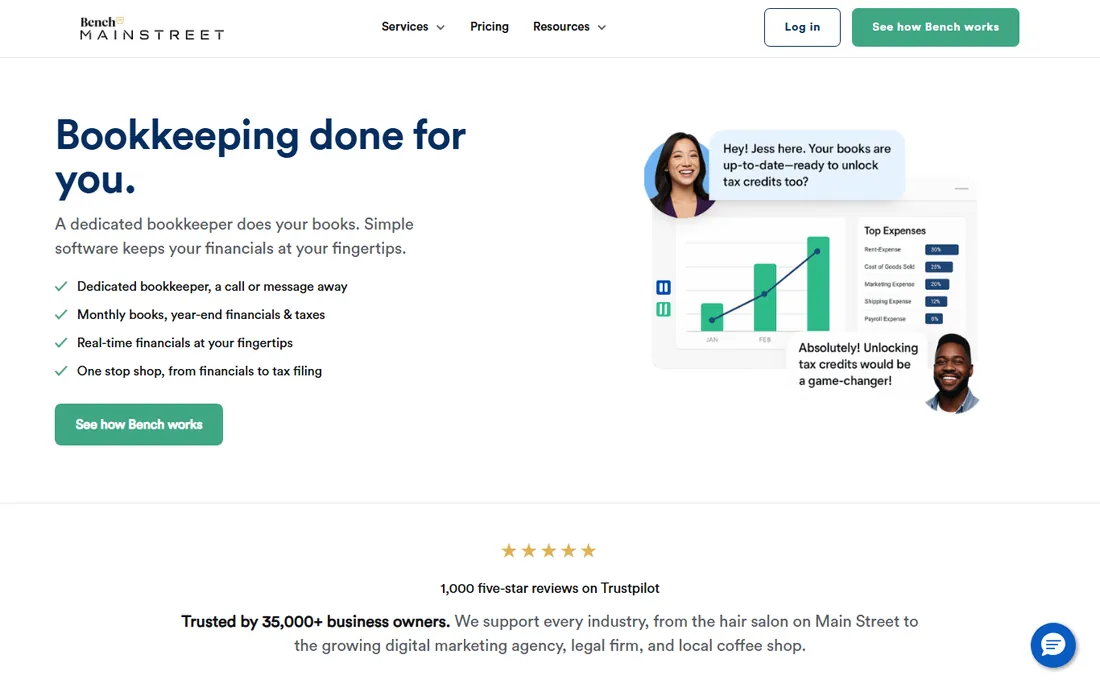
Bench is the odd one out and belongs on the list because it answers the question honestly: what if you do not want to do bookkeeping at all, AI or otherwise. A dedicated bookkeeper reconciles your accounts transaction by transaction, delivers clean monthly books and year-end tax-ready financials, and stays a message or call away.
Pricing is transparent: Bookkeeping Light at $199 a month for businesses under $250K revenue, standard Bookkeeping at $399, and Bookkeeping plus Tax at $649, with 20 percent off annual plans. Catch-up bookkeeping is free on annual plans, which alone can justify the switch for anyone years behind.
The trade-off is cost and control. Bench costs many times more than software-only tools, and you are delegating rather than managing. For owners who value their time over the subscription line, that is exactly the point.
What we like- A dedicated bookkeeper does your books every month
- Tax filing and advisory available in higher tiers
- Catch-up bookkeeping included on annual plans
Watch out for- The priciest option here by far
- You are buying a service, not software control
- Less useful if you like hands-on financials
How we chose
We reviewed vendor pricing pages, documentation and feature descriptions, then cross-checked against public reviews on G2, Capterra, Fit Small Business and Reddit's accounting communities, where practitioners debate automation accuracy endlessly. We favored tools with clear AI bookkeeping functionality, transparent pricing and a genuine fit for small to mid-size US businesses. We did not test any platform hands-on, so treat this as research synthesis rather than a lab review, and confirm current prices before buying.
What to check before you commit
Start with who does the reviewing. AI bookkeeping still needs a human in the loop, whether that is you, your accountant or the vendor's team. Ask how the AI handles low-confidence transactions, what the review workflow looks like and who is accountable when it miscategorizes something material.
Next, check the migration path. Moving historical books into a new ledger is where implementations die. Ask whether the vendor migrates your history, how long it takes and what it costs. Zoho Books offers free migration; others vary.
Price the whole relationship, not the entry tier. Per-entity pricing, payroll add-ons, extra users and tax services can multiply the headline number. Map your actual needs against two tiers up, because growing businesses rarely stay on the starter plan.
Finally, confirm your accountant can work with it. The best software in the world creates friction if your CPA cannot open the file. Ask them before you buy, not after.
When software is not the answer
Sometimes the bottleneck is not the tool but the absence of anyone minding the books. If you are years behind, facing an audit or simply never going to review AI categorizations, a managed service like Bench or your local CPA will outperform any software subscription. The AI tools on this list are force multipliers for people who engage with their finances; they are not substitutes for engagement itself.
Frequently asked questions
What is the best AI bookkeeping software for small business?
For most small businesses, QuickBooks Online, Xero or Zoho Books with their built-in AI assistants are the practical picks because accountants know them. Businesses that want maximum automation should look at AI-native options like Digits or Puzzle.
How much does AI bookkeeping software cost?
Self-serve tools run from free (Wave, Zoho Books) to about $38 a month for QuickBooks Online, with AI-native ledgers and multi-entity tools priced higher. Managed services like Bench start at $199 a month, and firm-oriented tools price at the practice level.
Can AI really do my bookkeeping?
AI handles categorization, reconciliation and anomaly flagging well, often automating the large majority of transaction volume. A human still needs to review exceptions, handle judgment calls and sign off at tax time. Think of it as replacing data entry, not accountability.
Is QuickBooks or Xero better for AI features?
Both have capable AI assistants now. QuickBooks leans on Intuit Intelligence with deep forecasting across its ecosystem, while Xero's JAX focuses on conversational help and document capture. The deciding factor is usually which ecosystem your accountant and apps already use.
Do I still need an accountant with AI bookkeeping software?
For simple businesses, many owners manage with software alone plus a tax preparer at year-end. As complexity grows, an accountant's review remains valuable for compliance, tax strategy and judgment calls the AI cannot make.
What is the difference between AI bookkeeping software and a service like Bench?
Software automates the work and leaves you in control; a service like Bench assigns a human bookkeeper who does the work for you. Software costs less and gives more control, while a service costs more and demands less of your time.
Sources we checked (12)
- https://digits.com/
- https://quickbooks.intuit.com
- https://www.xero.com
- https://www.zoho.com/books
- https://docyt.com/
- https://botkeeper.com/
- https://puzzle.io/
- https://www.waveapps.com
- https://bench.co/
- https://fitsmallbusiness.com/best-ai-accounting-software/
- https://www.gotofu.com/blog/best-ai-bookkeeping-software
- https://curatesuite.com/accounting/articles/ai-bookkeeping-software
Is your product missing or out of date?
We review this list regularly. Vendors can request a listing, send updated pricing or ask about featured placement.

Shihab Mia · Founder, Rankite
Shihab has 5+ years in B2B and SaaS SEO. He writes Rankite's software buying guides from pricing pages, documentation and public user reviews. More about Shihab.