How we make this list: we compare pricing pages, product documentation and public user reviews. Ratings come from G2, Capterra or Trustpilot, with the date we checked them.
Key takeaways
- Profound is the deepest platform here, but its pricing is sales led, so budget for a quote rather than a checkout page.
- Otterly.AI at $29 per month and Rankscale are the cheapest ways to start tracking how AI engines describe your product.
- Peec AI and Promptwatch both start at $95 per month and suit product teams that want clean, prompt level reporting.
- AthenaHQ is the only tool here with a real free tier, and its paid plan pairs visibility data with fixes you can ship.
- No AEO tool can promise visibility. These tools measure AI answers and show gaps. Rankings inside AI answers still come from your content, citations, and product reputation.
Quick comparison
| Tool | Best for | Starting price | Free plan |
|---|
 Profound | Deep AEO programs at funded AI companies | See website | No |
 Otterly.AI | First AEO tracker on a small budget | $29 per month | No |
 Peec AI | Clean brand tracking across engines | $95 per month | No |
 AthenaHQ | Visibility data plus shipped fixes | $295 per month | Yes |
 Promptwatch | Prompt level detail and AI traffic data | $95 per month | No |
 Rankscale | Wide engine coverage on credits | See website | No |
 Semrush AI Visibility Toolkit | AEO inside an existing SEO suite | $99 per month per domain | No |
 Writesonic GEO | Turning gaps into published content | See website | No |
Is your product missing or out of date?
We review this list regularly. Vendors can request a listing, send updated pricing or ask about featured placement.
#1Profound
Best for: Deep AEO programs at funded AI companies4.6/5 on
G2 (640 reviews, checked Oct 2026)
Visit tryprofound.com
Starting priceSee website
Free planNo
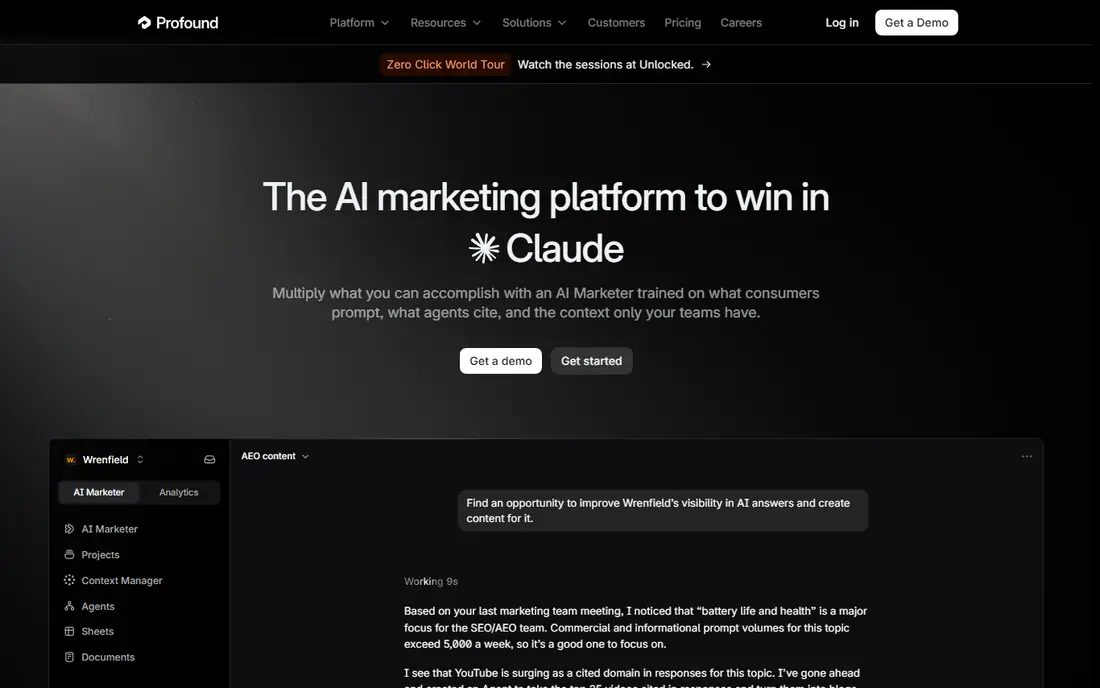
Profound is the name most AEO buyers meet first, and it is the deepest platform in this list. It tracks prompts across engines including ChatGPT, Gemini, Perplexity, Claude, and AI Overviews, then ties what it finds to agent analytics that show how AI crawlers move through your site. For an AI product company, that crawler view is useful, because it shows whether the pages that explain your pricing and features are even being read by the bots that build answers.
The trade off is price transparency. Profound runs a free seven day trial, and after that the real plans are quoted. Published guides conflict on the entry figure, so this guide lists the price as See website. Profound fits funded AI companies with a marketing team that will act on the data every week.
What we like- Tracks up to nine answer engines on higher plans
- Agent analytics show how AI crawlers read your site
- Content agents can draft fixes
- Strong citation detail
Watch out for- Pricing is sales led and guides disagree on entry cost
- API and MCP access sit on Enterprise
- More platform than a small team needs
#2Otterly.AI
Best for: First AEO tracker on a small budget4.7/5 on
G2 (54 reviews, checked Oct 2026)
Visit otterly.ai
Starting price$29 per month
Free planNo
Otterly.AI is where most small AI startups should start. The Lite plan costs $29 per month and tracks 15 prompts across four engines, which is enough to learn whether buyers searching in AI chat see your product at all. Reports are plain and easy to share with a founder or a small team.
The trade off is depth. Prompt caps are low, extra engines cost more, and there is no direct line from a visibility gap to a content fix. Otterly.AI fits early stage AI products that need a weekly visibility check without a platform commitment.
What we like- Cheapest published entry price in this list
- Covers ChatGPT, AI Overviews, Perplexity, and Copilot on the base plan
- Simple setup with brand reports
Watch out for- Only 15 prompts on the Lite plan
- Claude, Gemini, and AI Mode cost extra as add ons
- No built in analytics integrations
#3Peec AI
Best for: Clean brand tracking across engines4.7/5 on
G2 (21 reviews, checked Oct 2026)
Visit peec.ai
Starting price$95 per month
Free planNo
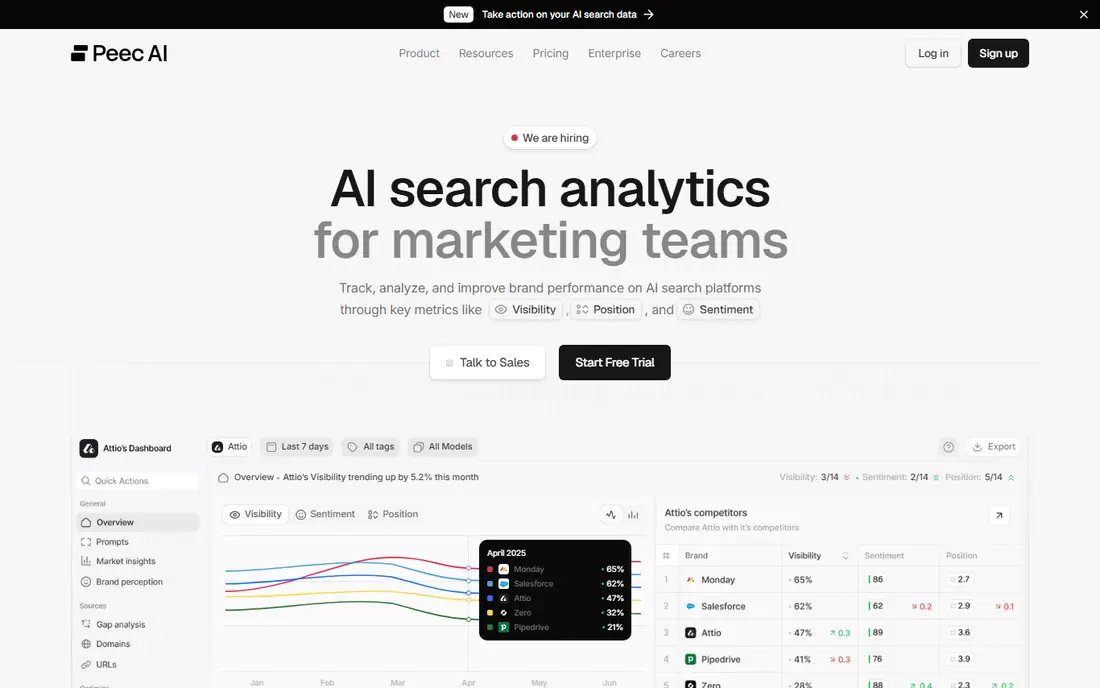
Peec AI is a Berlin built tracker that product marketers like for its clean reporting. It shows whether your brand is named in an answer, cited as a source, or missing, and it does that across engines you choose, including ChatGPT, Gemini, Copilot, and AI Overviews. Unlimited seats make it easy to share with a whole product team.
The trade off is flexibility against cost per engine. You pick three engines at entry and pay more as you add models and countries. Peec AI fits AI products selling into several markets that want directional visibility data without a heavy onboarding project.
What we like- Unlimited seats on brand plans
- Separates named mentions from cited sources
- Pick three engines from six at entry
- Multi country tracking on higher plans
Watch out for- No free plan, only a trial
- Extra engines cost more per month
- Agency plans meter usage in credits
Starting price$295 per month
Free planYes
AthenaHQ stands out because it tries to close the gap between measuring AI visibility and fixing it. Its citation engine and recommendation tools suggest content and source changes, and it can act on some of them. The free Essential tier gives you 300 credits to test the workflow, and Starter at $295 per month tracks 11 models.
The trade off is a credit system you have to learn before you can predict cost. One credit buys one AI response, and heavy prompt sets burn credits fast. AthenaHQ fits AI product teams that want one tool for tracking and for acting on what the tracking finds.
What we like- Free Essential tier with 300 credits
- 11 models tracked on Starter
- Connects GA4 and Search Console data
- Recommendation engine suggests on page and off page actions
Watch out for- Credit based pricing takes time to learn
- Starter covers one country and one language
- Top features need higher tiers
Starting price$95 per month
Free planNo
Promptwatch is built for buyers who distrust summary scores. It shows the actual answers engines give, prompt by prompt, and it measures AI driven visits with its own tracking script instead of trusting analytics that lose the referrer. That matters for an AI product, because AI referrals often land as direct traffic and get miscounted.
The trade off is that depth takes setup work. You choose prompts, engines, and locations, and the bill grows with each add on. Promptwatch fits product teams that want evidence they can inspect, not a single visibility percentage.
What we like- $95 plan covers 50 prompts and about 6,000 responses
- Measures AI referral traffic with its own script
- Runs prompts at city level
- API and MCP access on paid plans
Watch out for- No free plan
- Per engine add ons can raise the bill
- Smaller brand than the suite vendors
Starting priceSee website
Free planNo
Rankscale sells breadth. If your buyers ask questions in less common engines, its 17 plus engine coverage catches answers the big four trackers miss. Pricing runs on credits that roll over, which suits teams whose prompt volume swings from month to month.
The trade off is price clarity. Sources disagree on the current entry figure, so this guide lists See website and you should confirm on the pricing page. Rankscale fits agencies and AI products that need wide engine coverage and client ready reporting.
What we like- Tracks 17 or more engines, more than any rival here
- Credits roll over instead of expiring monthly
- White label reports on higher plans
Watch out for- Published entry prices conflict between sources, so confirm before buying
- Credit maths needs care at high prompt counts
- Smaller support team than suite vendors
#7
Semrush AI Visibility Toolkit
Best for: AEO inside an existing SEO suite
Visit semrush.com
Starting price$99 per month per domain
Free planNo
Semrush added an AI Visibility Toolkit to its SEO platform, and for teams already paying for Semrush it is the lowest friction way to add AEO reporting. It tracks brand mentions and citations across the main engines and ties them to the keyword and backlink data Semrush already holds.
The trade off is focus. A dedicated AEO platform will usually show more answer level detail, and per domain pricing stings if you run several products. The toolkit fits AI companies whose marketing team already lives in Semrush and wants AI visibility in the same reports.
What we like- Sits inside the Semrush suite your SEO team already knows
- Large prompt database behind the reports
- Covers ChatGPT, Google AI, Gemini, and Perplexity
Watch out for- Priced per domain, which adds up across product lines
- AEO depth is thinner than dedicated platforms
- You pay for the wider suite whether you use it or not
Starting priceSee website
Free planNo
Writesonic rebuilt its writing platform around generative engine optimization, and its GEO product pairs tracking with an Action Center that edits pages to close the gaps it finds. For a small AI product team, that loop from finding to fixing inside one tool saves handoffs.
The trade off is that you are buying a content platform, not a pure tracker. If your team writes in other tools, part of the value is wasted. Writesonic GEO fits AI products that want tracking and content production under one bill.
What we like- Action Center fixes pages in place
- Tracking across up to 10 engines on Enterprise
- Built on a writing platform, so drafts come from the same tool
Watch out for- Entry pricing is not confirmed on a public page we could rely on
- Writing features can distract from pure measurement
- Best value if you also use the content tools
How we chose
We compared the AEO tools an AI product team can actually buy today, using each vendor pricing page and product documentation as the source for prices, engine counts, and plan limits. Where published sources conflicted on price, we wrote See website rather than print a number we could not stand behind. We weighted engine coverage, prompt level evidence, the path from data to a fix, and how pricing scales as prompt counts grow. We did not claim hands on testing, and we left out tools that only track one engine or that had no public pricing or product information we could verify.
Start with the engines your buyers actually use. Most B2B and prosumer research now happens in ChatGPT, Perplexity, Gemini, and Google AI Overviews, so a tool that misses one of those four has a hole in it. Then look at the unit you are really buying. Some vendors price by prompts, some by responses or credits, and a plan that looks cheap at 15 prompts can cost three to five times more at the volume a real product needs.
Next, ask what the tool does with a gap. A score on its own changes nothing. The useful tools show the exact answer, the sources cited, and which of your pages or third party pages earned the citation, so your team knows what to write, fix, or pitch. Finally, treat every visibility number as directional. Method differs between vendors, answers change daily, and no tool can guarantee that an engine will name your product. Buy the tool that gives your team a steady trend and clear next actions, and keep your comparison inside one tool over time.
Frequently asked questions
What does AEO mean for an AI product?
AEO, or answer engine optimization, is the work of getting your product named and cited in answers from tools like ChatGPT, Perplexity, and Google AI Overviews. For an AI product it matters because buyers often ask an assistant for a shortlist before they open a search engine, so the answer itself becomes the first comparison they read.
How much does an AEO tool cost in 2026?
Published entry prices in this list run from $29 per month for Otterly.AI Lite to $295 per month for AthenaHQ Starter, with several vendors quoting enterprise plans instead of publishing them. The real cost driver is volume: prompts, responses, engines, and countries all raise the bill, so model your full prompt set before you compare headline prices.
Can an AEO tool guarantee my product appears in ChatGPT answers?
No. Any vendor that promises a guaranteed placement is selling something the engines do not offer. AEO tools measure answers, show which sources get cited, and point at gaps. Whether an engine names your product depends on your content, your citations across the web, and the engine itself, and answers change from day to day.
Which AI engines should my AEO tool track?
Cover ChatGPT, Perplexity, Gemini, and Google AI Overviews at a minimum, because those four handle most buyer research. Add Claude, Copilot, or AI Mode if your audience uses them. If your buyers are technical, wide coverage tools like Rankscale also catch smaller engines where niche products get recommended.
Do I need an AEO tool if I already pay for an SEO suite?
Not always. If your suite has an AI visibility add on, like the Semrush toolkit, start there and learn what the data tells you. Move to a dedicated AEO platform when you need prompt level answers, crawler level detail, or a workflow that turns findings into content changes.
Sources we checked (0)
Is your product missing or out of date?
We review this list regularly. Vendors can request a listing, send updated pricing or ask about featured placement.

Shihab Mia · Founder, Rankite
Shihab has 5+ years in B2B and SaaS SEO. He writes Rankite's software buying guides from pricing pages, documentation and public user reviews. More about Shihab.