How we make this list: we compare pricing pages, product documentation and public user reviews. Ratings come from G2, Capterra or Trustpilot, with the date we checked them.
Best account takeover fraud prevention software
Arkose Labs is the top pick for banks, fintech and SaaS teams that face credential stuffing at login, because it pairs bot detection with managed challenges and a financial warranty. Castle is the best alternative for smaller engineering teams that want a developer-first API with published pricing. The other six tools below cover breached credentials, phone intelligence and identity-led defence.
Key takeaways
- Account takeover fraud starts with stolen credentials, so the best tools combine breached-credential data with live login signals.
- Arkose Labs leads for high-volume enterprise login defence, while Castle is the most accessible option for small engineering teams.
- Most enterprise ATO vendors publish no prices, so expect a quote and an annual contract.
- SpyCloud is the strongest choice when the main gap is knowing which credentials are already exposed.
- Sift and Kount also sell checkout fraud tools, but this guide covers only their account takeover features. A separate Rankite guide covers ecommerce fraud prevention with chargeback guarantees.
Comparison table
| Tool | Best for | Starting price | Free plan |
| Arkose Labs | Enterprise login and credential stuffing defence | Quote | None |
| HUMAN Security | Large enterprises facing advanced bot attacks | Quote | None |
| SpyCloud | Breached credential and session exposure data | Quote | None |
| Castle | Developer-first teams that want published pricing | $200 per month | Free evaluation tier |
| Transmit Security | Banks replacing passwords with passkeys and risk-based login | Quote | Free developer tier |
| Telesign | Phone intelligence and step-up verification | $0.011 per Phone ID lookup | Free trial |
| Sift | Account Defense module for high-volume platforms | Quote | Free trial |
| Kount | Account protection backed by Equifax identity data | Quote | None |
What is account takeover fraud
Account takeover fraud happens when a criminal gains access to a real customer account using stolen credentials, a hijacked session or a reset flow. The attacker then changes the password, drains funds or steals loyalty points. TransUnion reported an 81 percent surge in account takeover fraud over four years in its 2023 State of Omnichannel Fraud Report. Banks, fintech firms, SaaS companies and ecommerce sites are the main targets because their accounts hold money or stored payment details. The attack usually starts with credentials bought from a breach or harvested by infostealer malware.
How does credential stuffing detection work
Credential stuffing detection works by spotting large volumes of login attempts that reuse username and password pairs stolen in earlier breaches. Attackers automate the attempts with bots, testing thousands of credential pairs per minute against your login endpoint. Detection tools score each attempt on device fingerprint, IP reputation, velocity, behaviour and breach data. A stuffing attack shows new devices, datacentre IPs, proxy use and hundreds of failed logins from one source, unlike a normal user on a familiar device. When the score crosses a threshold, the tool can block the attempt, serve a challenge or trigger step-up authentication.
How much does ATO prevention cost
ATO prevention costs from about $200 per month for a developer-first tool to six figures per year for an enterprise platform, and most enterprise vendors quote only. Castle publishes its pricing, with Pro at $200 per month and Enterprise from $4,000 per month. Telesign charges per transaction, from $0.011 per Phone ID lookup. Arkose Labs, HUMAN Security, SpyCloud, Transmit Security, Sift and Kount all hide pricing behind a sales quote. Third-party reports put enterprise entry points at $10,000 to $50,000 per year for Arkose Labs and HUMAN Security, and $40,000 to $120,000 per year for standalone Sift Account Defense. These figures conflict across sources, so treat them as budget guides and get a written quote. Watch for multi-year minimums, per-transaction fees and SMS charges.
What should you check before you buy
Check where each tool sits in the login flow, which signals it scores, and how it acts on a risky session before you sign a contract. Ask whether it protects login only or also covers signup, password reset, account recovery and post-login sessions. Ask which data it uses, since each signal type catches different attacks. Check how it responds to risk and how much control your team has over those rules. Finally, ask for the full price in writing, including minimums, overage rates and renewal terms.
Quick comparison
| Tool | Best for | Starting price | Free plan |
|---|
 Arkose Labs | Banks, fintech and large platforms facing heavy credential stuffing at login | Quote. Arkose Labs publishes no price. Third-party reports conflict: entry pricing is put at $10,000 to $15,000 per year by one source and at $50,000 or more per year by another. | None |
 HUMAN Security | Large enterprises that need network-scale bot and ATO defence across web, mobile and APIs | Quote. HUMAN Security publishes no price. Third-party reports conflict: starter pricing is put at $20,000 to $50,000 per year by one source and at $40,000 to $75,000 per year by another. | None |
 SpyCloud | Security teams that need to know which employee and customer credentials are already exposed | Quote. SpyCloud publishes no prices. Its MSSP program starts at $10,000 per month. A third-party source reports a mid-market tier of $500 to $3,000 per month, which conflicts with the enterprise-only pricing SpyCloud lists. | None |
 Castle | Developer-first teams that want API-based ATO protection with published pricing | $200 per month for Pro, including $200 of usage, then $0.005 per Risk or Filter call. Enterprise starts from $4,000 per month. Figures are from the vendor pricing page as read on 10 October 2026. Price conflict: another third-party source reports starter pricing at $10,000 to $15,000 per year and says Castle publishes no pricing. | Free tier with $5 of API usage per month, about 1,000 Risk API calls, for evaluation |
 Transmit Security | Banks and insurers replacing passwords with passkeys and risk-based authentication | Quote. The vendor pricing page lists no rates and says final pricing is provided within 24 hours, based on monthly active users or event volume. Price conflict: a third-party report cites a $200,000 per year floor, which the vendor does not publish. | Free developer tier for evaluation |
 Telesign | Teams that need phone intelligence and step-up verification at login and signup | Pay as you go from $0.011 per Phone ID lookup, with SMS Verify at $0.0072 per message and Intelligence risk scoring at $0.15 per transaction, per third-party reporting of the vendor live pricing feed. Price conflict: another third-party source reports $5 per user per month. | Free trial account for testing select products such as SMS, SMS Verify and Phone ID. No free plan. |
 Sift | High-volume platforms that want machine learning ATO scoring across the full user journey | Quote for Account Defense. Sift publishes no standard price. Price conflict: G2 lists a vendor-supplied Basic figure of $0.06 per month, while Vendr buyer data puts standalone Account Defense at $40,000 to $120,000 per year. | Free trial available. No free plan. |
 Kount | Enterprise merchants and financial services teams that want account protection backed by Equifax identity data | Quote. Equifax publishes no prices for Kount 360. Price conflict: third-party sources report Essentials at $0.07 per transaction with Advanced from $1,000 per month, while another reports typical pricing of $10,000 to $30,000 per year. These are legacy plan names. | None |
Is your product missing or out of date?
We review this list regularly. Vendors can request a listing, send updated pricing or ask about featured placement.
#1
Arkose Labs
Best for: Banks, fintech and large platforms facing heavy credential stuffing at login
Visit arkoselabs.com
Starting priceQuote. Arkose Labs publishes no price. Third-party reports conflict: entry pricing is put at $10,000 to $15,000 per year by one source and at $50,000 or more per year by another.
Free planNone
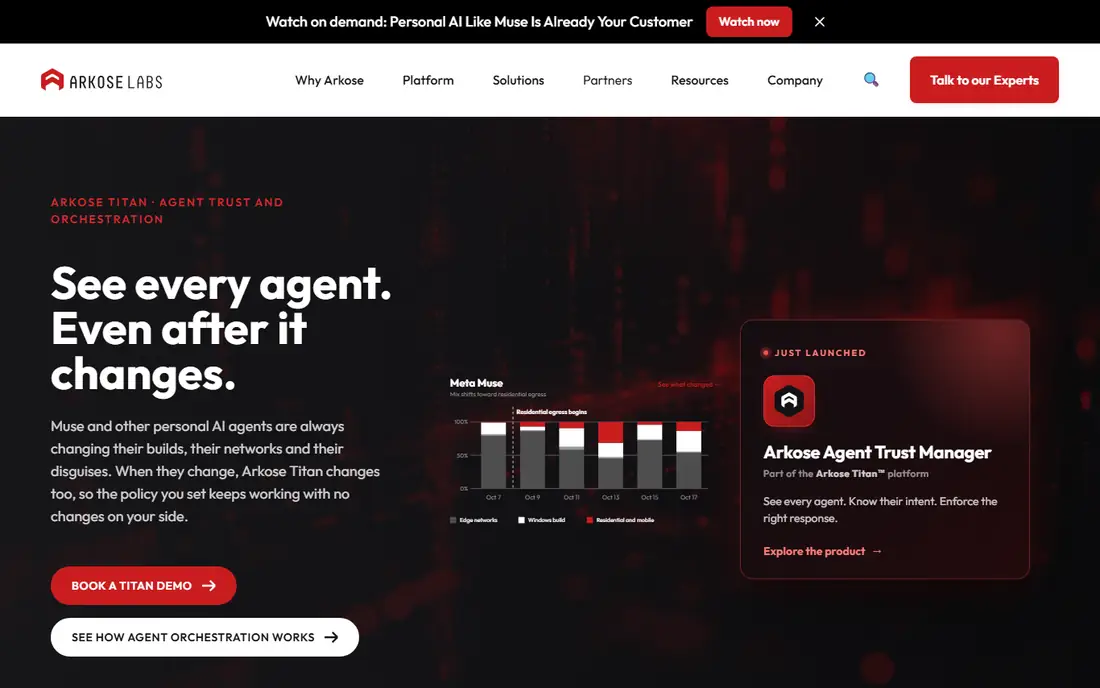
Arkose Labs is the strongest pick here for enterprise teams whose main problem is automated credential stuffing at login. Its Titan platform scores sessions using more than 200 risk signals and serves adaptive challenges only to suspicious traffic. A 24 by 7 security operations centre tunes the protection continuously. The financial warranty is unusual, because Arkose Labs puts money behind its detection claims. The trade-off is access: there is no trial and no published price.
What we like- Managed bot defence with adaptive challenges, financial warranty of up to $1 million for SMS toll fraud and credential stuffing losses, 24 by 7 security operations centre included
Watch out for- No self-serve access, no free tier and no public pricing, so small teams cannot try it without a sales cycle. Third-party reports also flag a false positive rate near 1.9 percent on some traffic.
#2
HUMAN Security
Best for: Large enterprises that need network-scale bot and ATO defence across web, mobile and APIs
Visit humansecurity.com
Starting priceQuote. HUMAN Security publishes no price. Third-party reports conflict: starter pricing is put at $20,000 to $50,000 per year by one source and at $40,000 to $75,000 per year by another.
Free planNone
HUMAN Security, formerly White Ops and now owned by Thales Group, is an enterprise bot and fraud prevention platform built for scale. Its Decision Engine examines more than 2,500 signals per interaction, drawing on telemetry from over 3 billion unique devices. The Satori threat research team uncovers attack campaigns early. HUMAN suits banks, retailers and payment processors that protect high-value transactions at large volume. The cost is the main barrier: quote-only pricing, contracts that often run two to three years, and no self-serve tier.
What we like- Named a Leader in the Forrester Wave for Bot and Agent Trust Management in Q2 2026, verifies more than 20 trillion interactions per week, dedicated Satori threat research team
Watch out for- No published pricing and multi-year minimum contracts are common, which locks buyers in before they can judge renewal value. The platform also needs a dedicated security or DevSecOps team to run it well.
#3
SpyCloud
Best for: Security teams that need to know which employee and customer credentials are already exposed
Visit spycloud.com
Starting priceQuote. SpyCloud publishes no prices. Its MSSP program starts at $10,000 per month. A third-party source reports a mid-market tier of $500 to $3,000 per month, which conflicts with the enterprise-only pricing SpyCloud lists.
Free planNone
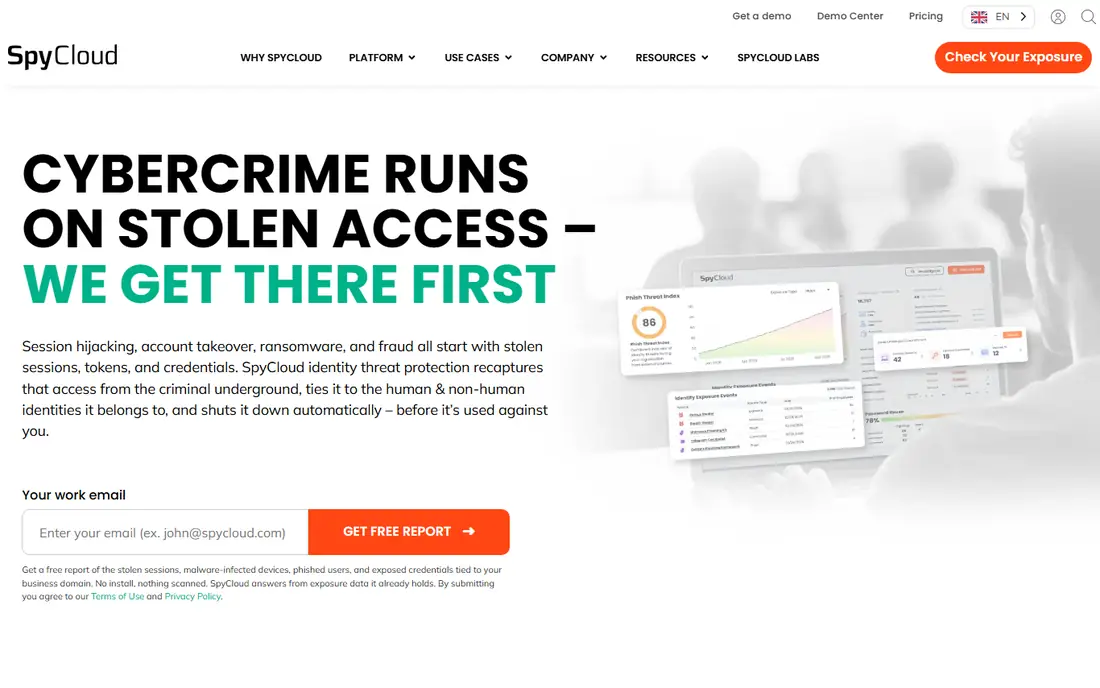
SpyCloud takes a different angle from the bot detection tools in this guide. Instead of scoring logins in real time, it recaptures stolen credentials and session cookies from the criminal underground and shows which users are exposed before attackers use the data. Its data lake holds more than 1 trillion recaptured identity assets, with coverage of more than 110 infostealer malware families. Identity Guardians can reset exposed passwords automatically in Active Directory, Entra ID and Okta. SpyCloud is best as a complement to a login defence tool, not a replacement for one.
What we like- Recaptured credential and session cookie data from breaches and infostealer malware, automated password resets in Active Directory, Entra ID and Okta, deep identity correlation across accounts
Watch out for- It detects exposed credentials but cannot stop a live bot attack at login on its own, so most buyers still need a second tool for real-time blocking. Pricing is enterprise only with no free tier or trial.
#4
Castle
Best for: Developer-first teams that want API-based ATO protection with published pricing
Visit castle.io
Starting price$200 per month for Pro, including $200 of usage, then $0.005 per Risk or Filter call. Enterprise starts from $4,000 per month. Figures are from the vendor pricing page as read on 10 October 2026. Price conflict: another third-party source reports starter pricing at $10,000 to $15,000 per year and says Castle publishes no pricing.
Free planFree tier with $5 of API usage per month, about 1,000 Risk API calls, for evaluation
Castle is the most accessible tool in this guide. It protects the API edge against account takeover, credential stuffing and fake signups by scoring any user event you send it, from login to in-app actions. Device fingerprinting claims 99.5 percent accuracy, and the rules engine lets your team allow, challenge or deny requests in real time. Integration is light, with a single API and SDKs for iOS and Android. The pricing cliff is the main weakness, because a growing team can outgrow Pro fast and face a 20-fold jump to Enterprise.
What we like- Published transparent pricing, single API for device fingerprinting, bot detection and risk scoring, free evaluation tier with no sales call needed
Watch out for- The jump from Pro at $200 per month to Enterprise from $4,000 per month leaves no mid-market tier. Its Rails Devise gem is still labelled beta with breaking-change warnings.
#5
Transmit Security
Best for: Banks and insurers replacing passwords with passkeys and risk-based authentication
Visit transmitsecurity.com
Starting priceQuote. The vendor pricing page lists no rates and says final pricing is provided within 24 hours, based on monthly active users or event volume. Price conflict: a third-party report cites a $200,000 per year floor, which the vendor does not publish.
Free planFree developer tier for evaluation
Transmit Security sells Mosaic, a platform that merges customer identity management with fraud prevention instead of bolting fraud checks onto a separate identity provider. That matters for account takeover, because the riskiest moments are often inside identity flows: login, step-up authentication and account recovery. Mosaic scores hundreds of risk signals in real time and supports passkeys and passwordless login. The platform is built for large regulated enterprises. The trade-off is complexity and cost, and migration of a live consumer identity base carries real churn risk.
What we like- Mosaic platform fuses customer identity management, passwordless authentication and fraud detection in one system, risk-scored account recovery flows, named a Leader in customer identity and access management
Watch out for- Pricing is quote only and often mixes per-user and per-transaction units, which makes early budgeting hard. Smaller deployments get less value from its models because they need traffic volume to learn from.
#6
Telesign
Best for: Teams that need phone intelligence and step-up verification at login and signup
Visit telesign.com
Starting pricePay as you go from $0.011 per Phone ID lookup, with SMS Verify at $0.0072 per message and Intelligence risk scoring at $0.15 per transaction, per third-party reporting of the vendor live pricing feed. Price conflict: another third-party source reports $5 per user per month.
Free planFree trial account for testing select products such as SMS, SMS Verify and Phone ID. No free plan.
Telesign takes a communication-first approach to account takeover prevention. Its APIs verify that a user controls a phone number, score the risk of that number using carrier and reputation data, and deliver step-up authentication by SMS, voice, WhatsApp or silent verification. The Intelligence product flags risky numbers at signup and login, which stops fake accounts and SIM swap style attacks. Coverage spans more than 230 countries. The limit is scope: Telesign does not detect bots or score devices, so it works best as a verification layer inside a wider ATO stack.
What we like- Carrier-grade phone data across more than 230 countries, pay-as-you-go pricing with no contracts or monthly fees, multi-channel verification including SMS, voice, WhatsApp and silent verification
Watch out for- It covers phone intelligence and verification, but it does not offer full bot protection on its own. SMS costs can climb fast at high volume, and several products are priced only through sales.
#7Sift
Best for: High-volume platforms that want machine learning ATO scoring across the full user journey4.6/5 on
G2 (614 reviews, checked Oct 2026)
Visit sift.com
Starting priceQuote for Account Defense. Sift publishes no standard price. Price conflict: G2 lists a vendor-supplied Basic figure of $0.06 per month, while Vendr buyer data puts standalone Account Defense at $40,000 to $120,000 per year.
Free planFree trial available. No free plan.
Sift is covered here strictly for its Account Defense module, which protects against account takeover and fake account creation. The module scores logins, registrations and password resets in real time, tracks post-login behaviour to catch session hijacking that password checks miss, and feeds decisions into a review console with reason codes. Sift also sells Payment Protection for checkout fraud, but that sits outside this guide. The platform suits marketplaces, fintech and travel companies with high transaction volumes and a dedicated fraud team.
What we like- Account Defense module built for login fraud and session hijacking, large global network of fraud signals from customers such as Airbnb and Uber, review console with reason codes for manual decisions
Watch out for- Account Defense is sold as a module inside a wider platform, so buyers pay for an enterprise contract even when they only need ATO. There is no public pricing and no free plan, and integration can take weeks.
#8
Kount
Best for: Enterprise merchants and financial services teams that want account protection backed by Equifax identity data
Visit kount.com
Starting priceQuote. Equifax publishes no prices for Kount 360. Price conflict: third-party sources report Essentials at $0.07 per transaction with Advanced from $1,000 per month, while another reports typical pricing of $10,000 to $30,000 per year. These are legacy plan names.
Free planNone
Kount, now an Equifax company sold as Kount 360, is covered here strictly for its account protection capability. The Kount Control module scores logins and account activity, applies adaptive authentication and draws on Equifax identity data to flag synthetic identities and identity theft that device signals alone cannot catch. That data depth is the main reason to choose Kount over a standalone bot tool. Kount also sells payment scoring and chargeback tools, but those sit outside this guide. Pricing has moved upmarket since the Equifax acquisition, and integration is substantial.
What we like- Kount Control module built for account takeover protection and adaptive authentication, access to Equifax identity, credit and address history for synthetic identity detection, mature case management for manual review
Watch out for- Kount.com now redirects to Equifax, and current sales run on the consolidated Kount 360 platform, so older plan names online no longer match what is sold. Pricing is often a percentage of approved order value, which grows with volume.
Frequently asked questions
What is the best account takeover fraud prevention software
Arkose Labs is the best overall pick for enterprise teams, because it combines bot detection, adaptive challenges and a managed security operations centre at login. Castle is the best pick for smaller engineering teams, with a developer-first API, published pricing and a free evaluation tier. SpyCloud is the best pick when the main gap is knowing which credentials are exposed.
How do I stop credential stuffing attacks on my login page
Score every login attempt on device, IP, velocity and breach data, then block or challenge the risky ones in real time. Use breached-credential screening to force a password reset when a password appears in a known breach. Add step-up authentication for high-risk sessions instead of blocking every unfamiliar login.
Does account takeover prevention need breached password data
Yes, breached password data is one of the most useful signals in ATO prevention, because most takeovers start with credentials stolen in an earlier breach. A tool that only scores behaviour can miss a login that uses valid credentials from a normal-looking device. SpyCloud specialises in this data, and the other tools here screen credentials against breach lists.
How much does account takeover fraud prevention software cost
Costs run from about $200 per month for Castle Pro to six figures per year for enterprise platforms such as Arkose Labs, HUMAN Security, Sift and Kount. Most enterprise vendors publish no prices and quote per contract. Telesign charges per transaction from $0.011 per Phone ID lookup. Always ask for the full price in writing.
Can a small team afford account takeover prevention software
Yes, a small team can start with Castle, which offers a free evaluation tier and Pro from $200 per month, or with Telesign, which charges per transaction with no monthly fee. Both go live faster than enterprise platforms and need no sales cycle. Arkose Labs and HUMAN Security are usually out of reach for small teams because they need a sales engagement and a large annual contract.
Sources we checked (17)
- https://www.arkoselabs.com/
- https://aws.amazon.com/marketplace/pp/prodview-jgqogfxt34fku
- https://www.device.ai/blog/arkose-labs-alternative
- https://www.humansecurity.com/
- https://www.device.ai/blog/human-security-alternative
- https://castle.io/
- https://maskbreak.com/blog/best-fake-account-detection-software
- https://spycloud.com/
- https://www.breachsense.com/compare/breachsense-vs-spycloud/
- https://transmitsecurity.com/
- https://transmitsecurity.com/pricing
- https://www.telesign.com/
- https://softwarefinder.com/customer-service-software/telesign
- https://sift.com/
- https://www.vendr.com/marketplace/sift-science
- https://www.kount.com/
- https://www.erp-information.com/anti-fraud-software
Is your product missing or out of date?
We review this list regularly. Vendors can request a listing, send updated pricing or ask about featured placement.

Shihab Mia · Founder, Rankite
Shihab has 5+ years in B2B and SaaS SEO. He writes Rankite's software buying guides from pricing pages, documentation and public user reviews. More about Shihab.