How we make this list: we compare pricing pages, product documentation and public user reviews. Ratings come from G2, Capterra or Trustpilot, with the date we checked them.
Basecamp vs monday: which one should your team pick
Basecamp and monday both help a team run projects, but they start from opposite ideas. Basecamp is deliberately simple. Each project gets the same six built in tools: a message board, a to do list, a schedule, docs and files, group chat and automatic check ins. monday is deliberately visual. Work lives on boards with columns for status, owner, date and priority, plus automations and timelines.
A team that wants one calm place for communication and tasks will settle faster in Basecamp. A team that wants to shape the tool around its own process will get more from monday. Basecamp charges per user or a flat rate for unlimited users, while monday charges per seat with a three seat minimum on paid plans.
Direct answer: monday Work Management is the top pick for most teams, because its boards, automations and timeline views cover more kinds of work, and its entry price is $9 per seat per month. Basecamp is the better pick for teams that want simplicity above all, and for teams of 20 or more, where the flat $299 per month Pro Unlimited plan undercuts every per seat tool. If neither fits, Asana is the strongest alternative for structured projects.
Key takeaways
- Basecamp Plus costs $15 per user per month, while monday Basic costs $9 per seat per month billed annually, so monday is cheaper for small teams.
- Basecamp Pro Unlimited costs a flat $299 per month billed annually for unlimited users, which beats every per seat plan above about 20 people.
- monday wins for automations, timelines and dashboards, while Basecamp wins for simplicity and built in chat.
- Asana Starter at $10.99 per user per month is the priciest entry plan here.
- Smartsheet has no free plan for new signups, while every other tool here offers a free tier.
monday is the better tool for managing client work for most teams. Its boards can hold a client pipeline, a project plan and a delivery tracker, and the Standard plan at $12 per seat per month adds timeline and Gantt views, guest access and 250 automation and integration actions a month. You can invite a client as a guest and automate status updates. The Pro plan at $19 adds private boards and time tracking, which matter when client work needs to stay separate from internal work.
Basecamp handles client work differently. Every project has client access built in, and the message board, to dos and schedule give a client one place to see what is happening. Basecamp has no Gantt chart, no time tracking and no custom fields, so a team that bills by the hour or runs dependent timelines will need a second tool. If your client work is mostly communication and checklists, Basecamp is enough. If it is a pipeline with deadlines and handoffs, monday is the stronger choice.
How much do Basecamp and monday cost in 2026
Basecamp and monday price work in opposite ways. Basecamp has three options. A limited free personal plan covers one project. Plus costs $15 per user per month, billed month to month, with unlimited projects, 500 GB of storage and client access. Pro Unlimited costs $299 per month billed annually for unlimited users and projects, with 5 TB of storage and priority support. Sources list Pro Unlimited at $349 per month on monthly billing, so confirm the figure on the vendor page. The crossover is near 20 users, where 20 Plus seats cost $300 a month.
monday Work Management has five tiers. Free covers up to 2 seats and 3 boards. Basic is $9 per seat per month billed annually, Standard is $12 and Pro is $19, with Enterprise on a custom quote. Paid plans start at 3 seats, and seats are sold in buckets of 5 above that, so a 6 person team pays for 10 seats. The pricing page shows Standard with a $14 list price struck through and Pro with a $22 list price struck through under a limited time special offer. Monthly billing costs about 18 percent more. These are Work Management prices, not monday CRM prices, which are higher.
What is the biggest feature difference between Basecamp and monday
The biggest feature difference is philosophy. Basecamp gives every team the same fixed set of tools and refuses to add the features other tools treat as essential. There is no Gantt chart, no time tracking, no custom fields and no resource management. The founders argue that most of those features add noise. monday takes the opposite approach. It gives you boards, columns, views and automations you can shape into almost any process, from a sales pipeline to a sprint board.
A second difference is communication. Basecamp has group chat built in, so a team can skip a separate chat app. monday has no built in chat, and most teams pair it with Slack or email. A third difference is reporting: monday has dashboards and time tracking on Pro, while Basecamp has almost no reporting. Buyers who want one tool to run and measure work should lean monday. Buyers who want a quiet place for work and conversation should lean Basecamp.
How hard is it to switch from Basecamp to monday, or the other way
Moving from Basecamp to monday means turning each project into a board, each to do list into a group, and each to do into an item. Message board threads and Campfire chats do not map onto monday, so most teams export the live tasks and leave the old project read only as an archive. A team of 10 can usually move its live work in a day.
Moving from monday to Basecamp is simpler in one way and harder in another. Each board becomes a project and each item becomes a to do. The hard part is giving up what Basecamp does not have. Automations, timelines, dashboards and time tracking have no equivalent, so teams that relied on them need a new way to do that work. Before switching, run both tools side by side on one real project for two weeks.
Quick comparison
| Tool | Best for | Starting price | Free plan |
|---|
 Basecamp | Teams that want one simple place for projects and chat | $15 per user per month (Plus); $299 per month flat billed annually for unlimited users (Pro Unlimited) | Yes, a limited free personal plan for one project |
 monday Work Management | Teams that want visual boards and automations | $9 per seat per month billed annually (Basic); $12 billed monthly | Yes, free plan for up to 2 seats and 3 boards |
 Asana | Teams that need structured projects and timelines | $10.99 per user per month billed annually (Starter); $13.49 billed monthly | Yes, Personal plan for up to 2 users |
 ClickUp | Teams that want one tool for tasks, docs, goals and time tracking | $9 per user per month billed annually (Core); $12 billed monthly | Yes, Free Forever plan with unlimited tasks and members |
 Trello | Teams that manage work as a visible pipeline | $5 per user per month billed annually (Standard); $6 billed monthly | Yes, up to 10 collaborators per workspace and 10 open boards |
 Notion | Teams that want tasks, notes and a wiki in one place | $10 per user per month billed annually (Plus); $12 billed monthly | Yes, free plan for individuals with unlimited blocks for a single member |
 Wrike | Departments that need forms, approvals and resource planning | $10 per user per month billed annually (Team) | Yes, free plan with task and project management for small teams |
 Smartsheet | Teams that plan work in spreadsheets with Gantt views | $9 per member per month billed annually (Pro); $12 billed monthly | No, closed to new signups on 28 August 2024; a 30 day trial is offered instead |
Is your product missing or out of date?
We review this list regularly. Vendors can request a listing, send updated pricing or ask about featured placement.
The eight tools below cover the full range of this decision. Prices are the vendor list prices checked in November 2026, in US dollars before tax.
#1Basecamp
Best for: Teams that want one simple place for projects and chat4.1/5 on
G2 (5,488 reviews, checked Oct 2026)
Visit basecamp.com
Starting price$15 per user per month (Plus); $299 per month flat billed annually for unlimited users (Pro Unlimited)
Free planYes, a limited free personal plan for one project
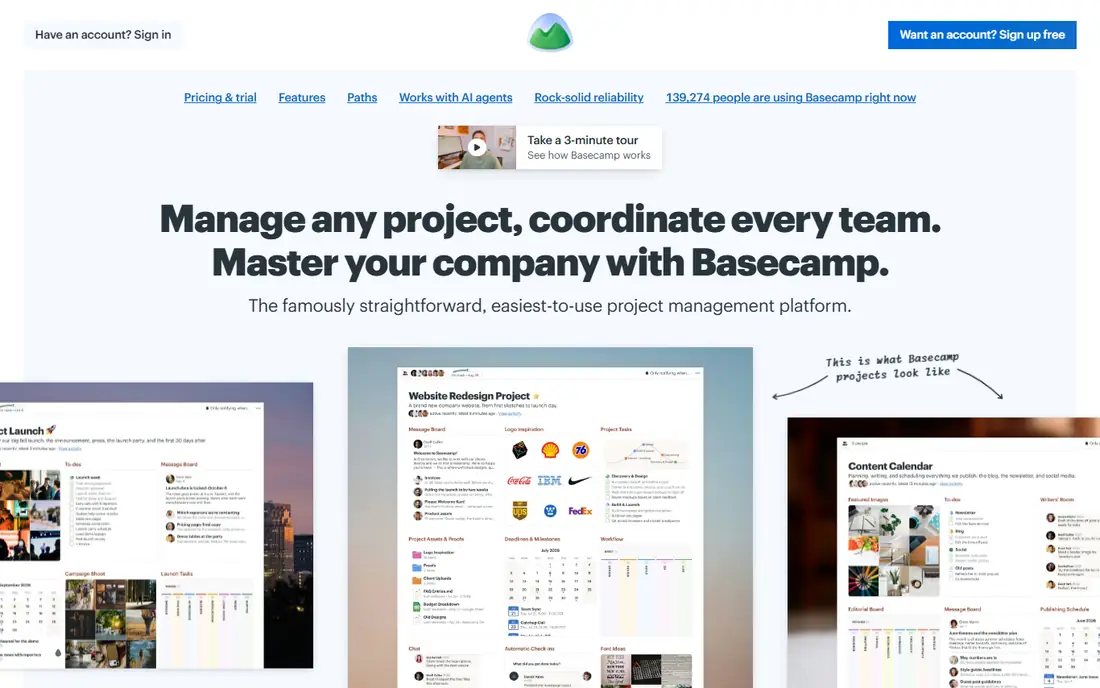
Basecamp has been a project tool since 2004. Every project has the same six tools: a message board, to dos, a schedule, docs and files, group chat and automatic check ins. There is nothing to configure, so new members start fast. Plus at $15 per user per month suits small teams, while Pro Unlimited at $299 per month billed annually is cheaper than any per seat plan above about 20 users. Sources list Pro Unlimited at $349 per month on monthly billing, so check the vendor page.
What we like- Flat rate for unlimited users, built in group chat, very fast to learn
Watch out for- No Gantt chart, no time tracking and no custom fields, so hourly billing teams need a second tool
#2
monday Work Management
Best for: Teams that want visual boards and automations
Visit monday.com
Starting price$9 per seat per month billed annually (Basic); $12 billed monthly
Free planYes, free plan for up to 2 seats and 3 boards
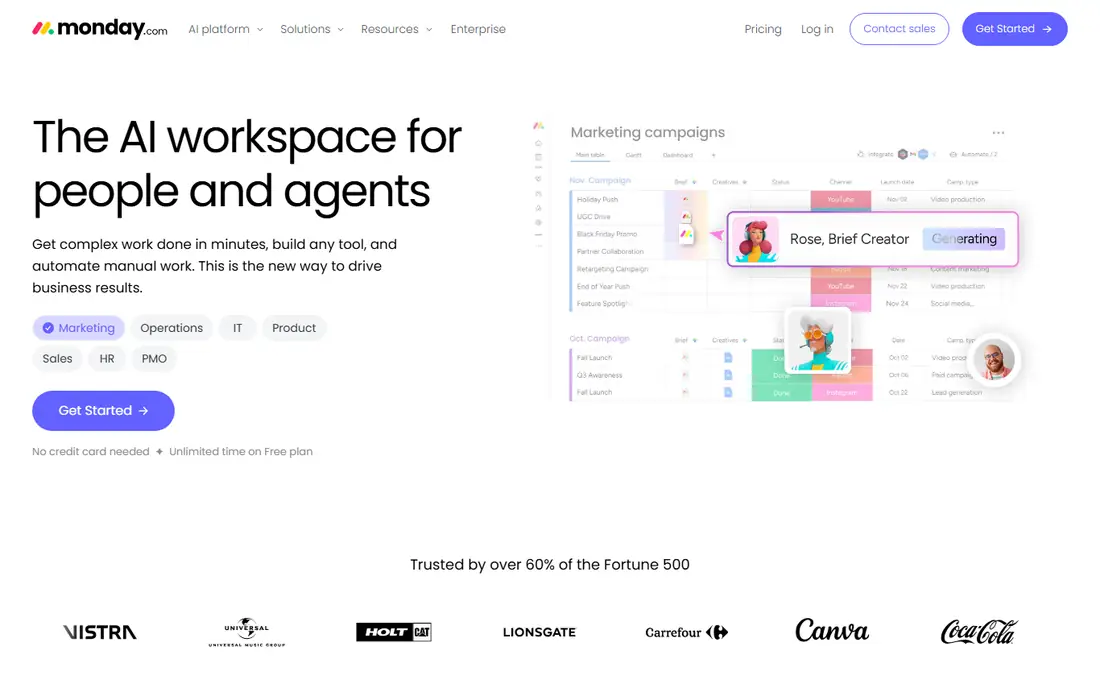
monday organises work on boards with columns for status, owner, date and priority. Basic at $9 covers simple task management with unlimited items and free viewers. Standard at $12 adds timeline and Gantt views, guest access, and 250 automation and integration actions. Pro at $19 adds time tracking, private boards and 25,000 actions a month. The pricing page shows Standard with a $14 list price struck through and Pro with $22 struck through under a limited time offer. These are Work Management prices, not monday CRM prices.
What we like- Visual boards that are easy to read, strong automations from Standard upward, good templates
Watch out for- Paid plans start at 3 seats with seats sold in buckets of 5, and Basic lacks automations and integrations
#3Asana
Best for: Teams that need structured projects and timelines4.4/5 on
G2 (13,930 reviews, checked Oct 2026)
Visit asana.com
Starting price$10.99 per user per month billed annually (Starter); $13.49 billed monthly
Free planYes, Personal plan for up to 2 users
Asana is the most structured tool in this group, and it suits teams that run projects with deadlines, owners and dependencies. Starter adds timeline and Gantt views, dashboards, forms, custom fields and unlimited automations. Advanced at $24.99 per user per month billed annually adds portfolios, goals, workload management, approvals and native time tracking. Asana prices rose on 13 October 2026, so older guides showing Starter at $7.53 or lower are out of date. A small team that only needs a task list will find Asana pricey, but a team managing several projects will get value from it.
What we like- Timeline and Gantt views, strong dashboards and reporting, unlimited automations on Starter
Watch out for- The free Personal plan caps at 2 users, and Starter costs more than double the entry price of Trello
#4ClickUp
Best for: Teams that want one tool for tasks, docs, goals and time tracking4.6/5 on
G2 (14,878 reviews, checked Oct 2026)
Visit clickup.com
Starting price$9 per user per month billed annually (Core); $12 billed monthly
Free planYes, Free Forever plan with unlimited tasks and members
ClickUp combines tasks, documents, whiteboards, goals, chat and time tracking in one workspace. Core at $9 adds custom fields, unlimited storage and spaces, unlimited Gantt charts and 1,000 automations a month. Business at $17 adds advanced dashboards, workload management, timesheets and 10,000 automations. The pricing page shows Core at $9 against a regular price of $12 and Business at $17 against $25. An October 2026 source read Core at $8, while November 2026 reads show $9, so this guide uses the $9 vendor figure.
What we like- Many views in one tool, generous free plan, docs and goals built in
Watch out for- The interface packs in so many features that new users can find it busy
#5Trello
Best for: Teams that manage work as a visible pipeline4.4/5 on
G2 (14,064 reviews, checked Oct 2026)
Visit trello.com
Starting price$5 per user per month billed annually (Standard); $6 billed monthly
Free planYes, up to 10 collaborators per workspace and 10 open boards
Trello turns work into cards on a board, and that visual model is its greatest strength. A new team member can open a board and see where every item stands. Butler automation handles routine moves and is included on every plan. Standard at $5 adds unlimited boards, custom fields and 1,000 automation runs a month. Premium at $10 adds the calendar, timeline, table, dashboard and map views. Pick Trello when the state of work matters as much as the work itself.
What we like- Clear visual boards, built in automation on every plan, easy to read
Watch out for- The calendar, timeline, table and dashboard views are locked behind Premium at $10 per user per month
#6Notion
Best for: Teams that want tasks, notes and a wiki in one place4.6/5 on
G2 (13,834 reviews, checked Oct 2026)
Visit notion.com
Starting price$10 per user per month billed annually (Plus); $12 billed monthly
Free planYes, free plan for individuals with unlimited blocks for a single member
Notion is a workspace for notes, documents, wikis and databases that can also hold tasks. Plus at $10 adds unlimited file uploads, a 30 day page history and collaborative features. Business at $20 adds full Notion AI, including the Notion Agent, plus SAML single sign on and private teamspaces. A team can build a project tracker as a database with kanban, calendar, table and timeline views. That setup takes time, but it suits teams that want their docs and their tasks in the same place.
What we like- Flexible pages and databases, strong wiki and docs, generous free plan
Watch out for- Task management is weaker than in monday or Asana, and full AI needs Business at $20
#7Wrike
Best for: Departments that need forms, approvals and resource planning4.2/5 on
G2 (4,540 reviews, checked Oct 2026)
Visit wrike.com
Starting price$10 per user per month billed annually (Team)
Free planYes, free plan with task and project management for small teams
Wrike is a work management platform built for departments that run intake, approvals and resource planning. Team at $10 per user per month billed annually covers 2 to 15 users, with Gantt charts, shareable dashboards and starter AI features. Business at $25 covers 5 to 200 users and adds proofing, approvals, request forms, time tracking and resource management. Pinnacle and Apex are quote only, and Wrike no longer lists an Enterprise tier. Prices apply to new purchases from 21 January 2026.
What we like- Gantt charts and shareable dashboards from Team, strong proofing and approvals on Business
Watch out for- Seats are sold in bands, so a team of 11 may pay for a larger block, and time tracking starts on Business at $25
#8Smartsheet
Best for: Teams that plan work in spreadsheets with Gantt views4.4/5 on
G2 (22,767 reviews, checked Oct 2026)
Visit smartsheet.com
Starting price$9 per member per month billed annually (Pro); $12 billed monthly
Free planNo, closed to new signups on 28 August 2024; a 30 day trial is offered instead
Smartsheet behaves like a project tool with a spreadsheet grid, which suits teams that already plan in rows and columns. Pro at $9 per member per month billed annually covers 1 to 10 members, with unlimited sheets, core views, forms, dashboards and 250 automations a month. Business at $19 needs at least 3 members and adds unlimited automations, baselines, workload tracking and unlimited free Guests. The free plan has not been available to new signups since 28 August 2024, so new teams start with a 30 day trial.
What we like- Familiar spreadsheet grid, strong Gantt engine, unlimited free Contributors who can view and comment
Watch out for- No free plan for new signups, and resource management is a paid add on, so the $19 price is a floor
Comparison table
| Tool | Starting price | Free plan | Best for |
| Basecamp | $15 per user per month (Plus); $299 flat (Pro Unlimited) | Yes, limited personal plan | Simple projects and chat |
| monday Work Management | $9 per seat per month, annual (Basic) | Yes, 2 seats | Visual boards, automations |
| Asana | $10.99 per user per month, annual (Starter) | Yes, Personal, 2 users | Structured projects, timelines |
| ClickUp | $9 per user per month, annual (Core) | Yes, Free Forever | Tasks, docs and goals |
| Trello | $5 per user per month, annual (Standard) | Yes, 10 collaborators, 10 boards | Visual pipelines of cards |
| Notion | $10 per user per month, annual (Plus) | Yes, free for individuals | Tasks, notes, docs, wiki |
| Wrike | $10 per user per month, annual (Team) | Yes, free plan | Forms, approvals, resources |
| Smartsheet | $9 per member per month, annual (Pro) | No, 30 day trial instead | Spreadsheet planning, Gantt |
Frequently asked questions
Is Basecamp or monday better for a small team?
monday is better for a small team that needs automations, timelines and dashboards, since Basic starts at $9 per seat per month billed annually. Basecamp is better when the team wants one simple place for tasks and chat, at $15 per user per month. A team that needs structured portfolios should look at Asana.
How much does Basecamp cost for a team of 20 people?
A team of 20 pays $300 a month on Basecamp Plus at $15 per user, or $299 a month flat on Pro Unlimited billed annually, so the two cost almost the same at that size. Above 20 people, Pro Unlimited is cheaper, and at 50 people it works out to about $6 per user per month. Below 20 people, monday Basic at $9 a seat is cheaper still.
Can I use Basecamp and monday for free?
Yes, both tools have a free plan, but they are limited. Basecamp offers a limited free personal plan for one project, while monday offers a free plan for up to 2 seats and 3 boards. The paid plans add views and automations, so a growing team will usually pay soon. Smartsheet has no free plan for new signups.
Does monday have a flat rate plan like Basecamp?
No, monday has no flat rate plan. It charges per seat, with paid plans starting at 3 seats and seats sold in buckets of 5, so a 6 person team pays for 10 seats. Basecamp is the only tool here with a flat rate, at $299 per month billed annually for unlimited users. Teams above 20 people should compare it against monday Pro at $19 a seat.
Can I move my projects from Basecamp to monday?
Yes, move projects with a CSV export and import. Each Basecamp project becomes a monday board, each to do list a group, and each to do an item. Message board threads and group chats do not carry over, so most teams archive the old project and move only live work.
Sources we checked (8)
- https://basecamp.com/pricing
- https://monday.com/pricing
- https://asana.com/pricing
- https://clickup.com/pricing
- https://trello.com/pricing
- https://notion.com/pricing
- https://wrike.com/pricing
- https://smartsheet.com/pricing
Is your product missing or out of date?
We review this list regularly. Vendors can request a listing, send updated pricing or ask about featured placement.

Shihab Mia · Founder, Rankite
Shihab has 5+ years in B2B and SaaS SEO. He writes Rankite's software buying guides from pricing pages, documentation and public user reviews. More about Shihab.