How we make this list: we compare pricing pages, product documentation and public user reviews. Ratings come from G2, Capterra or Trustpilot, with the date we checked them.
Azure Data Factory alternatives at a glance
Fivetran is the best Azure Data Factory alternative for most teams, because it runs managed pipelines with hundreds of maintained connectors and handles schema changes automatically. Airbyte is the best open-source option, Hevo Data is the best value for small teams, and Matillion suits warehouse-native transformation in Snowflake, BigQuery or Databricks.
Key takeaways
- Azure Data Factory is a managed ETL and orchestration service for Microsoft and hybrid systems, and teams leave it for simpler pricing, more SaaS connectors or less Azure lock-in.
- Fivetran leads on managed reliability, with hundreds of maintained connectors and automated schema handling that removes pipeline maintenance.
- Airbyte is the only open-source pick here, with self-hosting for data sovereignty and a cloud option for teams that want managed hosting.
- Most tools in this category charge by usage or by quote, so model the cost at your real volume before choosing.
- AWS Glue and Azure Data Factory itself are the cheapest options inside their own clouds, but they tie you to one ecosystem.
Azure Data Factory alternatives compared
| Tool | Best for | Starting price | Free plan |
| Fivetran | Managed reliability | Usage-based; quote | Free trial |
| Airbyte | Open-source control | Free self-hosted; Cloud usage-based | Yes, self-hosted |
| Hevo Data | Small team value | From $239 per month | Free trial |
| Matillion | Warehouse-native ELT | Quote | Free trial |
| Informatica | Enterprise governance | Quote | Free trial |
| AWS Glue | AWS-native ETL | Pay per use from $0.44 per DPU-hour | Free tier |
| Qlik Talend Cloud | Enterprise integration | Quote | Free trial |
| Integrate.io | No-code pipelines | From $15,000 per year | Free trial |
Why do teams look for an Azure Data Factory alternative?
Azure Data Factory is Microsoft's managed data integration service, and it works well for teams that live inside Azure. It connects cloud and on-premises systems, supports SSIS scenarios and orchestrates scheduled or event-triggered pipelines. The reasons teams look elsewhere are practical. Pricing is usage-based across activities, runtimes, data movement and transformation, which makes the monthly bill hard to forecast. The SaaS connector library is thinner than managed competitors, so teams that ingest from many SaaS apps end up building custom connectors. Outside Azure the tool loses much of its advantage, and teams that run Snowflake, BigQuery or Databricks often want a tool that runs transformation inside the warehouse. Finally, Data Factory is orchestration-first, so teams that want simple no-code ingestion look for a managed platform that handles the whole pipeline.
Check the connector list against your actual sources first, because a tool with 500 connectors is no help if it lacks the three you need. Check whether connectors are fully maintained or community-built, since a community connector that breaks becomes your problem. Check how schema changes are handled: Fivetran and Hevo automate schema drift, while code-first tools leave it to your team. Check the pricing model at your real volume, because per-row, per-connector and consumption-based models produce very different bills at scale. Check deployment: Airbyte and open-source tools can run inside your own network, while managed tools move data through their cloud. Check governance features such as lineage, data quality checks and access controls if you work in a regulated industry.
How much do Azure Data Factory alternatives cost?
Prices in this category are mostly usage-based or quote-based, which is why only two tools here have a public starting price. Fivetran charges by monthly active rows, so costs rise with the volume of data you sync and can be hard to forecast at high volume. Airbyte Cloud is also usage-based, while self-hosting Airbyte costs only your infrastructure. Hevo Data starts at $239 per month for its Starter plan with transparent tiers. AWS Glue charges from $0.44 per DPU-hour, which is cheap for small jobs and grows with compute. Matillion, Informatica, Qlik Talend Cloud and Integrate.io quote custom prices, and Integrate.io is reported to start around $15,000 per year. Get a written quote at your real volume before committing.
Can you migrate pipelines from Azure Data Factory?
Yes, but migration is a rebuild rather than a copy, because each tool models pipelines differently. Start by listing every Data Factory pipeline, its sources, its schedule and its transformations, then map each one to the new tool's connectors and transformation layer. Managed tools such as Fivetran and Hevo replace the ingestion half quickly, since you point a connector at a source and it builds the pipeline. Transformation logic usually needs rewriting, often in SQL or dbt, because Data Factory mapping data flows do not transfer. Plan a parallel run: keep Data Factory running while the new tool syncs the same tables, compare row counts and values, and cut over one pipeline at a time. Budget time for testing, because silent differences in data types and timestamps cause most migration failures.
Quick comparison
| Tool | Best for | Starting price | Free plan |
|---|
 Fivetran | Managed reliability with hundreds of maintained connectors | Usage-based by monthly active rows; quote on request, third-party reported, checked 13 Nov 2026 | Free trial; no permanent free tier |
 Airbyte | Open-source control and self-hosting for data sovereignty | Free self-hosted open source; Cloud usage-based, third-party reported, checked 13 Nov 2026 | Yes; the open-source version is free to self-host |
 Hevo Data | Small teams that want no-code pipelines with predictable pricing | From $239 per month, third-party reported, checked 13 Nov 2026 | Free trial; no permanent free tier |
 Matillion | Warehouse-native ELT inside Snowflake, BigQuery or Databricks | Quote, third-party reported, checked 13 Nov 2026 | Free trial; no permanent free tier |
 Informatica | Enterprise governance, data quality and lineage at scale | Quote, third-party reported, checked 13 Nov 2026 | Free trial; no permanent free tier |
 AWS Glue | Serverless ETL for AWS-native workloads | Pay per use from $0.44 per DPU-hour, third-party reported, checked 13 Nov 2026 | Free tier with limited DPU-hours for new accounts |
 Qlik Talend Cloud | Enterprise integration with governance and data quality built in | Quote, third-party reported, checked 13 Nov 2026 | Free trial; no permanent free tier |
 Integrate.io | No-code pipelines for teams without data engineers | From $15,000 per year, third-party reported, checked 13 Nov 2026 | Free trial; no permanent free tier |
Is your product missing or out of date?
We review this list regularly. Vendors can request a listing, send updated pricing or ask about featured placement.
The 8 best Azure Data Factory alternatives compared
#1Fivetran
Best for: Managed reliability with hundreds of maintained connectors4.3/5 on
G2 (841 reviews, checked Oct 2026)
Visit fivetran.com
Starting priceUsage-based by monthly active rows; quote on request, third-party reported, checked 13 Nov 2026
Free planFree trial; no permanent free tier
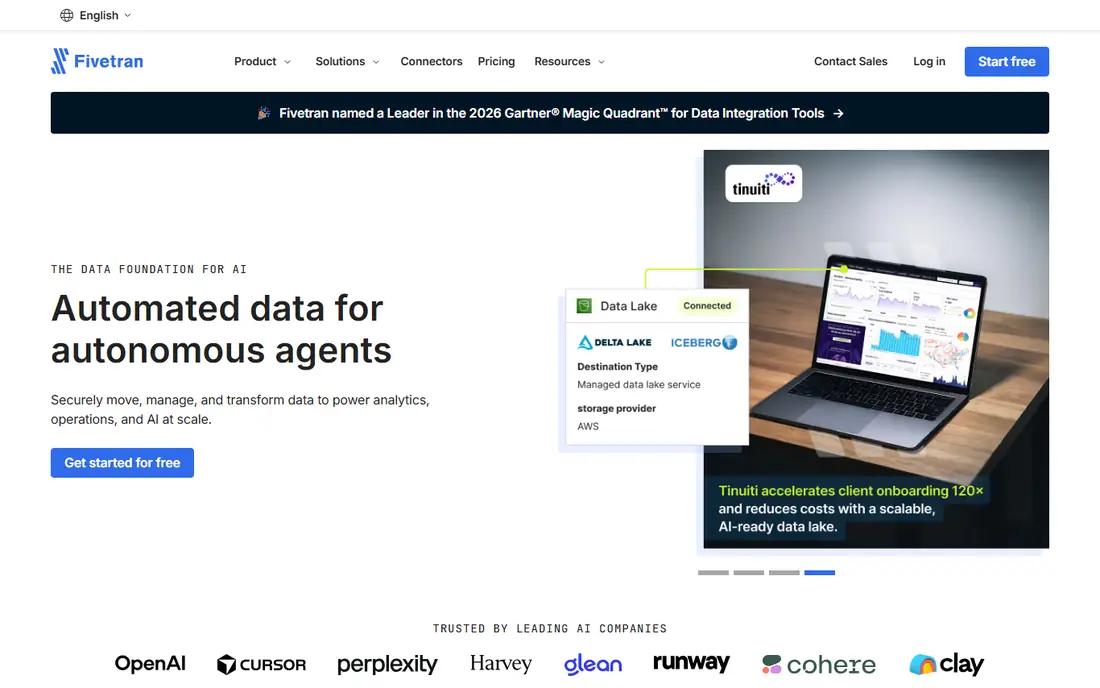
Fivetran is the managed standard for data loading, and it is the best Azure Data Factory alternative for teams that want pipelines to run themselves. It offers hundreds of pre-built connectors with fully automated ELT and automatic schema drift handling, so a source that adds a column does not break the pipeline. The dbt integration covers transformation, and the hosted model removes server maintenance entirely. The trade-off is pricing: monthly active row pricing becomes unpredictable at high volume, and support responsiveness is a common complaint. For teams that value reliability over control, Fivetran is the safest pick.
What we like- Hundreds of fully maintained connectors, automated schema drift handling, dbt integration, low day-to-day maintenance
Watch out for- Consumption-based pricing is hard to forecast at high volume, and exact cutover control is limited
#2Airbyte
Best for: Open-source control and self-hosting for data sovereignty4.4/5 on
G2 (78 reviews, checked Oct 2026)
Visit airbyte.com
Starting priceFree self-hosted open source; Cloud usage-based, third-party reported, checked 13 Nov 2026
Free planYes; the open-source version is free to self-host
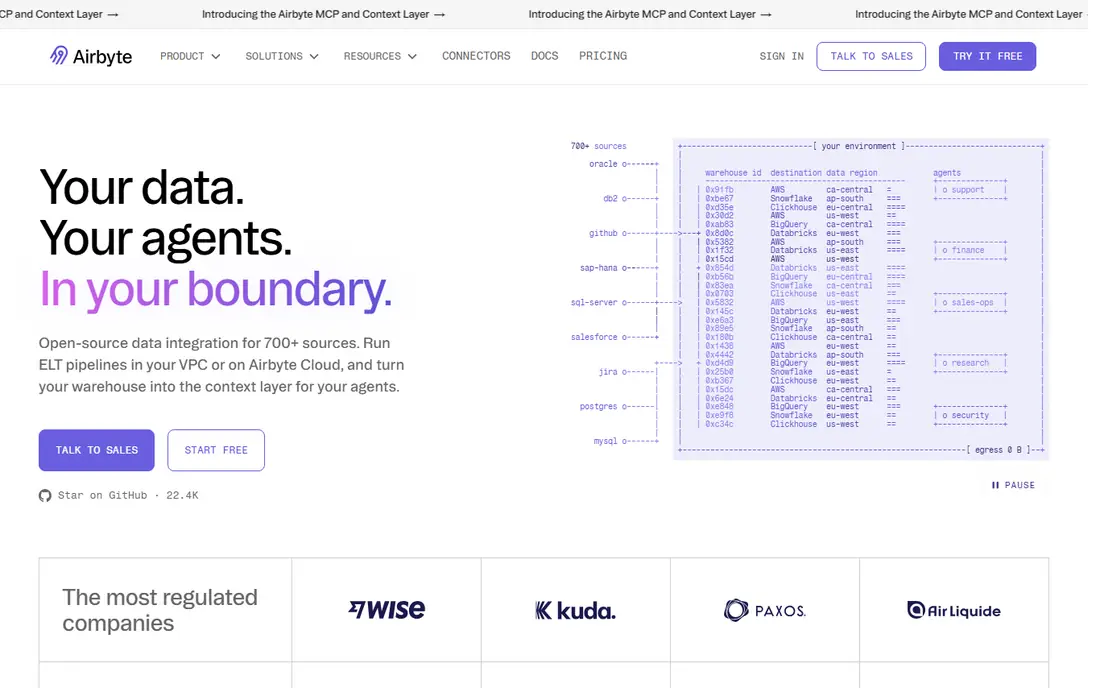
Airbyte made open-source data integration popular, and it is the best pick for engineering teams that want control over where data runs. The open-source version is free to self-host, with more than 600 connectors and a low-code connector development kit for custom sources. Airbyte Cloud offers the same connectors as a managed service for teams that do not want to run infrastructure. The cost of self-hosting is real: your team owns upgrades, scaling and reliability, and community connectors can break without warning. For teams with sovereignty rules or strict budgets, Airbyte is the most flexible option here.
What we like- Open source with 600 plus connectors, self-hosted or cloud deployment, low-code connector builder, strong community
Watch out for- Self-hosted deployments need upgrades, scaling and reliability work from your team, and community connectors vary in quality
#3Hevo Data
Best for: Small teams that want no-code pipelines with predictable pricing4.4/5 on
G2 (295 reviews, checked Oct 2026)
Visit hevodata.com
Starting priceFrom $239 per month, third-party reported, checked 13 Nov 2026
Free planFree trial; no permanent free tier
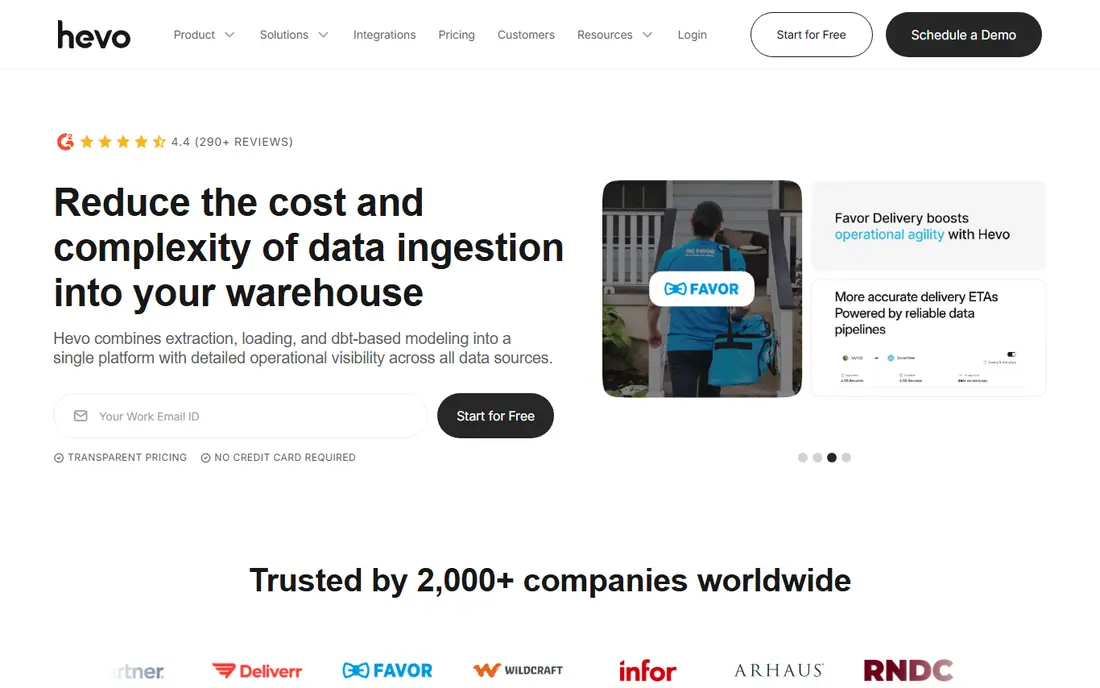
Hevo Data is a fully managed, no-code data pipeline platform, and it leads on value for small teams. It delivers simple, reliable pipelines with auto-scaling, pre-built connectors, schema evolution and event-based pricing that scales predictably. Real-time syncs and detailed logs make it easy to see what a pipeline did, and 24/7 expert support is included. The main limits are that it is cloud-only, with no self-hosted option, and it is lighter on heavy transformation and enterprise governance than the big suites. For a small data team that wants pipelines running in days, Hevo is the best value here.
What we like- No-code pipelines with auto-scaling, real-time syncs, transparent tiered pricing, schema evolution, 24/7 expert support
Watch out for- Cloud-only deployment, and lighter on heavy transformation and enterprise governance than Informatica or Talend
#4Matillion
Best for: Warehouse-native ELT inside Snowflake, BigQuery or Databricks4.4/5 on
G2 (83 reviews, checked Oct 2026)
Visit matillion.com
Starting priceQuote, third-party reported, checked 13 Nov 2026
Free planFree trial; no permanent free tier
Matillion is a cloud-native data integration platform that uses the power of your warehouse for high-speed processing. It loads data and runs transformation jobs inside Snowflake, BigQuery, Databricks or Redshift, using the warehouse's own compute instead of moving data to a separate engine. The visual workflow builder suits analytics teams that think in tables rather than code, and dbt support covers teams that prefer SQL transformations. Pricing is subscription or quote-based, and the tool can be excessive for a simple database copy. For warehouse-centric teams, Matillion is the most natural Azure Data Factory replacement.
What we like- Runs transformation inside the warehouse for speed, visual cloud-oriented workflows, strong dbt support, no data movement for transforms
Watch out for- Subscription or quote-based pricing, and it can be excessive for a simple database copy
Starting priceQuote, third-party reported, checked 13 Nov 2026
Free planFree trial; no permanent free tier
Informatica is the enterprise data management suite in this list, and it suits organisations that need governance as much as movement. It combines broad integration with data quality, lineage and governance capabilities, so a pipeline carries its documentation and checks with it. Cloud and hybrid deployment cover teams that still run on-premises systems alongside cloud warehouses. The cost is enterprise-scale with no public starting price, and setup is heavier than a no-code tool such as Hevo. For regulated industries and large data estates, Informatica is the most complete pick, but small teams will find it too much.
What we like- Broad integration plus data quality, lineage and governance in one suite, strong enterprise support, cloud and hybrid deployment
Watch out for- Enterprise pricing with no public starting price, and a heavier setup than managed no-code tools
Starting pricePay per use from $0.44 per DPU-hour, third-party reported, checked 13 Nov 2026
Free planFree tier with limited DPU-hours for new accounts
AWS Glue is the serverless ETL service for teams that run on Amazon Web Services, and it is the closest cloud-native parallel to Azure Data Factory. It runs Spark-based ETL without servers, discovers schemas automatically through the Glue Data Catalog, and integrates natively with S3, Redshift and the rest of AWS. Pricing is pay per use from $0.44 per DPU-hour, which keeps small jobs cheap. The limits are the mirror of its strengths: it locks you into AWS, and complex transformations need Spark knowledge that a no-code team may not have. For an AWS shop leaving Azure, Glue is the obvious replacement.
What we like- Serverless Spark-based ETL, automatic Glue Data Catalog discovery, native AWS integration, no servers to manage
Watch out for- AWS ecosystem lock-in, and complex transformations need Spark knowledge
#7Qlik Talend Cloud
Best for: Enterprise integration with governance and data quality built in3.7/5 on
Capterra (3 reviews, checked Oct 2026)
Visit qlik.com
Starting priceQuote, third-party reported, checked 13 Nov 2026
Free planFree trial; no permanent free tier
Qlik Talend Cloud is the enterprise data management platform formed when Qlik acquired Talend, and it covers the full pipeline from ingestion to governance. It offers broad integration with data quality, lineage and governance capabilities, so regulated teams can trace every field from source to warehouse. Cloud and hybrid deployment suit organisations that still run on-premises systems. Pricing is quote-based with no public starting price, and the learning curve is steeper than a no-code tool. For large teams that need one platform for integration, quality and governance, Talend Cloud is a strong Azure Data Factory replacement.
What we like- Broad integration, data quality and lineage built in, strong enterprise support, cloud and hybrid deployment
Watch out for- Enterprise pricing with no public starting price, and a steeper learning curve than no-code tools
#8Integrate.io
Best for: No-code pipelines for teams without data engineers4.3/5 on
G2 (213 reviews, checked Oct 2026)
Visit integrate.io
Starting priceFrom $15,000 per year, third-party reported, checked 13 Nov 2026
Free planFree trial; no permanent free tier
Integrate.io is a no-code data pipeline platform aimed at teams that do not have data engineers to spare. Its visual builder lets a business user connect a SaaS source to a warehouse in hours rather than weeks, with managed hosting and pre-built connectors for common sources. Setup is fast, and the interface is friendlier than a code-first tool. The reported starting price of around $15,000 per year puts it out of reach for very small teams, and transformation depth is thinner than Airbyte or Matillion for complex logic. For a business-led team that needs pipelines without hiring engineers, Integrate.io is a practical pick.
What we like- No-code visual pipeline builder, fast setup for common SaaS sources, managed hosting, good for non-technical teams
Watch out for- Reported starting price is high for small teams, and transformation depth is thinner than code-first tools
How we chose these alternatives
We compared 2026 data integration roundups, vendor pricing pages and product documentation, and kept only tools with public evidence of real deployments as Azure Data Factory replacements. We favoured tools with broad connector libraries, clear pricing models and documented reliability, and we excluded narrow single-source tools. We checked each vendor's official website by search on 13 Nov 2026. Prices marked third-party reported come from 2026 roundups and vendor pricing pages read via search, not from a page we opened directly, so confirm them with the vendor before relying on them. We did not test pipelines ourselves.
How to pick the right Azure Data Factory alternative
Match the tool to the job. Managed reliability needs Fivetran. Open-source control and self-hosting need Airbyte. Small-team value needs Hevo Data. Warehouse-native transformation needs Matillion. Enterprise governance needs Informatica or Qlik Talend Cloud. AWS-native workloads need AWS Glue. No-code setup without engineers needs Integrate.io. Then model the cost at your real volume, because usage-based pricing punishes heavy syncs. Check the connector list against your actual sources, run a parallel sync against Data Factory, and compare row counts before cutting over.
Frequently asked questions
What is the best Azure Data Factory alternative?
For most teams, Fivetran, because it runs managed pipelines with hundreds of maintained connectors and handles schema changes automatically. Airbyte is the best open-source option for teams that want self-hosting, Hevo Data is the best value for small teams, and Matillion suits warehouse-native transformation in Snowflake, BigQuery or Databricks. The right pick depends on your warehouse, your volume and how much pipeline maintenance your team wants to own.
Is there a free Azure Data Factory alternative?
Yes. Airbyte is free to self-host as open-source software, and you pay only for your own infrastructure. AWS Glue has a free tier with limited DPU-hours for new accounts. Cloud-based tools here offer free trials rather than permanent free plans, and Fivetran, Hevo Data, Matillion, Informatica, Qlik Talend Cloud and Integrate.io all require a paid plan or quote after the trial ends.
How much does it cost to replace Azure Data Factory?
It depends on volume and the pricing model. Hevo Data starts at $239 per month, AWS Glue charges from $0.44 per DPU-hour, and Integrate.io is reported to start around $15,000 per year. Fivetran and Airbyte Cloud charge by usage, so the bill rises with the volume of data you sync. Matillion, Informatica and Qlik Talend Cloud quote custom prices. Get a written quote at your real volume before committing.
Can I migrate my Data Factory pipelines to another tool?
Yes, but migration is a rebuild rather than a copy, because each tool models pipelines differently. List every pipeline, its sources, its schedule and its transformations, then map each one to the new tool's connectors and transformation layer. Run the new tool in parallel with Data Factory, compare row counts and values, and cut over one pipeline at a time. Budget time for testing, because silent differences in data types and timestamps cause most migration failures.
Do Azure Data Factory alternatives work with Snowflake?
Yes. Fivetran, Airbyte, Hevo Data, Matillion, Informatica, Qlik Talend Cloud and Integrate.io all support Snowflake as a destination. Matillion is the strongest Snowflake pick here, because it runs transformation jobs inside Snowflake using the warehouse's own compute. Fivetran is the simplest Snowflake loader for teams that want managed ingestion with automated schema handling. Check the connector list for your other sources before choosing.
Sources we checked (10)
- https://hevodata.com/learn/azure-data-factory-alternative/
- https://rankite.com/blog/airbyte-alternatives
- https://hevodata.com/learn/matillion-alternatives/
- https://www.maia.ai/resources/blog/fivetran-competitors-and-alternatives
- https://fivetran.com
- https://airbyte.com
- https://hevodata.com
- https://matillion.com
- https://aws.amazon.com/glue/
- https://integrate.io
Is your product missing or out of date?
We review this list regularly. Vendors can request a listing, send updated pricing or ask about featured placement.

Shihab Mia · Founder, Rankite
Shihab has 5+ years in B2B and SaaS SEO. He writes Rankite's software buying guides from pricing pages, documentation and public user reviews. More about Shihab.