How we make this list: we compare pricing pages, product documentation and public user reviews. Ratings come from G2, Capterra or Trustpilot, with the date we checked them.
Key takeaways
- Apache Spark is a distributed engine for batch and streaming, and its alternatives differ in scale, pricing model, and skill required.
- Databricks is the best managed Spark pick, with the Data plus AI Platform used by over 60 percent of the Fortune 500.
- Snowflake is the best SQL analytics pick, with a fully managed AI Data Cloud and Cortex AI agents.
- Google BigQuery is the best serverless pick, with 10 GiB storage and 1 TiB queries free per month.
- Apache Flink is the best streaming pick, with exactly-once state consistency and event-time processing.
- Trino is the best federated query pick, with distributed SQL across lakes, warehouses, and databases without moving data.
- Dask is the best Python pick, with pandas-compatible DataFrames that scale across clusters.
- DuckDB is the best single-machine pick, with an in-process analytical database that reads Parquet, CSV, JSON, and Iceberg.
- Polars is the best DataFrame speed pick, with a Rust engine, 900 million plus downloads, and Polars Cloud for larger workloads.
Quick comparison
| Tool | Best for | Starting price | Free plan |
|---|
 Databricks | Managed Spark | See website | Free trial |
 Snowflake | SQL analytics | See website | Free trial |
 Google BigQuery | Serverless | $6.25 per TiB scanned | Free tier |
 Apache Flink | Streaming | Free open source | Yes |
 Trino | Federated query | Free open source | Yes |
 Dask | Python | Free open source | Yes |
 DuckDB | Single machine | Free open source | Yes |
 Polars | DataFrame speed | Free open source | Yes |
Is your product missing or out of date?
We review this list regularly. Vendors can request a listing, send updated pricing or ask about featured placement.
The best Apache Spark alternatives
Starting priceSee website
Free planFree trial
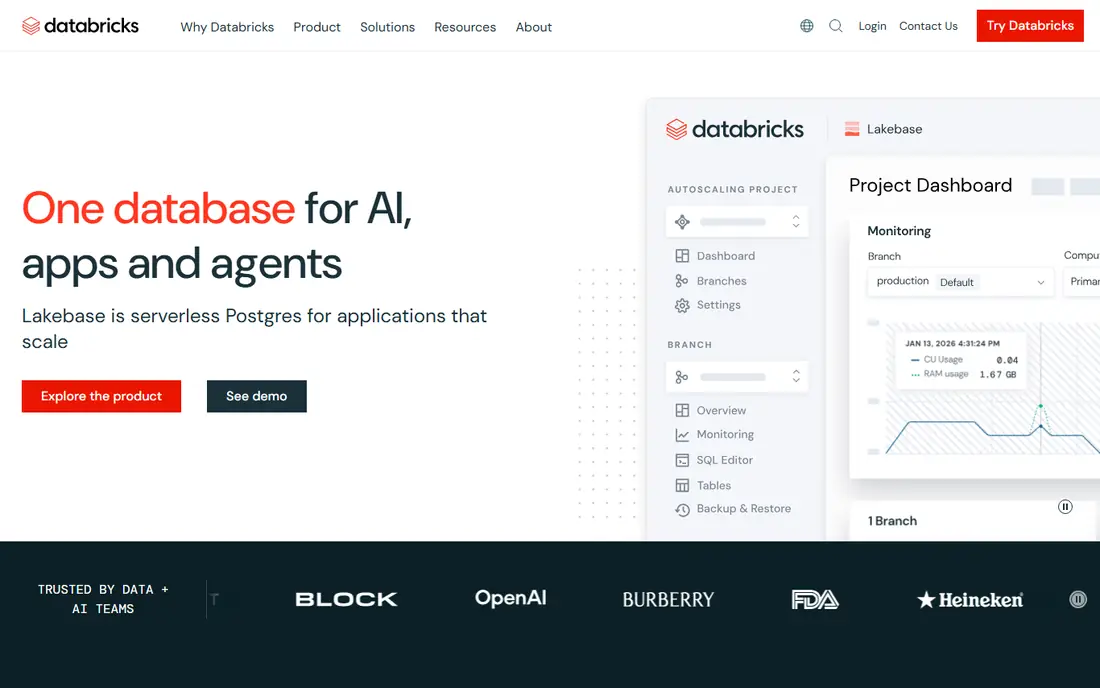
Databricks is the best managed Spark pick. Its homepage describes the Data plus AI Platform for building and running apps, agents, and AI on your data, unifying data, analytics, and AI in one platform. Featured products include Lakebase, the first serverless Postgres database integrated with the lakehouse, Genie, a data-aware AI partner, Unity Gateway for governing enterprise AI, and Lakehouse Serverless data warehousing on open lake data. Databricks reports over 60 percent of the Fortune 500 using its platform, over 20,000 customers worldwide, and 5x Leader status in Gartner Magic Quadrant reports. Comparison sources cite entry costs around 50,000 dollars per year for serious deployments, with a free trial available.
The trade-off is that Databricks is still Spark at its core. Teams that want to escape Spark complexity should consider Snowflake, BigQuery, or DuckDB instead. For teams that want managed Spark with AI and governance built in, Databricks is the best pick.
What we like- Data plus AI Platform unifying data, analytics, and AI
- Lakebase serverless Postgres
- Unity Catalog governance
- Used by over 60 percent of the Fortune 500
Watch out for- Pricing by quote on the homepage
- Still a Spark platform, so teams leaving Spark entirely should look elsewhere
Starting priceSee website
Free planFree trial
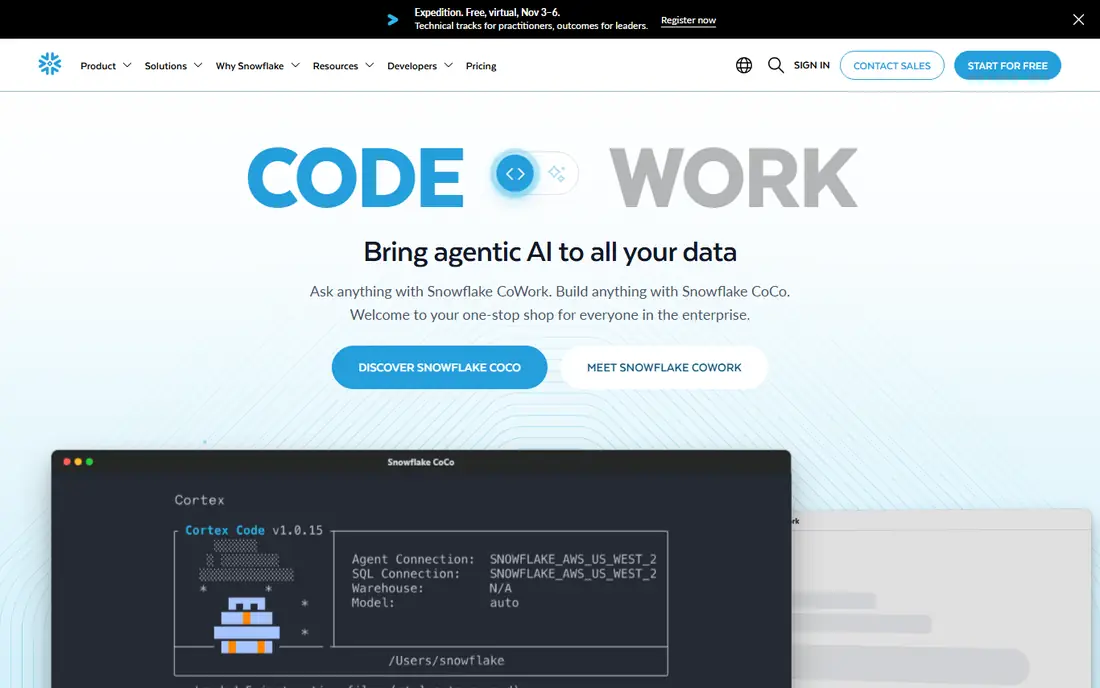
Snowflake is the best SQL analytics pick. Its homepage describes the AI Data Cloud, bringing agentic AI to all your data with Snowflake CoWork for asking anything and Snowflake CoCo for building anything, plus an easy, fully managed platform integrated across data types and clouds. Features include a rich ecosystem with interoperability across open table formats, universal security and governance with always-on observability and disaster recovery, and case studies from Novo Nordisk unifying 900TB of data for 40,000 users, United Rentals reaching 1,600 plus locations, and Booking.com unifying 31 million travel listings. Comparison sources cite entry costs from 500 to 2,000 dollars per month, with credits billed per second.
The catch is workload fit. Snowflake suits SQL-first analytics teams best, while engineering-heavy Python and ML pipelines fit Databricks better. For SQL analytics at enterprise scale without cluster management, Snowflake is the best pick.
What we like- Fully managed AI Data Cloud with no cluster tuning
- Cortex AI agents CoWork and CoCo
- Cross-cloud ecosystem with open table formats
Watch out for- Pricing by quote on the homepage
- Best for SQL-first teams, less suited to custom Python pipelines
Starting price$6.25 per TiB scanned
Free planFree tier
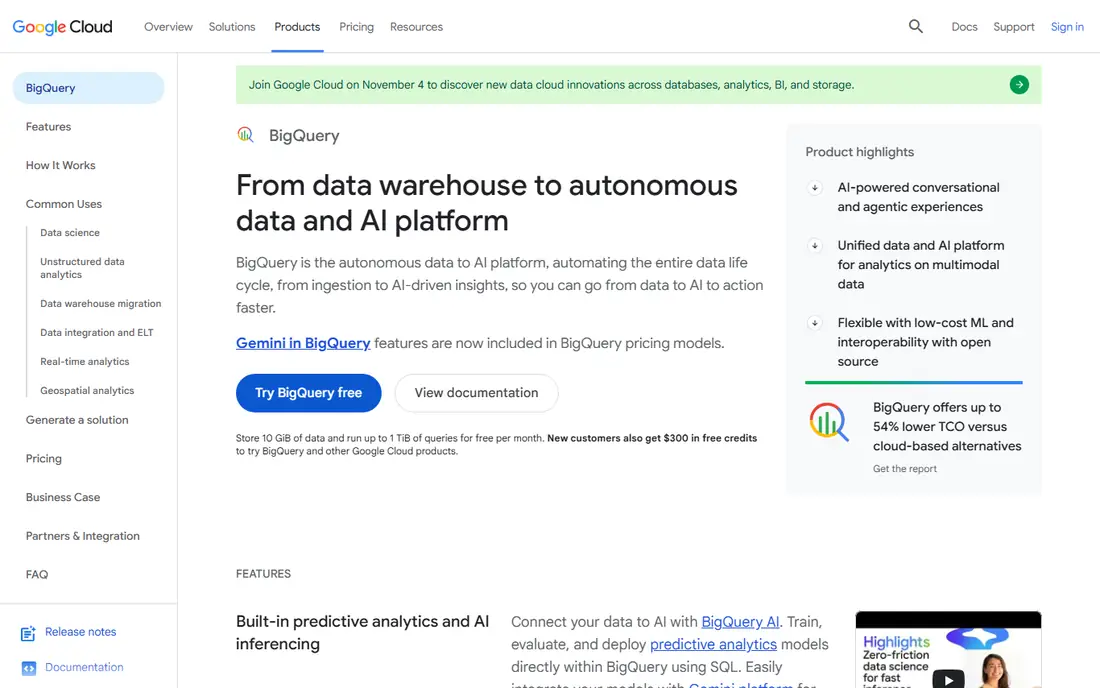
Google BigQuery is the best serverless pick. Its homepage describes an autonomous data to AI platform, automating the entire data life cycle from ingestion to AI-driven insights, with built-in predictive analytics and AI inferencing, agentic experiences for all data teams, and real-time analytics with streaming pipelines. Pricing on the homepage is clear: free tier with 10 GiB storage and up to 1 TiB queries per month, on-demand compute from 6.25 dollars per TiB scanned with the first 1 TiB free, editions from 0.04 dollars per slot hour, logical storage from 0.01 dollars per GiB, and new customers getting 300 dollars in free credits. BigQuery's architecture decouples storage and compute for petabyte-scale analysis, with fluid scaling and per-second billing.
The trade-off is cloud lock-in. BigQuery is Google Cloud native, with BigQuery Omni for AWS and Azure, so multi-cloud teams should weigh that. For serverless analytics with transparent pricing, BigQuery is the best pick.
What we like- Fully serverless with per-second billing
- Free tier with 10 GiB storage and 1 TiB queries per month
- Gemini in BigQuery included in pricing models
Watch out for- Google Cloud only for full features
- On-demand scanning costs can spike on unpartitioned tables
Starting priceFree open source
Free planYes
Apache Flink is the best streaming pick. Its homepage describes stateful computations over data streams, with correctness guarantees including exactly-once state consistency, event-time processing, and sophisticated late data handling. Features include layered APIs with SQL on stream and batch data, DataStream API, and ProcessFunction for time and state, plus operational focus with flexible deployment, high-availability setup, savepoints, scalability, and support for very large state with incremental checkpoints. Use cases include event-driven applications, stream and batch analytics, and data pipelines and ETL. Recent releases include Flink CDC 3.7.0 with AI-powered data processing and the Flink Kubernetes Operator 1.16.0.
The catch is operations. Flink is open source and self-managed, so teams need DevOps capacity or a managed service. For streaming-first workloads where correctness matters, Flink is the best pick.
What we like- Exactly-once state consistency
- Event-time processing with sophisticated late data handling
- SQL on stream and batch data
- High-availability setup with savepoints
Watch out for- Self-managed deployment complexity
- Smaller batch ecosystem than Spark
Starting priceFree open source
Free planYes
Trino is the best federated query pick. Its homepage describes a distributed SQL query engine for big data, the fastest growing open-source analytics project, built for efficient, low-latency analytics. Features include speed from a highly parallel distributed engine, scale to exabyte data lakes and massive warehouses, simplicity through ANSI SQL compliance with BI tools like R, Tableau, Power BI, and Superset, versatility across interactive analytics, massive batch queries, and high-volume sub-second queries, in-place analysis of Hadoop, S3, Cassandra, MySQL, and more without copying data, and query federation joining historic log data in S3 with customer data in MySQL in a single query. Trino runs on-premise and on Amazon, Azure, and Google Cloud, and is used for critical business operations including financial results for public markets.
The trade-off is scope. Trino queries data where it lives but does not store it or orchestrate pipelines, so teams need separate storage and scheduling. For federated analytics across many systems, Trino is the best pick.
What we like- Distributed SQL across Hadoop, S3, Cassandra, MySQL, and more without moving data
- ANSI SQL compliant
- Works with Tableau, Power BI, and Superset
Watch out for- Query engine only, not storage or pipeline orchestration
- Self-managed deployment
Starting priceFree open source
Free planYes
Dask is the best Python pick. Its homepage describes scaling the Python tools you love, with Dask DataFrames using pandas under the hood so current code likely just works, parallel for loops for arbitrary dependencies and fine-grained scheduling, big arrays with NumPy and Xarray for terabytes of multi-dimensional data, and machine learning with XGBoost, PyTorch, Optuna, and scikit-learn. Dask claims to be 50 percent faster than Spark on standard benchmarks and to process cloud data at 0.10 dollars per TiB, with a dashboard that guides users toward efficiency. Users include Capital One, NASA, NVIDIA, Shell, Walmart, and the US Air Force, with one Capital One case citing 91 percent faster model training times.
The catch is language. Dask is Python-only, so JVM and Scala teams should stay with Spark or Flink. For Python teams whose code is already pandas or NumPy, Dask is the best pick.
What we like- Pandas-compatible DataFrames that scale
- Parallel for loops and big arrays with NumPy and Xarray
- ML with XGBoost, PyTorch, and scikit-learn
- Lightweight and local-first
Watch out for- Python-only
- Cluster management still needed at scale
- Performance claims rest on vendor benchmarks
Starting priceFree open source
Free planYes
DuckDB is the best single-machine pick. Its homepage describes an analytical SQL database management system deployable anywhere, from edge devices to servers with hundreds of cores, with a friendly and expressive PostgreSQL-inspired query language, extensible functions and formats, and native clients for all major programming languages. Features include reading and writing CSV, JSON, Parquet, and Iceberg locally or in object storage, a Duck Stack including DuckDB, Quack client-server protocol, DuckLake lakehouse format, and first-class Iceberg support, plus free and open-source MIT licensing under the independent DuckDB Foundation. The latest release is DuckDB 2.0.0 LTS, called Cinnamon Teal.
The trade-off is scale. DuckDB runs in-process on one machine, so multi-terabyte jobs that truly need a cluster should use Spark, Databricks, or BigQuery. For local processing, fast prototyping, and zero cloud cost, DuckDB is the best pick.
What we like- In-process analytical database deployable from edge devices to servers with hundreds of cores
- Friendly PostgreSQL-inspired SQL
- Reads CSV, JSON, Parquet, and Iceberg locally or in object storage
Watch out for- Single-machine scale limits
- No built-in cluster or managed service without MotherDuck
Starting priceFree open source
Free planYes
Polars is the best DataFrame speed pick. Its homepage describes DataFrames for the new era, an open-source library for data manipulation known as one of the fastest data processing solutions on a single machine, with a well-structured, typed API that is expressive and easy to use. Features include a multi-threaded query engine written in Rust with vectorized and columnar processing, cache-coherent algorithms, and high performance on modern processors, plus support for CSV, JSON, Parquet, Delta Lake, AVRO, Excel, Feather, Arrow, MySQL, Postgres, SQL Server, SQLite, Redshift, Oracle, S3, and Azure storage. Polars reports 900 million plus downloads, 40,000 plus GitHub stars, and use by Optiver, Netflix, Microsoft, G-Research, Appian, and UCSF, with benchmark claims of more than 30x performance gains over pandas on derived TPC-H workloads. Polars Cloud offers the same API with zero code changes, cloud or on-prem deployment, and pay-per-query execution.
The catch is migration. Polars APIs differ from pandas, so existing code needs rewriting, though the speed gains often justify it. For DataFrame work where speed matters most, Polars is the best pick.
What we like- Rust multi-threaded query engine with vectorized columnar processing
- 900 million plus downloads and 40,000 plus GitHub stars
- Polars Cloud scales with the same API
Watch out for- Newer API than pandas, so migration takes effort
- Single-machine focus without Polars Cloud
How we chose
We compared tools that replace Apache Spark across its core jobs: batch processing, streaming, SQL analytics, and machine learning pipelines. Each vendor homepage was opened to confirm the product exists today and matches its category, and we kept a mix of managed platforms, serverless warehouses, streaming engines, federated query engines, Python libraries, and single-machine tools, since Spark users range from solo analysts to enterprise data teams. Pricing is taken from vendor homepages where published, and written as See website where vendors price by quote or on pricing pages not shown on the homepage.
Switching from Apache Spark without losing pipelines
Your data formats usually transfer, since Parquet, Delta Lake, and Iceberg are open, so point the new engine at the same storage, rewrite job logic in the new API, and validate outputs row by row before retiring Spark jobs. Budget time for re-creating scheduling, monitoring, and access controls, which rarely migrate automatically. Run the new engine alongside Spark for one pipeline cycle, compare results, and fix gaps before cutting over.
Test with a small workload first. Pick one batch job or one streaming pipeline, measure cost and latency, and confirm the new tool handles your data volumes before migrating the whole estate. Finally, check pricing models carefully: per-second credits, per-TiB scanning, and per-slot pricing can change total cost dramatically as data grows.
Frequently asked questions
What is the closest alternative to Apache Spark?
Databricks is the closest managed Spark replacement, since it was founded by Spark's creators. For teams leaving Spark entirely, Snowflake and BigQuery are the closest managed platforms.
Which Apache Spark alternative is cheapest?
DuckDB, Polars, Dask, Flink, and Trino are free open source, so infrastructure is the only cost. For managed services, BigQuery's free tier with 10 GiB storage and 1 TiB queries per month is the lowest entry point.
Can I run these tools without a cluster?
Yes. DuckDB and Polars run in-process on a single machine, Dask runs locally with multiple processes, and BigQuery is fully serverless. Databricks, Snowflake, Flink, and Trino need clusters or managed services at scale.
Which alternative is best for streaming?
Apache Flink is the best streaming pick, with exactly-once state consistency and event-time processing. Spark Structured Streaming users will find Flink's model familiar but more streaming-native.
Which alternative is best for SQL analytics?
Snowflake is the best SQL analytics pick for enterprise teams, BigQuery for serverless teams, and Trino for federated queries across existing systems. DuckDB is best for local SQL analytics.
Do these tools work with Parquet and Iceberg?
Yes, all eight support Parquet, and most support Iceberg, Delta Lake, or both. DuckDB has first-class Iceberg support, Databricks supports Delta Lake and Iceberg, and BigQuery supports Iceberg through its lakehouse features.
Sources we checked (8)
- https://www.databricks.com
- https://www.snowflake.com
- https://cloud.google.com/bigquery
- https://flink.apache.org
- https://trino.io
- https://www.dask.org
- https://duckdb.org
- https://pola.rs
Is your product missing or out of date?
We review this list regularly. Vendors can request a listing, send updated pricing or ask about featured placement.

Shihab Mia · Founder, Rankite
Shihab has 5+ years in B2B and SaaS SEO. He writes Rankite's software buying guides from pricing pages, documentation and public user reviews. More about Shihab.