How we make this list: we compare pricing pages, product documentation and public user reviews. Ratings come from G2, Capterra or Trustpilot, with the date we checked them.
Key takeaways
- Python is the default R alternative for most data work, trading R's statistical depth for a general purpose language and the largest hiring pool.
- Julia answers R's speed limits in scientific computing, while MATLAB remains the engineering organisation standard with licensed toolboxes.
- SAS, Stata, and SPSS serve the regulated and social science worlds where validated procedures, support contracts, and point and click workflows matter more than openness.
- GNU Octave is the free MATLAB compatible route for numerical work on a zero budget.
Quick comparison
| Tool | Best for | Starting price | Free plan |
|---|
 Python | General data science and production | Free | Yes |
 Julia | High performance scientific computing | Free | Yes |
 MATLAB | Engineering and simulation standard | See website | No |
 SAS | Regulated enterprise statistics | See website | No |
 Stata | Econometrics and social science | See website | No |
 GNU Octave | Free MATLAB compatible numerics | Free | Yes |
 SPSS Statistics | Survey and social science analysis | See website | No |
Is your product missing or out of date?
We review this list regularly. Vendors can request a listing, send updated pricing or ask about featured placement.
The best alternatives to R
Starting priceFree
Free planYes
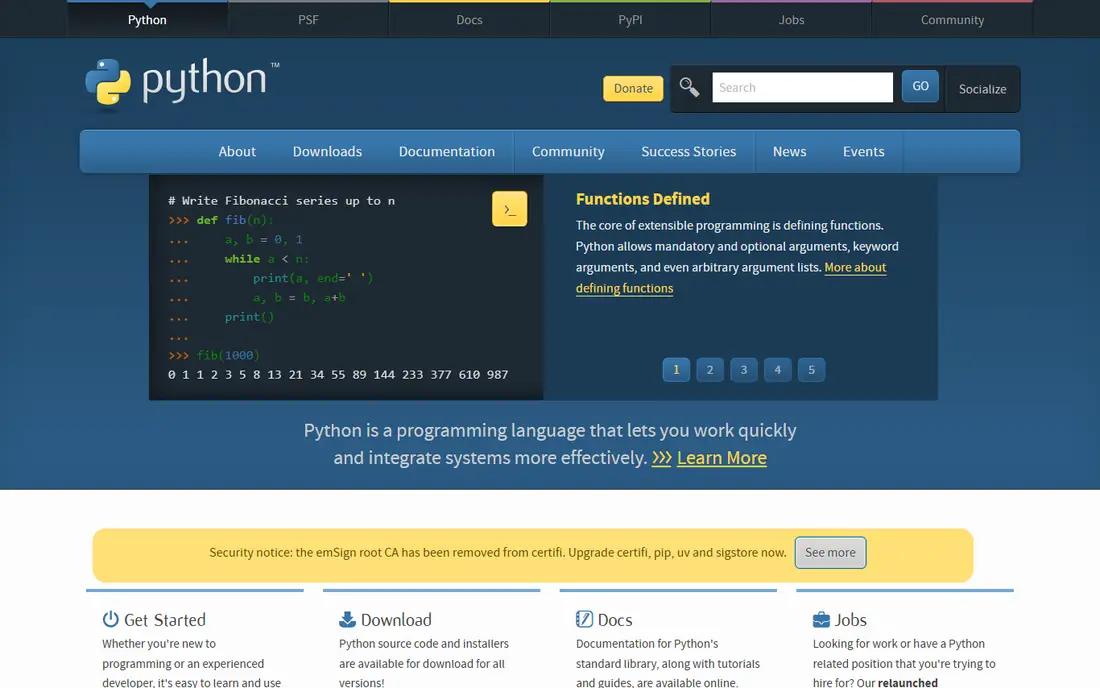
What we like- Python is where most R users land: pandas and Polars for the data frames R users expect, scikit learn for machine learning, statsmodels for classical statistics, and a general purpose language around them that builds the API, the pipeline, and the dashboard without switching tools. The hiring pool and tutorial base are the largest in data work, and Jupyter provides the notebook workflow R Markdown users adapt to quickly. For analysis that must become production software, Python's path is the clearest in this list.
Watch out for- Classical statistics depth trails R's CRAN ecosystem
- Some models R users take for granted arrive later or rougher in Python's libraries. The language's flexibility produces several ways to do everything, which fragments team conventions. Version and environment management, the conda versus venv folklore, wastes real time for newcomers from R's simpler setup.
Starting priceFree
Free planYes
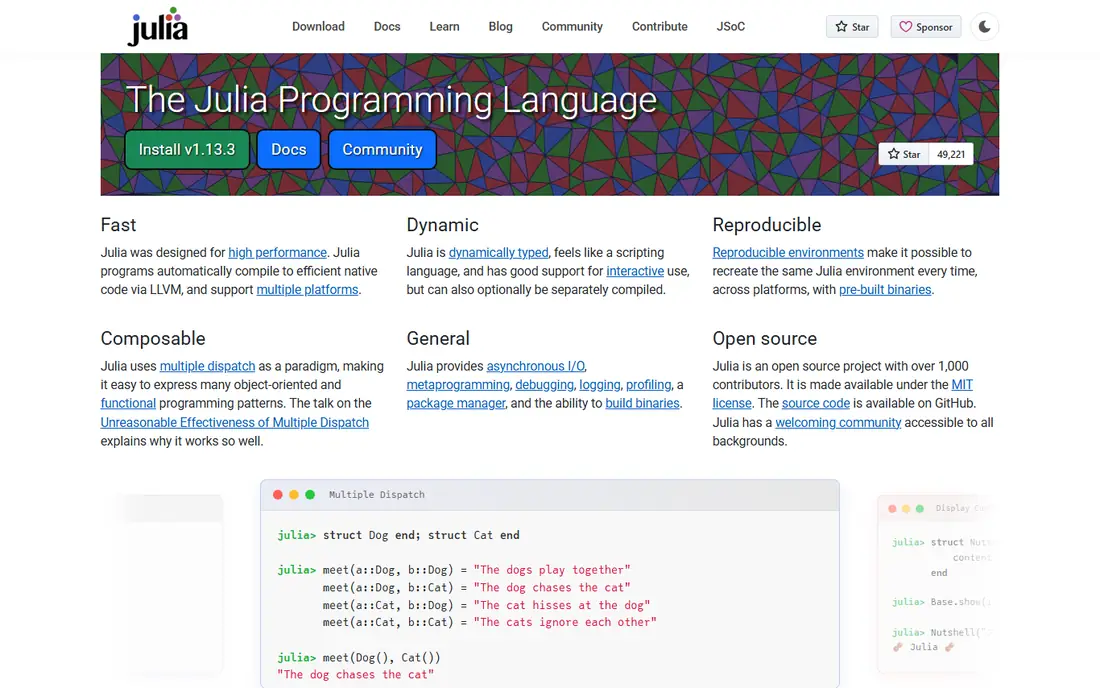
What we like- Julia was designed against R and MATLAB's shared weakness, speed, without surrendering interactive analysis: its just in time compilation runs loops and custom algorithms at near C pace, and its data frames, plotting, and modelling packages have matured into a genuine statistics workflow. Researchers in simulation heavy fields, economics, and the sciences use it when R prototypes cannot finish and rewriting in C is out of the question. Multiple dispatch makes statistical code unusually composable once the model clicks.
Watch out for- The ecosystem is smaller than R's and Python's, so niche methods may simply not exist yet and hiring is a specialist exercise. Compile latency on first runs still surprises interactive users despite steady improvement. Commercial support and validated deployment stories are thin beside SAS and MATLAB, which ends the conversation in regulated settings.
#3MATLAB
Best for: Engineering and simulation standard4.5/5 on
G2 (773 reviews, checked Oct 2026)
Visit mathworks.com
Starting priceSee website
Free planNo
What we like- MATLAB is the licensed standard of engineering organizations: matrices as the native tongue, Simulink for system simulation, and toolboxes, including a capable Statistics and Machine Learning Toolbox, validated and supported by MathWorks. Universities teach it, aerospace and automotive employers assume it, and its documentation quality sets the bar commercial tools are judged by. R users moving into engineering teams will find MATLAB already installed, licensed, and integrated with the models their colleagues run.
Watch out for- Licensing is the story: commercial seats and toolboxes are priced per product and organization size, quoted through MathWorks channels, and the total for a toolbox heavy team is significant. As a data science platform for messy real world data it is less natural than R or Python, and its community packages cannot match CRAN's statistical long tail. Code written in MATLAB stays in MATLAB's economy.
Starting priceSee website
Free planNo
What we like- SAS is the incumbent of regulated statistics: pharmaceutical trials, banking risk, and government statistics run on it because its procedures are validated, its support is contractual, and regulators accept its output without an argument about open source provenance. The modern Viya platform adds cloud deployment and open source interop, letting SAS shops call R and Python inside governed pipelines. For an R user whose analysis must survive an audit in a regulated industry, SAS is often not a choice but the house standard they are joining.
Watch out for- Pricing is enterprise negotiation, historically substantial, and the platform's breadth assumes an IT organization behind it. The SAS language itself is a career niche: skills transfer poorly outward compared with Python. Installation and administration complexity are from an older era of software, softened by cloud options but not erased.
#5Stata
Best for: Econometrics and social science4.3/5 on
G2 (166 reviews, checked Oct 2026)
Visit stata.com
Starting priceSee website
Free planNo
What we like- Stata owns econometrics and much of social science: a single consistent command language for estimation, panel data, survival analysis, and survey methods, with output formatted the way journals in those fields expect and documentation famous for worked examples. Its data management is cleaner than base R for the rectangular datasets social scientists live in, and results replicate exactly across versions, a property researchers cite by name. University pricing makes it standard issue in economics departments.
Watch out for- Stata is licensed per seat, with editions capped by variable and observation counts that push serious work to pricier tiers, and figures are quoted by StataCorp's channels rather than published simply. Programming depth beyond its command model, and machine learning breadth, trail R and Python. Outside its academic and policy heartlands, employer recognition drops sharply.
Starting priceFree
Free planYes
What we like- Octave is the free software answer to MATLAB: a numerical language highly compatible with MATLAB syntax, running much existing MATLAB code with modest changes, maintained by the GNU project and a volunteer community. For numerical methods courses, small labs, and R users who need matrix computation without a licence budget, it removes the purchasing conversation entirely. Its forge packages extend it into statistics, optimization, and signal processing.
Watch out for- Compatibility is high, not total: Simulink has no equivalent, toolboxes map partially, and GUI polish trails the commercial original. Statistical depth for data analysis proper is thinner than R's, so Octave complements rather than replaces R for most analysts. Support is community forums and documentation rather than a vendor's contract.
#7
SPSS Statistics
Best for: Survey and social science analysis
Visit ibm.com
Starting priceSee website
Free planNo
What we like- IBM SPSS Statistics serves the analyst who does not want a programming language at all: menus and dialogues for the standard social science repertoire, crosstabs, regression, factor analysis, with a syntax layer underneath for reproducibility when needed. Survey research firms, market research, and psychology and public health departments run on it, and its output tables match what those fields publish. R users advising non programming colleagues often recommend SPSS precisely because it removes the code barrier honestly rather than pretending everyone should script.
Watch out for- Licensing through IBM is subscription and module based, with the useful procedures spread across add on modules whose combined price surprises buyers
- Figures are quoted per configuration. Statistical innovation arrives slowly compared with R's package ecosystem, and complex data work hits the menu model's ceiling quickly. Data handling at scale is not its strength.
How we chose
We compared statistical and numerical computing tools against R's jobs: data analysis, modelling, visualization, and reporting, across open source and licensed options. We framed each by the use case it genuinely wins, research statistics, production data science, engineering, regulated analysis, teaching, rather than pretending a single successor exists. Licensed tools are listed as see website because their real prices depend on seats, modules, and sector agreements that no headline figure survives.
How to choose the right R alternative
Match the destination to the reason you are moving. If the analysis must ship as software, Python, and budget real time for its environment tooling. If computation is the wall, Julia for new scientific work, MATLAB where engineering infrastructure already runs on it. If the work is regulated or audit facing, SAS or the licensed standard your industry already accepts, chosen with compliance colleagues rather than by preference. If the audience is social science, Stata for researchers who script and SPSS for teams who should not have to.
Keep R where it wins during any transition. R and its package ecosystem remain free, and most destinations here interoperate with it deliberately: Python through shared data formats, SAS Viya by calling it, MATLAB through file exchange. A working pattern is new projects in the new tool, existing R pipelines left running, and skills built project by project. The expensive mistake is a flag day rewrite of trusted analyses, which converts a tooling decision into a correctness risk. Choose per project, verify results against the R originals while both live, and let the portfolio migrate at the speed of trust.
Frequently asked questions
Is Python really better than R for statistics?
For pure statistics breadth, no: R's CRAN ecosystem still leads in niche models and methods published by statisticians first. Python wins on everything around the statistics, data engineering, deployment, hiring, and general programming. Most data scientists end up bilingual, prototyping models wherever the method lives and shipping in the stack their organization runs.
Which alternative is best for academic research?
It follows the field. Economics and much social science run on Stata; psychology and survey fields on SPSS; engineering on MATLAB; and statistics and data science on R itself or Python. Check your target journals and departments before choosing, because methods sections, replication packages, and supervisor expectations are field standards, not personal preferences.
Are the free options good enough for professional work?
Python and Julia are professional grade by any measure and run production and published research at scale; their cost is learning and ecosystem fit, not capability. Octave is professional for numerical work within its compatibility limits. The licensed tools charge for validation, support contracts, documentation, and field conventions, which are real value in regulated and institutional settings rather than marks of superior mathematics.
How hard is it to move R code to Python?
Analysis logic translates readily; the friction is idiomatic. Data frames behave alike in pandas or Polars with different syntax, formulas become explicit model calls, and plotting improves or changes character depending on taste. A competent R user reads Python data code within days and writes it comfortably within a project or two. Automated converters exist for fragments, but reimplementation with verification against R's results is the professional pattern.
What do SAS and Stata offer that free tools do not?
Validated procedures with a vendor standing behind them, contractual support, documentation with worked examples for every method, and in SAS's case, acceptance by regulators as a standard environment. In clinical trials and official statistics those properties are the product. Free tools answer with transparency and community review, and the argument between the two models is settled by each industry's rules, not by benchmarks.
Sources we checked (0)
Is your product missing or out of date?
We review this list regularly. Vendors can request a listing, send updated pricing or ask about featured placement.

Shihab Mia · Founder, Rankite
Shihab has 5+ years in B2B and SaaS SEO. He writes Rankite's software buying guides from pricing pages, documentation and public user reviews. More about Shihab.