How we make this list: we compare pricing pages, product documentation and public user reviews. Ratings come from G2, Capterra or Trustpilot, with the date we checked them.
Key takeaways
- Dagster and Prefect are the leading open source Airflow alternatives, with Dagster built around data assets and Prefect built around Python-native flows.
- Managed Airflow from Astronomer, Amazon MWAA and Google Cloud Composer suits teams that want Airflow itself without running it.
- Pricing models differ sharply: hourly deployments, per-seat plans and credit-based billing change total cost as pipeline counts grow.
- Prefect acquired Dagster Labs in July 2026, so teams choosing between the two should watch how the two products converge.
Quick comparison
| Tool | Best for | Starting price | Free plan |
|---|
 Dagster | Data asset lineage and quality | $10 per month | Yes |
 Prefect | Python-native dynamic pipelines | Free | Yes |
 Astronomer Astro | Managed Airflow without operations | $0.35 per hour | No |
 Amazon MWAA | Airflow inside AWS | $0.49 per hour | No |
 Google Cloud Composer | Airflow inside Google Cloud | $0.06 per DCU-hour | No |
 Kestra | Declarative YAML orchestration | Free | Yes |
 Mage AI | Code-first pipeline building | $100 per month | No |
 Temporal | Durable stateful workflows | See website | Yes |
Is your product missing or out of date?
We review this list regularly. Vendors can request a listing, send updated pricing or ask about featured placement.
The best airflow alternatives
Starting price$10 per month
Free planYes
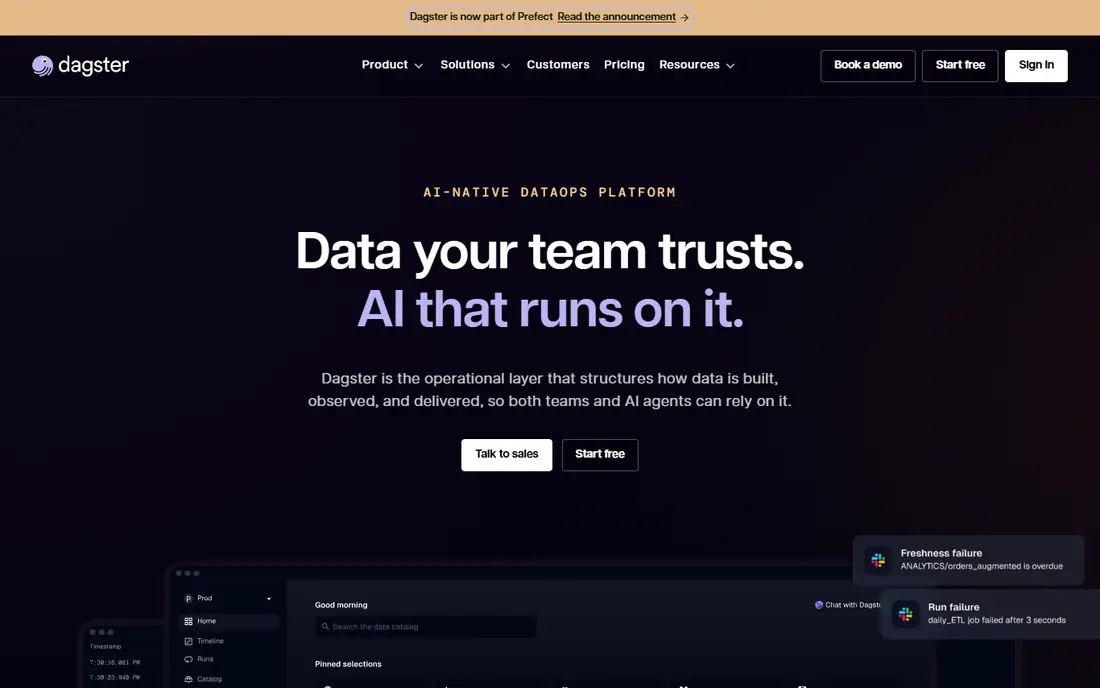
Dagster is the most credible open source alternative to Airflow for teams that think in data assets rather than tasks. Pipelines are defined as assets with dependencies inferred from code, which gives lineage, data quality checks and backfills a first-class place instead of bolting them on. The dbt integration is deep, and the asset catalog shows what data exists, how fresh it is and what broke upstream. For analytics engineering teams, that model fits daily work better than task graphs.
The cost is a learning curve for Airflow veterans, who must shift from DAG wiring to asset thinking, and a smaller integration catalog than Airflow's thousand-plus providers. Dagster+ cloud pricing starts at $10 per month plus $0.040 per credit on the Solo tier, so teams should count a month of real runs before committing, since credits grow with every materialization. Note also that Prefect acquired Dagster Labs in July 2026, so the two leading open source orchestrators now share an owner, and their roadmaps may converge over time.
What we like- Software-defined assets with built-in lineage
- Strong dbt integration
- Open source core with a 30-day cloud trial
Watch out for- Asset model takes learning for Airflow users
- Credit-based cloud pricing grows with usage
- Smaller operator catalog than Airflow
#2Prefect
Best for: Python-native dynamic pipelines4.5/5 on
G2 (125 reviews, checked Oct 2026)
Visit prefect.io
Starting priceFree
Free planYes
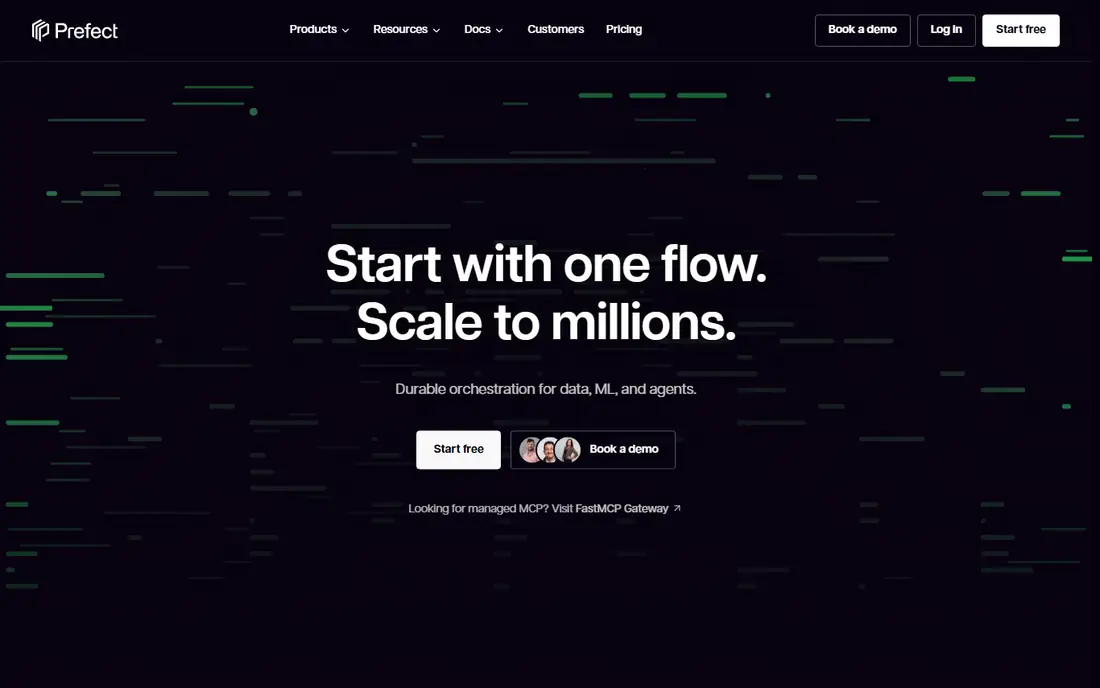
Prefect is the easiest Airflow alternative for Python-first teams. Flows and tasks are plain functions decorated with @flow and @task, so writing a pipeline feels like writing normal Python, and workflows can be shaped at runtime rather than declared fully upfront. That dynamic model carries less orchestration overhead for smaller, high-frequency jobs than Airflow's scheduler-and-worker design, and the hybrid model lets workers run in your own infrastructure while the control plane lives in Prefect Cloud.
The Hobby cloud tier is free for 2 users, 5 deployments and 500 serverless minutes, while Starter starts at $100 per month for up to 3 users, and Team runs $100 per user per month with a 4-user minimum. The ecosystem and hiring pool are smaller than Airflow's, and governance features such as role-based access sit behind Cloud tiers. For a small Python team without a platform engineer, Prefect is the fastest path to reliable orchestration.
What we like- Plain Python functions with decorators
- Dynamic workflows built at runtime
- Free Hobby cloud tier
- Hybrid execution model
Watch out for- Smaller ecosystem and talent pool than Airflow
- Access controls are Cloud-only
- Dynamic model can complicate static analysis
Starting price$0.35 per hour
Free planNo
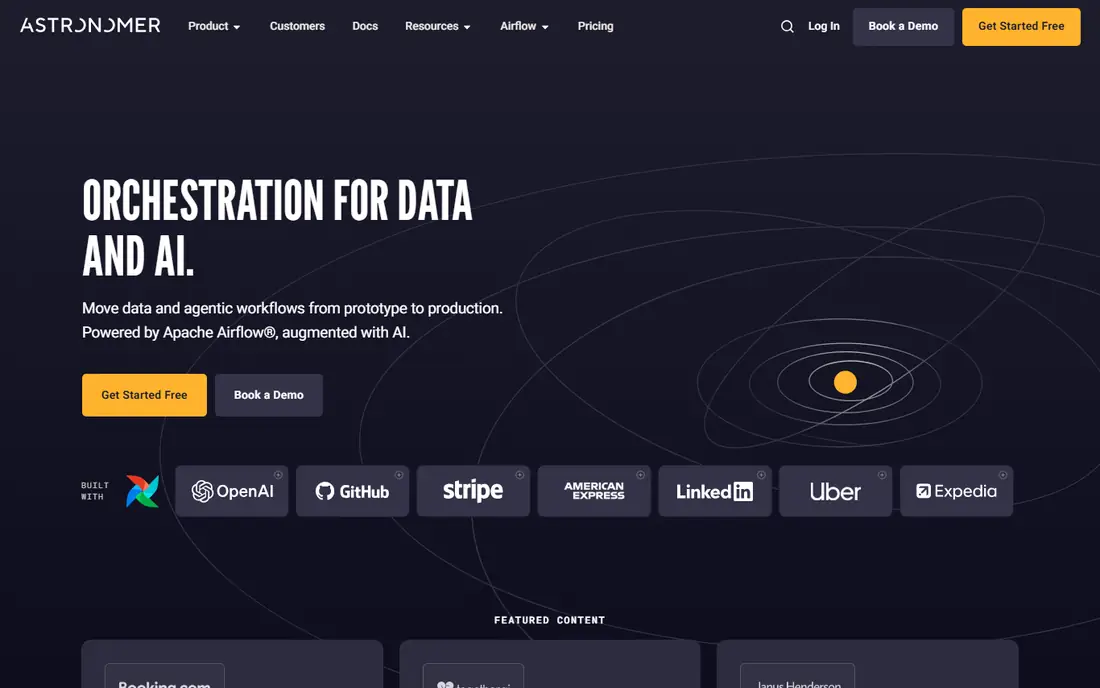
Astronomer Astro is the answer for teams that like Airflow but not running it. It is managed Airflow: the same DAGs, operators and providers, operated by the company closest to the project, with deployments starting from $0.35 per hour on the Developer tier and $0.42 per hour on Team, plus worker hours from $0.13 to $4.16 per hour. Workers scale to zero when idle, which helps on uneven workloads, and dedicated clusters run $2.00 per hour for teams that need isolation.
The billing basis deserves attention: the deployment charge runs for every hour it is up, quiet day or not, so a small deployment still bills around the clock. Business and Enterprise tiers are quoted rather than published, and private networking, high availability and audit logging sit in higher tiers. Choose Astro when Airflow's ecosystem and hiring pool matter and operations time is the scarce resource.
What we like- Run real Airflow without operating it
- Deployments from $0.35 per hour
- Workers scale to zero when idle
- Strong Airflow expertise
Watch out for- Hourly billing runs even on quiet days
- Higher tiers are quoted, not published
- Still Airflow, with its learning curve
Starting price$0.49 per hour
Free planNo
Amazon Managed Workflows for Apache Airflow, known as MWAA, brings managed Airflow to teams already on AWS. Small environments start at $0.49 per hour and large environments at $0.99 per hour, with small workers at $0.055 per hour and large workers at $0.22 per hour, plus metadata storage at $0.10 per GB-month. A serverless option bills per task at $0.080 per hour for large workers with a one-minute minimum, which suits spiky workloads better than an always-on environment.
There is no free tier, and environment hours bill continuously, so an idle environment still costs money. Tuning workers, schedulers and web servers takes AWS familiarity, and support follows AWS-wide plans rather than a dedicated Airflow plan. For AWS-centered data teams that want Airflow without managing its moving parts, MWAA is the natural managed choice.
What we like- Managed Airflow inside AWS
- Small environments from $0.49 per hour
- Serverless option for spiky workloads
- AWS-native integrations
Watch out for- No free tier
- Environment hours bill continuously
- AWS knowledge required to tune workers and schedulers
Starting price$0.06 per DCU-hour
Free planNo
Google Cloud Composer is the GCP counterpart to MWAA: managed Airflow with Google's integrations, especially BigQuery, built in. Pricing runs $0.06 per DCU-hour, with committed-use discounts bringing it to $0.054 with a one-year commitment and $0.048 with three years, plus database storage at $0.00023287 per GB-hour. Autoscaling environments adjust to workload, which helps teams with uneven schedules.
As with other managed options, there is no free tier, and DCU-hour billing needs modeling against your real pipeline volume before the monthly cost is clear. GCP familiarity helps with tuning and networking. For teams already on Google Cloud, Composer keeps Airflow close to the warehouse and avoids a second cloud relationship.
What we like- Managed Airflow inside Google Cloud
- DCU-hour billing from $0.06
- Strong BigQuery and GCP integrations
- Autoscaling environments
Watch out for- No free tier
- DCU pricing needs modeling for your workload
- GCP knowledge required for tuning
Starting priceFree
Free planYes
Kestra takes a declarative route: flows are written in YAML, which makes them easy to read, review and version without deep Python knowledge. The UI for monitoring runs, logs and retries is strong, and the open source core is free to self-host, with your Kubernetes or server cost as the only bill. For teams with analysts and engineers sharing pipeline ownership, readable YAML lowers the barrier to contributing.
The community is smaller than Airflow's, and the native integration catalog is thinner, so some connectors need custom work. Cloud pricing for larger teams is quoted rather than published, which makes budgeting harder upfront. Pick Kestra when readable, declarative pipelines and a good UI matter more than the largest possible integration library.
What we like- Declarative YAML flows that are easy to read
- Open source core
- Good UI for monitoring and debugging
- Plugin ecosystem growing
Watch out for- Smaller community than Airflow
- Fewer native data integrations
- Cloud pricing needs a quote for larger teams
Starting price$100 per month
Free planNo
Mage AI blends notebooks with pipelines: build data flows in code, edit them in a visual interface, and run them on a schedule, which suits data scientists who prototype in notebooks and need production runs without rewriting everything. The hybrid approach keeps experimentation and orchestration in one tool, and the integration set covers common warehouses, lakes and APIs.
Paid plans start from $100 per month plus compute, so it is not a free self-host alternative in the same way as Dagster or Kestra cores, and the community is smaller than the leaders. The product also changes faster, which can mean breaking updates for early adopters. Choose Mage when notebook-style prototyping and pipeline production need to live in the same tool.
What we like- Code-first pipeline creation with a visual editor
- Hybrid notebook and pipeline workflow
- Growing data integration set
Watch out for- Paid plans from $100 per month plus compute
- Smaller community than leaders
- Newer product with faster changes
Starting priceSee website
Free planYes
Temporal is the outlier here: it orchestrates durable, stateful workflows rather than data pipelines, and it excels where a process must survive failures, retries and long waits without losing state. SDKs cover many languages, and the execution model replays history to recover exactly where a workflow stopped. For order processing, onboarding flows and long-running business processes, that durability is a genuine advantage over task schedulers.
For pure data orchestration, Temporal lacks native lineage and asset tracking, and setup is engineering-heavy, with distributed systems knowledge needed for self-hosting. Cloud pricing is quoted for larger use, with a free tier and trial for getting started. Pick Temporal when workflow durability matters more than data lineage, and pick Dagster or Prefect when data assets are the core concern.
What we like- Durable execution that survives failures
- Strong SDKs for many languages
- Excellent for long-running business workflows
Watch out for- Engineering-heavy setup
- Not built for data pipeline lineage
- Pricing needs a quote for larger use
How we chose
We compared orchestrators on model, ecosystem, managed options and pricing basis, since headline prices mislead when billing units differ. Pricing figures come from vendor pages and October 2026 comparison guides: Astronomer deployments from $0.35 per hour, MWAA small environments from $0.49 per hour, Composer at $0.06 per DCU-hour, Dagster+ Solo at $10 per month plus credits, and Prefect Cloud Hobby free with Starter at $100 per month. Teams should model their own run volume against these units before committing.
We also flagged the Prefect acquisition of Dagster Labs in July 2026, since it changes the competitive picture for the two leading open source options. No tool here was tested hands-on for this guide; the picks rest on published features, pricing pages and documented architecture, not on personal use claims.
What to check before you switch
Count your real workload first. Per-credit pricing grows with every run, hourly pricing bills an idle deployment the same as a busy one, and per-seat pricing grows with team size. Run a month of your actual pipelines through a pricing calculator, or at least estimate deployments, workers and run counts, before choosing between hourly, seat and credit models.
Test migration effort on one real pipeline, not a demo. Airflow DAGs do not convert automatically to Dagster assets or Prefect flows, though converters exist for common patterns. Check operator coverage for your sources and sinks, confirm how retries, alerts and backfills behave, and verify that the UI gives your on-call staff the visibility they need at 2 a.m. For managed Airflow, confirm which governance features sit behind higher tiers before signing.
Frequently asked questions
What is the best free Airflow alternative?
Dagster's open source core and Prefect's free Hobby cloud tier are the strongest free starting points. Dagster suits asset-based analytics work, while Prefect suits Python-native dynamic pipelines. Both offer paid cloud tiers when self-hosting stops making sense.
Should I switch from Airflow or use managed Airflow?
Stay on Airflow through Astronomer Astro, Amazon MWAA or Google Cloud Composer when the ecosystem, hiring pool and existing DAGs matter most. Switch to Dagster or Prefect when the asset model or Python ergonomics solve a real pain, such as lineage or dynamic workflows, rather than for novelty alone.
How much does managed Airflow cost?
Astronomer deployments start from $0.35 per hour, MWAA small environments from $0.49 per hour, and Google Cloud Composer from $0.06 per DCU-hour, plus worker, storage and support costs. Hourly billing runs around the clock, so model your deployment size and worker hours before committing.
What does Prefect owning Dagster mean for users?
Prefect announced the acquisition of Dagster Labs in July 2026, so the two leading open source orchestrators now share an owner. Both products continue, but teams should watch roadmaps for convergence, joint features or pricing changes before making a long-term bet on either one alone.
Is Airflow still a good choice in 2026?
Yes, for large-scale scheduled batch work with a big ecosystem and hiring pool. Airflow 3.x adds an assets layer and multi-language task support, and managed options remove much of the operational burden. Its weaknesses are operational load when self-hosted and weaker native lineage than Dagster.
Can I orchestrate dbt with these tools?
Yes. Dagster has the deepest dbt asset support, Airflow and Astronomer handle dbt through operators, and Prefect offers official dbt integrations. For dbt-heavy teams, Dagster's asset model usually fits best, since dbt models map naturally to assets with lineage.
Sources we checked (0)
Is your product missing or out of date?
We review this list regularly. Vendors can request a listing, send updated pricing or ask about featured placement.

Shihab Mia · Founder, Rankite
Shihab has 5+ years in B2B and SaaS SEO. He writes Rankite's software buying guides from pricing pages, documentation and public user reviews. More about Shihab.