How we make this list: we compare pricing pages, product documentation and public user reviews. Ratings come from G2, Capterra or Trustpilot, with the date we checked them.
Key takeaways
- Google Analytics suits most sites for free, aggregate traffic and conversion tracking, with privacy settings that need care.
- Hotjar and Microsoft Clarity suit teams that want to see how visitors actually behave, through heatmaps and session recordings.
- Leadfeeder and Clearbit Reveal suit B2B teams that want to identify visiting companies for sales follow-up.
- Privacy law matters: visitor tracking, especially identification, needs consent and data handling rules in many regions.
Quick comparison
| Tool | Best for | Starting price | Free plan |
|---|
 Google Analytics | Free aggregate traffic analytics | Free | Yes |
 Hotjar | Heatmaps and session recordings | See website | Yes |
 Microsoft Clarity | Free behavior analytics | Free | Yes |
 Matomo | Privacy-focused self-hosted analytics | Free (open source) | Yes |
 Plausible | Lightweight privacy analytics | See website | Free trial |
 Leadfeeder | B2B company identification | See website | Free trial |
 Clearbit Reveal | Company identification plus enrichment | See website | No |
 Mixpanel | Product and event analytics | See website | Yes |
Is your product missing or out of date?
We review this list regularly. Vendors can request a listing, send updated pricing or ask about featured placement.
Starting priceFree
Free planYes
Google Analytics remains the default website analytics tool, tracking traffic sources, pages, conversions, and audiences for free at most sites' scale. Its event-based model in GA4 covers web and app traffic, and its integration with Google Ads and Search Console ties marketing to outcomes. Nearly every reporting tool and agency already knows it, which simplifies hiring and support.
Privacy scrutiny in the EU, setup complexity in GA4, and sampled data on very large free properties are real drawbacks. Google Analytics also offers a paid Analytics 360 tier for large properties that need unsampled data and higher limits. Google Analytics fits most sites that want capable, free aggregate analytics and can configure consent and data retention properly for their regions.
What we like- Free
- Huge adoption
- Deep traffic and conversion reporting
Watch out for- Privacy scrutiny in the EU
- Setup complexity
- Sampled data on free tier
#2Hotjar
Best for: Heatmaps and session recordings4.3/5 on
G2 (345 reviews, checked Oct 2026)
Visit hotjar.com
Starting priceSee website
Free planYes
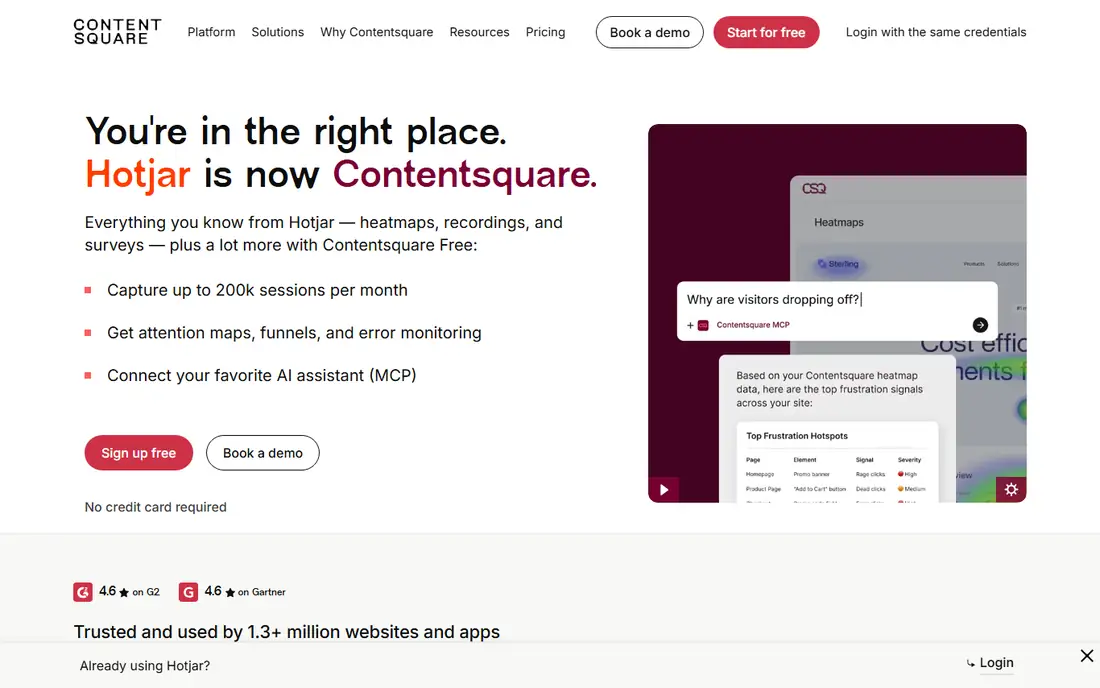
Hotjar shows how visitors actually behave: heatmaps of clicks and scrolls, session recordings of real visits, plus surveys and feedback widgets that ask visitors directly. That behavior view answers questions aggregate analytics cannot, such as why a form is abandoned or which page element draws attention. Setup is a simple script, and the free tier covers small sites.
The free tier limits recordings and sessions, recordings need consent and masking care for personal data, and Hotjar does not replace aggregate analytics. Hotjar also offers AI-assisted survey analysis that summarizes open feedback themes without manual reading. Hotjar fits teams optimizing pages and funnels that want to watch real behavior, not just count visits.
What we like- Heatmaps and recordings
- Surveys and feedback
- Easy setup
Watch out for- Free tier limited
- Recordings need consent care
- Not a full analytics replacement
Starting priceFree
Free planYes
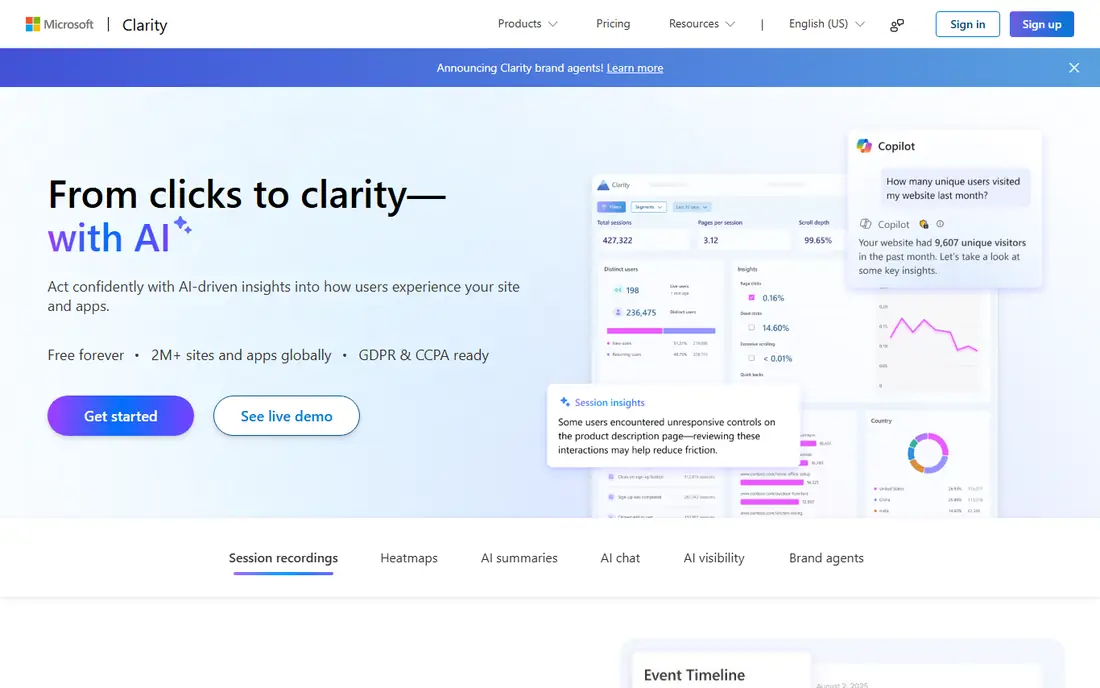
Microsoft Clarity offers heatmaps, session recordings, and behavior insights free, with no traffic caps that matter for most sites. Its dashboard surfaces rage clicks, dead clicks, and excessive scrolling automatically, which helps teams find broken experiences fast. Integration with Bing and Microsoft Advertising adds value for advertisers in that ecosystem.
It lacks the funnel and goal depth of paid analytics tools, and its community and integrations are smaller than Hotjar's. Clarity also offers Copilot-assisted session summaries that highlight likely issues without watching every recording. Clarity fits teams that want behavior analytics free, especially smaller sites and Microsoft advertisers, without paying for Hotjar.
What we like- Free with generous limits
- Heatmaps and recordings
- No traffic caps
Watch out for- No funnels or goals depth
- Microsoft ecosystem tie-in
- Smaller community
#4Matomo
Best for: Privacy-focused self-hosted analytics4.2/5 on
G2 (96 reviews, checked Oct 2026)
Visit matomo.org
Starting priceFree (open source)
Free planYes
Matomo is an open source analytics platform that sites can self-host, keeping visitor data on their own servers instead of a vendor's. It offers traffic, conversion, heatmap, and session recording features, with no data sampling and strong privacy controls including IP anonymization and cookieless options. EU sites value its GDPR-friendly design and data ownership.
Self-hosting needs server maintenance and updates, and premium features such as advanced heatmaps cost extra. Matomo also supports white-label reporting for agencies that manage analytics for clients under their own brand. Matomo fits privacy-conscious sites, EU businesses, and organizations that must own their analytics data rather than share it with a third-party vendor.
What we like- Self-hosted data ownership
- No sampling
- Strong privacy controls
Watch out for- Self-hosting needs maintenance
- Premium features cost extra
#5Plausible
Best for: Lightweight privacy analytics4.8/5 on
G2 (3 reviews, checked Oct 2026)
Visit plausible.io
Starting priceSee website
Free planFree trial
Plausible is a lightweight, privacy-focused analytics tool with a tiny tracking script that barely affects page speed, no cookies, and simple dashboards covering traffic, sources, goals, and devices. It suits sites that want essential analytics without the weight and privacy complexity of Google Analytics, and its open source code adds transparency. Bloggers, small businesses, and agencies use it for clean, fast reporting.
It offers no heatmaps, recordings, or deep product analytics, and it is paid beyond a trial. Plausible fits sites that want simple, privacy-respecting traffic analytics and do not need behavior recordings or complex funnels.
What we like- Lightweight script
- Privacy by design
- Simple dashboards
Watch out for- No heatmaps or recordings
- Paid only beyond trial
#6Leadfeeder
Best for: B2B company identification4.3/5 on
G2 (860 reviews, checked Oct 2026)
Visit leadfeeder.com
Starting priceSee website
Free planFree trial
Leadfeeder identifies companies visiting a B2B website by matching IP addresses to company databases, then shows which pages they viewed, how long they stayed, and how often they returned. Sales teams use it to follow up with warm companies that never filled a form, and its CRM integrations push leads into existing workflows. Lead scoring prioritizes the most engaged visitors.
Identification is company-level, not individual, and data quality varies by region and company size, with larger companies identified more reliably. Leadfeeder also offers website visitor alerts that notify sales when a target account returns. Leadfeeder fits B2B companies with meaningful website traffic that want sales follow-up on anonymous company visits.
What we like- Identifies visiting companies
- CRM integration
- Lead scoring
Watch out for- Company-level only, not individuals
- Data quality varies by region
Starting priceSee website
Free planNo
Clearbit Reveal identifies visiting companies and enriches them with firmographic data such as industry, size, and technology, feeding sales and marketing systems with actionable context. Its Salesforce and marketing automation integrations let teams route high-value visitors to sales automatically. Data quality is strong for US companies, which suits B2B SaaS and services firms.
Pricing is premium, identification remains company-level, and low-traffic sites see limited value. Clearbit Reveal also supports website personalization that tailors content by visiting company segment. Clearbit Reveal fits B2B companies with solid website traffic that want identification plus enrichment in one system, integrated with their CRM.
What we like- Company identification plus enrichment
- Strong data
- Salesforce integration
Watch out for- Premium pricing
- Company-level identification only
- Needs traffic volume
#8Mixpanel
Best for: Product and event analytics4.5/5 on
G2 (1,375 reviews, checked Oct 2026)
Visit mixpanel.com
Starting priceSee website
Free planYes
Mixpanel tracks events and user journeys inside products and websites, with funnels, retention, and cohort analysis that show how users move from signup to activation to payment. Product teams use it to measure feature adoption and drop-off, while its free tier covers early-stage products. Its analysis tools go deeper than pageview analytics for product questions.
The learning curve is steeper than Google Analytics, and session recording and marketing attribution are thinner. Mixpanel fits product teams that need event-based analytics for funnels and retention, alongside or instead of pageview tools.
What we like- Strong event and funnel analytics
- Product insights
- Free tier
Watch out for- Learning curve
- Session and marketing analytics thinner
How we chose
We compared pricing pages, product documentation, and public user reviews for website visitor tracking tools that are actively sold in 2026. We favored tools with real tracking capability, current availability, and clear privacy handling. We checked identification claims carefully, since company identification is probabilistic and never identifies individuals lawfully from IP data alone, and we left out tools that no longer sell a current tracking product.
Aggregate analytics and identification are different jobs
Most tracking confusion comes from mixing two jobs: aggregate analytics, which counts visits and conversions, and identification, which names visiting companies. Aggregate tools like Google Analytics, Matomo, and Plausible answer how many visitors and what they did. Identification tools like Leadfeeder and Clearbit answer which companies visited. B2B teams often need both, but buying an identification tool for aggregate reporting, or vice versa, wastes money and disappoints.
Handle consent before you track
Privacy law in the EU, UK, California, and other regions restricts tracking, especially identification, recordings, and cross-site data. Use a consent management platform, configure IP anonymization and data retention, mask personal data in recordings, and document what each tool collects and why. When in doubt, track less: aggregate, anonymized data usually answers business questions without personal data risk.
Combine behavior with numbers for real insight
Aggregate numbers show what happened, while heatmaps and recordings show why. A page with high traffic and low conversion needs behavior data: recordings reveal confusing forms, broken elements, and misleading copy that numbers alone cannot explain. Pair an aggregate tool with Hotjar or Clarity for optimization work, and keep the aggregate tool as the source of truth for traffic and revenue.
Review tracking performance quarterly
Tracking tools drift: consent banners change, scripts break after site redesigns, and identification accuracy shifts with traffic mix. Review data quality quarterly, compare analytics against server logs and CRM records, and fix gaps promptly. A tracking setup nobody audits slowly stops reflecting reality.
Check identification accuracy on your own traffic
Company identification accuracy varies by region, company size, and traffic source, and vendor claims rarely match every site. Trial identification tools on your own traffic, compare identified companies against known customers and form fills, and measure how many identified visits turn into real conversations before committing to premium pricing.
Frequently asked questions
Is Google Analytics still the best free option?
For aggregate traffic and conversion tracking, yes for most sites, with proper consent and retention settings. Privacy-focused sites may prefer Matomo or Plausible, and behavior questions need Hotjar or Clarity alongside any aggregate tool.
Can visitor tracking tools identify individual visitors?
No, lawfully, from IP data alone. Company identification tools identify visiting companies, not named individuals, and personal identification needs consent-based identification such as a form fill or login. Vendors claiming individual identification from anonymous visits should be treated with skepticism.
Is Microsoft Clarity really free with no limits?
Clarity is free with generous limits and no traffic caps that affect most sites. Very large sites should confirm current limits on its site, but for small and mid-sized sites it is effectively free behavior analytics.
Do I need consent for analytics cookies?
In the EU and UK, generally yes for non-essential cookies, while cookieless and privacy-focused configurations reduce consent burden. Rules vary by region and tool configuration, so confirm requirements for your audience locations with qualified counsel.
Which tool should a B2B startup pick first?
Start with Google Analytics or Plausible for aggregate traffic, add Clarity free for behavior, and trial Leadfeeder once traffic is meaningful enough to produce identifiable companies. That stack covers traffic, behavior, and sales follow-up without premium cost early.
Sources we checked (8)
- https://analytics.google.com
- https://www.hotjar.com
- https://clarity.microsoft.com
- https://matomo.org
- https://plausible.io
- https://www.leadfeeder.com
- https://clearbit.com
- https://mixpanel.com
Is your product missing or out of date?
We review this list regularly. Vendors can request a listing, send updated pricing or ask about featured placement.

Shihab Mia · Founder, Rankite
Shihab has 5+ years in B2B and SaaS SEO. He writes Rankite's software buying guides from pricing pages, documentation and public user reviews. More about Shihab.