How we make this list: we compare pricing pages, product documentation and public user reviews. Ratings come from G2, Capterra or Trustpilot, with the date we checked them.
Key takeaways
- ShipBob offers the widest warehouse network in this group, with more than 50 fulfillment centers and a 99.97 percent accuracy rate stated on its homepage.
- Simpl Fulfillment is the only provider here with a published starting rate, at 7 dollars per order with postage and packaging included.
- Red Stag Fulfillment is the clear pick for heavy or bulky goods, with a written guarantee covering zero shrink, zero mispicks, and zero late shipments.
- Most 3PL pricing is custom quote only, so the monthly minimum and the storage rate matter more than any headline per-order figure.
- Switching 3PLs takes planning: inventory transfer, integration setup, and a parallel shipping period all need time before peak season.
Quick comparison
| Tool | Best for | Starting price | Free plan |
|---|
 ShipBob | Large DTC brands that need fast nationwide delivery | See website | No |
 Red Stag Fulfillment | Heavy, bulky, or high-value products | See website | No |
 Flowspace | Mid-market omnichannel brands | See website | No |
 Shipfusion | Scaling DTC brands that want transparent billing | See website | No |
 Simpl Fulfillment | Founder-led brands that want published pricing | $7 per order | No |
 Stord | Larger brands that want software plus fulfillment | See website | No |
 DCL Logistics | High-growth brands with retail and kitting needs | See website | No |
 Flexport | Brands that want freight and fulfillment together | See website | No |
Is your product missing or out of date?
We review this list regularly. Vendors can request a listing, send updated pricing or ask about featured placement.
The best ShipMonk alternatives
#1ShipBob
Best for: Large DTC brands that need fast nationwide delivery3.7/5 on
G2 (122 reviews, checked Oct 2026)
Visit shipbob.com
Starting priceSee website
Free planNo
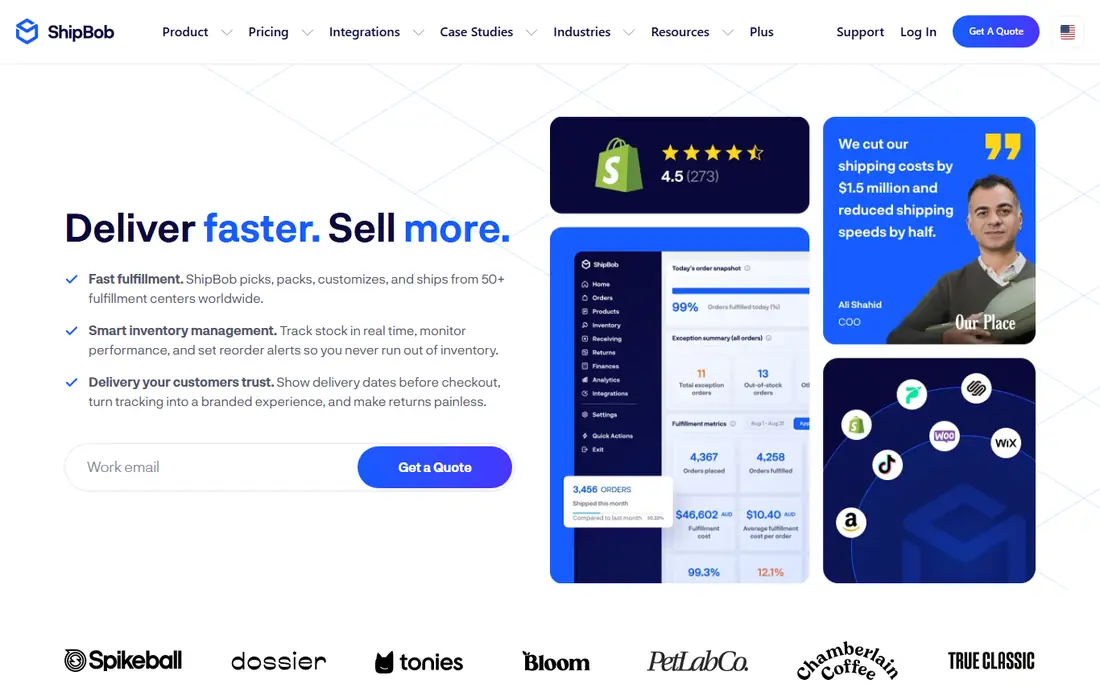
ShipBob is the default shortlist pick for brands that have outgrown a single warehouse. Its network spans more than 50 fulfillment centers, which lets a brand split inventory across regions and cut both transit time and shipping zones. The dashboard handles order routing, inventory tracking, and retail channel connections in one place, so a team selling on Shopify, Amazon, and Walmart does not need a separate tool for each channel.
The trade-off is transparency. Pricing is custom quote only, and minimums exist but are not published, so a smaller brand cannot tell from the website whether it qualifies. ShipBob also runs a large operation, and some merchants report that support feels less personal than at a boutique 3PL. For a brand shipping hundreds of orders a day and chasing two-day delivery promises, the network effect usually outweighs those drawbacks.
What we like- More than 50 fulfillment centers worldwide
- 99.97 percent order accuracy stated on its homepage
- Support for more than 200 retail channels
Watch out for- Custom quote pricing hides costs until you talk to sales
- Minimums apply and are not published
- Service can feel less personal at very large scale
Starting priceSee website
Free planNo
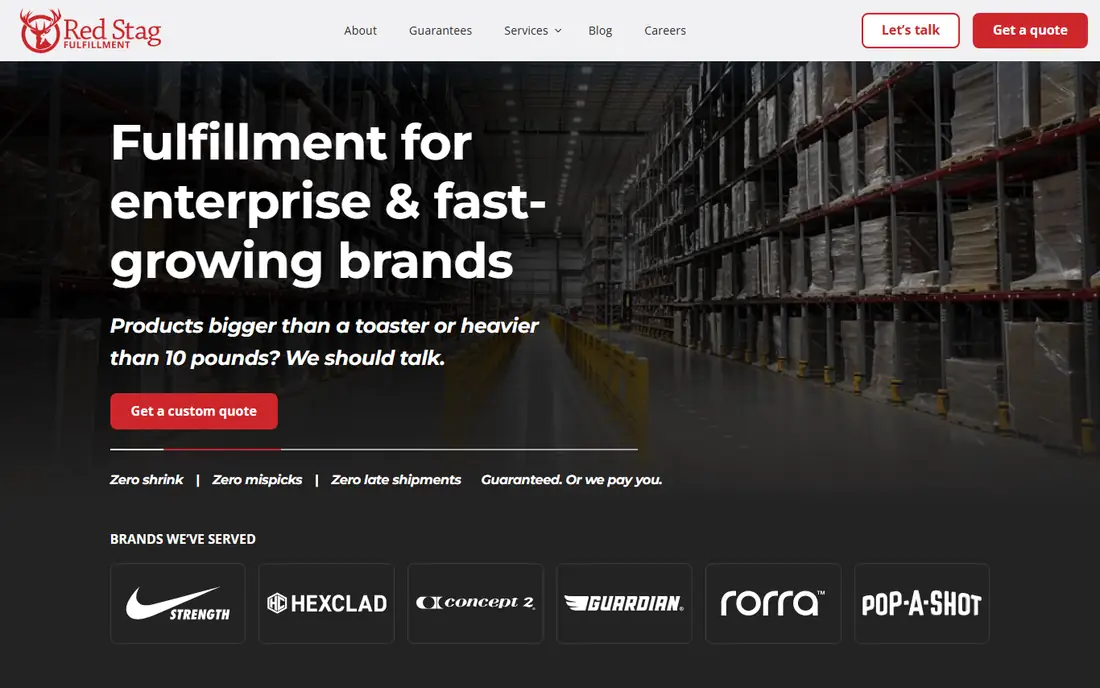
Red Stag Fulfillment built its name on products most 3PLs avoid: items bigger than a toaster or heavier than 10 pounds. Its two warehouses in Tennessee and Utah handle parcel and pallet orders under one roof, and the company states plainly that it pays you when it misses its guarantee on shrink, mispicks, or late shipments. That guarantee is unusual in an industry where most contracts bury accuracy terms in fine print.
The catch is geography and price. Two warehouses cannot match the zone coverage of a 50-node network, and specialist handling costs more per order. Brands shipping kayaks, fitness equipment, or furniture will likely save on damage claims and surcharge negotiations, but a brand selling small, light goods will find cheaper options elsewhere. Red Stag also says it has no set order minimum, which helps mid-size brands that a larger 3PL might turn away.
What we like- Written guarantee on zero shrink, zero mispicks, and zero late shipments
- Deep experience with oversize surcharges
- US-based account support
Watch out for- Only two US warehouses, so coastal coverage is thinner
- Premium pricing for a specialist service
- Domestic focus with no international network of its own
#3Flowspace
Best for: Mid-market omnichannel brands4.0/5 on
G2 (53 reviews, checked Oct 2026)
Visit flow.space
Starting priceSee website
Free planNo
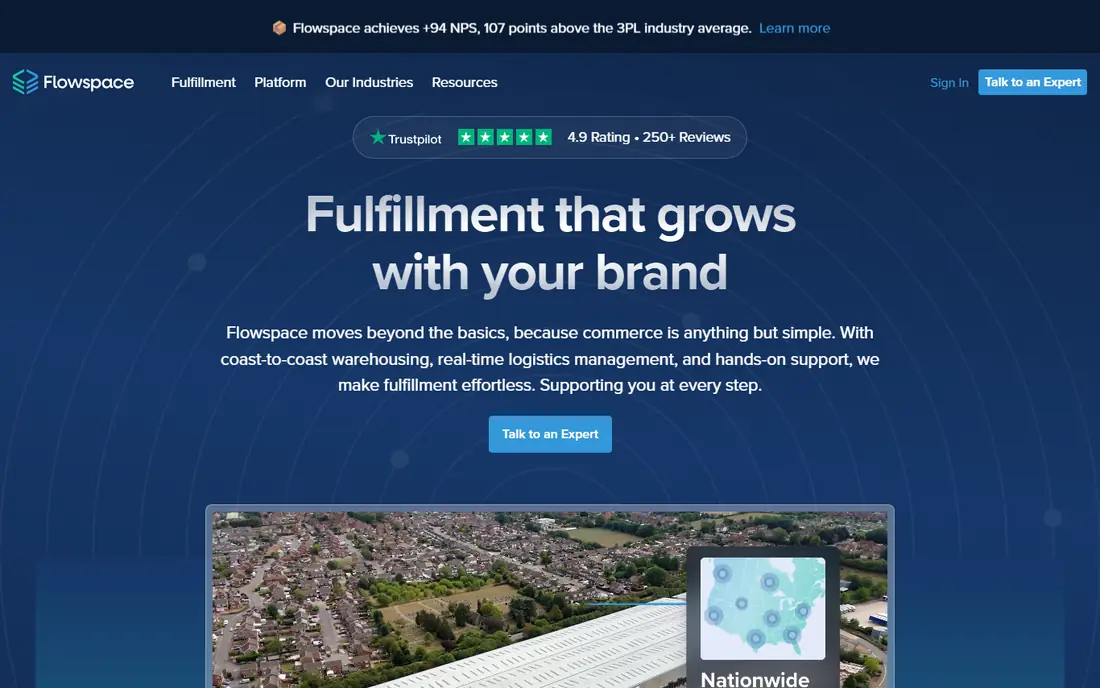
Flowspace pairs a fulfillment network with software that treats every channel as one operation. A brand selling direct, on Amazon, and into retail can route orders, track inventory, and manage retail compliance from a single platform instead of juggling separate workflows. The company highlights FDA-registered facilities and lot tracking, which matters for supplements, food, and beauty brands with compliance needs.
Flowspace says it works without long-term contracts, which lowers the risk of trying it. The open question is fit: its own guidance points to brands doing 1,000 or more orders a month, and pricing is custom, so a startup cannot self-serve a quote. The partner warehouse model also means service quality can differ by node, so a brand should ask which specific facilities would hold its stock before signing.
What we like- Centralized control across DTC, marketplace, and B2B orders
- Real-time inventory visibility
- No long-term contracts stated on its homepage
Watch out for- Best fit starts around 1,000 orders a month, so very small brands may not qualify
- Custom pricing only
- Partner warehouse model varies by location
Starting priceSee website
Free planNo
Shipfusion positions itself as the 3PL for brands that are tired of surprise fees. Its homepage states transparent pricing from day one, dedicated account management without service tiers, and in-house technology built by its own team. Warehouses in Toronto, Chicago, Las Vegas, York in Pennsylvania, and a coming Dallas site give solid North American coverage for DTC and B2B orders, plus freight services through Shipfusion 360.
The network is smaller than the biggest players, so a brand needing deep international coverage or dozens of nodes may look elsewhere. Pricing is custom, which undercuts the transparency message a little, since the actual rate still comes from a quote. For a scaling DTC brand that values a named account contact and a clear invoice, Shipfusion is a strong alternative to ShipMonk.
What we like- Transparent pricing with no hidden fees stated on its homepage
- Dedicated account management with no service tiers
- Owned warehouses in the US and Canada
Watch out for- Smaller network than ShipBob or Stord
- Custom pricing only
- Newer Dallas site was still listed as coming soon
Starting price$7 per order
Free planNo
Simpl Fulfillment is the rare 3PL that publishes its price. Orders start at 7 dollars each, covering three picks, postage, and packaging, and orders received by noon Central ship the same day. The 750 dollar monthly minimum works on a pay-the-difference basis, so a slow month costs the gap rather than a separate fee on top of fulfillment charges. That clarity makes budgeting simple for a founder-led brand.
The limit is geography. One Austin warehouse means longer transit to the coasts than a distributed network can offer, and brands shipping nationwide may pay more in zones. Simpl also focuses on founder-led brands, so a large enterprise with complex retail compliance may need a bigger partner. For a small brand that wants to know its fulfillment cost before it signs anything, Simpl is hard to beat.
What we like- Published starting rate of 7 dollars per order with postage and packaging included
- Same-day shipping for orders in by noon Central
- Pay-the-difference 750 dollar monthly minimum
Watch out for- Single Austin warehouse limits zone coverage
- No upper size limit but custom pricing only above 5,000 orders a month
- Smaller team than national 3PLs
#6
Stord
Best for: Larger brands that want software plus fulfillment
Visit stord.com
Starting priceSee website
Free planNo
Stord sells fulfillment and the software that runs it as one package. Its order management and warehouse management systems sit alongside more than 20 omnichannel nodes, and the company states 99 percent ground coverage in under two days. Brands also get parcel optimization and inventory planning tools, which help a team that wants to manage its whole supply chain rather than just outsource picking and packing.
That breadth comes with an enterprise lean. Stord suits larger, complex operations, and a small brand may find the sales process and onboarding heavier than at a boutique 3PL. Pricing is custom, so there is no way to estimate cost from the website. For a brand already thinking about demand forecasting, retail distribution, and multi-node inventory, Stord offers more than a warehouse.
What we like- Integrated OMS and WMS software with fulfillment
- 99 percent coverage in under two days via ground
- More than 20 omnichannel nodes
Watch out for- Enterprise-leaning, so small brands may not fit
- Custom pricing only
- Software depth can mean a longer onboarding
#7
DCL Logistics
Best for: High-growth brands with retail and kitting needs
Visit dclcorp.com
Starting priceSee website
Free planNo
DCL Logistics brings four decades of experience to brands that need more than basic pick, pack, and ship. Its eFactory platform gives one view of orders, inventory, returns, and integrations, and its client list includes hardware and consumer brands with demanding retail programs. Kitting, subscription boxes, and complex assemblies are core strengths, and the ISO 9001 certification signals process discipline that matters when retail chargebacks are on the line.
The drawback is accessibility. DCL is built for high-growth brands, and comparison guides report higher minimums and a complex pricing structure. A small brand may struggle to get a straight answer on cost without a long sales conversation. For a brand moving into retail or running intricate kits, DCL is a credible ShipMonk alternative with a long track record.
What we like- 40 years of operational experience and ISO 9001 certification
- Proprietary eFactory platform for orders, inventory, and returns
- Strong kitting and retail compliance record
Watch out for- Custom pricing only
- Higher minimums reported by comparison guides
- Complex pricing structure for smaller brands
Starting priceSee website
Free planNo
Flexport is best known as a freight forwarder, and that heritage is the point for brands that import goods and then need them fulfilled. Its platform covers ocean, air, rail, and road freight plus customs brokerage and ecommerce fulfillment, so a brand can manage the journey from factory to customer door in one place. The network reaches 135 countries, which suits brands with global sourcing.
The catch is the fulfillment minimum. Comparison guides report a 5,000 dollar monthly fulfillment spend minimum since January 2026, which rules out small brands. Flexport also comes at fulfillment from freight, so a pure DTC brand may find deeper ecommerce tooling at a dedicated 3PL. For an importer that wants one partner across freight and fulfillment, Flexport is a logical ShipMonk alternative.
What we like- Freight forwarding, customs brokerage, and fulfillment on one platform
- Network reaching 135 countries
- Strong fit for importers
Watch out for- Fulfillment minimum spend reported at 5,000 dollars a month since January 2026
- Freight-first heritage means DTC depth varies
- Custom pricing only
How we chose
We compared 3PL providers that serve ecommerce brands in the United States, using vendor homepages, pricing pages, and public comparison guides. We checked each homepage to confirm it loads and belongs to the provider named, and we used published rates where a provider states them, marking the rest as custom quote. We favored providers with distinct strengths, such as heavy goods, published pricing, or freight integration, over a list of near-identical warehouses. Where a price could not be verified from the vendor, we wrote See website rather than repeating a third-party estimate.
What to ask before you sign with a 3PL
A 3PL quote is only useful when every cost line is visible. Ask for the pick fee, the per-order fee, storage per pallet or per cubic foot, receiving fees, account management fees, and the cost of returns processing. Then ask how each fee changes at your actual volume, since a rate quoted at 5,000 orders a month may not apply at 500. Get the monthly minimum in writing, and ask whether it is pay-the-difference or an extra charge on top of fulfillment.
Check the warehouse map against your customers
Plot your last six months of orders by state, then ask which warehouses would hold your stock and what share of orders would ship in one or two zones. A provider with a single warehouse can still win if most of your customers live nearby, but a national brand usually saves on shipping zones by splitting inventory. Ask about cutoff times too, since a 2 pm cutoff versus a noon cutoff changes how many orders ship same day.
Plan the switch before peak season
Moving 3PLs involves transferring inventory, connecting your store and marketplace integrations, and testing order flows with real orders. Run both providers in parallel for at least two weeks if you can, and keep safety stock at the old warehouse until the new one proves its accuracy. Never switch in November if you can avoid it, since carrier capacity and warehouse labor are both tightest then.
Watch the contract terms
Look for the initial term, the notice period, and any fee for leaving early. Ask who owns your data and how you export order history if you leave. A provider that refuses a month-to-month option or charges heavily for data export is telling you something about how it treats departing clients, and that signal matters as much as the per-order rate.
Frequently asked questions
Is ShipMonk itself a good 3PL?
ShipMonk is a large, technology-led 3PL with warehouses in the US, Canada, Europe, and Mexico, and it suits subscription and kitting-heavy brands. Brands consider alternatives when pricing transparency, support responsiveness, or a specific specialty such as heavy goods matters more than network size.
How much does 3PL fulfillment cost per order?
For standard lightweight products, comparison guides put all-in costs around 3 to 6 dollars per order plus storage and receiving, but the real figure depends on weight, picks per order, packaging, and shipping zones. Simpl Fulfillment publishes a 7 dollar starting rate with postage included, while most others quote custom rates.
Do 3PLs have monthly minimums?
Many do, and the form varies. Simpl charges a 750 dollar monthly minimum on a pay-the-difference basis, ShipMonk ties its minimum to order volume and pick fee, and Flexport has been reported with a 5,000 dollar monthly fulfillment spend minimum. Always get the minimum in writing before signing.
How long does it take to switch 3PL providers?
A typical switch takes four to eight weeks, including integration setup, inventory transfer, and parallel testing. The timeline stretches if you need custom packaging, kitting workflows, or retail compliance setup, so start the process well before a sales peak.
Can a small brand use a 3PL?
Yes, but the fit depends on minimums. Simpl and Red Stag state friendlier terms for smaller brands, while larger networks may require volume minimums that a startup cannot meet. A brand shipping fewer than 100 orders a month may still be better off fulfilling in-house until volume grows.
Should I split inventory across multiple warehouses?
Splitting inventory cuts shipping zones and transit time for a national customer base, but it adds complexity in forecasting and stock transfers. It pays off once order volume is high enough that zone savings exceed the extra storage and management cost, which most brands reach in the low thousands of orders per month.
Sources we checked (10)
- https://shipbob.com
- https://redstagfulfillment.com
- https://flow.space
- https://www.shipfusion.com
- https://www.simplfulfillment.com
- https://www.stord.com
- https://www.dclcorp.com
- https://www.flexport.com
- https://www.simplfulfillment.com/blog/shipmonk-alternatives
- https://amzprep.com/best-3pl-ecommerce/
Is your product missing or out of date?
We review this list regularly. Vendors can request a listing, send updated pricing or ask about featured placement.

Shihab Mia · Founder, Rankite
Shihab has 5+ years in B2B and SaaS SEO. He writes Rankite's software buying guides from pricing pages, documentation and public user reviews. More about Shihab.