How we make this list: we compare pricing pages, product documentation and public user reviews. Ratings come from G2, Capterra or Trustpilot, with the date we checked them.
Direct answer
Mailgun is the closest SendGrid alternative for most developers, with Basic at $15 per month for 10,000 emails and a free plan of 100 emails per day. Postmark suits transactional-only senders better, also at $15 per month, with separate message streams for transactional and broadcast mail.
Key takeaways
- Developers who need inbound routing: Mailgun Basic costs $15 per month for 10,000 emails and includes 5 inbound routes.
- Transactional-only senders: Postmark Basic costs $15 per month for 10,000 emails, with extra emails at $1.80 per 1,000.
- High volume senders on AWS: Amazon SES Essentials costs $0.16 per 1,000 emails for the first 10 million emails per month.
- Small teams mixing marketing mail: Mailjet Starter costs $9 per month for 8,000 emails, with a free plan of 6,000 emails per month.
- Teams that also test email in staging: Mailtrap Basic costs $15 per month for 10,000 emails, with a free plan of 4,000 emails per month.
Quick comparison
| Tool | Best for | Starting price | Free plan |
|---|
 Mailgun | Developers needing API plus inbound routing | Basic $15/mo, 10,000 emails/mo included | Free $0/mo, 100 emails/day included |
 Postmark | Transactional-only senders wanting fast delivery | Basic $15.00/mo at 10,000 emails | Free Developer plan, 100 emails/month, no overages |
 Resend | Modern app teams wanting a clean API | Pro $20/mo, 50,000 emails/mo | Free $0/mo, 3,000 emails/mo, 100 emails a day |
 Amazon SES | High volume senders already on AWS | Essentials $0.16 per 1,000 emails, 0 to 10M emails/month | Up to $200 in AWS Free Tier credits for new AWS customers |
 Mailtrap | Teams wanting sending plus email testing | Basic $15/month at 10,000 emails/month | Free $0 forever, 4,000 emails/mo, 150 emails/day |
 Mailjet | Small teams mixing marketing and transactional | Starter $9/month, 8,000 emails/month | Free $0/month, 6,000 emails/month, 200 emails per day |
 Brevo | Budget senders wanting API plus marketing tools | Starter $9 per month, from 5,000 emails per month | Free 300 emails/day, no credit card required |
 SMTP2GO | Simple SMTP relay with phone support | Starter $10/mo, 10,000 emails/mo | Free up to 1,000 emails per month |
 Elastic Email | Cost-sensitive high volume API sending | Email API Starter $19/month, 50,000 emails/month | Free 3,000 emails/month, 100/day limit |
 Bird | High volume senders wanting SparkPost infrastructure | Email Startup $15/month to shared balance, usage charged separately | Free $0/month, 1,000 emails/month allowance |
Is your product missing or out of date?
We review this list regularly. Vendors can request a listing, send updated pricing or ask about featured placement.
The best sendgrid alternatives
SendGrid built its name on API and SMTP sending for app mail, such as receipts, password resets, and alerts. Teams look for an alternative when they want a permanent free tier, a lower entry price, better log retention, or a dedicated IP without a high plan jump. This list ranks providers by published vendor pricing, free plan limits, and the cost of the features app teams ask for first, such as webhooks, inbound routing, and dedicated IPs. Prices below were checked on vendor pages on 2026-11-28.
Starting priceBasic $15/mo, 10,000 emails/mo included
Free planFree $0/mo, 100 emails/day included
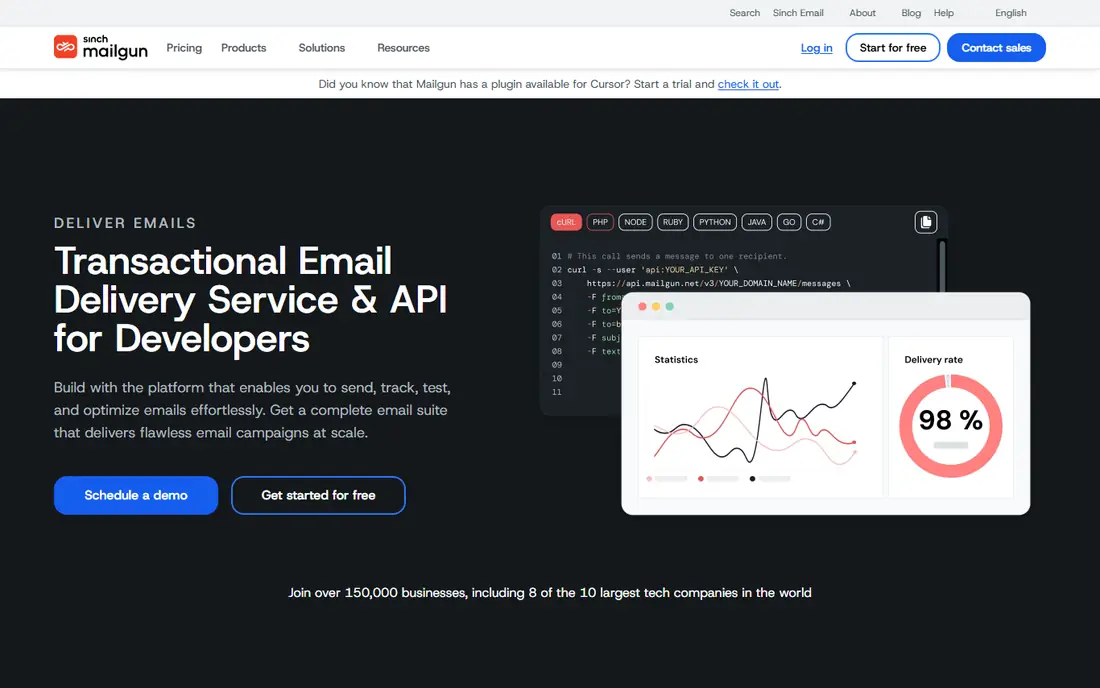
Mailgun is a developer email service with a REST API, SMTP relay, inbound routing, and email validation sold beside sending. It suits apps that send transactional mail and also receive replies or process incoming messages by route. Basic costs $15 per month for 10,000 emails, with extra emails from $1.80 per 1,000. The free plan sends 100 emails per day with ticket support, one custom domain, and one inbound route. Foundation at $35 per month raises the allowance to 50,000 emails and extends log retention to 5 days for each sending domain.
The catch is retention and domains at the low end. Free and Basic keep logs for 1 day and allow 1 custom sending domain, so a team debugging a delivery problem a week later has little history to read. Additional dedicated IPs cost $59 per IP per month. Pick Mailgun if inbound routing and validation matter beside sending. Look elsewhere if long log history on the entry plan is a hard need.
What we like- RESTful email APIs and SMTP relay on every plan
- Tracking, analytics, and webhooks included
- US or EU sending region from one account
Watch out for- Free and Basic allow 1 custom sending domain with 1 day log retention
- Additional dedicated IPs cost $59 per IP per month
Starting priceBasic $15.00/mo at 10,000 emails
Free planFree Developer plan, 100 emails/month, no overages
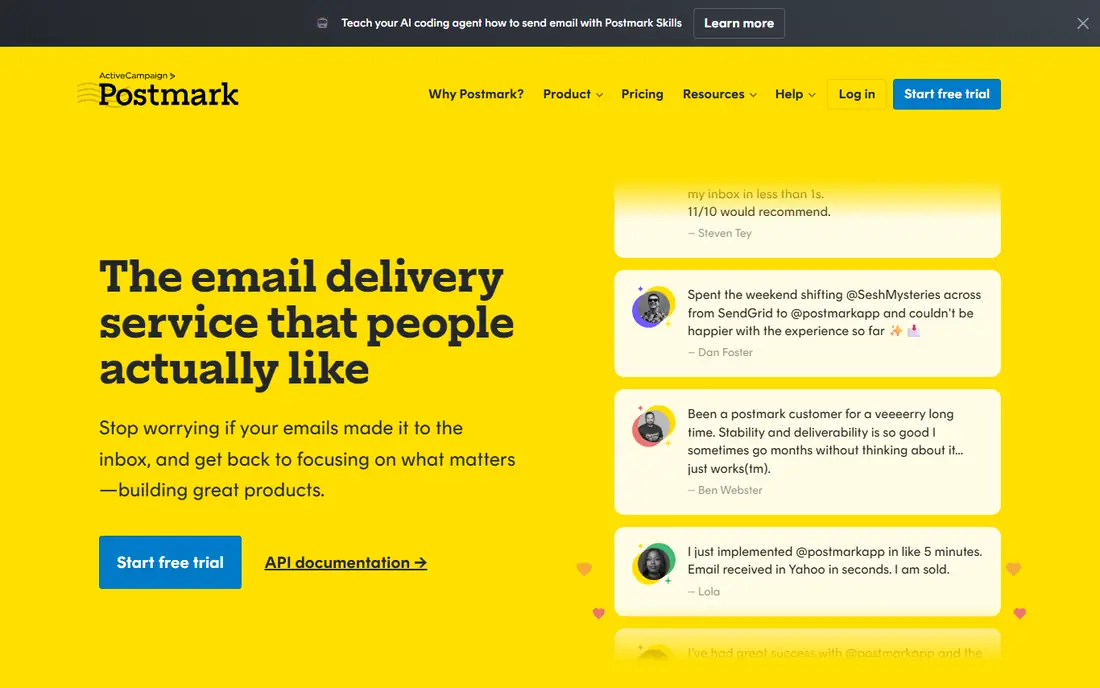
Postmark is built for transactional email, with Message Streams that keep transactional mail apart from broadcast mail. It suits products where receipts, alerts, and password resets must not share a stream with newsletters. Basic costs $15.00 per month at 10,000 emails, with extra emails at $1.80 per 1,000. Pro and Platform keep the same 10,000 email starting volume and lower the extra email rate. The free Developer plan gives 100 emails per month with no overages, which suits a first integration test before a paid public launch.
The catch is the jump from free to paid. There is no small paid tier between 100 emails and 10,000 emails per month, and the free plan stops at 100 with no paid overage. Dedicated IPs start at $50 per month per IP and require 300,000 or more emails per month on Pro or higher. Pick Postmark for focused transactional sending. Look elsewhere if you need a mid-size plan under 10,000 emails.
What we like- Separate transactional and broadcast Message Streams
- 45-day data retention on Basic
- Inbound email processing on Pro and Platform
Watch out for- No tier between 100 free emails and 10,000 paid emails per month
- Dedicated IPs start at $50 per month per IP and require 300,000 or more emails per month
Starting pricePro $20/mo, 50,000 emails/mo
Free planFree $0/mo, 3,000 emails/mo, 100 emails a day

Resend is an email API aimed at app teams that want sending set up with little code. It suits startups and product teams sending account mail, receipts, and product alerts from one API. The free plan gives 3,000 emails per month, capped at 100 emails a day, with 3 domains and ticket support. Pro costs $20 per month for 50,000 emails and removes the daily limit, with extra emails at $0.90 per 1,000. Scale costs $90 per month for 100,000 emails and raises the domain limit to 1,000 for larger sending setups.
The catch is the free daily cap and the dedicated IP gate. A launch day spike above 100 emails needs a paid plan, and dedicated IPs cost $30 per month as an add-on only for Scale customers sending over 3,000 emails per day. Upgrading also does not raise the API rate limit, which is set per team. Pick Resend for a clean API and a usable free tier. Look elsewhere if a dedicated IP is needed at low volume.
What we like- Free plan includes 3 domains and open and click tracking
- Pro removes the daily limit at 50,000 emails per month
- Overages are billed per 1,000 emails on paid plans
Watch out for- Free plan is capped at 100 emails a day and 3 domains
- Dedicated IPs are a $30 per month add-on for Scale customers sending over 3,000 emails per day
Starting priceEssentials $0.16 per 1,000 emails, 0 to 10M emails/month
Free planUp to $200 in AWS Free Tier credits for new AWS customers
Amazon SES is the AWS email service, sending through an API or SMTP interface inside an AWS account. It suits high volume senders already on AWS that can manage sending setup, suppression handling, and monitoring with AWS tools. Essentials costs $0.16 per 1,000 emails for the first 10 million emails per month, then $0.14 per 1,000 to 100 million. New SES accounts start on Essentials. New AWS customers can receive up to $200 in Free Tier credits, which can cover early sending while a team tests its full sending setup.
The catch is plan cost above Essentials. Pro adds $105 per account per region per month and Enterprise adds $500, on top of per email rates, and attachments add $0.12 per GB. The old SES free allowance of 3,000 message charges per month ended for new customers on 21 July 2026. Pick SES for volume inside AWS. Look elsewhere if you want deliverability tools and support bundled at a flat entry price.
What we like- Pay-as-you-go pricing with no upfront commitments
- Tiered per 1,000 rates fall as volume rises
- Pro and Enterprise plans bundle deliverability features
Watch out for- New accounts start on Essentials at $0.16 per 1,000 emails
- Pro adds $105 and Enterprise $500 per account per region per month
- Attachments add $0.12 per GB
Starting priceBasic $15/month at 10,000 emails/month
Free planFree $0 forever, 4,000 emails/mo, 150 emails/day
Mailtrap combines live email sending with testing tools that many teams already use in staging. It suits product teams that test app mail in a sandbox and then send production mail through an API or SMTP relay. Basic costs $15 per month for 10,000 emails, with no daily sending limit and 5 days log retention. The free plan gives 4,000 emails per month at 150 emails per day. Business costs $85 per month at 100,000 emails and includes a dedicated IP for higher volume production email senders.
The catch is product split and retention. Email Sandbox and Email Marketing are separate Mailtrap products with their own plans, so the sending price does not cover every testing need. The free plan keeps logs for 3 days and allows 1 sending domain. Pick Mailtrap if your team tests and sends in one workflow. Look elsewhere if you need long log history on a low plan.
What we like- API and SMTP sending with searchable logs
- Free plan gives 4,000 emails per month
- Email Sandbox testing sits in the same product family
Watch out for- Free plan allows 1 sending domain and 3 days log retention
- Dedicated IPs require Business at $85 per month
- Sandbox and Marketing are separate products
Starting priceStarter $9/month, 8,000 emails/month
Free planFree $0/month, 6,000 emails/month, 200 emails per day
Mailjet sends transactional and marketing email from one platform, with an Email API, SMTP relay, and campaign tools. It suits small teams that send app mail and newsletters without buying two services. The free plan gives 6,000 emails per month, capped at 200 emails per day, with no credit card required. Starter costs $9 per month for 8,000 emails per month and removes the daily sending limit on paid plans. Real-time message logs and webhooks help a small team trace a failed send without buying a separate external logging tool.
The catch is the free daily cap and the small Starter allowance. A team sending a launch email to more than 200 people in a day must move to a paid plan, and Starter stops at 8,000 emails per month before higher tiers. Custom pricing for high volume is on request, so the top end is not published. Pick Mailjet for mixed sending at low volume. Look elsewhere for high volume transactional mail with published rates.
What we like- REST Email API and SMTP with real-time message logs and webhooks
- Free plan gives 6,000 emails per month with no credit card required
- No daily sending limit on paid plans
Watch out for- Free plan is capped at 200 emails per day
- Starter includes 8,000 emails per month
- High volume Custom pricing is on request
#7
Brevo
Best for: Budget senders wanting API plus marketing tools
Visit brevo.com
Starting priceStarter $9 per month, from 5,000 emails per month
Free planFree 300 emails/day, no credit card required
Brevo is a marketing platform with a transactional email API, SMTP relay, and CRM tools in the same account. It suits budget senders that want app mail and campaigns under one bill. The free plan sends 300 emails per day with no credit card required. Starter costs $9 per month from 5,000 emails per month. The API supports batch sending up to 1,000 emails per request, and SDKs are offered in 7 languages. Transactional email is included on every plan, including Free, which keeps a small app running before it pays.
The catch is the plan jump and the bundle. Professional costs $499 per month, and a dedicated IP is listed under Enterprise, so a sender that needs its own IP faces a large step. Plans also bundle marketing and CRM features, so transactional-only buyers pay for tools they may not use. Pick Brevo for low cost mixed sending. Look elsewhere if a dedicated IP at a mid price is the main need.
What we like- REST API, SMTP relay, webhooks, and SDKs in 7 languages
- Batch sending up to 1,000 emails per API request
- Transactional email included on every plan including Free
Watch out for- Professional costs $499 per month
- Dedicated IP is listed under Enterprise
- Plans bundle marketing and CRM features with sending
Starting priceStarter $10/mo, 10,000 emails/mo
Free planFree up to 1,000 emails per month
SMTP2GO is an SMTP relay service for teams that want sending fixed without changing app code. It suits businesses moving mail from a local server or a basic host to a managed relay with support by phone. The free plan sends up to 1,000 emails per month. Starter costs $10 per month for 10,000 emails, with extra emails at $1 per thousand, and includes ticket, chat, and phone support plus subaccounts. Paid plans keep 30 days of email reporting, and the service includes blacklist monitoring and spam-trap detection for each account.
The catch is where the advanced tools sit. A dedicated IP address and email testing tools come with Professional at $75 per month, not with Starter. The free plan also stops at 1,000 emails per month, so a growing app must upgrade early. Pick SMTP2GO for a simple relay with human support. Look elsewhere if you need API-first sending with inbound routing.
What we like- Blacklist monitoring and spam-trap detection included
- Starter includes ticket, chat, and phone support plus subaccounts
- 30 days of email reporting on paid plans
Watch out for- Free plan stops at 1,000 emails per month
- Dedicated IP and email testing tools come with Professional at $75 per month
Starting priceEmail API Starter $19/month, 50,000 emails/month
Free planFree 3,000 emails/month, 100/day limit
Elastic Email sells an Email API plan priced for volume, beside a separate marketing product. It suits cost-sensitive senders that send tens of thousands of app emails each month and need API or SMTP access. The free tier allows 3,000 emails per month with a 100 per day limit. Email API Starter costs $19 per month for 50,000 emails per month, which undercuts several rivals at that volume. Email verification is included in Starter on the vendor comparison pages, which can cut bounces from bad addresses before a production send.
The catch is account split and short logs. Email API and Email Marketing require separate accounts, so a team sending both kinds of mail manages two setups. Log retention is short, at 7 days on Pro, and private IPs require an upgrade. Pick Elastic Email for low cost volume sending. Look elsewhere if one account must cover marketing and transactional mail with long logs.
What we like- Email API Starter gives 50,000 emails per month at $19
- Free tier allows 3,000 emails per month with API and SMTP access
- Email verification is included in Starter
Watch out for- Email API and Email Marketing require separate accounts
- Log retention is short, at 7 days on Pro
- Private IPs require an upgrade
#10
Bird
Best for: High volume senders wanting SparkPost infrastructure
Visit bird.com
Starting priceEmail Startup $15/month to shared balance, usage charged separately
Free planFree $0/month, 1,000 emails/month allowance
Bird is the current home of the SparkPost email service, sold as part of a wider customer platform. It suits high volume senders that want SparkPost sending infrastructure with API and SMTP access. The free plan gives a 1,000 emails per month allowance. Email Startup costs $15 per month, paid as a deposit to a shared balance, and email usage is charged separately from that balance. SMTP supports ports 465, 587, and 2525, which helps apps that cannot use the default SMTP port on their local office network.
The catch is the billing model. The $15 Startup figure is a balance deposit, not an included bundle of emails, so the real monthly cost depends on usage charges drawn from the balance. Stored message bodies are kept up to 30 days, which limits later debugging. Pick Bird if SparkPost infrastructure is the draw and you accept deposit billing. Look elsewhere for a flat included email bundle.
What we like- Runs on the SparkPost sending network
- SMTP supports ports 465, 587, and 2525
- Free plan gives a 1,000 emails per month allowance
Watch out for- Paid plans are deposits to a shared balance with usage charged separately
- Stored message bodies are kept up to 30 days
What does 100,000 emails a month cost on each plan?
At 100,000 emails a month, entry price stops telling the story. Mailgun Scale and Resend Scale each cost $90 for 100,000 emails. Mailtrap Business costs $85 and includes a dedicated IP. SES Essentials charges $0.16 per 1,000, or $16 for 100,000 emails before attachments and account fees. Postmark Platform at $18 plus 90,000 extra emails at $1.20 per 1,000 comes to about $126. Compare the total, the dedicated IP rule, and log retention together.
Which SendGrid alternative is cheapest for a small app?
Mailjet and Brevo start lowest at $9 per month. Mailjet Starter gives 8,000 emails per month, while Brevo Starter starts from 5,000 and bundles marketing tools. Mailjet free gives 6,000 per month at 200 per day, and Brevo free gives 300 per day. Resend free gives 3,000 per month at 100 per day. Price the month after launch, not the test month.
Do you need a dedicated IP for transactional email?
Most small senders do not. A dedicated IP helps when volume is high and steady. Mailgun charges $59 per additional IP per month. Postmark dedicated IPs start at $50 and require 300,000 or more emails per month. Resend charges $30 on Scale for senders over 3,000 emails per day. Mailtrap includes one on Business at $85. Low volume senders must warm a new IP, so shared sending is often safer first.
What free plan lasts longest before you must pay?
Mailtrap free gives 4,000 emails per month at 150 per day, and Mailjet free gives 6,000 per month at 200 per day, so both can carry a small live app. Resend free gives 3,000 per month at 100 per day. Brevo free gives 300 emails per day. Mailgun free gives 100 emails per day. Postmark free gives 100 emails per month with no overages, so it suits testing rather than live sending. Daily caps matter as much as monthly caps, because a single launch day can pass a daily limit while the monthly total stays low.
Frequently asked questions
What is the best SendGrid alternative for developers?
Mailgun fits most developers, with Basic at $15 per month for 10,000 emails, an API, SMTP relay, and inbound routing. Resend suits teams that want a simpler API, with Pro at $20 for 50,000 emails. Postmark suits transactional-only sending at $15. Choose by daily features, then compare log retention.
Is Amazon SES cheaper than SendGrid alternatives at high volume?
On per email price, yes. SES Essentials costs $0.16 per 1,000 emails, so 100,000 emails cost $16 before attachments and account fees. Mailgun Scale and Resend Scale each cost $90 for 100,000 emails. SES Pro adds $105 per account per region monthly, which narrows the gap.
Which alternative has the best free plan?
Mailjet free gives 6,000 emails per month at 200 per day, the largest monthly free allowance here. Mailtrap free gives 4,000 per month at 150 per day. Brevo free gives 300 per day. Postmark free gives 100 per month with no overages. Judge the daily cap against your busiest day.
Can I switch from SendGrid without changing my app code?
If your app sends by SMTP, most switches need a new host, username, and password, plus DNS records. If it calls the SendGrid API, code changes to the new API or SDK. Webhooks, suppression lists, and templates move by hand. Test from a subdomain first, then move volume in steps.
What should I check before moving transactional email?
Check the daily cap, price at real volume, log retention, and the dedicated IP rule. Mailgun Basic keeps logs for 1 day, Postmark Basic keeps data for 45 days, and SMTP2GO paid plans keep 30 days of reporting. Confirm inbound routing and webhook events, then test reset and receipt mail in staging.
What to look for before you buy
First, price your busiest month, because $15 for 10,000 emails and $0.16 per 1,000 emails rank differently at 100,000 emails. Second, check the daily cap on the free plan, since 100 emails a day can block a launch. Third, read log retention, which runs from 1 day on Mailgun Basic to 45 days on Postmark Basic. Fourth, confirm the dedicated IP rule and price before you need one. Fifth, test inbound routing, webhooks, and suppression handling in staging, because those features decide whether the switch stays simple.
How we chose
We compared vendor pricing pages and documentation checked on 2026-11-28, ranking providers by entry price, free plan limits, volume pricing, log retention, and dedicated IP rules. Each weakness points to a stated cap, fee, or plan gate on a vendor page. We did not run hands-on delivery tests. Confirm the price and limits on the vendor page before you move production mail.
Sources we checked (10)
- https://www.mailgun.com/pricing/
- https://postmarkapp.com/pricing
- https://resend.com/pricing
- https://aws.amazon.com/ses/pricing/?p=pdp&c=ses&s=3
- https://mailtrap.io/email-api/
- https://www.mailjet.com/lander/transactional-email/
- https://www.brevo.com/features/email-api/
- https://www.smtp2go.com/benefit/smtp-api/
- https://elasticemail.com/upgrade
- https://bird.com/en-de/email-api/compare/bird-vs-brevo
Is your product missing or out of date?
We review this list regularly. Vendors can request a listing, send updated pricing or ask about featured placement.

Shihab Mia · Founder, Rankite
Shihab has 5+ years in B2B and SaaS SEO. He writes Rankite's software buying guides from pricing pages, documentation and public user reviews. More about Shihab.