How we make this list: we compare pricing pages, product documentation and public user reviews. Ratings come from G2, Capterra or Trustpilot, with the date we checked them.
What Is Relativity and Who Should Look for an Alternative
Relativity is the most widely used e-discovery review platform in large litigation. It covers processing, early case assessment, review, production, and trial preparation, with Relativity aiR bundling conversational AI, cited answers, and AI review into the data-volume commitment. Relativity charges by data volume on pay-as-you-go or one- or three-year commitments, with no dollar figures published.
Most teams look for an alternative for one of four reasons. They need a specialised workflow that Relativity licenses separately, such as Data Breach Response, Translate, FOIA, or Legal Hold. They want published pricing so they can budget a case without a sales call. They are a small firm and need a self-serve tool with a free case instead of an enterprise platform. Or they want flat per-user pricing with no data-volume meter at all.
How Much Do Relativity Alternatives Cost
All eight tools in this list publish no starting price, so e-discovery pricing here is quote only. Nextpoint uses flat per-user pricing across Essential, Advanced, and Apex plans with unlimited cases and free data hosting, but publishes no per-user rate. DISCO bills per GB of processed data with unlimited Cecilia AI use, but publishes no rate. Logikcull charges per GB stored with a 10 GB minimum on pay-as-you-go, but publishes no per-GB rate. Everlaw publishes no prices and meters some AI features by credits. Ask every vendor for the full rate, the minimum commitment, and what AI review costs on top before comparing tools. For a published price benchmark, GoldFynch, which is not in this list, states prices average 6 dollars per GB per month.
How Do I Choose the Right Relativity Alternative
Start with your case size and your budget process, because those two facts rule out half the list at once. A team that wants flat per-user pricing with no data-volume meter should look at Nextpoint first, since it includes unlimited cases and free data hosting. A team that wants a self-serve platform with a free sample matter should look at Logikcull first, since a project goes live in 30 seconds. Then check the AI model. If you want AI review bundled into the subscription, DISCO Cecilia includes unlimited use in its per-GB rate, while Everlaw meters some AI features by credits. Then test the platform on a sample matter and confirm the rate in writing before you commit.
Can I Move My Review Work from Relativity
Yes, in most cases, but the effort varies by tool and by how much review history you need to keep. Relativity lets you export productions, coding decisions, and document sets, usually through its export tools or API. Most alternatives in this list offer assisted migration, and several will ingest an existing production set for a trial. Ask each vendor exactly what migrates and what stays behind.
Plan the move in three steps. First, finish any live review in Relativity and export the production set with its coding history. Second, load a sample matter into the new tool and check that tags, redactions, and privilege logs land correctly. Third, keep Relativity read-only until the matter closes so you can check old decisions without paying for two live systems.
Which Relativity Alternative Is Best for a Small Law Firm
For a small law firm, Logikcull and Nextpoint are the strongest starting points. Logikcull offers a free sample matter with every pay-as-you-go account, drag-and-drop uploads, and a project live in 30 seconds, so a small team can start reviewing the same day. Nextpoint is the better pick for a firm that wants predictable flat per-user pricing with unlimited cases and free data hosting, so the bill does not grow with every gigabyte processed.
DISCO suits a larger team that needs to clear a big review set fast, with Auto Review at up to 32,000 documents per hour. Everlaw suits a team that wants an open platform connecting external AI tools. Exterro and Nuix suit teams that need forensics or investigations alongside e-discovery. Avoid quote-only enterprise tools unless you have a clear reason to need them, since a sales conversation adds days to a decision a small firm can usually make in an afternoon.
Do Relativity Alternatives Include AI Review
Most of them do, but the pricing model varies a lot. DISCO includes unlimited Cecilia AI use in its per-GB rate, though Auto Review is charged separately per document. Everlaw meters some AI features by credits, including Deep Dive, coding suggestions, and machine translation. Logikcull includes Reveal AI fact-finding on its annual subscription, but not on pay-as-you-go. OpenText eDiscovery includes GenAI Aviator Review for first-pass review. Exterro now offers the ARMOUR agentic AI framework across its platform. Reveal offers agentic AI across the whole matter. Always confirm which AI features are included in the plan you would actually buy, since several vendors charge extra for AI or limit it to top tiers.
Quick comparison
| Tool | Best for | Starting price | Free plan |
|---|
 Everlaw | Teams that want one evidentiary system of record with an open platform | quote | No free plan; demo available |
 Logikcull | Small teams that want self-serve discovery with no learning curve | quote | Free sample matter included with every pay-as-you-go account, no commitment |
 DISCO | Teams that want fast AI review at scale | quote | No free plan; demo available |
 Reveal | Teams that want a choice of cloud, on-premises, or private deployment | quote | No free plan; demo available |
 Exterro | Teams that need forensics and data governance with e-discovery | quote | No free plan; demo available |
 Nuix | Teams that need investigations and data privacy on the same engine | quote | No free plan; demo available |
 OpenText eDiscovery | Enterprise teams with complex data sources and long matters | quote | No free plan; demo available |
 Nextpoint | Teams that want flat per-user pricing with no per-GB charges | quote | No free plan; demo available |
Is your product missing or out of date?
We review this list regularly. Vendors can request a listing, send updated pricing or ask about featured placement.
8 Best Relativity Alternatives
The table below gives a fast view of all eight tools. Prices are per GB in United States dollars where published, as confirmed in dated pricing reads on 16 November 2026. Quote means the vendor does not publish a starting price.
| Tool |
Best for |
Starting price |
Free plan |
| Everlaw |
Teams that want one evidentiary system of record |
Quote |
Demo only |
| Logikcull |
Small teams that want self-serve discovery |
Quote |
Free sample matter |
| DISCO |
Teams that want fast AI review at scale |
Quote |
Demo only |
| Reveal |
Teams that want cloud or on-premises deployment |
Quote |
Demo only |
| Exterro |
Teams that need forensics with e-discovery |
Quote |
Demo only |
| Nuix |
Teams that need investigations and data privacy |
Quote |
Demo only |
| OpenText eDiscovery |
Enterprise teams with complex data sources |
Quote |
Demo only |
| Nextpoint |
Teams that want flat per-user pricing |
Quote |
Demo only |
#1Everlaw
Best for: Teams that want one evidentiary system of record with an open platform4.7/5 on
G2 (744 reviews, checked Oct 2026)
Visit everlaw.com
Starting pricequote
Free planNo free plan; demo available
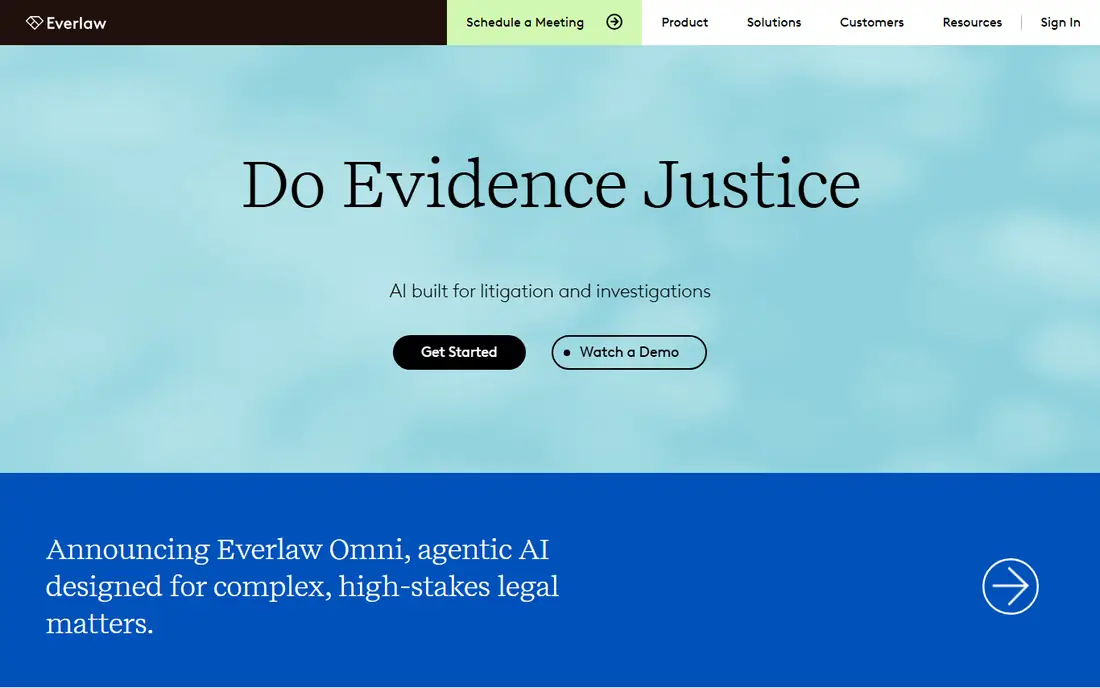
Everlaw is the pick for a team that wants a modern review platform with an open architecture. Its processing speed of 1 million documents per hour clears large sets fast, and its open platform connects external AI tools rather than locking the team into one vendor. The trade-off is metered AI. With Deep Dive, coding suggestions, and machine translation consuming credits on top of the subscription, a team that uses AI heavily should model the credit cost against its actual review volume before choosing Everlaw over a bundled-AI rival such as DISCO.
What we like- One evidentiary system of record with an open platform that connects external AI tools
- High-speed processing of 1 million documents per hour
- Strong review, production, and trial preparation in one system
Watch out for- No published prices, and several AI features such as Deep Dive, coding suggestions, and machine translation consume credits, so AI use is metered on top of the subscription
#2Logikcull
Best for: Small teams that want self-serve discovery with no learning curve4.7/5 on
G2 (517 reviews, checked Oct 2026)
Visit logikcull.com
Starting pricequote
Free planFree sample matter included with every pay-as-you-go account, no commitment
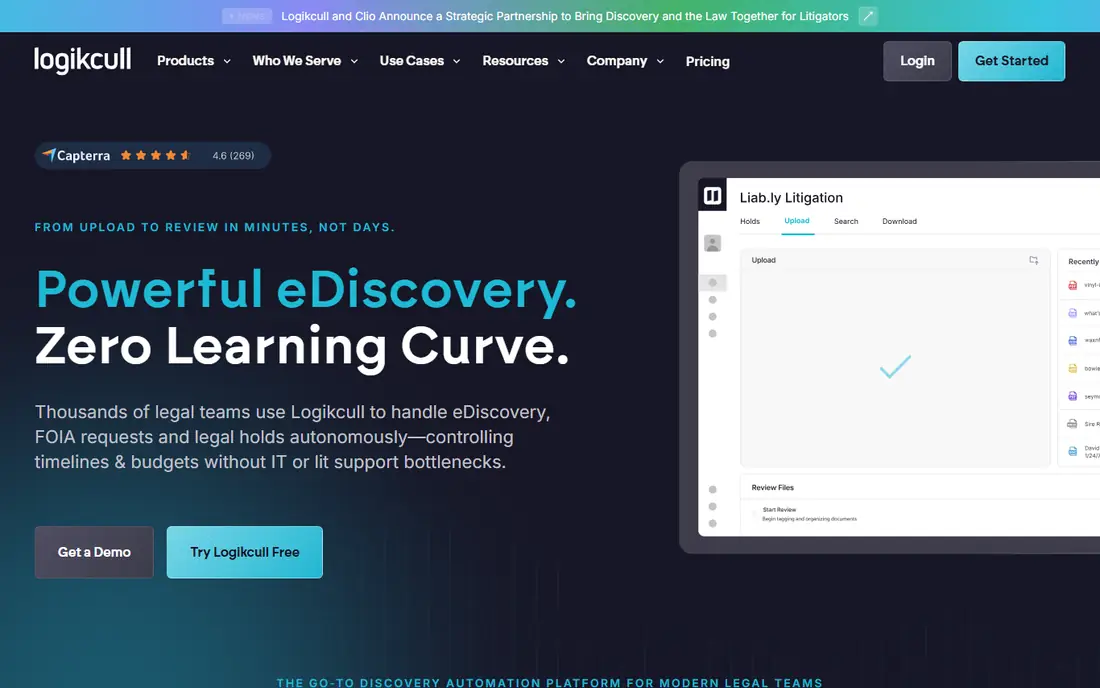
Logikcull is the pick for a team that wants to start reviewing today without training or implementation. Its pricing charges per GB stored, with a 10 GB minimum on pay-as-you-go, but publishes no per-GB rate. The platform handles processing, search, review, and production in one login, and the free sample matter lets a team test it on real documents. The trade-off is feature gating. A team that needs AI fact-finding or PII redaction must move to the annual subscription, so the pay-as-you-go price is not the full story. Note that Reveal owns Logikcull, so the two are not fully independent alternatives.
What we like- Self-serve setup with a project live in 30 seconds and review starting in minutes
- Drag-and-drop uploads with more than 300 automated processing steps
- Free sample matter to test the platform
Watch out for- Key features such as Reveal AI fact-finding, PII detection and redactions, audio and video transcription, and Slack filtering are only on the annual subscription, not the pay-as-you-go plan
#3DISCO
Best for: Teams that want fast AI review at scale4.6/5 on
G2 (171 reviews, checked Oct 2026)
Visit csdisco.com
Starting pricequote
Free planNo free plan; demo available
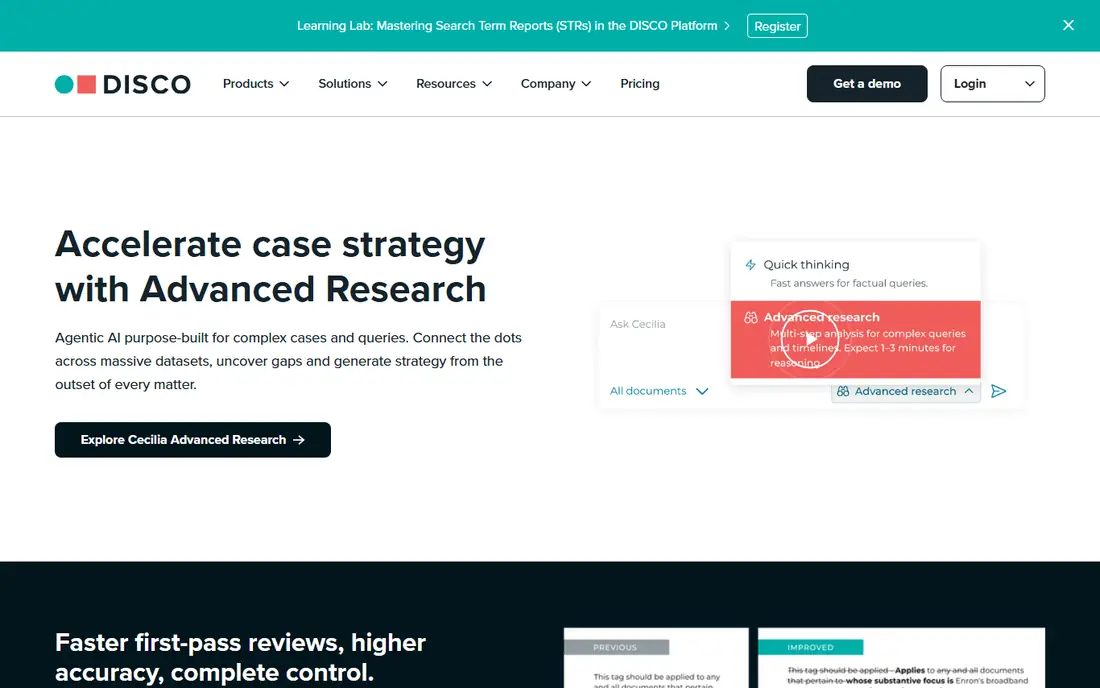
DISCO suits a team that needs to clear a large review set fast. Cecilia AI reviews documents, builds timelines, and manages depositions in the same platform, and the per-GB platform rate includes unlimited Cecilia use. The headline speed figure is 32,000 documents per hour for Auto Review, which is the fastest in this list. The trade-off is price transparency. With no published rates and a separate per-document charge for Auto Review, a team should get the full per-GB and per-document rates in writing and model them against its actual document count before choosing DISCO.
What we like- Cecilia AI with Auto Review that reviews up to 32,000 documents per hour
- Deposition management and AI timelines in one platform
- Unlimited Cecilia AI use in the per-GB rate
Watch out for- No published rates at all, and Auto Review is charged separately per document on top of the per-GB platform rate
#4Reveal
Best for: Teams that want a choice of cloud, on-premises, or private deployment4.2/5 on
G2 (52 reviews, checked Oct 2026)
Visit revealdata.com
Starting pricequote
Free planNo free plan; demo available
Reveal is the pick for a team with strict data residency or security rules that rule out a cloud-only platform. Its suite covers the full matter from collection with Onna through review with Brainspace and Logikcull to trial presentation with Trial Director, and its agentic AI works across the whole matter. The trade-off is pricing. With no plans or rates published, a team cannot budget Reveal without a sales conversation, so it suits firms that already know they need the deployment choice and are willing to negotiate. Note that Reveal owns Logikcull, which appears separately in this list.
What we like- Deployment choice across cloud, on-premises, or private hosting
- Agentic AI across the whole matter
- Suite includes Logikcull, Brainspace, Onna, and Trial Director
Watch out for- No pricing transparency, since the pricing page is only a demo-request form with no plans or rates, so any cost estimate requires a sales conversation
#5Exterro
Best for: Teams that need forensics and data governance with e-discovery4.4/5 on
G2 (171 reviews, checked Oct 2026)
Visit exterro.com
Starting pricequote
Free planNo free plan; demo available
Exterro suits a team that needs more than review, such as a corporate legal department handling forensics, privacy, and governance alongside litigation. Its platform covers legal hold, collection, processing, review, and production, plus digital forensics and data-risk work, so one vendor covers several legal functions. The trade-off is price transparency. With no pricing page at all, a team cannot budget Exterro without a sales conversation, and third-party listings of about 50,000 dollars a year are not vendor-published. Get a written quote that covers every module you need before comparing Exterro against a review-only rival.
What we like- The only platform in this set that combines eDiscovery, digital forensics, and data governance and privacy on one data-risk platform
- ARMOUR agentic AI orchestration framework across the suite
Watch out for- No published pricing and no pricing page at all, so costs are entirely quote-based, and third-party figures are not vendor-confirmed
#6Nuix
Best for: Teams that need investigations and data privacy on the same engine4.4/5 on
G2 (15 reviews, checked Oct 2026)
Visit nuix.com
Starting pricequote
Free planNo free plan; demo available
Nuix is the pick for an investigations-led team that needs to process unusual file types at scale. Its engine handles more than 1,000 file types, which matters when a matter includes chat exports, forensic images, or legacy formats other tools cannot read. Nuix Neo covers eDiscovery, investigations, and data privacy on the same engine, so one platform serves several teams. The trade-off is accessibility. With consumption-based licensing built for enterprise scale and no published figures, Nuix suits large firms and corporate teams rather than small firms that need a published price and a self-serve trial.
What we like- The patented Nuix Engine processes more than 1,000 file types
- The Nuix Neo platform spans eDiscovery, investigations, and data privacy on one engine
Watch out for- Pricing is explicitly built for enterprise scale with consumption-based licensing and no published figures, so smaller teams cannot self-serve or budget without a sales conversation
#7
OpenText eDiscovery
Best for: Enterprise teams with complex data sources and long matters
Visit opentext.com
Starting pricequote
Free planNo free plan; demo available
OpenText eDiscovery, formerly sold as Axcelerate, suits an enterprise team with complex data sources and strict deployment rules. Its 45-plus data-source connectors cover email archives, chat, cloud drives, and legacy systems, and GenAI Aviator Review handles first-pass review. Deployment runs cloud, on-premises, or hybrid, which suits firms with data residency rules. The trade-off is scope and price. The suite is broader than a review-only tool, and with no public pricing a team must go through sales to budget it. It fits large firms and corporate departments rather than small firms.
What we like- More than 20 years of eDiscovery leadership
- GenAI Aviator Review for first-pass review
- More than 45 data-source connectors
- Cloud, on-premises, or hybrid deployment
Watch out for- Enterprise-grade product with no public pricing, and a broad suite that bundles eDiscovery with wider information-management offerings, which is more than a small team needs
#8Nextpoint
Best for: Teams that want flat per-user pricing with no per-GB charges4.4/5 on
G2 (131 reviews, checked Oct 2026)
Visit nextpoint.com
Starting pricequote
Free planNo free plan; demo available
Nextpoint is the pick for a team that wants predictable billing. Its Essential, Advanced, and Apex plans charge per user rather than per GB, with unlimited cases and free data hosting included, so a team that processes large volumes does not watch the meter climb. The platform covers the full litigation lifecycle, from eDiscovery through deposition and trial presentation, in one login. The trade-off is transparency and testing. With no published per-user rate and no self-serve trial, a team must go through a demo and a quote to budget Nextpoint, which suits firms that value predictable billing over self-serve signup.
What we like- Flat per-user pricing with unlimited cases and free data hosting, so the bill does not grow with data volume
- Covers the full litigation lifecycle from eDiscovery through deposition and trial presentation
Watch out for- No published per-user rate despite the simple, predictable pricing claim, and no self-serve trial, so buyers cannot test it without a demo
Frequently asked questions
Is Relativity good for small law firms
Relativity is built for large litigation and enterprise teams, with data-volume pricing and no published rates, so a small firm may find it heavier than it needs. Logikcull offers a free sample matter with self-serve setup, and Nextpoint offers flat per-user pricing with unlimited cases. A small firm should test both before committing to a quote-only enterprise platform.
Can I try these alternatives free before I switch
Yes, one of them offers a free start. Logikcull includes a free sample matter with every pay-as-you-go account. Everlaw, DISCO, Reveal, Exterro, Nuix, OpenText eDiscovery, and Nextpoint offer demos instead of self-serve trials. Ask each vendor for a trial matter on your own documents before you commit.
Which alternative has the best AI review
DISCO Cecilia and Everlaw are the strongest AI options in this list. DISCO includes unlimited Cecilia AI use in its per-GB rate, though Auto Review is charged separately per document. Everlaw offers Deep Dive, coding suggestions, and machine translation, but meters them by credits on top of the subscription. OpenText eDiscovery includes GenAI Aviator Review for first-pass review. Logikcull includes Reveal AI fact-finding only on its annual subscription, so check which plan you would actually buy.
How long does it take to switch from Relativity
A mid-size team can usually switch in two to six weeks, including exporting the production set, loading a sample matter, and training reviewers. The timeline grows when privilege logs and coding history must move, when the matter has years of review history, or when the team needs on-premises deployment. Load a sample matter first, keep Relativity read-only until the matter closes, and confirm tags and redactions land correctly before cancelling.
Do Relativity alternatives charge per GB or per user
Most charge per GB. DISCO bills per GB processed, Logikcull charges per GB stored, and Relativity itself charges by data volume. Nextpoint is the exception in this list, with flat per-user pricing and unlimited cases and free data hosting. GoldFynch, which is not in this list, averages 6 dollars per GB per month. Always confirm the billing unit, the minimum commitment, and what AI review costs on top, since the same case can cost very different amounts under per-GB and per-user pricing.
Sources we checked (17)
- https://www.everlaw.com/pricing/
- https://www.everlaw.com
- https://www.logikcull.com/pricing/
- https://www.logikcull.com
- https://csdisco.com/pricing/
- https://www.csdisco.com
- https://revealdata.com/pricing/
- https://www.revealdata.com
- https://www.exterro.com
- https://www.nuix.com/pricing/
- https://www.nuix.com
- https://www.opentext.com/products/axcelerate
- https://www.opentext.com
- https://nextpoint.com/pricing/
- https://www.nextpoint.com
- https://www.relativity.com/pricing/
- https://www.relativity.com
Is your product missing or out of date?
We review this list regularly. Vendors can request a listing, send updated pricing or ask about featured placement.

Shihab Mia · Founder, Rankite
Shihab has 5+ years in B2B and SaaS SEO. He writes Rankite's software buying guides from pricing pages, documentation and public user reviews. More about Shihab.