How we make this list: we compare pricing pages, product documentation and public user reviews. Ratings come from G2, Capterra or Trustpilot, with the date we checked them.
Key takeaways
- Encited is the closest managed replacement for Prerender.io, from 19 dollars a month, with per bot logging and snapshots for AI crawlers as well as search engines.
- SEO4Ajax is the budget managed option, with a free plan and paid tiers from 29 dollars a month, at the cost of more hands on configuration.
- Puppeteer and Playwright are the free build your own route, and Browserless sells the hosted browser infrastructure if you would rather not run Chrome yourself.
- Google's own guidance keeps pointing the same way: dynamic rendering is a bridge, and server side rendering or frameworks such as Next.js are the long term fix.
Quick comparison
| Tool | Best for | Starting price | Free plan |
|---|
 Encited | Managed rendering with AI crawler handling | $19 per month | No |
 SEO4Ajax | Managed snapshots on a budget | $29 per month | Yes |
 Browserless | Hosted headless Chrome API | See website | Yes |
 Puppeteer | Building your own rendering service | Free | Yes |
 Playwright | Rendering plus testing in one toolkit | Free | Yes |
 Next.js | Fixing rendering at the source | Free | Yes |
 Botify SpeedWorkers | Enterprise edge rendering | See website | No |
 seoClarity Bot Optimizer | Large sites rendering at the edge | See website | No |
Is your product missing or out of date?
We review this list regularly. Vendors can request a listing, send updated pricing or ask about featured placement.
The best Prerender alternatives
Starting price$19 per month
Free planNo
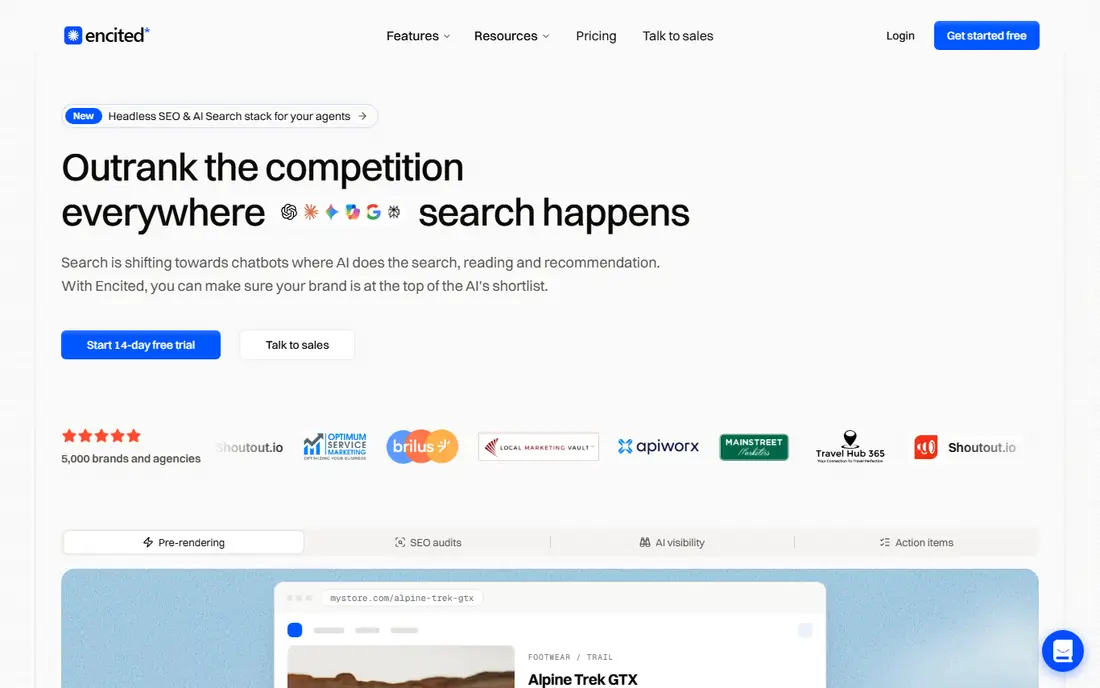
What we like- Encited is the managed service built most directly at Prerender.io defectors: plans at 19, 49, 149, and 349 dollars a month, connection through a two click Cloudflare link or DNS rather than server middleware, and cache controls that refresh by sitemap dates or by URL without running your own re-caching scripts. Its distinguishing feature is the AI layer: every bot visit is logged with its outcome, AI crawlers are tracked separately from search bots, and it can serve AI friendly snapshots including Markdown output for tools such as ChatGPT and Claude.
Watch out for- Encited is a younger vendor than Prerender.io, so its track record at extreme enterprise volume is still being written. Error responses are never billed, which is consumer friendly, but hard spend caps mean rendering stops at your limit rather than overrunning, a behaviour you must set deliberately. Teams deeply invested in Prerender.io's middleware integrations still face a connection change.
Starting price$29 per month
Free planYes
What we like- SEO4Ajax is the established European managed alternative: it captures snapshots of your JavaScript pages and serves them to crawlers, configured through NGINX, Apache, or application middleware, with a free plan covering small sites and paid tiers at 29, 99, and 199 dollars a month on annual terms. The free developer plan makes it the cheapest way to test dynamic rendering properly before committing. EU based data handling suits companies with European data requirements.
Watch out for- The service is more hands on than Prerender.io or Encited: browser quotas, storage caps, and caching intervals need managing rather than being abstracted away. Published throughput and latency numbers are absent, and third party review volume is thin, so you are trusting your own trial. Its bot list should be verified against your server logs, particularly for the newer AI crawlers.
Starting priceSee website
Free planYes
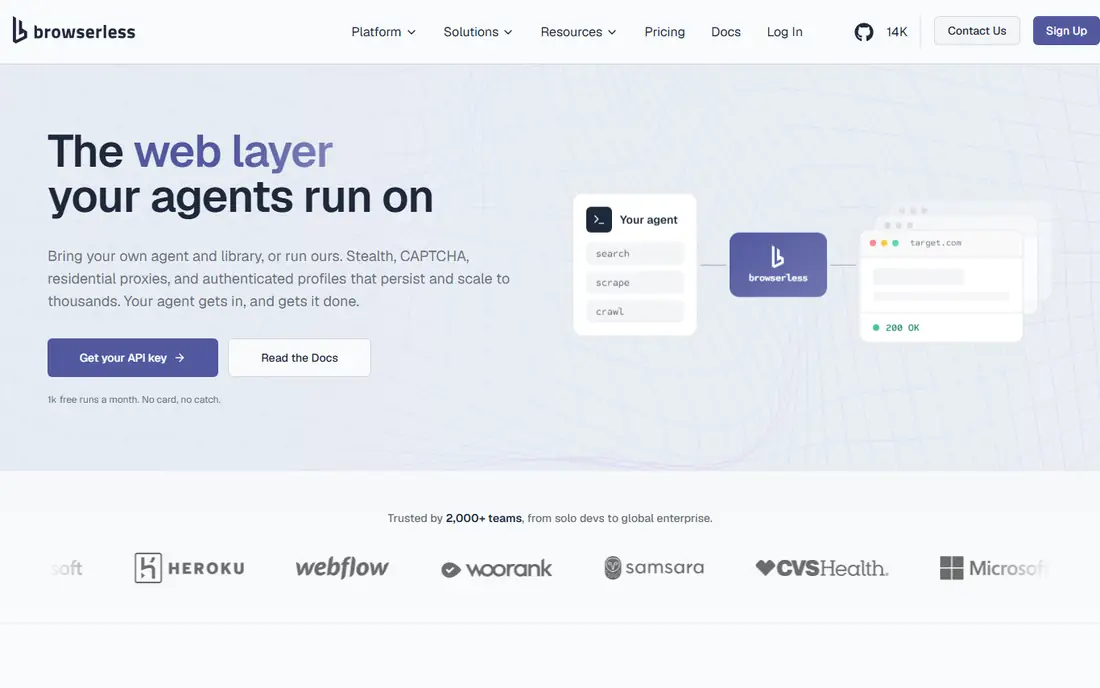
What we like- Browserless sells the browser itself as an API: send it a page through Puppeteer or Playwright over a websocket and get rendered HTML, screenshots, or PDFs back, without running Chrome fleets on your own servers. For a team building its own rendering pipeline, it removes the hardest operational part, browser crashes, versioning, and scaling, and it includes a free allowance of 1,000 units a month for testing and small jobs. The same API covers screenshot and PDF work beyond SEO.
Watch out for- Browserless is infrastructure, not a finished prerendering product: bot detection, caching, and serving logic are still yours to build, which is real engineering. Paid tier pricing is published on its site but structured in units whose cost depends on your usage pattern, so this guide lists see website
- Model your crawl volume before committing. Latency and cost at millions of pages need a load test, not a brochure.
#4
Puppeteer
Best for: Building your own rendering service
Visit pptr.dev
Starting priceFree
Free planYes
What we like- Puppeteer is Google's maintained Node library for controlling Chrome, and it is what a large share of home built prerenderers run on: request a page, wait for the JavaScript to settle, serialize the HTML, cache it, serve it to bots. It is free, documented thoroughly, and surrounded by the largest community in headless browsing, so every problem you hit has been solved publicly. For a platform team, it becomes a small internal service tailored exactly to your app's rendering behaviour.
Watch out for- Free software with an infrastructure bill attached: you run, scale, secure, and update the Chrome fleet, and you build the bot routing and cache invalidation yourself. Total cost is engineering salaries, which dwarfs managed pricing at most volumes. Google maintains the library, not your deployment of it, and there is no support line when a Chrome update changes rendering behaviour the night before a crawl spike.
#5Playwright
Best for: Rendering plus testing in one toolkit4.8/5 on
G2 (14 reviews, checked Oct 2026)
Visit playwright.dev
Starting priceFree
Free planYes
What we like- Playwright, from Microsoft, drives Chromium, Firefox, and WebKit from one API across Node, Python, .NET, and Java, and teams already using it for end to end testing can reuse the same skills and infrastructure to render pages for crawlers. Its auto waiting for elements makes snapshots more reliable than hand timed Puppeteer scripts on complex apps. Like Puppeteer it is free and open source, with strong documentation and an active release cadence.
Watch out for- The same build and operate burden as Puppeteer applies: Playwright renders pages, but the crawler routing, caching, and serving layer is your project. Multi browser support is wasted on SEO rendering, where Chromium is what matters, so part of what you learn is surplus. It is a toolkit, and judging it against managed services on features alone misses the staffing it assumes.
Starting priceFree
Free planYes
What we like- Next.js is the alternative that removes the category: a React framework where pages render to HTML on the server or at build time as a property of the application, so crawlers and users get the same real HTML and no snapshot layer exists to bill you. Server components, static generation, and incremental regeneration let content heavy pages be fast and current. For a team already on React and planning a rebuild, it is the destination Google's guidance points to, and the framework itself is free and open source.
Watch out for- Next.js only helps if your application is, or becomes, a Next.js application: adopting it is a replatforming project, not a configuration change, which is precisely what Prerender.io customers were avoiding. Hosting server rendered pages has its own costs and operational shape. Legacy single page apps with years of client only code may take quarters to migrate, during which a managed renderer remains necessary as the bridge.
Starting priceSee website
Free planNo
What we like- Botify's SpeedWorkers serves rendered pages to bots at the edge through your CDN, inside the wider Botify platform of crawl analysis and log file intelligence, so the rendering decision and the evidence of what bots did with it live in one system. For enterprise sites already using Botify for technical SEO, adding rendering there avoids a second vendor and a second data model. AI bot user agents can be included in the rendering set by configuration.
Watch out for- Pricing is not published and the product is sold as part of an enterprise platform, so there is no self serve route or small site tier. It makes sense mainly for existing or prospective Botify customers
- Buying the platform for rendering alone is hard to justify. Implementation runs through enterprise sales and integration cycles, not an afternoon signup.
Starting priceSee website
Free planNo
What we like- SeoClarity's Bot Optimizer prerenders pages at the CDN or edge layer without front end code changes, delivering full renders to a configurable set of search and AI crawlers, OpenAI, Perplexity, Google AI, Bing AI, and the classic bots, selectable by the site owner. For very large sites whose front end cannot be rebuilt, edge rendering with per bot control is the pragmatic route, and it sits inside seoClarity's enterprise SEO platform and reporting.
Watch out for- It is an enterprise contract product with custom pricing and no published rate, part of a platform purchase rather than a point tool. Small and mid sized sites will find the managed services above faster to adopt and far cheaper. As with all edge approaches, you are maintaining a bot serving layer indefinitely, with the monitoring duty that implies.
How we chose
We compared managed dynamic rendering services, hosted browser infrastructure, open source rendering libraries, a source level framework fix, and enterprise edge platforms, on rendering and caching control, bot and AI crawler coverage, setup effort, and pricing transparency. We favoured options in active maintenance, which is why the deprecated Rendertron is mentioned as a warning rather than listed as a pick. Where a vendor publishes no self serve price we wrote see website instead of estimating from other buyers' contracts.
How to choose the right Prerender alternative
First decide whether you are bridging or fixing. If the single page app is staying, you need a managed renderer, and the choice is Encited for AI crawler handling and modern caching, or SEO4Ajax for budget and a free start. If a rebuild is on the road map, treat the managed service as rental during migration to server rendering, most often Next.js in React shops, and negotiate terms that let you leave.
Then test with your own logs, not the vendor's bot list. The recurring failure in this category is a crawler you care about, a search engine's secondary bot or an AI crawler, not being on the service's list and receiving the raw JavaScript shell. Pull a month of server logs, list every bot user agent that fetched your pages, and verify each one against the finalist's coverage before signing. Watch billing shape too: per render pricing makes a crawl spike a finance event, so caps and error billing rules belong in the contract conversation. And keep the compliance line bright: rendered HTML must present the same content users get; the moment a snapshot shows bots something better than the human page, you have left dynamic rendering for cloaking.
Frequently asked questions
Is dynamic rendering against Google's guidelines?
No, when done honestly. Google describes dynamic rendering as a workaround for JavaScript heavy sites: serve crawlers a rendered version with the same content users see, and it is acceptable. Serving different content to crawlers is cloaking and risks penalties. Google also states plainly that server side rendering or full hydration is the better long term answer, which is why Next.js appears in this list.
What happened to Rendertron?
Google deprecated and archived it. Rendertron was a reference implementation rather than a product, and it no longer receives maintenance, so it should not be adopted for new work. Existing Rendertron deployments are a migration prompt: move to a managed service, to Puppeteer or Playwright maintained as your own service, or to server rendering in the app.
How much does prerendering cost in 2026?
Managed services start at 19 dollars a month with Encited and 29 dollars with SEO4Ajax, with Prerender.io itself starting at 59 dollars for 30,000 renders. Costs scale with rendered page volume and crawl frequency, so a large site can reach hundreds per month. The open source route costs nothing in licences and real money in engineering and infrastructure, which is why it suits platform teams rather than small sites.
Do AI crawlers need prerendered pages too?
Increasingly, yes. Many AI crawlers fetch pages with limited or no JavaScript execution, so a client rendered app can be invisible or truncated to them even when Googlebot manages it. Managed services such as Encited and enterprise tools such as seoClarity's now track and serve AI bots explicitly; with a self built pipeline, you must add those user agents to your rendering rules yourself.
When should we stop prerendering altogether?
When your framework renders content to HTML natively, through server side rendering, static generation, or a hybrid of the two, the snapshot layer has nothing left to do. Most teams retire it during a replatforming rather than as a standalone project. Until then, monitor crawl stats and server logs monthly; prerendering that nobody verifies tends to rot silently as the app changes.
Sources we checked (0)
Is your product missing or out of date?
We review this list regularly. Vendors can request a listing, send updated pricing or ask about featured placement.

Shihab Mia · Founder, Rankite
Shihab has 5+ years in B2B and SaaS SEO. He writes Rankite's software buying guides from pricing pages, documentation and public user reviews. More about Shihab.