How we make this list: we compare pricing pages, product documentation and public user reviews. Ratings come from G2, Capterra or Trustpilot, with the date we checked them.

Key takeaways
- Prerender.io serves cached HTML to crawlers for JavaScript apps, and its alternatives split into managed services, DIY rendering libraries, and audit crawlers.
- Encited is the best managed replacement, with prerendering plus AI search analytics, crawl log analysis, and a 19 dollar plan in comparison sources.
- SEO4Ajax is the best snapshot pick, with managed dynamic rendering for Angular, React, and JavaScript sites.
- Browserless is the best hosted browser pick, with 1,000 free units per month and Puppeteer and Playwright compatibility.
- Rendertron is the best open-source pick, but it is deprecated and archived, so new projects should prefer maintained options.
- Puppeteer is the best DIY pick for Chrome automation, with a high-level API over DevTools Protocol and WebDriver BiDi.
- Playwright is the best cross-browser pick, covering Chromium, Firefox, and WebKit with auto-waiting and parallel testing.
- Screaming Frog is the best audit crawler pick, with on-demand crawling to surface rendering and indexing issues.
- Sitebulb is the best deep-dive pick, with desktop crawling, prioritized issue hints, and modern reporting.
Quick comparison
Is your product missing or out of date?
We review this list regularly. Vendors can request a listing, send updated pricing or ask about featured placement.
The best Prerender.io alternatives
Starting priceSee website
Free planNo

Encited is the best managed replacement. Its homepage describes technical optimizations and AI search analytics for businesses, making dynamic content indexable by Google and citable by AI. Encited pre-renders pages into plain HTML and caches them in its CDN for instant delivery in milliseconds, serving pre-rendered HTML to Google and Bing and Markdown to ChatGPT, Claude, Perplexity, and Gemini. The platform also runs technical SEO audits at scale, traces indexing delays with Index Rush, analyzes crawl logs and crawler behavior, tracks AI visibility over time with competitor tables and cited sources, and offers an MCP server for agent workflows. Encited reports 5,000 brands and agencies, 400 million crawler requests served monthly, and 4 million daily renders per domain.
The trade-off is maturity. Encited is newer than Prerender.io, so long-term reliability data is thinner, though customer stories report fast indexing gains for JavaScript sites built with tools like Lovable. For teams moving off Prerender.io or starting fresh, Encited is the best pick.
What we like- Pre-renders pages into plain HTML cached in a CDN
- Markdown for AI agents
- Crawl log analysis and AI visibility tracking
Watch out for- Newer vendor with less track record than Prerender.io
- Pricing by plan, with 19 dollar plan cited in comparison sources
Starting priceSee website
Free planNo
SEO4Ajax is the best snapshot pick. Its homepage describes making JavaScript websites SEO friendly with dynamic rendering, solving the AJAX dilemma where dynamic sites offer a faster, richer user experience but bots cannot see dynamically generated content. SEO4Ajax implements dynamic rendering and warrants full presence of AJAX content on search engine results and social networks, supporting websites based on Angular, React, and JavaScript generally. Comparison sources recommend SEO4Ajax for SPAs needing scalable managed rendering on a tighter budget, with EU handling and snapshot-based prerendering fitting teams that can configure the server side.
The catch is setup. SEO4Ajax requires server-side configuration, so teams without DevOps capacity should prefer a fully managed option like Encited. For teams that want managed snapshot rendering with EU handling, SEO4Ajax is the best pick.
What we like- Managed dynamic rendering for AJAX sites
- Full visibility on search engines and social networks
- EU handling cited in comparison sources
Watch out for- Homepage extract was thin, showing only core positioning
- Server-side configuration required
Starting priceFree to start
Free planYes
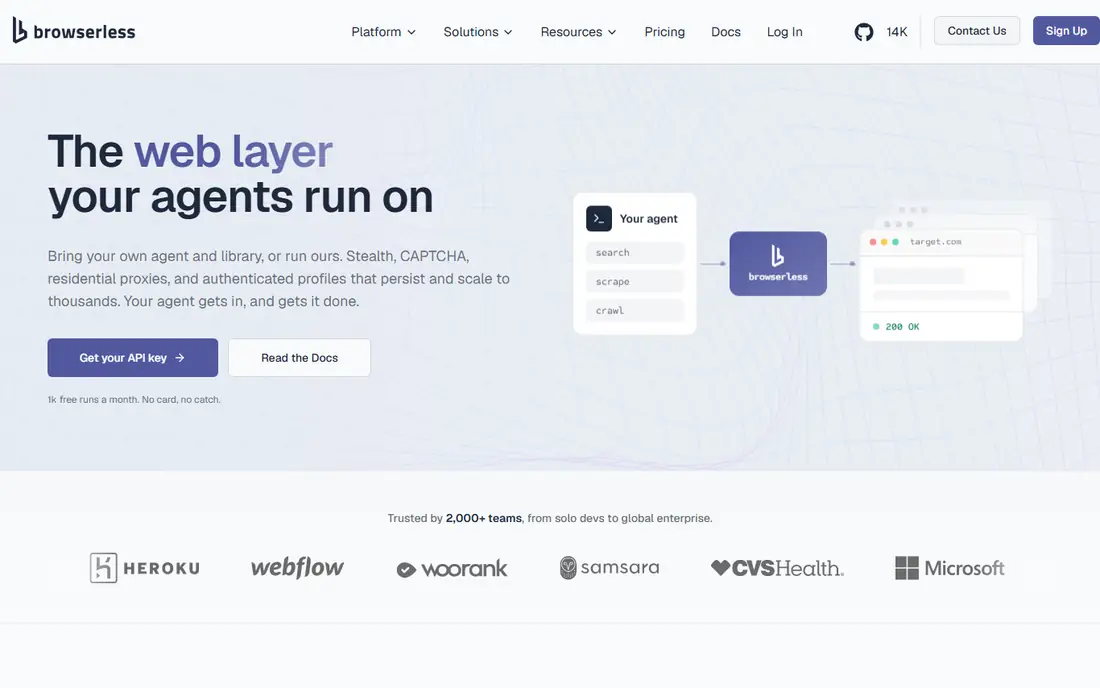
Browserless is the best hosted browser pick. Its homepage describes the web layer AI agents run on, with stealth, CAPTCHA handling, residential proxies, and authenticated profiles that persist and scale to thousands of sessions. For rendering, Browserless lets teams replace launch with connect in existing Puppeteer or Playwright scripts, pointing to a Browserless endpoint while Browserless manages browsers, concurrency, memory, and Chrome versions. The free plan offers 1,000 units per month with 2 concurrent browsers and no credit card required, and paid plans scale from there. Browserless reports 8 years in production, 175 million plus Docker pulls, 99.9 percent uptime, and SOC 2 Type II certification.
The trade-off is scope. Browserless provides browser infrastructure, not a turnkey prerender cache with bot detection and middleware, so teams must build the middleware layer themselves. For engineering teams building custom rendering pipelines, Browserless is the best pick.
What we like- Managed headless Chrome, Firefox, and WebKit
- One-line swap from launch to connect
- 1,000 free units per month
- Self-hosted option
Watch out for- Browser infrastructure, not a turnkey prerender service
- Unit pricing can grow with render volume
Starting priceFree
Free planYes
Rendertron is the best open-source pick, with a major warning. Its GitHub page states clearly that Rendertron is deprecated, the repository is archived, and the project will not be actively maintained, because dynamic rendering is not a recommended approach and better approaches to rendering on the web now exist. Rendertron is a headless Chrome rendering solution built with Puppeteer, designed to render and serialize web pages on the fly for bots that do not execute JavaScript, with middleware for Express, Firebase functions, ASP.NET Core, and Django, plus render, screenshot, and cache invalidation endpoints. It supports mobile rendering, cache refresh, and a 10-second rendering budget timeout.
The catch is maintenance. New projects should not adopt an archived tool as their core rendering layer, though Rendertron remains useful as an educational reference for middleware architecture. For teams that need open-source rendering today, Puppeteer or Playwright with a maintained wrapper is the safer pick, and Rendertron is listed here only for completeness.
What we like- Google-built headless Chrome rendering
- Middleware for Express, Firebase, ASP.NET, and Django
- Render, screenshot, and cache invalidation endpoints
Watch out for- Deprecated and archived, no longer actively maintained
- Dynamic rendering not recommended by Google as a long-term approach
Starting priceFree
Free planYes
Puppeteer is the best DIY pick for Chrome automation. Its homepage describes a JavaScript library providing a high-level API to control Chrome or Firefox over the DevTools Protocol or WebDriver BiDi, running headless by default. Puppeteer version 25.16.0 is current in the docs extract, with installation via npm, pnpm, Yarn, Bun, or Deno, plus a Puppeteer-based MCP server for browser automation and debugging. The example shows launching a browser, opening a page, setting viewport, interacting with elements, and extracting text, the same building blocks needed for a custom prerender service.
The trade-off is effort. Puppeteer is a library, so caching, bot user-agent detection, middleware, and scaling are your responsibility. For teams with DevOps capacity that want full control over rendering, Puppeteer is the best pick.
What we like- High-level API to control Chrome or Firefox
- Headless by default
- DevTools Protocol and WebDriver BiDi support
- MCP server for browser automation
Watch out for- Library, not a service
- Teams must build caching, bot detection, and middleware themselves
Starting priceFree
Free planYes
Playwright is the best cross-browser pick. Its homepage describes fast and reliable end-to-end testing for modern web apps, with a full-featured test runner offering auto-waiting, assertions, tracing, and parallelism across Chromium, Firefox, and WebKit. Playwright also offers a CLI for coding agents, an MCP server giving AI agents full browser control through accessibility snapshots, a test generator, trace viewer, and VS Code extension. Cross-browser support matters for rendering because different crawlers and AI agents may behave differently across engines, and Playwright covers all three major engines from one API.
The catch is purpose. Playwright is built for testing, not for serving prerendered HTML to bots, so the middleware and caching layer still needs building. For teams that want cross-browser rendering plus testing in one library, Playwright is the best pick.
What we like- Chromium, Firefox, and WebKit on Linux, macOS, and Windows
- Auto-waiting and web-first assertions
- Parallel testing and sharding
- Python, .NET, and Java support
Watch out for- Testing framework first, rendering service second
- Teams must build the prerender layer themselves
Starting priceSee website
Free planFree version
Screaming Frog is the best audit crawler pick. Its homepage describes an SEO Spider that crawls websites on demand, with JavaScript rendering to surface rendering and indexing issues, broken links, redirect chains, duplicate content, and metadata problems. The free version covers up to 500 URLs, making it useful for small sites and quick diagnostics, while paid licenses enable unlimited crawling and advanced features. Screaming Frog does not serve prerendered HTML to bots, but it diagnoses whether bots can see your content, which is the first step before choosing a rendering solution.
The trade-off is role. Screaming Frog audits rendering, it does not fix it, so pair it with a managed service or DIY renderer for production. For technical SEO audits that reveal rendering gaps, Screaming Frog is the best pick.
What we like- On-demand crawling to surface rendering and indexing issues
- Free version for up to 500 URLs
- JavaScript rendering in the crawler
Watch out for- Audit tool, not a rendering service
- Desktop app, not a hosted prerender layer
Starting priceSee website
Free planFree trial
Sitebulb is the best deep-dive pick. Its homepage describes a desktop crawler with up to 500,000 URLs per audit on Desktop and up to 10 million on Cloud, covering 300 plus issues with JavaScript crawling at no extra cost. Sitebulb prioritizes issues with hints explaining what matters most, making it strong for technical SEO audits that need to explain rendering problems to stakeholders. Like Screaming Frog, Sitebulb diagnoses rendering and indexing issues rather than serving prerendered HTML, so it complements a rendering service rather than replacing one.
The catch is scope. Sitebulb is an audit tool, not a prerender layer, so production rendering still needs Encited, SEO4Ajax, or a DIY build. For deep-dive audits with prioritized fixes, Sitebulb is the best pick.
What we like- Desktop crawler with prioritized issue hints
- Modern UI and reporting
- JavaScript crawling with deep-dive insights
- Cloud option for large audits
Watch out for- Audit tool, not a rendering service
- Desktop focus, though cloud audits cover larger sites
How we chose
We compared tools that replace Prerender.io across its core job: making JavaScript content visible to search engines and AI crawlers. Each vendor homepage was opened to confirm the product exists today and matches its category, and we kept a mix of managed services, hosted browsers, DIY libraries, and audit crawlers, since Prerender.io users range from solo developers to enterprise SEO teams. We flagged the Rendertron deprecation prominently, because adopting an archived tool as a core dependency is a real risk. We also flagged that Netlify standalone prerendering and Datajelly are discontinued in comparison sources, so teams on either should plan a move. Pricing is written as See website where vendors price by quote or on pricing pages not shown on the homepage.
Avoiding cloaking with dynamic rendering
Dynamic rendering is documented by Google as an appropriate interim strategy, not a permanent solution, and it carries one hard rule: serve the same content to crawlers as to users, with only the rendering method differing. Serving fundamentally different content to Googlebot than to users, such as different prices, different text, or hidden content, is cloaking under Google spam policies and risks manual actions. Always verify your setup delivers equivalent content, not selectively curated content.
The long-term fix is server-side rendering or static generation where possible. Frameworks like Next.js and Nuxt let content-heavy pages render on the server as a property of the application itself, removing the need for a prerender layer entirely. Use dynamic rendering as a bridge while migrating, not as a permanent architecture, and monitor crawl logs to confirm bots receive complete, current HTML.
Frequently asked questions
What is the closest alternative to Prerender.io?
Encited is the closest managed replacement, with prerendering, CDN caching, crawl log analysis, and AI search analytics. SEO4Ajax is the closest snapshot-based managed alternative.
Which Prerender.io alternative is cheapest?
Puppeteer, Playwright, and Rendertron are free open-source options, though they require engineering time to build into a service. Browserless offers 1,000 free units per month, and Encited's plan is cited at 19 dollars in comparison sources.
Is Rendertron still maintained?
No. Rendertron is deprecated and archived on GitHub, and Google states dynamic rendering is not a recommended long-term approach. New projects should use maintained libraries or managed services instead.
Do I still need prerendering if I use Next.js?
Usually not for content-heavy pages. Next.js with server components prerenders content to HTML as a property of the application, removing the need for a separate prerender layer. Dynamic rendering remains useful as a bridge for legacy SPAs.
Is dynamic rendering cloaking?
No, if done correctly. Dynamic rendering serves the same content to crawlers and users, differing only in rendering method. Serving different content to crawlers is cloaking and risks manual actions.
Which alternative works best for AI crawlers?
Encited is the best pick for AI crawlers, serving Markdown to ChatGPT, Claude, Perplexity, and Gemini alongside HTML for Google and Bing, with AI visibility tracking built in.
Sources we checked (8)
- https://encited.com
- https://seo4ajax.com
- https://www.browserless.io
- https://github.com/GoogleChrome/rendertron
- https://pptr.dev
- https://playwright.dev
- https://screamingfrog.co.uk
- https://sitebulb.com
Is your product missing or out of date?
We review this list regularly. Vendors can request a listing, send updated pricing or ask about featured placement.

Shihab Mia · Founder, Rankite
Shihab has 5+ years in B2B and SaaS SEO. He writes Rankite's software buying guides from pricing pages, documentation and public user reviews. More about Shihab.
 Encited
 SEO4Ajax
 Browserless
 Rendertron
 Puppeteer
 Playwright
 Screaming Frog
 Sitebulb