How we make this list: we compare pricing pages, product documentation and public user reviews. Ratings come from G2, Capterra or Trustpilot, with the date we checked them.

What Is Polymail and Why Do People Replace It?
Polymail is a desktop and mobile email client built for sales professionals, with email tracking, follow-up reminders, send later, message templates, and light automated sequences. It suits people who want a polished inbox with sales features layered on top, rather than a full CRM. Many buyers still look for an alternative, because Polymail is a single inbox app, not a sales engagement platform or a CRM. Teams that need multi-step sequences, shared pipelines, a dialer, or a contact database usually outgrow it. Pricing is another reason people shop around. Polymail's current pricing page lists Basic at $10 per month and Premium at $24 per month, with Enterprise on a custom quote. Older pages used different plan names, Pro at about $10 and Business at about $16, and G2 lists Basic at $13, so the price you see depends on where you look. The eight tools in this guide cover the full range, from free tracking extensions to enterprise sales platforms.
Which Polymail Alternative Is Best for Sales Outreach?
For most sales teams, Mixmax is the closest direct replacement. It lives inside Gmail, adds sequences, tracking, templates, and meeting scheduling, and its paid plans start at $29 per user per month billed annually. If your team also needs prospect data, Apollo is the better pick, because it bundles a 240 million plus contact database with sequences and a dialer from $49 per user per month billed annually. Larger teams that run structured outbound with managers, coaching, and forecasting should look at Outreach, which starts at about $100 per user per month on reported pricing, though it publishes no prices and requires a sales conversation.
What Should You Check Before Switching from Polymail?
First, check where your email lives. Mixmax, Streak, Mailtrack, and Boomerang are built around Gmail, so Outlook-only teams should shortlist Yesware, HubSpot Sales Hub, or Outreach instead. Second, check whether you need sequences or just tracking. Tracking-only tools such as Mailtrack and Boomerang cost a few dollars a month, while real sequencing starts at about $15 to $29 per user per month. Third, check the caps behind the headline price. Yesware Pro limits campaigns to 20 recipients a month, Mixmax Inbox Copilot limits sequences to 100 recipients a month, and Apollo plans run on credits, so the cheapest tier can be too small for daily outbound. Fourth, check whether your CRM is included. HubSpot Sales Hub and Streak put a CRM in the same subscription, while Mixmax, Yesware, and Outreach expect you to bring your own CRM.
How Much Do Polymail Alternatives Cost?
Prices below were checked against vendor pricing pages in November 2026. Outreach publishes no prices, so its figure is a reported estimate.
| Tool |
Starting paid price |
Free plan |
Best for |
| Mixmax |
$29 per user per month, billed annually |
Yes |
Gmail sales teams that want sequences and scheduling |
| Yesware |
$15 per seat per month, billed annually |
Yes, up to 5 users |
Small teams on Gmail or Outlook |
| Outreach |
Quote only, about $100 per user per month reported |
No |
Mid-market and enterprise outbound teams |
| Apollo |
$49 per user per month, billed annually |
Yes |
Prospecting data plus sequences in one tool |
| Streak |
$49 per user per month, billed annually |
Email tools only, no CRM |
Gmail teams that want a light CRM in the inbox |
| Mailtrack |
$2.99 per user per month, billed annually |
Yes |
Simple Gmail open and click tracking |
| Boomerang for Gmail |
$4.98 per month, billed annually |
Yes, 10 message credits a month |
Send later and follow-up reminders on a budget |
| HubSpot Sales Hub |
$20 per seat per month list for Starter |
Yes, up to 2 users |
Email tracking inside a full CRM |
A five person team on Mixmax Inbox Copilot pays about $1,740 a year at the annual rate, while the same team on Yesware Pro pays about $900 a year. The gap widens fast at the top end, since Outreach at a reported $100 per user per month costs about $6,000 a year for five seats before platform and implementation fees. Budget for the tier that removes the caps you will actually hit, not the cheapest tier on the pricing page.
Quick comparison
| Tool | Best for | Starting price | Free plan |
|---|
 Mixmax | Gmail-based sales teams that want sequences, tracking, templates, and meeting scheduling in one inbox tool | $29 per user per month billed annually for Inbox Copilot ($34 billed monthly) | Yes, free plan with 20 tracked emails and 50 sequence recipients per month |
 Yesware | Small sales teams on Gmail or Outlook that want tracking, templates, and simple campaigns without a full engagement platform | $15 per seat per month billed annually for Pro ($19 billed monthly) | Yes, free for up to 5 users with 10 campaign recipients per month |
 Outreach | Mid-market and enterprise sales teams that need full sales engagement, forecasting, and coaching in one platform | Quote only, buyer reports put Amplify Core at about $100 per user per month | No free plan, sales-led demo and annual contract only |
 Apollo | Teams that want prospecting data, sequences, and a dialer in one subscription | $49 per user per month billed annually for Basic ($65 billed monthly) | Yes, free plan with 900 credits a year and 2 sequences |
 Streak | Small teams that live in Gmail and want a lightweight CRM inside the inbox | $49 per user per month billed annually for Pro ($59 billed monthly) | Free email tools only, with tracking, snippets, and mail merge, but no CRM pipelines |
 Mailtrack | Individuals and small teams that only need reliable Gmail open and click tracking | $2.99 per user per month billed annually for Mailtrack ($6.99 billed monthly) | Yes, free plan with unlimited open tracking and a promotional signature on sent mail |
 Boomerang for Gmail | Gmail users who want send later, follow-up reminders, and Inbox Pause at a low price | $4.98 per month billed annually for Personal, $14.98 per month billed annually for Pro | Yes, Basic is free with 10 message credits per month |
 HubSpot Sales Hub | Teams that want email tracking inside a full CRM, with marketing and service in the same platform | $20 per seat per month list for Starter, with a new-customer promo from $7 per seat per month on annual billing | Yes, free CRM for up to 2 users with email tracking and contact management |
Is your product missing or out of date?
We review this list regularly. Vendors can request a listing, send updated pricing or ask about featured placement.
The 8 Best Polymail Alternatives
The eight tools below run from the closest full replacement to the simplest and cheapest options. Pick by your inbox, your team size, and whether you need a CRM or just better email.
#1Mixmax
Best for: Gmail-based sales teams that want sequences, tracking, templates, and meeting scheduling in one inbox tool4.6/5 on
G2 (1,486 reviews, checked Oct 2026)
Visit mixmax.com
Starting price$29 per user per month billed annually for Inbox Copilot ($34 billed monthly)
Free planYes, free plan with 20 tracked emails and 50 sequence recipients per month
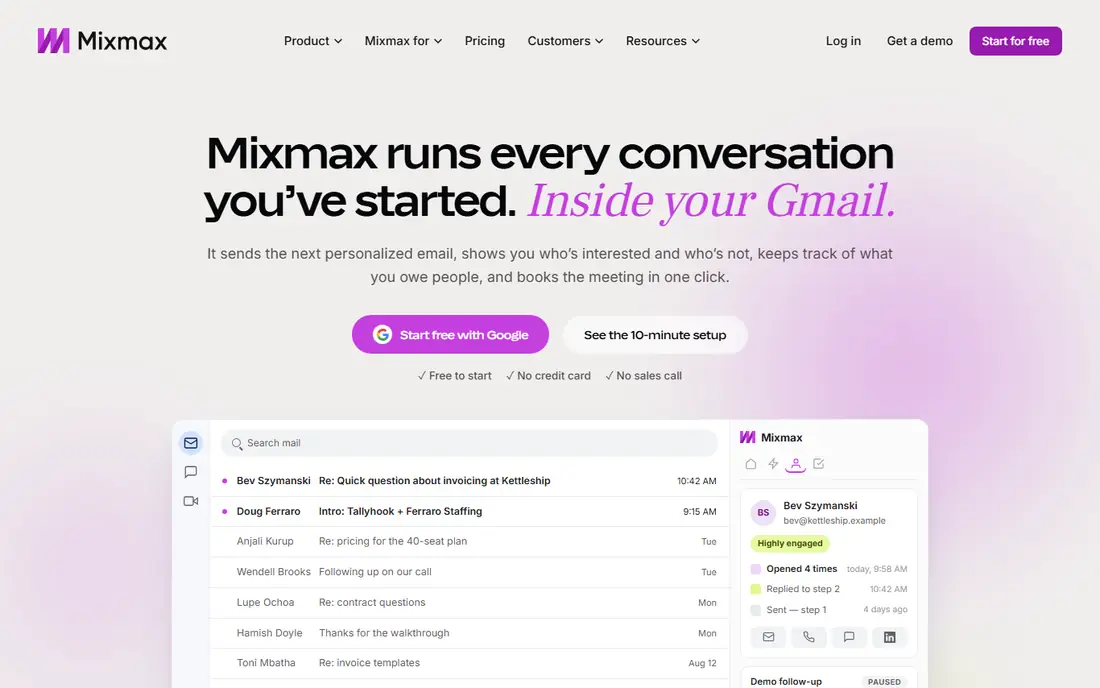
Mixmax is the most direct Polymail replacement for Gmail teams. It adds tracking, templates, and scheduling inside the inbox you already use, then layers on sequences, polls, and surveys as you move up the tiers. The current pricing structure uses Copilots, with Inbox Copilot at $29, Meeting Copilot at $29, Engagement Copilot at $49, and the full Suite at $89 per user per month billed annually. Older review pages still show legacy SMB and Growth tiers at $29 to $69, which explains conflicting prices in search results, so use the Copilot figures above. The free plan is genuinely usable for a solo seller testing tracking, but teams should budget for Engagement Copilot if they run daily sequences.
What we like- Published pricing with no sales call needed, deep Gmail integration, sequences and meeting scheduling in one place, free plan for testing
Watch out for- The $29 tier caps sequences at 100 recipients a month, so real outbound work needs Engagement Copilot at $49 per user per month billed annually, and there is no dedicated mobile app
#2Yesware
Best for: Small sales teams on Gmail or Outlook that want tracking, templates, and simple campaigns without a full engagement platform4.4/5 on
G2 (821 reviews, checked Oct 2026)
Visit yesware.com
Starting price$15 per seat per month billed annually for Pro ($19 billed monthly)
Free planYes, free for up to 5 users with 10 campaign recipients per month
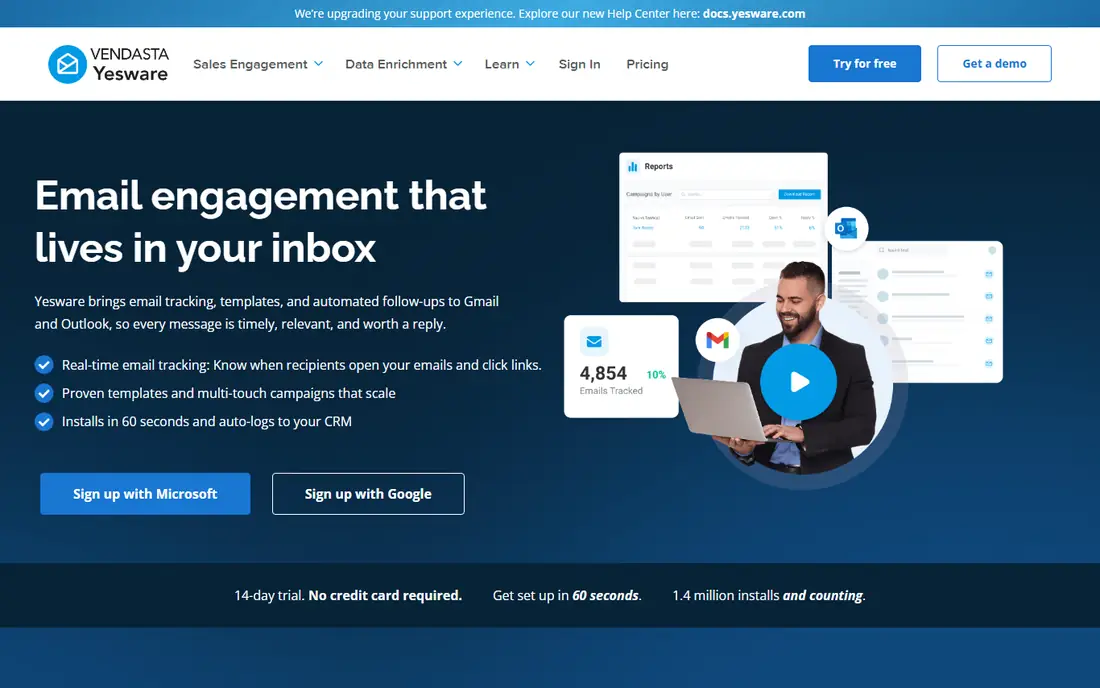
Yesware is the simplest step up from Polymail for a small team. It tracks opens, links, and attachments, stores templates, and runs basic campaigns from inside Gmail or Outlook, which matters for teams that do not all use Gmail. The four plans are Free at $0, Pro at $15, Premium at $35, and Enterprise at $65 per seat per month billed annually, or $19, $45, and $85 billed monthly. Premium is the realistic starting point for a team, because it removes the campaign cap and adds shared templates and team reporting. The Prospector add-on costs $37.50 a month billed annually for 600 contact credits a year, which is worth knowing if you also need prospect data.
What we like- Simple setup inside Gmail and Outlook, published pricing, meeting scheduler included on the free plan, Prospector contact data available as an add-on
Watch out for- Pro caps campaigns at 20 recipients a month, which is too small for real outbound, so usable campaigns need Premium at $35 per seat per month billed annually, and full Salesforce integration requires Enterprise at $65
#3Outreach
Best for: Mid-market and enterprise sales teams that need full sales engagement, forecasting, and coaching in one platform4.3/5 on
G2 (3,671 reviews, checked Oct 2026)
Visit outreach.io
Starting priceQuote only, buyer reports put Amplify Core at about $100 per user per month
Free planNo free plan, sales-led demo and annual contract only
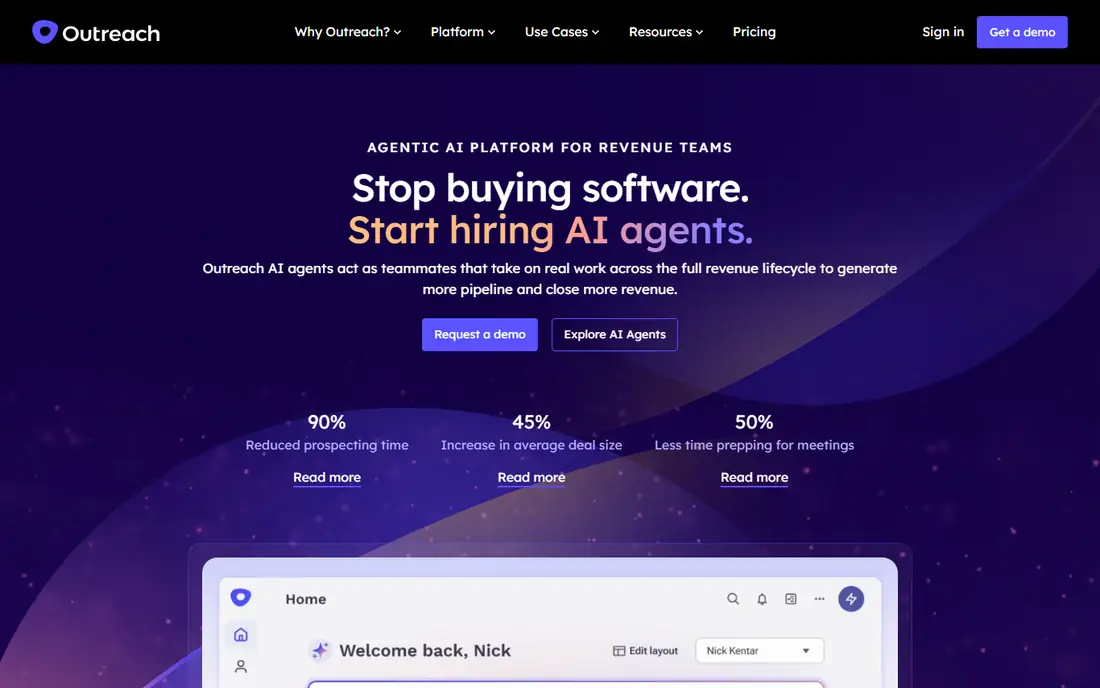
Outreach is the enterprise end of this list and the right pick when a team has outgrown inbox tools entirely. In 2026 it consolidated its plans into Amplify Core, Amplify Plus, and Amplify Pro, with reported per-seat prices of about $100, $130, and $160 per user per month, though some sources report wider ranges of $100 to $150 for Core and $150 to $200 for Plus. Because Outreach publishes no prices, treat every figure here as a reported estimate and get a written quote before budgeting. The platform adds deal management, forecasting, and coaching that Polymail never attempted, but the total cost runs well above the seat price once platform fees, implementation, and AI credits are included. Small teams should rule it out on price and process alone.
What we like- Mature sequencing and analytics, strong Salesforce integration, AI agents for meeting prep and deal summaries, conversation intelligence on higher tiers
Watch out for- No published pricing and no self-serve trial, annual contracts only, platform fees reported at $2,000 to $5,000 a year and implementation at $5,000 to $25,000, and AI credits add consumption-based cost on top of seat prices
#4Apollo
Best for: Teams that want prospecting data, sequences, and a dialer in one subscription4.7/5 on
G2 (9,847 reviews, checked Oct 2026)
Visit apollo.io
Starting price$49 per user per month billed annually for Basic ($65 billed monthly)
Free planYes, free plan with 900 credits a year and 2 sequences
Apollo replaces Polymail and a data provider at the same time, which is why it is popular with outbound teams. The plans are Free at $0, Basic at $49, Professional at $79, and Organization at $119 per user per month billed annually, with monthly billing at $65 and $99 for Basic and Professional. Basic includes 30,000 credits a year, Professional includes 48,000 credits plus the US dialer and AI research, and Organization adds a three seat minimum, the international dialer, SSO, and advanced security. Monthly prices for Basic are reported as $59 by some sources and $65 by others, so confirm the checkout total before buying.
What we like- A 240 million plus contact database bundled into the same subscription, unlimited sequences on paid plans, transparent published pricing, free plan for testing
Watch out for- Plans run on credits, so heavy prospecting can force an upgrade or add-on spend, and all seats on one account must be on the same plan, so you buy for your heaviest user
#5Streak
Best for: Small teams that live in Gmail and want a lightweight CRM inside the inbox4.5/5 on
G2 (269 reviews, checked Oct 2026)
Visit streak.com
Starting price$49 per user per month billed annually for Pro ($59 billed monthly)
Free planFree email tools only, with tracking, snippets, and mail merge, but no CRM pipelines
Streak is the best fit if the thing you miss in Polymail is a pipeline, not sequences. It turns Gmail into a CRM, with deal stages, shared contacts, and team pipelines visible inside the inbox. The free CRM tier was removed in 2024, so the free plan now covers email tools only, and the CRM itself starts at Pro at $49 per user per month billed annually. Pro+ at $69 adds automations, advanced reports, and integrations such as Calendly, while Enterprise at $129 adds custom roles and data validation. One source lists Pro at $39 billed annually, but most November 2026 checks show $49, so use $49 as the verified figure.
What we like- A real CRM that runs inside Gmail with no separate app to open, fast setup with shared pipelines, mail merge up to 1,500 sends a day on Pro
Watch out for- Gmail only, with no Outlook version, workflow automation and native integrations need Pro+ at $69 per user per month billed annually, and Enterprise requires a 10 user minimum
#6
Mailtrack
Best for: Individuals and small teams that only need reliable Gmail open and click tracking
Visit mailtrack.io
Starting price$2.99 per user per month billed annually for Mailtrack ($6.99 billed monthly)
Free planYes, free plan with unlimited open tracking and a promotional signature on sent mail
Mailtrack, now sold under the Mailsuite brand, is the minimal alternative. It tells you when an email is opened and when a link is clicked, and little else, which is exactly what some Polymail users actually used. The vendor pricing page read in October 2026 lists Mailtrack at $2.99 per user per month billed annually, or $6.99 monthly, and the fuller Mailsuite tier at $9.99 billed annually, or $19.99 monthly, with full tracking history and up to 60,000 campaign emails a month. Other sources list $9.99 or $11.99 per month for the paid tier, which reflects older pricing and currency differences, so confirm the price on the checkout page before you pay.
What we like- The cheapest option in this guide, simple check-mark tracking inside Gmail, works in Gmail and Outlook, no setup beyond a browser extension
Watch out for- Limited to tracking, scheduling, and basic campaigns, with no sequences or CRM, and published prices conflict across sources, so the checkout page is the only reliable figure
#7
Boomerang for Gmail
Best for: Gmail users who want send later, follow-up reminders, and Inbox Pause at a low price
Visit boomeranggmail.com
Starting price$4.98 per month billed annually for Personal, $14.98 per month billed annually for Pro
Free planYes, Basic is free with 10 message credits per month
Boomerang covers the Polymail features people use every day, which are send later, reminders, and read receipts, for a fraction of the price. The plans are Basic free, Personal at $4.98, Pro at $14.98, and Premium at $49.98 per month billed annually, with monthly billing at $19.98 for Pro and $59.98 for Premium. New accounts get a 30 day trial of Pro features with no credit card. The free plan is limited to 10 message credits a month, which covers only light use, and Gmail already offers basic send later for free, so Boomerang earns its price on reminders and Inbox Pause rather than scheduling alone.
What we like- Very cheap, reliable follow-up reminders that fire only when nobody replies, Respondable writing feedback, Inbox Pause for focus time
Watch out for- Personal only works with @gmail.com addresses, so Google Workspace users need Pro at $14.98, and there are no sequences or CRM features
#8HubSpot Sales Hub
Best for: Teams that want email tracking inside a full CRM, with marketing and service in the same platform4.4/5 on
G2 (14,364 reviews, checked Oct 2026)
Visit hubspot.com
Starting price$20 per seat per month list for Starter, with a new-customer promo from $7 per seat per month on annual billing
Free planYes, free CRM for up to 2 users with email tracking and contact management
HubSpot Sales Hub is the right alternative when the real problem is that Polymail is not a CRM. The free plan covers contact management, deal tracking, and basic email tracking for up to two users, which is enough for a solo seller to test. Starter lists at $20 per seat per month, with a limited-time new-customer price of $7 on annual billing, while Professional is $90 billed annually or $100 billed monthly, and Enterprise is $150 per seat per month plus a $3,500 onboarding fee. Note that HubSpot's catalog prices seats in two ways, with a Core Seat at $20 on Starter and a Sales Seat at $100 on Professional, so check which seat type your quote uses.
What we like- A full CRM with deals, pipelines, and reporting in the same subscription, sequences and forecasting on Professional, strong integrations across marketing and service
Watch out for- Sequences, forecasting, and lead scoring need Professional at $90 per seat per month billed annually plus a one-time $1,500 onboarding fee, and the Starter promo price is for new customers only
Frequently asked questions
What is the best Polymail alternative for sales teams?
Mixmax is the best direct replacement for most Gmail sales teams, because it adds sequences, tracking, templates, and meeting scheduling inside the inbox from $29 per user per month billed annually. Apollo is better if you also need prospect data, since it bundles a large contact database with sequences from $49. Outreach suits larger teams that need forecasting and coaching, at a reported $100 per user per month and up.
Is there a free Polymail alternative?
Yes. Mixmax, Yesware, Apollo, Streak, Mailtrack, Boomerang, and HubSpot Sales Hub all offer free plans, though each one is limited. Mixmax free covers 20 tracked emails a month, Yesware free allows 10 campaign recipients, and Mailtrack free gives unlimited open tracking with a promotional signature. Streak free covers email tools only, with no CRM pipelines, so read the limits before you commit.
Why is Polymail pricing confusing?
Polymail has changed its plan names and prices over time. Its current pricing page lists Basic at $10 per month and Premium at $24 per month, with Enterprise on a custom quote. Older pages used Pro at about $10 and Business at about $16, and G2 lists Basic at $13.
Which Polymail alternative works with Outlook?
Yesware works with Gmail and Outlook, Mailtrack supports Outlook as well as Gmail, Boomerang has a separate Outlook version priced at $4.99 and $14.99 per month, and HubSpot Sales Hub connects to Outlook through its CRM. Mixmax, Streak, and Boomerang for Gmail are Gmail-first tools, so Outlook-only teams should shortlist Yesware or HubSpot first.
Can I move my Polymail data to another tool?
You can export contacts from Polymail and import them into a CRM such as HubSpot or Streak, and most tools here offer an import wizard for contacts and deals. Email templates, sequences, and tracking history do not transfer automatically, so plan to rebuild templates in the new tool and keep Polymail active until the move is done.
Sources we checked (10)
- https://polymail.io/pricing
- https://www.mixmax.com/pricing
- https://www.yesware.com/pricing
- https://revenuegrid.com/blog/outreach-pricing/
- https://www.apollo.io/pricing
- https://www.streak.com/pricing
- https://mailtrack.io/pricing
- https://www.boomeranggmail.com/subscriptions.html
- https://www.hubspot.com/pricing/sales
- https://www.g2.com/products/polymail/reviews
Is your product missing or out of date?
We review this list regularly. Vendors can request a listing, send updated pricing or ask about featured placement.

Shihab Mia · Founder, Rankite
Shihab has 5+ years in B2B and SaaS SEO. He writes Rankite's software buying guides from pricing pages, documentation and public user reviews. More about Shihab.