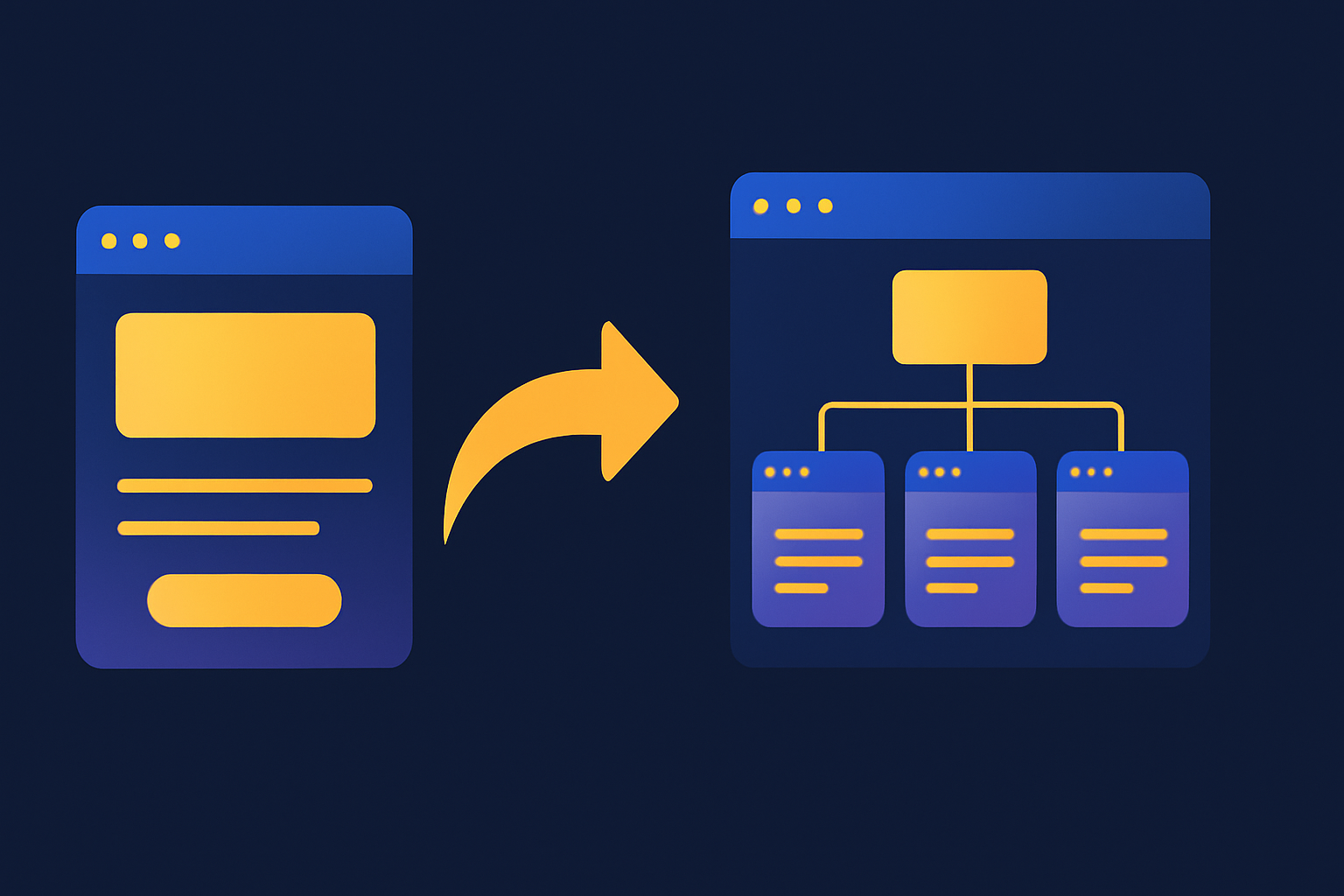
In the landing page vs website comparison, the difference comes down to focus: a landing page is a single, standalone page built to drive one action, while a website is a connected group of pages that represents your entire business. A landing page strips away navigation to push one signup, demo, or sale. A website gives visitors the full picture with a homepage, product pages, a blog, and contact details. Most growing brands end up needing both, for different jobs.
A landing page is a single, standalone web page created for one marketing goal, such as capturing a lead or closing a sale. A website is a group of linked pages under one domain that covers everything about your business. The clearest way to see it: a website invites people to explore, and a landing page asks them to decide.
That difference shapes every design choice. A website carries a navigation menu, a homepage, service pages, a blog, and a footer full of links, because its job is to serve many visitors with many needs. A landing page removes most of that on purpose. There is usually one headline, one offer, and one button, so the visitor is not pulled in ten directions. The visual craft of that focus, layout, hierarchy, and trust cues, is covered in our guide on how to design a landing page. If you are building the conversion-focused kind, our guide on how to structure an SEO landing page that ranks and converts walks through the layout in detail.
Put simply, a website is your digital headquarters, and a landing page is a focused entry point built for one campaign.
The two overlap in that both live on the web and both can convert visitors, but they are built for different outcomes. This table lays the differences side by side across the five things that matter most: purpose, pages, navigation, goal, and when to use each.
| Factor | Landing page | Website |
|---|---|---|
| Purpose | Convert one campaign or offer | Represent the whole business |
| Pages | One standalone page | Many linked pages under one domain |
| Navigation | Minimal or none, to keep focus | Full menu, footer, and internal links |
| Goal | One action (signup, demo, sale) | Many goals (inform, rank, sell, support) |
| When to use | Paid ads, email, launches, promos | Brand presence, SEO, ongoing content |
Notice that neither column is better in the abstract. A landing page would make a poor company website because it hides everything a browsing visitor wants. A website makes a leaky campaign destination because it gives an ad clicker too many exits. The skill is knowing which one a given piece of traffic needs.
Landing pages convert better because they give the visitor one clear choice instead of dozens. By removing the main navigation and competing calls to action, they keep attention on a single offer that matches the ad or email the visitor just clicked. Unbounce, in its analysis of 41,000 landing pages, found an average conversion rate of 6.6%, compared with the roughly 2.35% average WordStream reports for general site traffic.
The mechanism is simple. Every extra link on a page is another way to leave without converting. A homepage might have thirty of them. A good landing page has one path forward, so the percentage of people who take it climbs. Message match helps too: when the headline repeats the promise from the ad, the visitor feels they are in the right place and keeps going.
Form length plays a part as well. HubSpot found that 30.7% of marketers say four fields is the sweet spot for conversion, so landing pages tend to ask for less than a full contact or checkout flow. We put these principles to work for Meta Clipping Path, where focused optimization lifted leads by 250%. If you want the deeper playbook, see our conversion rate optimization best practices.
Use a dedicated landing page any time you send targeted traffic to a single offer. That includes pay-per-click ads, webinar and event signups, product launches, email promotions, and gated downloads like an ebook or template. In each case the visitor arrived with one intent, and a focused page converts that intent far better than dropping them on a busy homepage to fend for themselves. For software products, our SaaS landing page guide breaks down the exact sections that turn a click into a signup.
Send traffic to your full website, on the other hand, when the goal is discovery rather than a single action. Someone searching your brand name, reading your blog, comparing services, or looking for your contact details needs room to explore. Here is the quick rule.
Landing pages also shine for testing. Because each one targets a narrow audience, you can run two versions, measure which converts, and roll the winner into your ads. That is much harder to do on a homepage that serves everyone at once.
For almost every business, yes. A website and landing pages are not competitors; they cover different stages of how people find and choose you. The website earns organic search traffic, builds credibility, and answers the wide range of questions buyers ask over months. Landing pages capture the conversions when you actively drive traffic to a specific offer.
The data backs the pairing. HubSpot's Marketing Benchmarks found that companies with 10 to 15 landing pages generate 55% more leads than those with fewer than 10, and companies with 40 or more landing pages see over 500% more leads. Those pages sit alongside a real website, not instead of it, each one tuned to a different segment or campaign.
The website side compounds too. Strong organic content lifted Understood Care from roughly 1,000 to over 3,000 organic visits a month, the kind of durable growth a single landing page cannot deliver on its own. The healthiest setup runs both: a website that ranks and builds trust, plus landing pages that turn campaign clicks into leads. If you are still nailing down the broader strategy, start with what is SEO and how organic search fits the picture.
No, and mixing them up costs conversions. A homepage is the front door of your website. It greets every kind of visitor, introduces the brand, and links out to the rest of the site, so it juggles many goals at once. A landing page is built for one campaign and one action, with the distractions stripped out.
The practical mistake is pointing ads at the homepage. A visitor who clicked an ad for a specific product or offer lands on a general page, cannot immediately find what the ad promised, and often leaves. Matching each campaign to a purpose-built landing page keeps the promise consistent from click to conversion. The homepage still matters, it just serves browsing and brand traffic, not a targeted campaign.
You rarely choose one and abandon the other. The real question is which asset a given goal needs, and the answer follows from the traffic source and the outcome you want. Work through it in order.
If you already have a website and are running ads straight to it, the fastest win is usually building dedicated landing pages for your top campaigns. The lift in conversion rate often pays for the work quickly. The same discipline that improves a landing page also strengthens the pages on your main site, which our guide to content optimization covers end to end. As the website side grows, not every page keeps earning its place either; a periodic pass through our content pruning for SEO guide keeps the site lean and concentrates authority on the pages still doing the work.
Not every landing page belongs in Google's index. A throwaway page built for one paid campaign or one email blast should carry a noindex tag, while an evergreen landing page built around a keyword buyers actually search for should stay indexed and get full on-page SEO treatment. Treating every landing page the same, indexing all of them or noindexing all of them, is where most sites lose ground without realizing it.
The reasoning is straightforward. A short-lived campaign page usually repeats messaging that already lives elsewhere on the site, has almost no content left once the promotion ends, and rarely earns any organic traffic of its own. Left indexed, dozens of these near-duplicate pages pile up and dilute the site's topical focus, a problem our guide on index bloat covers in more depth, including when a canonical tag is the better fix instead of a full noindex; our explainer on what a canonical tag does walks through that distinction. An evergreen landing page is different: if it targets a real search term and earns its own visitors from organic search, it deserves the same title tag, heading structure, and internal linking as any other page on the site, because it is functioning as a website page even though it started life as a campaign asset.
The same split matters for AI search visibility, not just Google. A thin campaign page with a vague headline and a single lead form gives an AI engine nothing worth quoting, so it will not surface in ChatGPT, Gemini, or AI Overviews no matter how well the ad performs. An evergreen landing page written with real explanatory content has a shot at being cited the same way a blog page does. Our AEO strategy guide covers how to structure a page so an AI engine can actually extract and cite it.
What is the difference between a landing page and a website? A landing page is a single, standalone page built to drive one specific action, such as a signup or purchase, with little or no navigation. A website is a connected group of pages under one domain that represents your whole business and lets visitors explore freely. The landing page converts a campaign; the website builds your presence.
Is a landing page part of a website? It can be, but it does not have to be. Many landing pages live on the same domain as your main site, while others are hosted on dedicated builders like Unbounce or Leadpages and sit apart from the main navigation. What defines a landing page is its single focused goal, not where it is hosted.
Why do landing pages convert better than websites? Landing pages remove navigation and competing links so visitors face one clear choice instead of dozens. Unbounce, analyzing 41,000 landing pages, found an average conversion rate of 6.6%, well above the roughly 2.35% ecommerce average WordStream reports for general site traffic. Fewer distractions and message match with the ad are the main reasons.
Is a homepage a landing page? No. A homepage is the front door of your website and serves many audiences and goals at once, with full navigation to the rest of the site. A landing page is built for one campaign and one action. A visitor from a specific ad should land on a matching landing page, not your general homepage.
Do I need a website if I have a landing page? For most businesses, yes. A landing page is excellent for a single campaign, but it cannot rank for a wide range of searches, build brand trust, or answer every buyer question. A website earns organic traffic and credibility over time, while landing pages capture conversions from paid and email campaigns. The two do different jobs.
When should I use a landing page instead of my website? Use a dedicated landing page whenever you send targeted traffic to one offer: pay-per-click ads, a webinar signup, a product launch, an email promotion, or a gated download. Sending that traffic to your homepage forces visitors to hunt for the offer and lowers conversions. Match each campaign to its own focused page.
How many landing pages should a business have? More than most businesses run. HubSpot's Marketing Benchmarks data found that companies with 10 to 15 landing pages generate 55% more leads than those with fewer than 10, and companies with 40 or more see over 500% more leads. Each page can target a different audience segment or offer, which is why the count matters.
Does a landing page or a website help SEO more? A full website helps SEO more because it has the depth, internal links, and range of pages that search engines reward with rankings. A single landing page can rank, but it rarely builds topical authority on its own. Landing pages are usually optimized for paid traffic and conversions, while websites are built to earn organic search visibility.
Should a landing page be indexed by Google? Only if it can earn organic traffic on its own merit. A landing page built for one paid campaign or email send with no lasting content should be noindexed once you know it will not attract search traffic, since keeping it indexed only adds a near-duplicate page competing with the rest of the site. An evergreen landing page targeting a real search term should stay indexed and be treated like any other page on the site.
Can a landing page get cited by AI search tools like ChatGPT or AI Overviews? Only if it has substantive content to cite. A landing page stripped down to a headline, a few bullet points, and a form gives an AI engine nothing to quote, so campaign pages built purely for conversion rarely show up in AI answers. An evergreen landing page written with real explanatory content, the kind that also earns organic search traffic, has the same shot at being cited as a blog page.
Map your goals to the right asset. Keep your website as the foundation that ranks and builds trust, then build a focused landing page for each campaign you actively drive traffic to. If you want a fast read on where your site is leaking conversions and where dedicated landing pages would pay off, request a free SEO audit from Rankite and we will show you exactly what to build first.
Get a free, no-obligation SEO audit and a 30-minute strategy session. We'll show you exactly where the growth is hiding.
Fill out the form and we'll get back to you within one business day. Prefer email? Write to us directly at contact@rankite.com.