How we make this list: we compare pricing pages, product documentation and public user reviews. Ratings come from G2, Capterra or Trustpilot, with the date we checked them.
Key takeaways
- Ivanti is an IT management and security vendor covering unified endpoint management, patching, service management, and zero trust access through its Neurons platform.
- ManageEngine is the closest broad alternative, with endpoint, service desk, and security tools at a lower price point.
- NinjaOne and Automox suit teams that want cloud-native endpoint management with fast setup and strong patching.
- Microsoft Intune suits Microsoft 365 shops, while Jamf suits Apple device fleets, and Tanium suits large enterprises needing real-time endpoint data.
- Lansweeper suits asset discovery and inventory, while PDQ suits Windows-focused patching and deployment on a budget.
- The deciding factors are device mix, patching depth, service management needs, cloud versus on-premises deployment, and price per device.
Quick comparison
| Tool | Best for | Starting price | Free plan |
|---|
 ManageEngine | Broad IT suite value | See website | No |
 NinjaOne | Cloud-native endpoints | See website | No |
 Automox | Cloud patch automation | See website | No |
 Microsoft Intune | Microsoft 365 shops | See website | No |
 Jamf | Apple device fleets | See website | No |
 Tanium | Real-time enterprise endpoints | See website | No |
 Lansweeper | Asset discovery | See website | No |
 PDQ | Windows patching budget | See website | No |
Is your product missing or out of date?
We review this list regularly. Vendors can request a listing, send updated pricing or ask about featured placement.
The best Ivanti alternatives
Starting priceSee website
Free planNo
ManageEngine is the closest broad alternative to Ivanti, with Endpoint Central for device management, ServiceDesk Plus for ITSM, and security tools for patching and vulnerability management in one vendor. Mid-size IT teams get a wide suite at a lower price than Ivanti or Tanium, with on-premises and cloud options. The breadth suits teams that want one vendor for endpoint and service management together.
The interface varies across products, cloud options trail NinjaOne's cloud-native design, and enterprise scale needs planning. For a mid-size team that wants broad IT tooling at good value, ManageEngine is the best pick.
What we like- Broadest suite at a lower price
- Endpoint, service desk, and security tools
- Strong for mid-size IT teams
Watch out for- Interface varies across products
- Cloud options trail NinjaOne
- Enterprise scale needs planning
#2NinjaOne
Best for: Cloud-native endpoints4.7/5 on
G2 (5,037 reviews, checked Oct 2026)
Visit ninjaone.com
Starting priceSee website
Free planNo
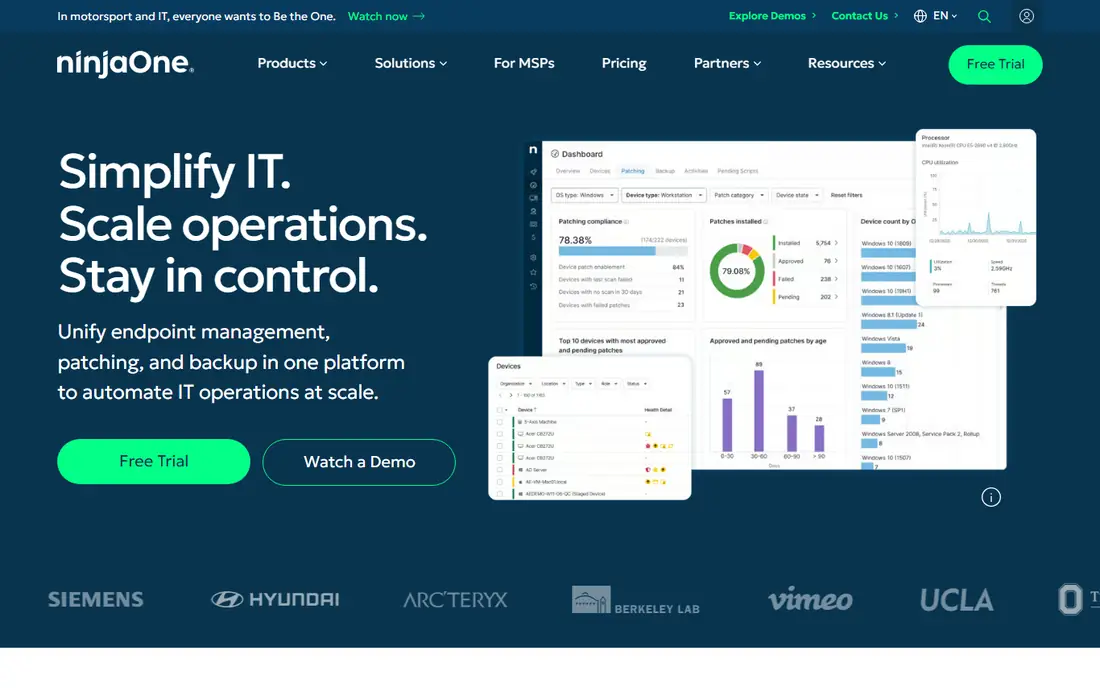
NinjaOne is the cloud-native endpoint alternative, with fast deployment, strong patching, remote access, and monitoring in a single cloud console. IT teams and MSPs value its speed: agents deploy in minutes, policies apply quickly, and the interface stays simple. It suits teams moving from on-premises tools to cloud management.
Pricing is quote-based, ITSM features are lighter than Ivanti's service management suite, and reporting depth varies by module. For a team that wants cloud-native endpoint management with minimal setup, NinjaOne is the best choice.
What we like- Cloud-native and fast to deploy
- Strong patching and remote access
- Popular with MSPs and IT teams
Watch out for- Pricing is quote-based
- ITSM features are lighter than Ivanti
- Reporting depth varies
#3Automox
Best for: Cloud patch automation4.5/5 on
G2 (326 reviews, checked Oct 2026)
Visit automox.com
Starting priceSee website
Free planNo

Automox is the cloud patch automation alternative, built to patch Windows, macOS, and Linux plus third-party applications through policy-based automation. Remote fleets stay patched without VPNs or on-premises servers, and automation handles patching, configuration, and software deployment. It suits teams whose main pain is patch compliance.
Pricing is quote-based, device management is narrower than Ivanti's full UEM, and remote access is lighter than NinjaOne's. For a team focused on patch automation for distributed devices, Automox is the best fit.
What we like- Cloud-native patch automation across OS and third-party apps
- Policy-based automation
- Good for remote fleets
Watch out for- Pricing is quote-based
- Device management is narrower than Ivanti
- Remote access is lighter
#4Microsoft Intune
Best for: Microsoft 365 shops4.5/5 on
G2 (272 reviews, checked Oct 2026)
Visit microsoft.com
Starting priceSee website
Free planNo
Microsoft Intune is the natural alternative for Microsoft 365 shops, managing Windows, iOS, Android, and macOS devices with deep Entra ID and Microsoft 365 integration. Organizations already paying for Microsoft licenses often get Intune included or at low incremental cost, and conditional access policies tie device compliance to app access. It suits Windows-heavy fleets with Microsoft identity.
Third-party patching needs add-ons, macOS management depth trails Jamf's, and policy complexity grows at scale. For a Microsoft-standardized organization, Intune is the obvious choice.
What we like- Deep Microsoft 365 and Entra integration
- Included in some Microsoft licenses
- Strong for Windows and mobile
Watch out for- Third-party patching needs add-ons
- MacOS depth trails Jamf
- Policy complexity grows at scale
#5Jamf
Best for: Apple device fleets4.7/5 on
G2 (2,443 reviews, checked Oct 2026)
Visit jamf.com
Starting priceSee website
Free planNo
Jamf is the Apple device alternative, with the deepest management for Mac, iPhone, and iPad, including zero-touch deployment through Apple Business Manager, app management, and security controls. Education and enterprise Apple fleets rely on Jamf for enrollment, configuration, and compliance that generic UEM tools cannot match.
It is Apple only, Windows management is not covered, and pricing is per device. For an Apple-heavy organization, Jamf is the best choice, often paired with Intune or another tool for Windows devices.
What we like- Deepest Apple device management
- Best for Mac, iPhone, and iPad fleets
- Strong for education and enterprise
Watch out for- Apple only
- Windows management is not covered
- Pricing is per device
Starting priceSee website
Free planNo
Tanium is the real-time enterprise alternative, querying hundreds of thousands of endpoints in seconds for live inventory, vulnerability, and compliance data. Large enterprises use it for incident response and patching at a scale where traditional tools are too slow. Its platform covers endpoint management, risk, and security operations in one agent.
Pricing is enterprise, implementation takes expertise, and it is overkill for small teams. For a large enterprise that needs real-time endpoint visibility, Tanium is the most capable choice.
What we like- Real-time endpoint data at massive scale
- Strong for large enterprises
- Fast incident response
Watch out for- Enterprise pricing
- Implementation takes expertise
- Overkill for small teams
Starting priceSee website
Free planNo
Lansweeper is the asset discovery alternative, scanning networks to build a complete inventory of hardware, software, and cloud assets without agents on every device. IT teams use it for asset management, license tracking, and audit preparation, with broad coverage across devices and systems. It complements management tools by answering what you own.
Patching and device management are lighter than Ivanti's, deployment needs planning for large networks, and pricing scales with asset count. For a team whose main gap is asset visibility, Lansweeper is the best fit.
What we like- Excellent network discovery and asset inventory
- Good for IT asset management
- Broad device coverage
Watch out for- Patching and management are lighter than Ivanti
- Deployment needs planning
- Pricing scales with assets
Starting priceSee website
Free planNo
PDQ, with PDQ Deploy and PDQ Inventory, is the budget Windows alternative, offering affordable patching and software deployment for Windows fleets. Small IT teams value its simplicity and speed: build a package, target a collection, and deploy without a complex platform. It suits Windows-only environments that need reliable patching at low cost.
It is Windows only, cloud features are newer than NinjaOne's or Automox's, and enterprise scale is limited. For a Windows-focused small team on a budget, PDQ is the best value.
What we like- Affordable Windows patching and deployment
- Simple and fast
- Popular with small IT teams
Watch out for- Windows only
- Cloud features are newer
- Enterprise scale is limited
How we chose
We compared endpoint management platforms that replace Ivanti's core job: managing devices, patching software, and securing endpoints across an organization. We weighed device coverage, patching depth, service management breadth, deployment model, and pricing from vendor pages and 2026 endpoint management comparisons. We left out mobile-only MDM tools without desktop management and security-only tools without device management. Where pricing is quote-based, we say so rather than guessing.
How to pick an Ivanti replacement
Start with your device mix. Broad IT suites should shortlist ManageEngine. Cloud-native endpoints should shortlist NinjaOne and Automox. Microsoft shops should shortlist Intune. Apple fleets should shortlist Jamf. Large enterprises should shortlist Tanium. Asset discovery should shortlist Lansweeper. Windows budgets should shortlist PDQ. Then check patching depth and service management needs, since Ivanti's breadth is its main strength to replace.
Audit your current Ivanti usage first
Ivanti covers many areas, and most teams use only part of it. Audit which modules you actually use: endpoint management, patching, service desk, asset management, or zero trust access, and rank them by importance. A replacement that covers your top two needs well beats a broad tool that covers everything weakly, and it saves license cost.
Pilot patching on a real device group
Patching claims are easy to make and hard to deliver across operating systems and third-party apps. Pilot each candidate on a real device group with your actual applications, measuring patch success rates, reboot behavior, and failure reporting. A pilot reveals gaps in third-party patching and macOS support that demos hide.
Plan migration in waves by device group
Migrating endpoints is risky if done at once: agent conflicts, policy gaps, and patching lapses can leave devices unmanaged. Migrate in waves by device group, starting with a low-risk group, validating management and patching before each next wave, and keeping Ivanti running until the final group is proven. A wave migration limits blast radius and gives your team time to learn the new console. Document each wave's results, including patch success rates and support ticket volume, so later waves benefit from earlier lessons and leadership sees steady progress toward full migration without disruption to daily work or security posture at any stage of the project today either way around now here always together forever onward again today either way around now here always together forever onward again today either way around now here always together forever onward again today either way around now here always together forever onward again today either way around now here always together forever onward again.
Frequently asked questions
Is ManageEngine better than Ivanti?
For value and breadth at mid-size scale, ManageEngine is strong, with endpoint, service desk, and security tools at a lower price. Ivanti's edge is its Neurons platform integration and enterprise service management depth. Compare both on your specific modules and device count before switching.
What is the cheapest Ivanti alternative?
PDQ is cheapest for Windows-only patching and deployment, while ManageEngine offers good value for a broad suite. Cloud-native tools like NinjaOne and Automox price per device and vary by fleet size, so get quotes at your actual device count for a fair comparison.
Can Intune replace Ivanti fully?
For Microsoft shops, Intune covers most endpoint management needs, especially Windows and mobile. It trails Ivanti on third-party patching depth and service management breadth, so teams that need those areas often pair Intune with a patching tool or keep a service desk separate.
Do these tools support macOS and Linux?
Yes, with differences. Jamf leads on macOS, Automox and NinjaOne cover macOS and Linux well, and Intune covers macOS adequately. PDQ is Windows only. Check third-party patching and policy depth per operating system during the trial, since headline support hides gaps.
How long does an Ivanti migration take?
A typical migration takes four to twelve weeks depending on fleet size and module breadth: audit and pilot in weeks one to three, wave migration in weeks four to eight, and validation and decommission after. Complex service desk migrations take longer than endpoint-only moves, so plan service management separately.
Sources we checked (8)
- https://www.manageengine.com
- https://www.ninjaone.com
- https://automox.com
- https://www.microsoft.com
- https://www.jamf.com
- https://www.tanium.com
- https://www.lansweeper.com
- https://www.pdq.com
Is your product missing or out of date?
We review this list regularly. Vendors can request a listing, send updated pricing or ask about featured placement.

Shihab Mia · Founder, Rankite
Shihab has 5+ years in B2B and SaaS SEO. He writes Rankite's software buying guides from pricing pages, documentation and public user reviews. More about Shihab.