How we make this list: we compare pricing pages, product documentation and public user reviews. Ratings come from G2, Capterra or Trustpilot, with the date we checked them.
Ecwid vs WooCommerce: the direct answer
Ecwid wins for a store owner who wants to add selling to an existing website without rebuilding it, while WooCommerce wins for a WordPress owner who wants full control and no platform fee. Ecwid Business costs $49 a month billed annually with 0 percent transaction fees, and WooCommerce core is free, with hosting from about $25 a month.
Key takeaways
- Ecwid Business costs $49 a month billed annually with 0 percent transaction fees, and the free plan ended in 2025.
- WooCommerce core is free, but hosting and extensions can cost more than a hosted plan.
- Ecwid caps products by plan, from 10 on Starter to unlimited on Unlimited, while WooCommerce has no product cap.
- Shopify Basic costs $29 a month billed annually, and BigCommerce and Squarespace repriced in 2026.
- Wix and WordPress.com prices rise at renewal, so budget on the renewal figure.
Which one is better for a store that already has a website?
Ecwid is better for a store that already has a website. It is a widget style store you add to an existing site, so you can start selling without rebuilding anything. WooCommerce is better for a store that already runs on WordPress and wants a full store inside that site. The plugin is free, you own the code and data, and there is no platform fee. The trade off is work: Ecwid handles hosting and updates, while WooCommerce leaves them to you. Pick Ecwid for a simple site, and WooCommerce for deep WordPress control.
How do Ecwid and WooCommerce prices compare?
Ecwid charges a flat monthly price that rises with your catalog, while WooCommerce charges nothing for the core plugin and bills hosting and extensions separately. Ecwid Starter costs $5 a month for up to 10 products, Venture costs $29 a month billed annually, or $35 billed monthly, for up to 100 products, Business costs $49 billed annually, or $65 billed monthly, for up to 2,500 products, and Unlimited costs $119 billed annually, or $149 billed monthly, for unlimited products. Prices rose on 2 March 2026, so guides showing $25, $45, and $105 are stale. WooCommerce core is free, and WooCommerce estimates hosting at about $25 to $350 a month for most stores. Paid extensions run about $29 to $299 a year each. Ecwid charges 0 percent transaction fees on every plan, though your payment provider still charges its own rate, and WooPayments charges 2.9 percent plus 30 cents on US cards.
| Tool |
Starting price |
Free plan |
Best for |
| Ecwid |
$5 per month |
No free plan; the free plan ended in 2025 |
Add a store to an existing site |
| WooCommerce |
$0 core plugin |
Yes, free and open source |
WordPress owners who want full control |
| Shopify |
$29 per month annual |
No free plan; 3-day free trial |
Stores where selling is the whole business |
| BigCommerce |
$29 per month annual |
No free plan; 15-day free trial |
Growing brands that want built in features |
| Squarespace |
$19 per month annual |
No free plan; 14-day free trial |
Design led brands where the website comes first |
| Wix |
$17 per month annual |
Yes, free plan with Wix branding |
Beginners who want a drag and drop site and store |
| Webflow |
$15 per month annual |
Yes, free Starter plan |
Design led sites that need precise layout control |
| WordPress.com |
$4 per month annual |
Yes, free plan on a wordpress.com subdomain |
Bloggers and content led stores |
What will a store pay in a real month?
Take a store doing $10,000 a month in online sales across 200 orders at $50 each. On Ecwid Business billed annually, the plan costs $49, and card fees at 2.9 percent plus 30 cents come to $350, for a total of $399 before apps. On WooCommerce with WooPayments, card fees are the same $350, and the platform fee is $0, so the total is $350 plus hosting. If hosting costs $30 a month, the WooCommerce total is $380, almost the same as Ecwid. If hosting costs $100 a month and extensions add $50, WooCommerce costs $500. Hosting, extensions, and the product cap decide the real winner at your volume.
What trade offs should a store owner watch before choosing?
Watch four trade offs. First, catalog size against price. Ecwid charges more as your catalog grows, and a store that outgrows 100 products must move from Venture at $29 to Business at $49 a month billed annually. WooCommerce has no product cap at all. Second, ownership against convenience. WooCommerce gives you code and hosting choice, while Ecwid and Shopify give you a managed store. Third, the app bill. Ecwid apps, Shopify apps, and WooCommerce extensions can each add $50 to $200 a month. Fourth, renewal pricing. WordPress.com prices rise at renewal, Wix discounts often double in year two, and Ecwid prices rose in March 2026. Read the renewal price and the card fee before you choose.
Quick comparison
| Tool | Best for | Starting price | Free plan |
|---|
 Ecwid | Owners who want to add a store to an existing site | Starter $5 per month for up to 10 products; Venture $29 per month billed annually ($35 billed monthly) for up to 100 products; Business $49 ($65) for up to 2,500 products; Unlimited $119 ($149) for unlimited products | No free plan for new sign-ups; the free plan was discontinued in 2025, and existing free stores closed on 20 November 2025 unless they upgraded |
 WooCommerce | WordPress owners who want full control and no platform fee | Free core plugin; WooCommerce estimates hosting at about $25 to $350 per month for most stores, plus extensions and payment fees | Yes, the core plugin is free and open source |
 Shopify | Stores where selling is the whole business | Basic $29 per month billed annually ($39 billed monthly); Grow $79 ($105); Advanced $299 ($399); Plus from $2,300 per month | No free plan; 3-day free trial, then $1 per month for 3 months on monthly plans |
 BigCommerce | Growing brands that want built in features | Core $29 per month billed annually ($39 billed monthly); Growth $79 ($105); Scale $299 ($399); Performance from $1,499 per month billed annually | No free plan; 15-day free trial |
 Squarespace | Design led brands where the website comes first | Basic $19 per month billed annually ($25 billed monthly); Core $29 ($39); Plus $49 ($65); Advanced $99 ($139) | No free plan; 14-day free trial |
 Wix | Beginners who want a drag and drop site and store | Light $17 per month billed annually ($24 billed monthly); Core $29 ($36); Business $39 ($46); Business Elite $159 ($172) | Yes, a free plan is available with Wix branding and no custom domain |
 Webflow | Design led sites that need precise layout control | Basic $15 per month billed annually ($25 billed monthly); Premium $25 ($39); ecommerce plans from Standard $29 per month billed annually | Yes, a free Starter plan is available for staging and learning |
 WordPress.com | Bloggers and content led stores | Personal $4 per month billed annually ($9 billed monthly, renews at $5); Premium $8 ($18, renews $9); Business $25 ($40, renews $28); Commerce $45 ($70, renews $50) | Yes, a free plan is available on a wordpress.com subdomain |
Is your product missing or out of date?
We review this list regularly. Vendors can request a listing, send updated pricing or ask about featured placement.
The eight tools below cover the full range in this guide, from a free plugin to premium hosted platforms. Read the starting price, the free plan, and the real con for each one before you shortlist. Prices were checked on 19 November 2026.
#1Ecwid
Best for: Owners who want to add a store to an existing site4.7/5 on
G2 (405 reviews, checked Oct 2026)
Visit ecwid.com
Starting priceStarter $5 per month for up to 10 products; Venture $29 per month billed annually ($35 billed monthly) for up to 100 products; Business $49 ($65) for up to 2,500 products; Unlimited $119 ($149) for unlimited products
Free planNo free plan for new sign-ups; the free plan was discontinued in 2025, and existing free stores closed on 20 November 2025 unless they upgraded
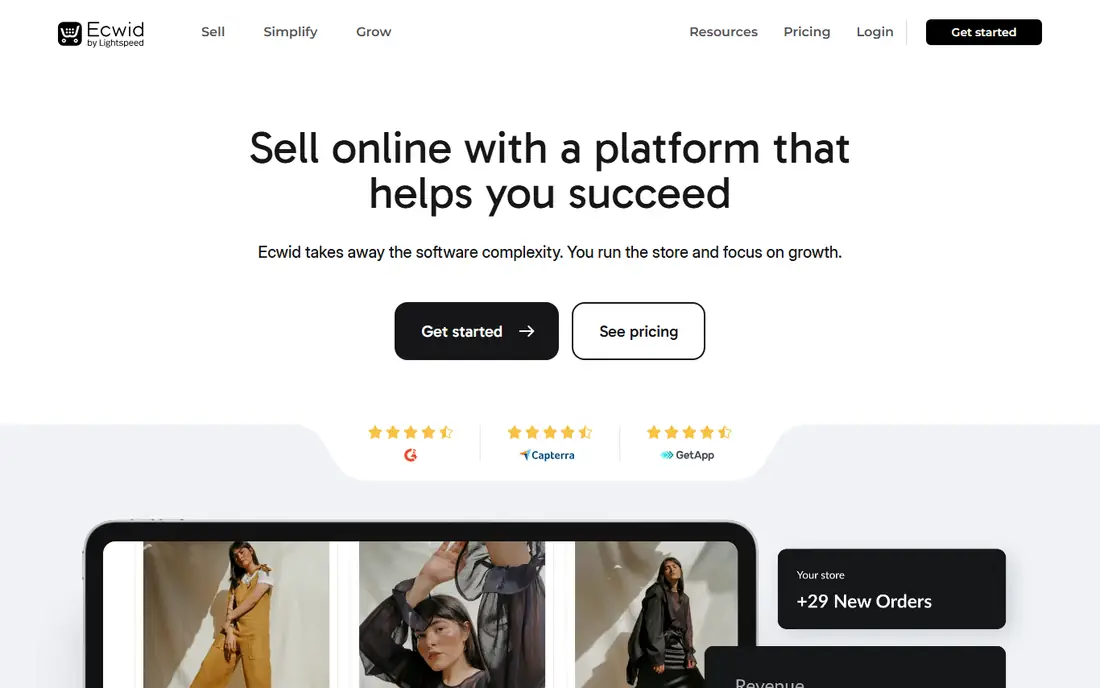
Ecwid by Lightspeed is a widget style store that you add to an existing website, blog, or social page. Starter at $5 a month covers up to 10 products, Venture at $29 billed annually covers up to 100, Business at $49 covers up to 2,500, and Unlimited at $119 has no product cap. Every plan charges 0 percent transaction fees from Ecwid, though your payment provider still charges its own rate. Prices rose on 2 March 2026, so guides showing $25, $45, and $105 are stale.
What we like- Adds selling to any existing site, charges 0 percent transaction fees on every plan, and needs no hosting setup
Watch out for- Product caps force a plan upgrade as your catalog grows, and the free plan is gone, so even a tiny store now pays at least $5 a month
#2WooCommerce
Best for: WordPress owners who want full control and no platform fee4.4/5 on
G2 (1,283 reviews, checked Oct 2026)
Visit woocommerce.com
Starting priceFree core plugin; WooCommerce estimates hosting at about $25 to $350 per month for most stores, plus extensions and payment fees
Free planYes, the core plugin is free and open source
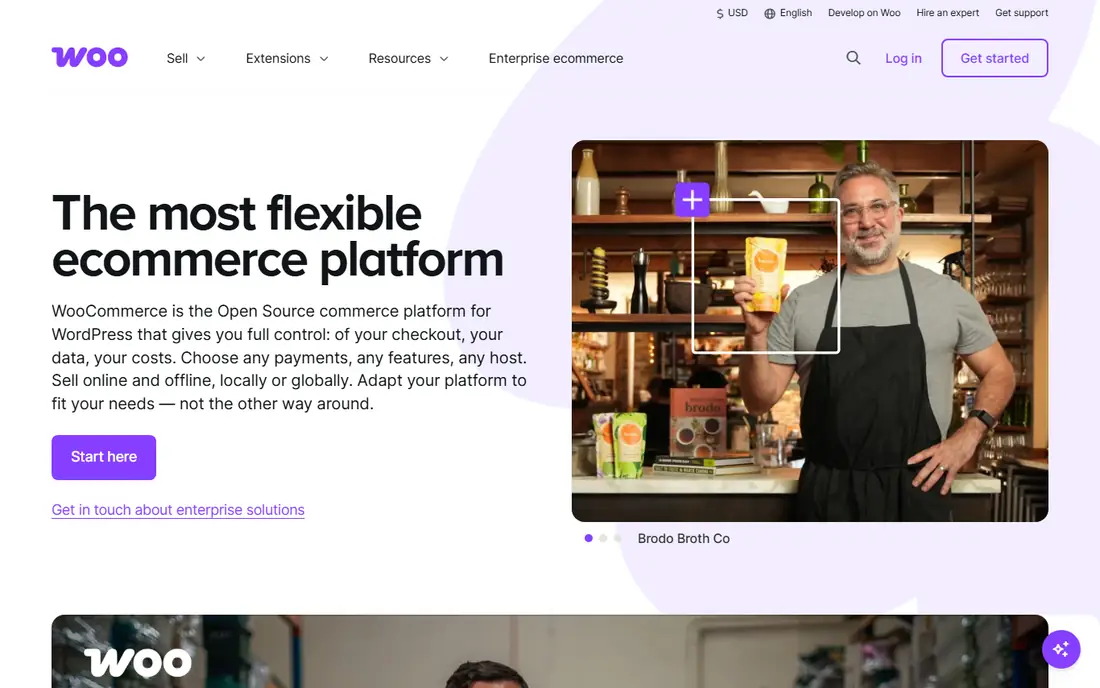
WooCommerce is a free plugin that turns a WordPress site into a store. There is no monthly platform fee and no revenue share, and you own the code and data. WooCommerce estimates hosting at about $25 to $350 a month for most stores, and paid extensions run about $29 to $299 a year each. WooPayments charges 2.9 percent plus 30 cents on US cards. There is no product cap, so a large catalog costs the same as a small one. A non technical owner who pays for help can spend more than on Ecwid or Shopify.
What we like- Free core, no platform fee or revenue share, and full ownership of code and data
Watch out for- You manage hosting, security, updates, and backups yourself, and paid extensions and developer time can make it cost more than a hosted platform
#3Shopify
Best for: Stores where selling is the whole business4.4/5 on
G2 (5,144 reviews, checked Oct 2026)
Visit shopify.com
Starting priceBasic $29 per month billed annually ($39 billed monthly); Grow $79 ($105); Advanced $299 ($399); Plus from $2,300 per month
Free planNo free plan; 3-day free trial, then $1 per month for 3 months on monthly plans

Shopify is the default choice when the store is the business. The admin is clear, the checkout converts well, and the app store covers almost every need, from subscriptions to wholesale. Card fees run 2.9 percent plus 30 cents on Basic with Shopify Payments, and paid apps can add $50 to $200 a month. Some November 2026 reads showed Grow at $89 and Advanced at $359 a year, and a non US read showed $19 and $49, so confirm the price on your own plan screen.
What we like- The largest app store, strong checkout, and staff accounts and reporting that scale with the store
Watch out for- Card fees and app costs stack up, and some November 2026 reads showed yearly Grow at $89 and Advanced at $359, which looks like a price test, so check your own plan screen before you pay
#4BigCommerce
Best for: Growing brands that want built in features4.2/5 on
G2 (580 reviews, checked Oct 2026)
Visit bigcommerce.com
Starting priceCore $29 per month billed annually ($39 billed monthly); Growth $79 ($105); Scale $299 ($399); Performance from $1,499 per month billed annually
Free planNo free plan; 15-day free trial
BigCommerce was renamed in June 2026. Standard became Core, Plus became Growth, and Pro became Scale, with base prices unchanged at $29, $79, and $299 a month billed annually. The cost trap is the sales cap. Core covers up to $30,000 in trailing 12 month sales, Growth up to $100,000, and Scale charges 0.9 percent overage above its monthly cap. Crossing a cap forces an upgrade whether you need the features or not. Compared with Ecwid, BigCommerce has no product cap, but the sales cap can push your bill up faster.
What we like- Strong built in features, no extra platform transaction fee on approved gateways, and solid B2B tools
Watch out for- Sales caps force a plan upgrade when revenue grows, and a new Open Payment Provider fee of 2 percent on Core, 1 percent on Growth, and 0.6 percent on Scale applies to gateways outside the approved list
#5Squarespace
Best for: Design led brands where the website comes first4.4/5 on
G2 (1,133 reviews, checked Oct 2026)
Visit squarespace.com
Starting priceBasic $19 per month billed annually ($25 billed monthly); Core $29 ($39); Plus $49 ($65); Advanced $99 ($139)
Free planNo free plan; 14-day free trial
Squarespace suits a brand where design matters as much as selling. The plans were renamed and repriced in 2026. Personal became Basic at $19 a month billed annually, Business became Core at $29, Commerce Basic became Plus at $49, and Commerce Advanced became Advanced at $99. Basic adds a 2 percent store transaction fee, while Core and above charge no store fee. Compared with Ecwid, Squarespace is a website first and a store second.
What we like- Polished templates, a single site for content and commerce, and no store transaction fee from Core up
Watch out for- Fewer apps and extensions than Shopify, and prices rose in July 2026, so old guides showing Personal $16 or Business $23 are stale
#6Wix
Best for: Beginners who want a drag and drop site and store4.2/5 on
G2 (1,888 reviews, checked Oct 2026)
Visit wix.com
Starting priceLight $17 per month billed annually ($24 billed monthly); Core $29 ($36); Business $39 ($46); Business Elite $159 ($172)
Free planYes, a free plan is available with Wix branding and no custom domain
Wix is the easiest way to launch a good looking site and store without code. Selling starts on Core at $29 a month billed annually, not on Light at $17, because Light cannot take payments. Wix often sells Core and above at 50 percent off for the first yearly term, then renews at the full price, so a $174 first year on Core becomes $348 in year two. Budget on the renewal price, not the intro price.
What we like- The easiest editor in this set, a free plan to start, and selling from Core at $29 a month billed annually
Watch out for- Light cannot take payments, first year discounts of 50 percent often double at renewal, and large catalogs outgrow the platform
#7Webflow
Best for: Design led sites that need precise layout control4.4/5 on
G2 (995 reviews, checked Oct 2026)
Visit webflow.com
Starting priceBasic $15 per month billed annually ($25 billed monthly); Premium $25 ($39); ecommerce plans from Standard $29 per month billed annually
Free planYes, a free Starter plan is available for staging and learning
Webflow is the designer choice in this set. Pricing changed in May 2026. The old CMS plan at $23 a month billed annually and Business at $39 were replaced by a single Premium plan at $25 a month billed annually, or $39 billed monthly. Basic rose from $14 to $15 billed annually, or $25 billed monthly. Ecommerce is a separate add on, with Standard from $29 a month billed annually. Webflow rewards a designer and frustrates a beginner.
What we like- Precise visual design control, strong CMS, and a clean, fast front end
Watch out for- The learning curve is steep, and the May 2026 plan change merged CMS and Business into Premium, so older guides showing CMS $23 or Business $39 are stale
#8WordPress.com
Best for: Bloggers and content led stores4.4/5 on
G2 (2,717 reviews, checked Oct 2026)
Visit wordpress.com
Starting pricePersonal $4 per month billed annually ($9 billed monthly, renews at $5); Premium $8 ($18, renews $9); Business $25 ($40, renews $28); Commerce $45 ($70, renews $50)
Free planYes, a free plan is available on a wordpress.com subdomain
WordPress.com is Automattic managed WordPress hosting, and it is the cheapest paid start in this set at $4 a month billed annually for Personal. Business at $25 a month billed annually adds staging, backups, SFTP, and priority support, and Commerce at $45 adds managed WooCommerce extensions with no WordPress.com transaction fee. Personal renews at $5 a month, Premium at $9, Business at $28, and Commerce at $50 on annual billing, so budget on the renewal figure.
What we like- Managed hosting, plugins on every paid plan since April 2026, and the lowest paid starting price in this set
Watch out for- Headline prices are first term prices that rise at renewal, and longer 2 year and 3 year terms lock you in to get the lowest monthly rate
We picked tools with a live selling product, a public pricing page, and a real user base. Prices were checked against vendor pricing pages on 19 November 2026, and older figures were flagged where a vendor had renamed plans or changed prices. We did not invent prices, ratings, or test results. Where sources disagreed, the guide says so. Last verified: 19 November 2026.
Frequently asked questions
Is Ecwid still free?
No. Ecwid ended its free plan for new sign-ups in 2025, and existing free stores closed on 20 November 2025 unless they upgraded to a paid plan. The cheapest paid plan is now Starter at $5 a month for up to 10 products. A guide that still calls Ecwid free is out of date, so budget from the current Starter price before you build.
Which is cheaper, Ecwid or WooCommerce?
It depends on your catalog and your hosting. Ecwid Business at $49 a month billed annually suits a store with up to 2,500 products, and it charges 0 percent transaction fees. WooCommerce core is free, but hosting costs about $25 to $350 a month, plus extensions. A small store on cheap hosting can pay less on WooCommerce.
Can Ecwid handle a large catalog?
Ecwid can handle a large catalog, but only on the higher plans. Starter covers up to 10 products, Venture up to 100, and Business up to 2,500, so a store with more than 2,500 products needs Unlimited at $119 a month billed annually. WooCommerce has no product cap, so a large catalog favours WooCommerce. Check your product count before you choose.
Which is easier for a beginner, Ecwid or WooCommerce?
Ecwid is easier for a beginner who already has a website, because you add the store to the site you have and Ecwid handles hosting and updates. WooCommerce is easier only for a beginner who already runs WordPress and is comfortable with hosting and plugins. A beginner with no WordPress experience will launch faster on Ecwid and spend less time on upkeep.
Can I move my store off Ecwid or WooCommerce later?
You can export products, customers, and orders from Ecwid, but the store design and settings do not move with you, and you will rebuild them on the new platform. WooCommerce gives you full ownership of code and data, so you can move hosting freely and keep your store intact. If exit freedom matters, that control is a real reason to pick WooCommerce.
Sources we checked (9)
- https://www.ecwid.com/pricing
- https://woocommerce.com/pricing
- https://www.shopify.com/pricing
- https://www.bigcommerce.com/pricing
- https://www.squarespace.com/pricing
- https://www.wix.com/pricing
- https://webflow.com/pricing
- https://wordpress.com/pricing
- https://rankite.com
Is your product missing or out of date?
We review this list regularly. Vendors can request a listing, send updated pricing or ask about featured placement.

Shihab Mia · Founder, Rankite
Shihab has 5+ years in B2B and SaaS SEO. He writes Rankite's software buying guides from pricing pages, documentation and public user reviews. More about Shihab.