How we make this list: we compare pricing pages, product documentation and public user reviews. Ratings come from G2, Capterra or Trustpilot, with the date we checked them.
Key takeaways
- Condens is the closest Dovetail replacement for structured qualitative synthesis and research repositories.
- Great Question covers the full workflow in one platform, from recruitment and interviews to repository and AI analysis.
- HeyMarvin suits solo researchers and small teams that want AI tagging on a free plan.
- Maze suits design teams running prototype tests with Figma integration.
- Aurelius suits consultancies and small teams on a tight budget, from $49 per month.
- EnjoyHQ suits enterprise feedback aggregation, though recent guides flag stalled product development.
Quick comparison
| Tool | Best for | Starting price | Free plan |
|---|
 Condens | Structured qualitative synthesis | €15 per month | Free trial |
 Great Question | Full research workflow | $129 per seat per month | Free trial |
 HeyMarvin | AI tagging for small teams | $0 | Yes |
 Maze | Prototype testing | $0 | Yes, 1 study per month |
 Aurelius | Small teams on a budget | $49 per month | Free trial |
 EnjoyHQ | Enterprise feedback aggregation | See website | Free trial |
 UserTesting | End-to-end research with panel | See website | No |
 Lookback | Live user sessions | $49 per month | Free trial |
Is your product missing or out of date?
We review this list regularly. Vendors can request a listing, send updated pricing or ask about featured placement.
The best Dovetail alternatives
Starting price€15 per month
Free planFree trial
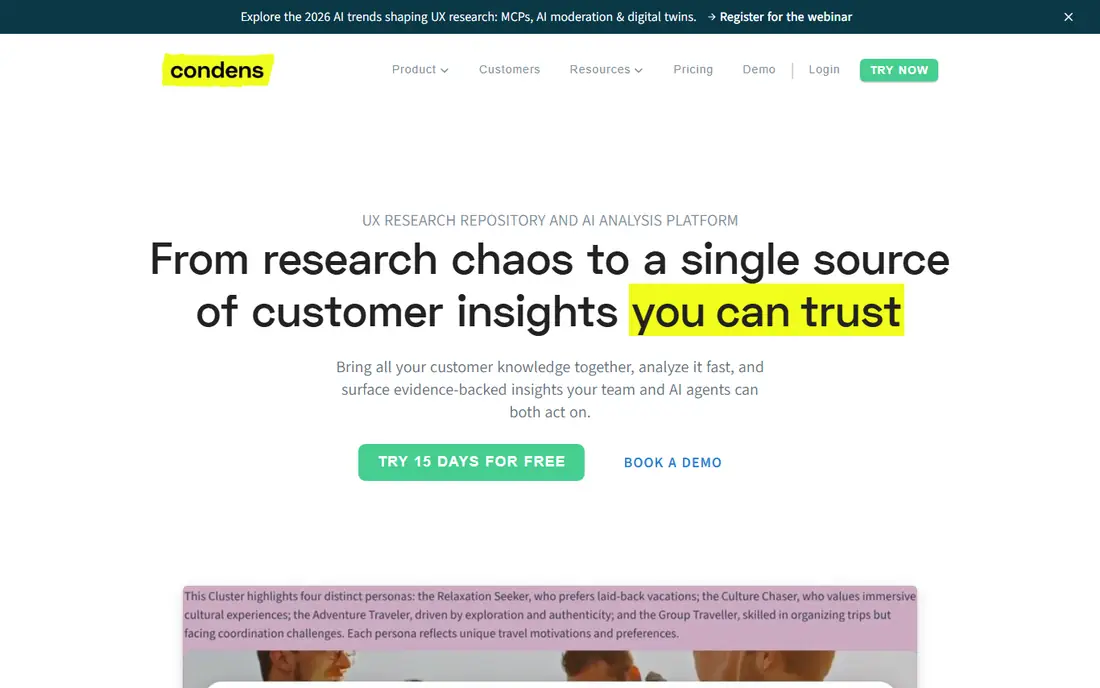
Condens is one of the most frequently mentioned Dovetail competitors among experienced UX researchers, focusing on turning raw research into reusable insights through structured coding, synthesis boards and evidence-backed findings. Teams appreciate its clarity, transparency and flexibility across research methods, and it is especially strong for organizations running continuous research programs. German data hosting suits European teams with strict data requirements.
Condens offers a Lite plan at €15 per month for one contributor, a Business plan from €500 per month, and a custom Enterprise plan. It does not recruit participants, and SSO is an add-on on Business. For a research team that wants Dovetail's repository workflow with a cleaner interface and simpler onboarding, Condens is the closest replacement.
What we like- Structured coding and synthesis boards
- Evidence-linked insights
- EU data hosting
- Clean interface
Watch out for- No participant recruiting
- SSO is an add-on on Business
- Smaller AI capability than newer tools
Starting price$129 per seat per month
Free planFree trial
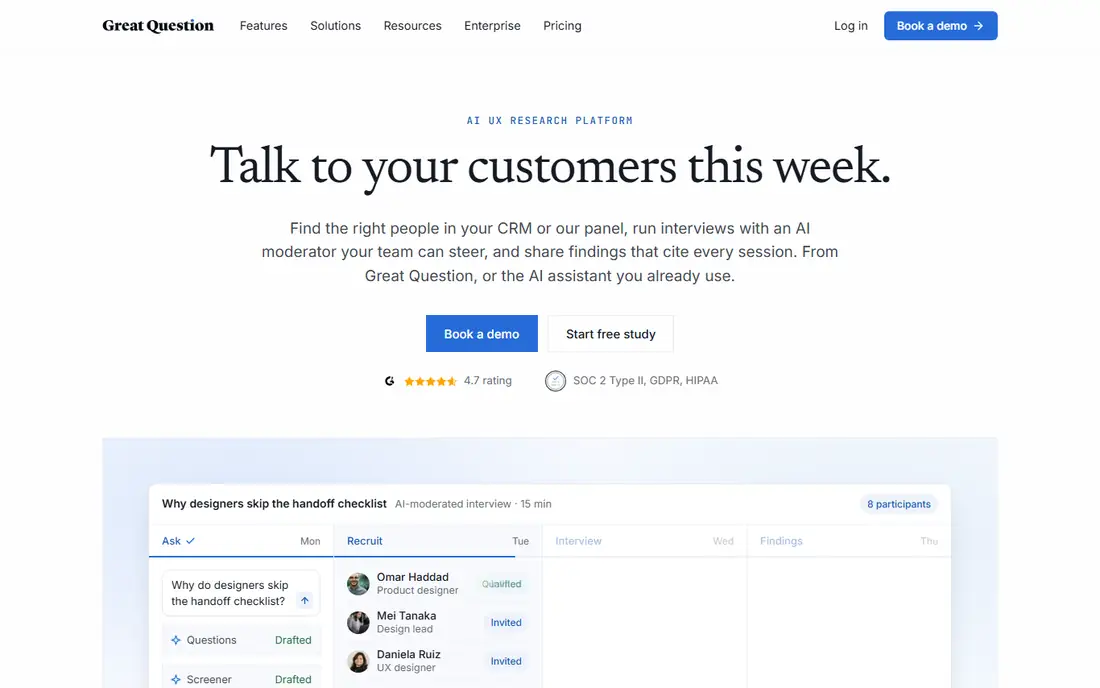
Great Question covers the full research workflow in one platform, for teams that recruit and interview their own customers and want sessions filed in the repository automatically. Global Ask AI analyzes 50 plus hours of transcripts with evidence trails, so insights stay traceable to source material rather than floating as unattributed claims. Recruitment, methods and repository in one place removes the tool-switching that slows research teams.
There is no free plan, only a free trial, and paid plans start at $129 per seat per month, which is steep for small teams. For a research team that wants one platform from recruitment to insight, Great Question is the most complete alternative.
What we like- Recruitment, methods and repository in one platform
- Global Ask AI analyzes 50 plus hours of transcripts with evidence trails
Watch out for- No free plan
- Paid plans start at $129 per seat per month
Starting price$0
Free planYes
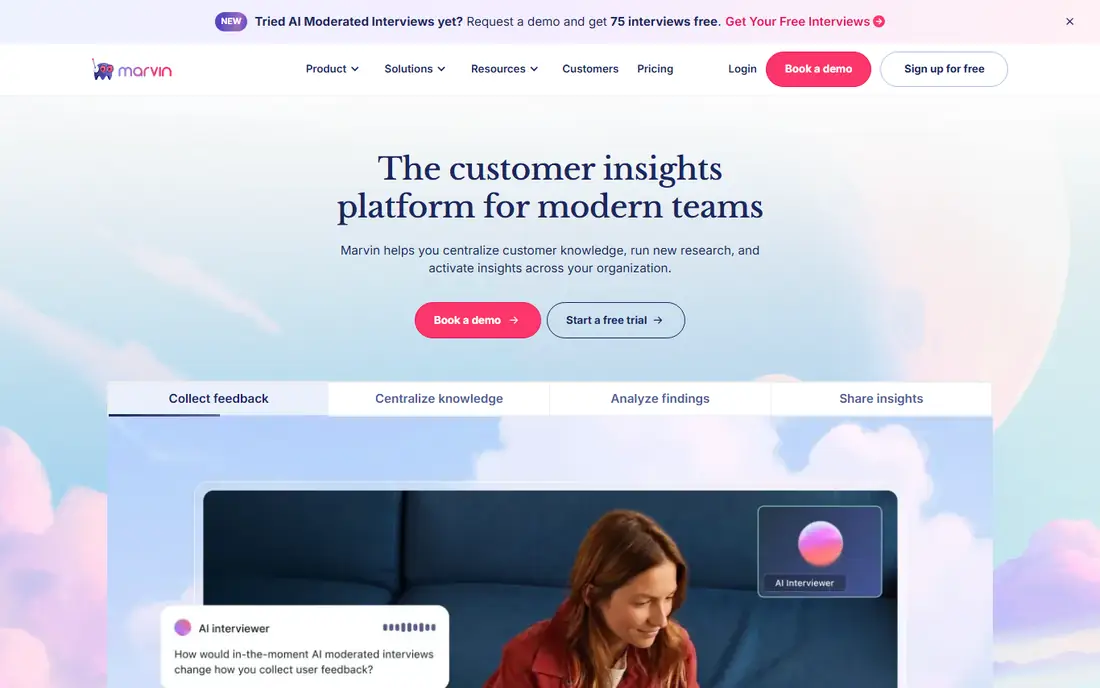
HeyMarvin suits solo researchers and small teams that want AI tagging, starting on a free plan. Fast AI tagging and summarization turn transcripts into themes quickly, and conversational querying lets teams ask questions across the full research corpus. That AI-native approach suits teams that spend most of their time analyzing rather than running studies.
HeyMarvin covers analysis only, with no recruitment or study creation, and paid plan pricing is not publicly listed. For a small team that mainly needs AI analysis of existing research, HeyMarvin is the best low-cost pick.
What we like- Fast AI tagging and summarization
- Free plan
- Conversational querying across the corpus
Watch out for- Analysis only, no recruitment or study creation
- Pricing opacity on paid plans
#4Maze
Best for: Prototype testing4.4/5 on
G2 (27 reviews, checked Oct 2026)
Visit maze.co
Starting price$0
Free planYes, 1 study per month
Maze suits design teams running prototype tests, with Figma and Sketch integration that turns designs into tests without extra setup. Product analytics add context to test results, and turnaround is fast, making Maze ideal for rapid validation during design sprints. The free plan covers one study per month, and Starter runs $99 per month for more.
The scope is narrow: prototype testing mainly, rather than a full research repository. For a design team that needs quick prototype validation rather than a repository, Maze is the best tool.
What we like- Figma and Sketch integration
- Product analytics
- Fast prototype test turnaround
Watch out for- Narrow scope, prototype testing mainly
- Starter at $99 per month for more studies
Starting price$49 per month
Free planFree trial
Aurelius suits consultancies and agencies managing research for many clients, with client workspace separation that keeps each client's insights apart. Simple insight tagging and search cover the core repository workflow without platform overhead, and entry pricing from $49 per month billed yearly makes it one of the cheapest paid options here.
The user base is smaller, integrations are fewer, and feature depth does not match complex enterprise programmes. For a small team or consultancy on a tight budget, Aurelius is the best value repository.
What we like- Client workspace separation
- Simple insight tagging and search
- Low entry price
Watch out for- Smaller user base
- Fewer integrations
- Feature depth below enterprise platforms
Starting priceSee website
Free planFree trial
EnjoyHQ suits enterprise teams that need governance, permissions and structured insight sharing across departments, aggregating feedback from multiple sources into one repository. It supports qualitative and quantitative inputs and emphasizes traceability from data to decisions, which suits teams managing research at scale across product, design and leadership.
Pricing is custom and enterprise-focused, and recent comparison guides flag stalled product development and an uncertain future, which buyers should verify before committing. For a legacy team already embedded in EnjoyHQ, it remains a capable repository, but new buyers should weigh that flag carefully.
What we like- Cross-source insight aggregation
- Enterprise governance
- Established repository features
Watch out for- Custom pricing
- Recent guides flag stalled product development and uncertain future
#7UserTesting
Best for: End-to-end research with panel4.4/5 on
G2 (794 reviews, checked Oct 2026)
Visit usertesting.com
Starting priceSee website
Free planNo
UserTesting suits teams that need end-to-end research with a massive participant panel, covering recruitment, moderated and unmoderated studies, and insight delivery in one platform. That panel access removes the hardest part of research for many teams: finding the right participants quickly. Enterprise scale and governance suit large organizations running research continuously.
Pricing is custom, and the platform is heavier than a repository-only tool for teams that only need analysis. For a team that wants participants plus research tooling in one place, UserTesting is the most complete option.
What we like- Massive participant panel
- End-to-end research from recruitment to insight
- Enterprise scale
Watch out for- Custom pricing
- Heavier than a repository-only tool
#8Lookback
Best for: Live user sessions4.3/5 on
G2 (21 reviews, checked Oct 2026)
Visit lookback.io
Starting price$49 per month
Free planFree trial
Lookback suits teams that run live user sessions, with in-app mobile recording and live observation that lets stakeholders watch sessions as they happen. Pricing from $49 per month keeps it accessible for small teams, and the session workflow is straightforward for moderated research.
The focus is sessions rather than a full repository, so analysis features are narrower than Condens or Dovetail. For a team whose research centers on live moderated sessions, Lookback is the best session tool.
What we like- Live session observation
- In-app mobile recording
- Straightforward pricing
Watch out for- Session-focused rather than full repository
- Narrower analysis features
How we chose
We compared research platforms on repository features, qualitative analysis, AI capabilities, recruitment, testing methods, pricing transparency and team fit. We used vendor pages and recent comparison guides for rates, and we favored tools with free plans or published entry prices. We did not claim hands-on testing. Instead we weighed what each tool covers of the research workflow, from recruitment to repository, and how it fits solo researchers, small teams and enterprises, so buyers can match a tool to their workflow gaps.
Repository versus full workflow
The choice that matters most is whether your team needs a repository or a full workflow. Repository tools such as Condens, HeyMarvin and Aurelius excel at storing, tagging, searching and reusing findings across studies, which suits teams that already run studies and need synthesis. Full workflow tools such as Great Question and UserTesting cover recruitment, moderation, incentives and analysis in one platform, which suits teams that want one tool from participant to insight.
Dovetail itself sits in the middle, with a repository plus video analysis and AI-assisted tagging, but without recruitment. Teams that only replace the repository should choose Condens or HeyMarvin. Teams that want to stop juggling separate recruitment and repository tools should choose Great Question. And teams whose main need is prototype validation should choose Maze, since a repository will not speed up design testing. Before switching, audit how your team actually uses Dovetail today, since many teams pay for repository features they rarely open while doing most analysis in spreadsheets and slide decks. Count active contributors versus viewers, since per-seat pricing punishes teams with many occasional readers. Condens offers unlimited free viewers on some plans, which makes it cheaper for stakeholder-heavy teams than per-seat tools. Ask each vendor how viewer seats are counted before signing, since the distinction can halve or double the annual bill. Run a pilot study in the new tool with a real project before migrating the whole archive, since taxonomy design and AI tagging quality only become clear on real data. Invite stakeholders to the pilot, since a repository that only researchers use will not survive the next budget review. Stakeholder usage is the strongest argument for renewal, and it starts with easy access. Free viewer seats make that access cheap to provide. Choose a tool stakeholders will actually open, not just one researchers admire most of all.
Frequently asked questions
What is the best Dovetail alternative?
Condens is the closest replacement for structured qualitative synthesis and repositories. Great Question is the most complete full-workflow alternative, and HeyMarvin is the best low-cost AI analysis option.
Is there a free Dovetail alternative?
Yes. HeyMarvin offers a free plan, Maze offers one free study per month, and Condens offers a Lite plan at €15 per month. Notion plus a manual workflow is free but lacks research-specific features.
Does any alternative include participant recruitment?
Yes. Great Question and UserTesting both include recruitment, with UserTesting offering a massive participant panel. Condens, HeyMarvin and Maze do not recruit participants.
What happened to EnjoyHQ?
Recent comparison guides flag stalled product development and an uncertain future for EnjoyHQ, though its repository features remain established. Buyers should verify the current roadmap before committing to a new contract.
How do I migrate research from Dovetail?
Export transcripts, tags and highlight reels before canceling, since migration formats vary across tools. Rebuild your taxonomy in the new tool during a pilot study rather than importing everything at once, so the new structure fits how your team actually searches.
Should I choose a repository or a full research platform?
Choose a repository if your team already runs studies and mainly needs synthesis and reuse. Choose a full platform if recruitment, moderation and analysis all live in separate tools today and the handoffs slow you down.
Sources we checked (8)
- https://condens.io
- https://greatquestion.co
- https://heymarvin.com
- https://maze.co
- https://www.aureliuslab.com
- https://enjoyhq.com
- https://www.usertesting.com
- https://lookback.io
Is your product missing or out of date?
We review this list regularly. Vendors can request a listing, send updated pricing or ask about featured placement.

Shihab Mia · Founder, Rankite
Shihab has 5+ years in B2B and SaaS SEO. He writes Rankite's software buying guides from pricing pages, documentation and public user reviews. More about Shihab.