How we make this list: we compare pricing pages, product documentation and public user reviews. Ratings come from G2, Capterra or Trustpilot, with the date we checked them.
Key takeaways
- GitBook is the closest swap for public product documentation, priced per site from about 65 dollars a month with a free tier for small projects.
- Helpjuice is the support led alternative, built to cut ticket volume, with published pricing from about 249 dollars a month.
- Confluence, Slab, Nuclino and Notion cover the internal wiki half of the job for between about 6 and 10 dollars per user per month.
- Guru is the different answer: verified answers pushed into the tools people already use, priced by quote for larger teams.
Quick comparison
| Tool | Best for | Starting price | Free plan |
|---|
 GitBook | Polished public product docs | $65 per site per month | Yes |
 Helpjuice | Support teams cutting tickets | $249 per month | No |
 Confluence | Teams already using Jira | $5.78 per user per month | Yes |
 Slab | A clean focused internal wiki | $6.67 per user per month | Yes |
 Nuclino | A simple lightweight team wiki | $6 per user per month | Yes |
 Guru | Verified answers inside other tools | See website | No |
 Notion | Docs and projects in one workspace | $10 per user per month | Yes |
Is your product missing or out of date?
We review this list regularly. Vendors can request a listing, send updated pricing or ask about featured placement.
The best Document360 alternatives
#1GitBook
Best for: Polished public product docs4.7/5 on
G2 (207 reviews, checked Oct 2026)
Visit gitbook.com
Starting price$65 per site per month
Free planYes
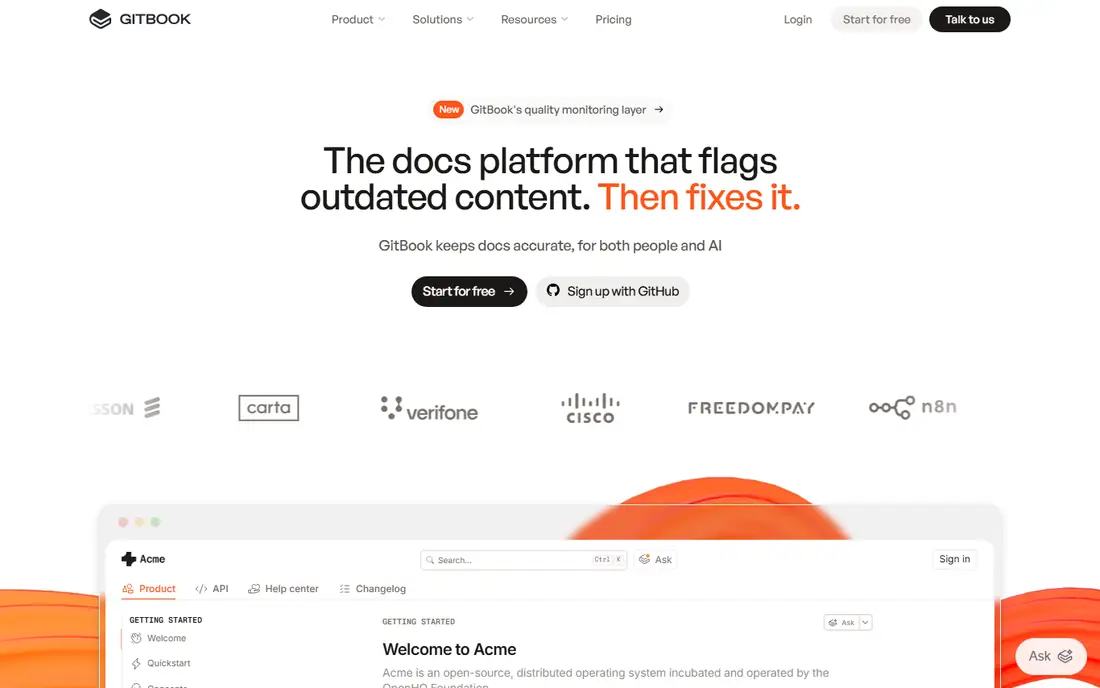
What we like- GitBook publishes beautiful public documentation with a visual editor for non technical writers and Git sync for teams that keep docs beside code. Premium is priced at about 65 dollars per site per month plus per user charges for editor seats, and a free plan covers a single user, which suits open source projects and solo founders. Search, custom domains, visitor insights and API documentation features cover the ground Document360 covers for product docs, and the reading experience is the cleanest in this list. AI search and answer features are available on the paid tiers.
Watch out for- The per site plus per user model needs arithmetic before you commit: several doc sites and a large writing team multiply the bill in ways the headline hides. Advanced AI chat features sit on the Ultimate tier at a much higher per site price. Git sync is powerful and will confuse writers who have never used version control, so mixed teams should test the editing flow with a real non technical writer before migrating a library.
#2Helpjuice
Best for: Support teams cutting tickets4.7/5 on
G2 (382 reviews, checked Oct 2026)
Visit helpjuice.com
Starting price$249 per month
Free planNo

What we like- Helpjuice is a knowledge base built for support deflection: powerful search with analytics that show what readers looked for and failed to find, easy authoring for support staff who do not write for a living, and reporting aimed at proving the help center saves tickets. Published pricing starts at about 249 dollars a month, tiered by authors and features, which undercuts a Document360 quote for many mid sized teams while keeping a dedicated public help center. It handles internal knowledge bases too, so one tool can serve customers and the support team itself.
Watch out for- There is no free plan, only a trial. The design system is less polished than GitBook's, and developer documentation features such as OpenAPI import are basic next to the docs first platforms. Pricing climbs by author count, so a company where fifty staff occasionally edit an article should model the author bill carefully rather than discover it at renewal.
#3Confluence
Best for: Teams already using Jira4.1/5 on
G2 (4,368 reviews, checked Oct 2026)
Visit atlassian.com
Starting price$5.78 per user per month
Free planYes
What we like- Confluence is the internal wiki inside the Atlassian ecosystem: pages link straight to Jira issues, permissions follow company structure, and the free plan covers up to 10 users with Standard at 5.78 dollars per user per month billed annually on Atlassian's listed rates. For engineering led companies, having the runbook, the postmortem and the ticket in one system ends the argument about where knowledge lives. Search across spaces, templates for recurring documents and a huge marketplace of add ons cover most internal documentation needs at a price Document360 cannot approach.
Watch out for- As a public customer help center, Confluence is the wrong tool: reader facing design, SEO controls and search analytics are weak, and Atlassian's own positioning keeps it internal. The interface rewards structure and punishes casual use, so non technical teams often let spaces rot. Per user pricing for a whole company adds up, and the AI features sit behind Atlassian's own tiers and add ons in ways that take a spreadsheet to model.
#4Slab
Best for: A clean focused internal wiki4.6/5 on
G2 (309 reviews, checked Oct 2026)
Visit slab.com
Starting price$6.67 per user per month
Free planYes
What we like- Slab does one thing with unusual care: a company wiki that people actually enjoy reading and searching. Posts are clean, topics organise themselves better than folder trees, editing is collaborative without version chaos, and unified search reaches into connected tools such as Google Drive and GitHub. The free plan covers up to 10 users and Startup is 6.67 dollars per user per month billed annually. Teams leaving Document360 because they bought a customer platform for an internal job often land here and wonder why they paid ten times more.
Watch out for- Slab is internal only: no public help center, no customer facing analytics, no ticket deflection reporting. AI question answering sits on the Business tier at a higher per user price. Companies that need one system for both audiences will end up running Slab beside a public tool, which may still be cheaper than Document360 but is two systems to govern.
#5Nuclino
Best for: A simple lightweight team wiki4.7/5 on
G2 (29 reviews, checked Oct 2026)
Visit nuclino.com
Starting price$6 per user per month
Free planYes
What we like- Nuclino is the lightest credible wiki here: pages link to each other in a graph as well as a tree, editing is real time and fast, and the free plan covers a small team with up to 50 items. Starter is 6 dollars per user per month billed annually. For a small company that needs meeting notes, how tos and onboarding pages findable in seconds, Nuclino's refusal to become a project platform is the appeal, and setup takes an afternoon rather than a rollout plan.
Watch out for- The lightness is the limit. There is no public knowledge base mode, limited analytics, and fewer enterprise controls than Confluence or Guru. AI assistance sits on the Business tier. Large organisations will find the permission model and audit features thin, and a company that later needs customer facing docs will migrate again, so treat Nuclino as the right tool for a stage, not a destination.
#6Guru
Best for: Verified answers inside other tools4.7/5 on
G2 (2,345 reviews, checked Oct 2026)
Visit getguru.com
Starting priceSee website
Free planNo
What we like- Guru rejects the destination model entirely: knowledge lives as verified cards, each with an owner and a review date, and answers surface inside Slack, the browser, the CRM and the support desk where the question was asked. Verification workflows are the product: stale answers flag themselves for review instead of quietly misleading a new hire or a customer. For support and sales teams drowning in repeat questions across tools, that push model saves more time than another well organised library nobody opens. Pricing is by custom package, so we list see website.
Watch out for- Guru is not a public help center and does not publish pricing
- Comparisons put it around the mid twenties per seat with a seat minimum, which makes it an enterprise line item. The card model fights long form documentation: a 40 page integration guide does not decompose into cards without real editorial work. Small teams will find the verification machinery heavier than their knowledge problem, and teams that need a public docs site still need GitBook or Helpjuice beside it.
#7Notion
Best for: Docs and projects in one workspace4.6/5 on
G2 (13,834 reviews, checked Oct 2026)
Visit notion.com
Starting price$10 per user per month
Free planYes
What we like- Notion is where many teams already keep their internal knowledge, and as a wiki it is genuinely good: pages, databases, templates and search in one workspace, a free plan for individuals and small teams, and Plus at 10 dollars per user per month billed annually. A startup can run onboarding, process docs, meeting notes and project tracking in the same place for one bill, and most new hires arrive already knowing the tool. Published Notion sites exist for simple public pages, which covers changelogs and small guides.
Watch out for- Let us be plain: Notion is not a customer help center. It lacks the search analytics, article feedback, versioning for public content and support integrations that Document360 and Helpjuice are built on, and public pages carry Notion's structure more than your brand's. AI features sit on the Business tier at double the Plus price. Companies that adopt Notion for internal docs and later need a real help center will buy one anyway, so count it as the internal answer only.
How we chose
We compared knowledge tools on the two jobs Document360 is bought for: a public, searchable help center and an internal source of truth. Public first tools were judged on reader experience, search and analytics; internal tools on findability, permissions and price per user. Every entry is in active sale in October 2026 with pricing from vendor pages or consistent current comparisons, and quote only pricing is marked see website. We excluded our own bias toward novelty: Confluence and Notion are here because thousands of teams genuinely run their knowledge on them, with their limits stated in the open.
Decide who reads it. Customers need a public help center with real search, analytics and your domain: that is GitBook or Helpjuice, full stop, and no internal wiki substitutes. Your own staff need findability and ownership: Slab, Nuclino, Confluence or Notion at a tenth of the price, chosen by what your team already uses. Teams whose problem is answers inside other tools, not a library at all, should trial Guru's model before buying another destination.
Then run the freshness test on any finalist. Import twenty real articles, set owners and review dates, and search for five questions your newest hire actually asked last month. The tool that surfaces the right answer fastest, and shows you which articles are rotting, wins. Finally, protect your readers during the move: redirect every old article link to its new home, because a knowledge base migration that breaks a thousand bookmarks teaches customers to stop trusting your help center at all.
Frequently asked questions
What is the closest alternative to Document360?
GitBook for public product documentation, with per site pricing and a free tier, and Helpjuice for support led help centers that need deflection analytics. The honest answer depends on which half of Document360 you use: teams using it as an internal wiki will save the most by moving to Slab or Confluence, since they were paying public platform prices for a private job.
How much does Document360 cost compared with these tools?
Document360 pricing is quote based and not published, which is itself a common reason for this search. The published alternatives here run from about 6 dollars per user per month for internal wikis to 65 dollars per site for GitBook and about 249 dollars a month for Helpjuice. Any Document360 quote should be compared against the alternative that matches your actual use, public or internal, rather than against the whole list.
Can Notion or Confluence replace a customer help center?
Not properly. Both can publish pages the public can read, and for a tiny product that may be enough for a while. What they lack is the machinery a help center runs on: search failure analytics, article level feedback, deflection reporting and reader focused design. Companies usually discover the gap when support tickets ask questions the wiki already answers, which means readers could not find or trust the page.
What should I check before migrating a knowledge base?
Four things: export quality, because your articles must leave the old tool in a usable format; link redirects, article by article for anything customers bookmark; search behaviour on your twenty most visited articles in the new tool; and ownership, meaning every migrated article gets a named owner and a review date during the move. A migration is the one moment a knowledge base gets cleaned, and skipping the cleaning imports the rot at full price.
Do these tools offer AI answers from our documentation?
Most do now, at different tiers: GitBook and Document360 sell AI search and answers, Guru builds its product on verified AI answers inside other tools, and Notion and Confluence place AI on higher plans. Test any of them with your hardest real questions during a trial, including two whose correct answer is that the docs do not say. A system that invents an answer confidently is worse than one that finds nothing.
Sources we checked (0)
Is your product missing or out of date?
We review this list regularly. Vendors can request a listing, send updated pricing or ask about featured placement.

Shihab Mia · Founder, Rankite
Shihab has 5+ years in B2B and SaaS SEO. He writes Rankite's software buying guides from pricing pages, documentation and public user reviews. More about Shihab.