How we make this list: we compare pricing pages, product documentation and public user reviews. Ratings come from G2, Capterra or Trustpilot, with the date we checked them.
Key takeaways
- SQLMesh is the closest code first alternative to dbt, with virtual environments for safer changes.
- Coalesce and Matillion suit teams that prefer visual, column aware modeling over raw SQL projects.
- Dataform fits teams already standardized on BigQuery and Google Cloud.
- Apache Hop and Apache Spark suit teams that want open source control and can manage infrastructure.
- Ingestion tools alone do not replace dbt, so check whether a tool models data in the warehouse or only moves it.
Quick comparison
| Tool | Best for | Starting price | Free plan |
|---|
 SQLMesh | Code first SQL modeling | See website | Yes |
 Coalesce | Visual Snowflake modeling | See website | No |
 Dataform | BigQuery native modeling | See website | No |
 Matillion | Visual warehouse ELT | See website | No |
 Alteryx | Analyst led data prep | See website | No |
 Apache Hop | Open source visual pipelines | Free | Yes |
 Integrate.io | All in one pipelines | $1,999 per month | No |
 Databricks | Unified data engineering | See website | No |
Is your product missing or out of date?
We review this list regularly. Vendors can request a listing, send updated pricing or ask about featured placement.
The best dbt alternatives
Starting priceSee website
Free planYes
SQLMesh, from Tobiko, is the most direct code first challenger to dbt. You write SQL models in a version controlled project, define tests and lineage, and run transformations in your warehouse, much as dbt users do. Its distinctive feature is virtual environments, which let you preview how a model change affects downstream tables before it reaches production. That preview step reduces the risk of a broken dashboard after a schema change.
The trade off is maturity and ecosystem. dbt has a larger package library, more hiring familiarity, and deeper documentation, so a team switching to SQLMesh should budget time for migration and training. SQLMesh fits teams that like dbt's workflow but want safer change previews, stronger handling of complex model changes, or a different vendor direction. Open source use is possible, with Tobiko Cloud for managed scheduling and collaboration.
What we like- Virtual data environments for testing changes
- Column level lineage
- Open source core with managed cloud option
Watch out for- Smaller community than dbt
- Migration needs SQL project rework
Starting priceSee website
Free planNo
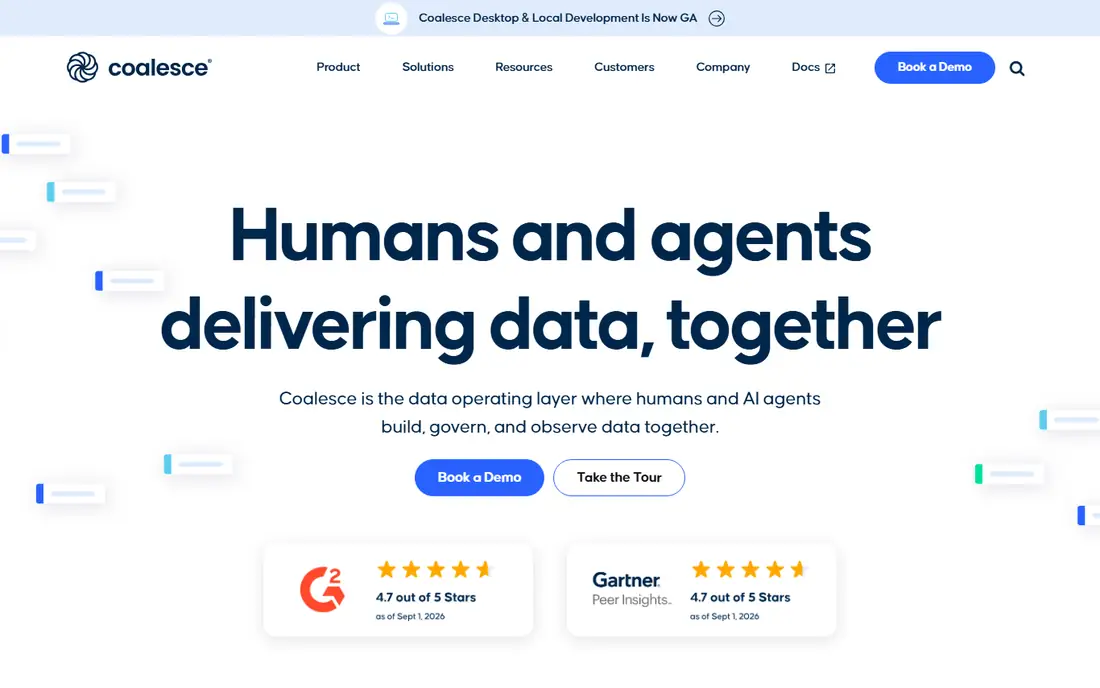
Coalesce rethinks dbt style modeling for teams that prefer a visual interface. Instead of editing only SQL files, you build column aware models in a graphical workspace that still generates SQL for Snowflake. That approach helps analysts who understand data logic but do not want to manage a large Git project by hand. Lineage, documentation, and deployment controls are built in, which suits governed enterprise teams.
Snowflake focus is both a strength and a limit. If your warehouse is Snowflake, Coalesce can feel tailored and efficient. If you run BigQuery, Databricks, or Redshift as well, you will need another approach for those platforms. Pricing is typically quoted, so budget discussions need a sales conversation. Choose Coalesce when visual modeling, governance, and Snowflake performance matter more than multi warehouse flexibility.
What we like- Visual, column aware modeling
- Snowflake focused optimization
- Built in lineage and documentation
Watch out for- Snowflake centric, so multi warehouse teams get less value
- Pricing is quote based
Starting priceSee website
Free planNo
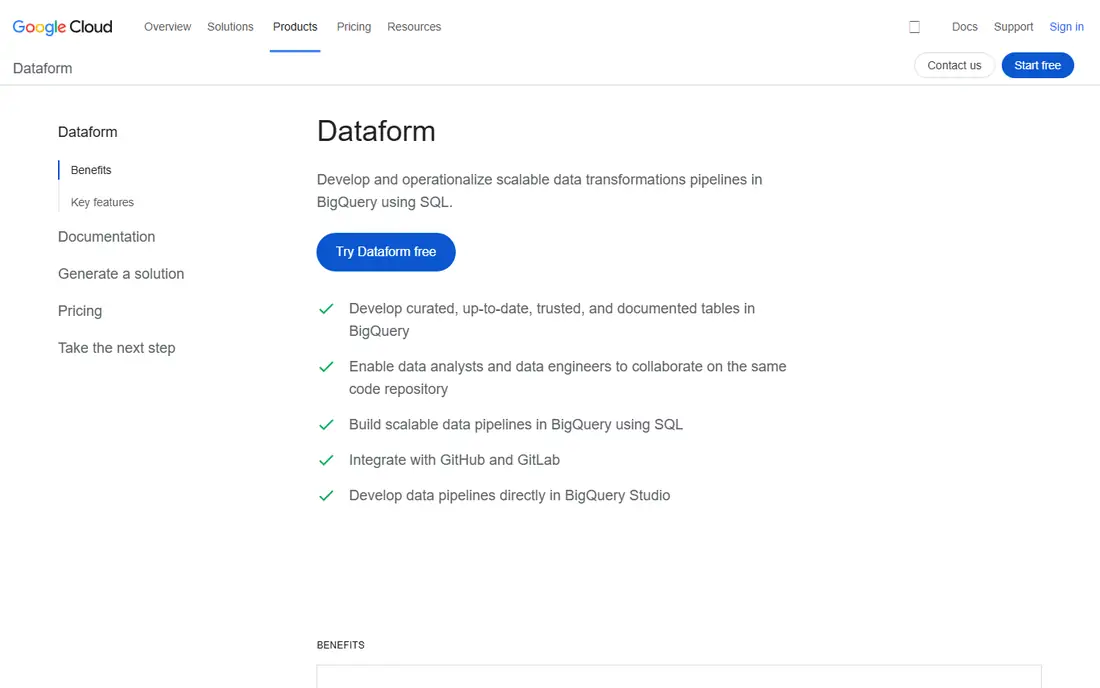
Dataform is Google's dbt like tool for BigQuery, and it makes most sense for teams already committed to Google Cloud. You define tables and views in SQLX, which adds JavaScript and templating to SQL, manage the project in Git, and schedule runs inside BigQuery. Because it sits inside Google's platform, authentication, permissions, and warehouse costs follow familiar Google Cloud patterns.
Outside BigQuery, Dataform offers little. Teams with a multi cloud warehouse strategy will find it too narrow, and the package ecosystem is smaller than dbt's. For a BigQuery native team, though, Dataform removes a vendor, simplifies billing, and keeps modeling close to the data. It is a practical alternative when Google Cloud is already the standard and dbt Cloud adds cost or complexity you do not need.
What we like- Native BigQuery integration
- SQLX modeling with JavaScript
- Scheduling and Git workflow in Google Cloud
Watch out for- Limited outside Google Cloud
- Smaller third party ecosystem than dbt
Starting priceSee website
Free planNo
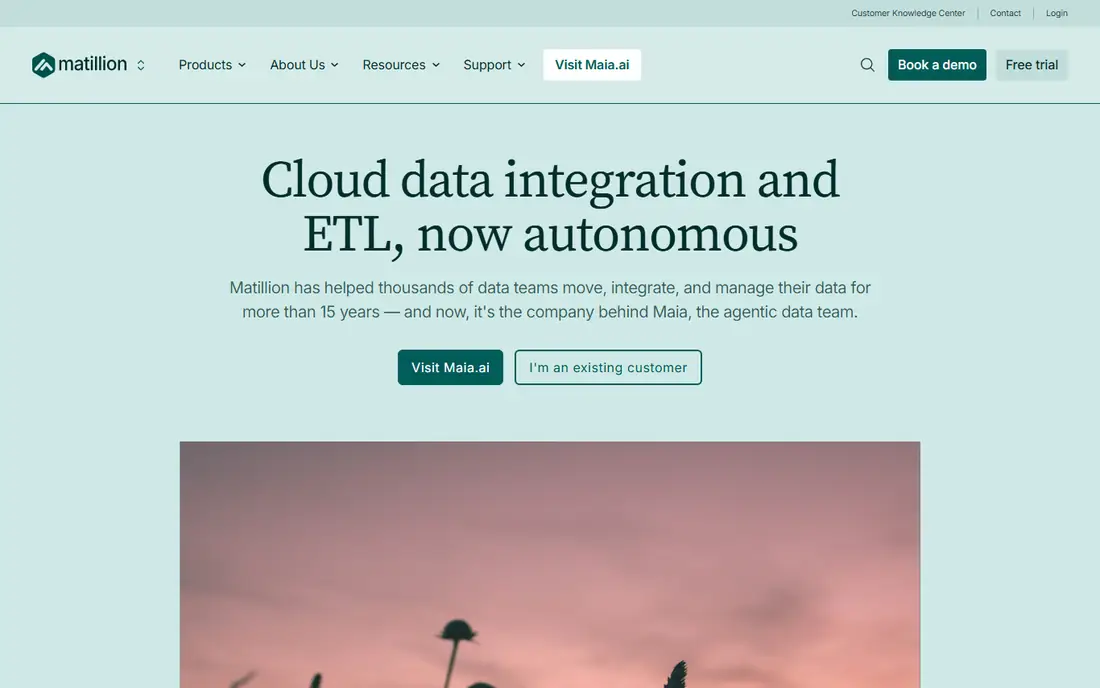
Matillion covers more of the pipeline than dbt alone. It handles extraction, loading, and transformation in a visual interface, pushing transformation work into your cloud warehouse rather than running it on a separate server. That design suits analytics teams who want one platform for ingestion and modeling, especially when analysts rather than software engineers build most pipelines. Connectors cover databases, SaaS apps, and files, which reduces custom code.
Git review is the honest catch. Visual pipelines are harder to diff and review than plain SQL files, so teams with strict code review habits may prefer a code first tool. Pricing is quote based and aimed at mid market and enterprise teams, not hobby projects. Matillion fits when visual speed, warehouse native execution, and broad connectors matter more than pure SQL version control.
What we like- Visual drag and drop pipelines
- Pushes work into Snowflake, BigQuery, Redshift, or Databricks
- Broad connector range
Watch out for- Quote based pricing
- Visual projects can be harder to review in Git than pure SQL
#5Alteryx
Best for: Analyst led data prep4.6/5 on
G2 (951 reviews, checked Oct 2026)
Visit alteryx.com
Starting priceSee website
Free planNo
Alteryx appeals to a different user from dbt. Analysts build workflows by dragging tools for joining, cleaning, blending, and modeling data, then schedule those workflows on a server. That visual approach opens data work to business analysts who would struggle with a dbt project, Jinja, and Git. It also handles spreadsheet, database, and file sources that sit outside a warehouse, which dbt alone does not.
Alteryx is not a drop in dbt replacement for warehouse modeling. Its licensing is enterprise oriented, and its workflow files differ from SQL models that analytics engineers maintain in Git. Choose Alteryx when the bottleneck is analyst productivity across varied sources, not warehouse SQL modeling at scale. Data teams that already use dbt may still use Alteryx alongside it for prep work that never belongs in the warehouse.
What we like- Drag and drop data prep and blending
- Strong for analysts without deep SQL
- Scheduling and sharing tools
Watch out for- Desktop and server licensing can be costly
- Not a direct dbt project replacement
Starting priceFree
Free planYes
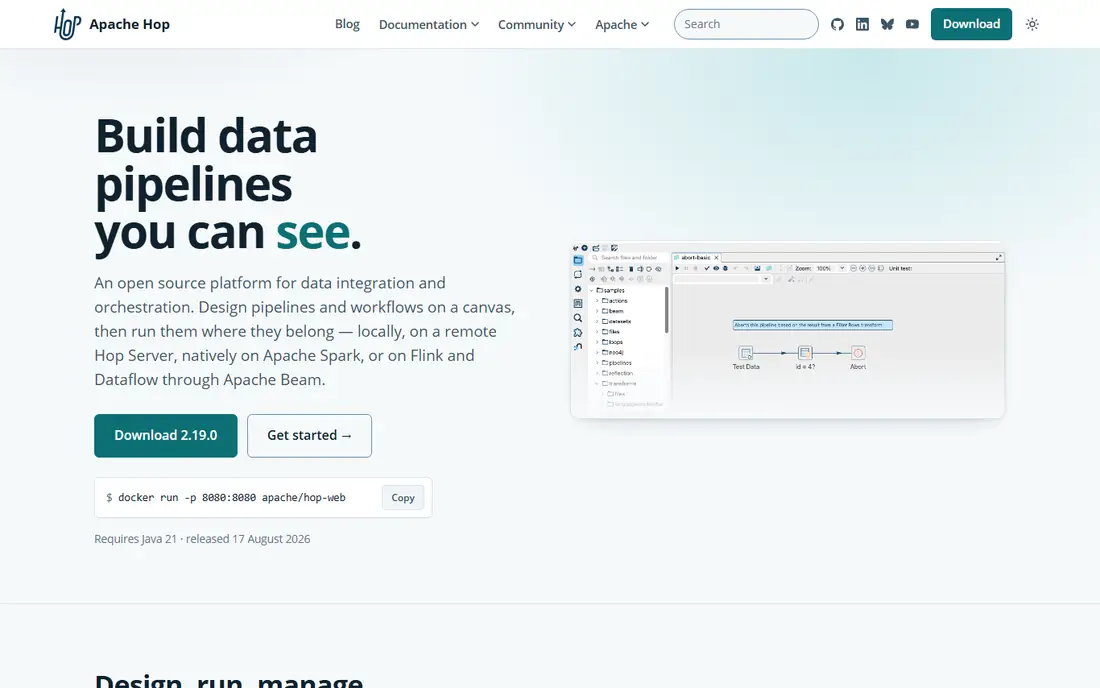
Apache Hop is an open source visual data integration platform that covers extraction, transformation, and loading. You design pipelines and workflows in a desktop or web interface, run them locally or on a server, and avoid licence fees. For small teams, nonprofits, and data engineers who like open source, Hop offers a lot of capability without a vendor bill. It also suits teams that need to run pipelines in their own infrastructure for control or compliance reasons.
Self hosting is the cost. You own installation, upgrades, monitoring, and troubleshooting, and commercial support options are thinner than for a paid platform. Hop also lacks the polished cloud scheduling and collaboration of dbt Cloud or Matillion. It fits teams with engineering time, a clear open source policy, and pipelines that benefit from visual design rather than pure SQL modeling.
What we like- Free open source visual pipelines
- Runs locally or on servers
- Broad transform and workflow tools
Watch out for- Self hosted setup and maintenance
- Smaller commercial support ecosystem than Matillion
#7Integrate.io
Best for: All in one pipelines4.3/5 on
G2 (213 reviews, checked Oct 2026)
Visit integrate.io
Starting price$1,999 per month
Free planNo
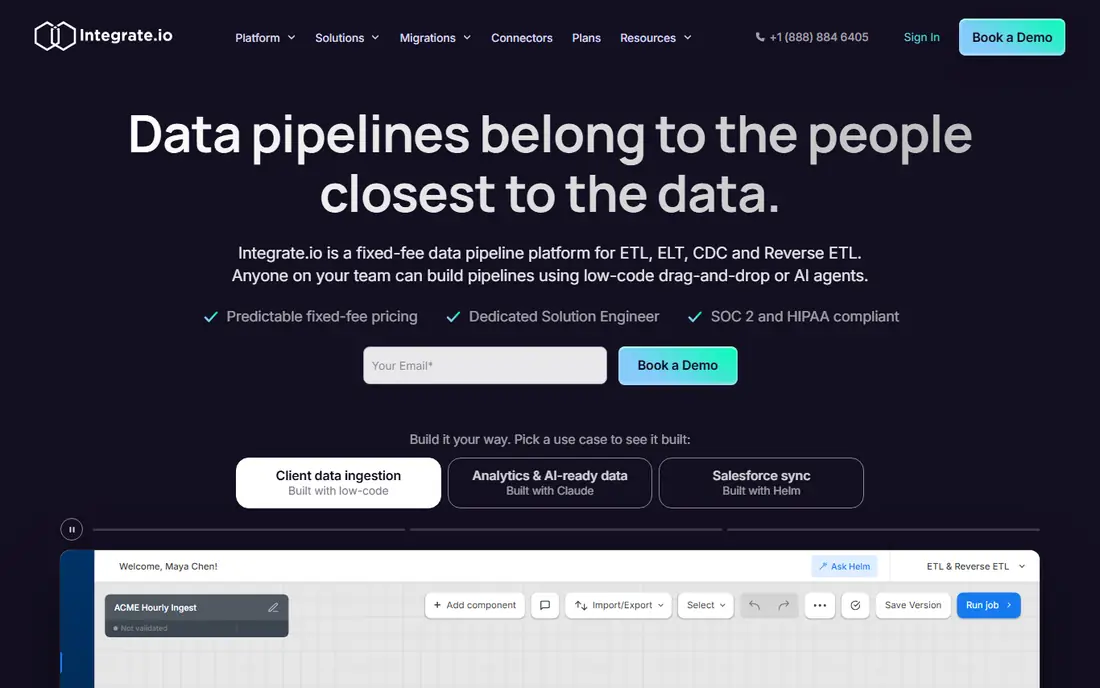
Integrate.io aims to replace a stack of tools with one platform. It covers extraction, transformation, loading, change data capture, and reverse ETL, with drag and drop transformations that let teams build pipelines without deep SQL or Jinja knowledge. A flat fee licence, listed at 1,999 dollars per month in recent coverage, gives cost predictability compared with usage based pricing that spikes with data volume. Native dbt integration is also available for teams that want both.
The starting price rules it out for small teams and side projects. SQL purists may also dislike the low code approach, because visual pipelines and SQL models differ in review, testing, and reuse. Integrate.io fits mid market teams that want one vendor, predictable cost, and a lower code path for analysts, while keeping dbt available where SQL modeling is still the right tool.
What we like- ETL, ELT, CDC, and reverse ETL in one platform
- 200 plus drag and drop transformations
- Flat fee licence in recent listings
Watch out for- High starting price for small teams
- Less code first control than dbt for SQL purists
#8Databricks
Best for: Unified data engineering4.6/5 on
G2 (1,383 reviews, checked Oct 2026)
Visit databricks.com
Starting priceSee website
Free planNo
Databricks is a larger platform than dbt, and it belongs here because many teams move transformation work into Databricks SQL, notebooks, and workflows. Delta Lake adds reliability features such as transactions and time travel to data lake storage, while Spark handles large batch and streaming workloads that pure SQL modeling tools do not. Machine learning teams benefit from sharing the same platform as data engineering, rather than moving data between systems.
Breadth is also the drawback. Databricks is a full platform to learn and govern, and compute costs need active monitoring. A small analytics team that only needs warehouse SQL models will find dbt or SQLMesh simpler and cheaper. Choose Databricks when transformation is part of a larger engineering, streaming, or machine learning workload, and when scale justifies a unified platform.
What we like- Unified lakehouse for engineering, SQL, and machine learning
- Delta Lake reliability
- Scalable Spark compute
Watch out for- Broad platform with a learning curve
- Costs depend on compute use and need monitoring
How we chose
We separated true transformation tools from ingestion only tools, because many lists mix the two. A tool that only moves data into a warehouse does not replace dbt, even if it appears in dbt comparison pages. We checked each tool for warehouse modeling, scheduling, testing or lineage, deployment options, and current pricing signals, and we favored tools with a clear modeling story. Where vendors quote prices privately, we wrote See website rather than inventing a figure.
Picking by team style
The right dbt alternative depends less on feature counts and more on who builds the models. A code first analytics engineering team, a visual analyst team, and a platform engineering team will pick different tools and all be right for their own context.
For SQL first teams
SQLMesh and Dataform are the closest to dbt's workflow. SQLMesh suits multi warehouse SQL teams that want safer change previews, while Dataform suits BigQuery only teams that want native Google Cloud integration. Keep Git workflow, testing, and documentation standards in place during any migration.
For visual and analyst led teams
Coalesce, Matillion, Alteryx, and Integrate.io reduce the SQL and Git burden. Compare how each handles lineage, deployment approval, and review, because visual speed can hide governance gaps. Trial with a real pipeline, not a demo dataset, to see how the tool handles messy source data.
For open source and platform teams
Apache Hop and Databricks cover opposite ends of this group. Hop gives free visual pipelines with self hosting effort, while Databricks gives a managed, scalable platform with compute costs to control. Match the choice to engineering capacity, data volume, and whether streaming or machine learning is also in scope.
Frequently asked questions
What is the best dbt alternative?
SQLMesh is the best direct alternative for most dbt style teams, because it keeps SQL modeling in Git while adding virtual environments for safer changes. Visual teams may prefer Coalesce or Matillion, and BigQuery teams may prefer Dataform. The best pick follows your warehouse and team style.
Can I replace dbt with Fivetran or Airbyte?
No, not on their own. Fivetran and Airbyte move data into your warehouse, while dbt models that raw data into clean tables for analysis. Many teams use an ingestion tool plus a transformation tool together. A true dbt replacement must model, test, and document data inside the warehouse.
Is SQLMesh free?
SQLMesh has an open source core that you can run yourself, with Tobiko Cloud as a managed option. Open source use still costs engineering time for hosting, scheduling, and maintenance. Check the current Tobiko pricing page for managed plan details before budgeting.
Do dbt alternatives support Snowflake, BigQuery, and Databricks?
Support varies by tool. Coalesce focuses on Snowflake, Dataform focuses on BigQuery, and Matillion supports several major warehouses. SQLMesh and Databricks cover broader use, but confirm your exact warehouse, version, and features on the vendor page before migrating.
How hard is it to migrate from dbt?
Migration effort depends on project size, Jinja use, macros, and package dependencies. Simple SQL models move more easily than projects heavy with custom macros and tests. Plan a phased migration, keep dbt running in parallel for a period, and validate downstream dashboards before switching production schedules.
Sources we checked (8)
- https://www.tobiko.com
- https://www.coalesce.io
- https://cloud.google.com/dataform
- https://www.matillion.com
- https://www.alteryx.com
- https://hop.apache.org
- https://www.integrate.io
- https://www.databricks.com
Is your product missing or out of date?
We review this list regularly. Vendors can request a listing, send updated pricing or ask about featured placement.

Shihab Mia · Founder, Rankite
Shihab has 5+ years in B2B and SaaS SEO. He writes Rankite's software buying guides from pricing pages, documentation and public user reviews. More about Shihab.