How we make this list: we compare pricing pages, product documentation and public user reviews. Ratings come from G2, Capterra or Trustpilot, with the date we checked them.
Key takeaways
- Dun and Bradstreet is a risk and compliance platform first, so prospecting teams and credit teams need different alternatives.
- D and B Hoovers credit packages run $5,000 to $27,300 per year with a 6% annual escalator, which is why cheaper prospecting tools win for outbound.
- Apollo at $99 per user per month and UpLead's credit model undercut D and B sharply for contact data.
- For credit risk itself, Experian Business and Creditsafe are bureau-level alternatives, while Nav monitors multiple bureaus in one place.
- Watch dual-credit charges and credit expiration in D and B contracts, since exporting a contact can also consume a company credit.
Quick comparison
| Tool | Best for | Starting price | Free plan |
|---|
 Experian Business | Bureau-level credit reports | See website | No |
 Creditsafe | International business data | See website | No |
 ZoomInfo Sales | Enterprise prospecting data | See website | Yes |
 Apollo.io | SMB outbound prospecting | Free | Yes |
 Cognism | EMEA prospecting, GDPR focus | See website | No |
 Lusha | Individual sellers, fast discovery | See website | Yes |
 UpLead | Budget SMB prospecting | See website | Yes |
 Nav | Multi-bureau credit monitoring | Free | Yes |
Is your product missing or out of date?
We review this list regularly. Vendors can request a listing, send updated pricing or ask about featured placement.
The best D and B alternatives
Starting priceSee website
Free planNo
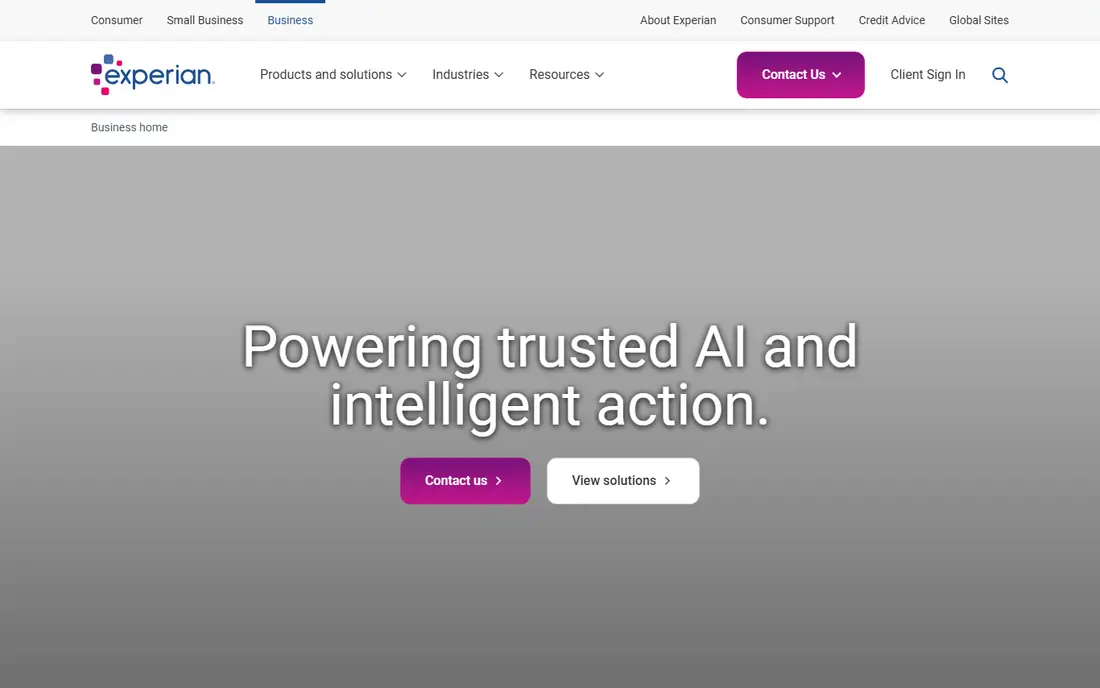
Experian Business is a primary credit bureau, which makes it the most direct alternative when the job is credit risk rather than prospecting. Business credit reports, scores, and monitoring come from Experian's own database, with fraud and risk tools for lenders, suppliers, and partners checking a counterparty.
The bureau-level distinction matters. D and B issues the PAYDEX score and D-U-N-S numbers, while Experian issues its own scores and reports. A supplier that checks Experian will see different data than one checking D and B, so many risk teams monitor both rather than replacing one with the other.
Pricing varies by product and is often quote-based for larger programs. Pick Experian Business when credit decisions need bureau-grade data. Pick a prospecting tool when the job is finding contacts, not judging creditworthiness.
What we like- Primary credit bureau data
- Business credit reports and scores
- Fraud and risk tools
Watch out for- Pricing varies and is often quote-based
- Experian data only, not multi-bureau
- Reports cost per pull on some plans
Starting priceSee website
Free planNo
Creditsafe runs its own business database with strength outside the United States, which suits companies checking international customers, suppliers, or partners. Credit reports, risk scores, and monitoring cover companies in many countries, with local data that US-centric bureaus cover thinly.
For a US company expanding abroad, Creditsafe fills the gap where D and B's US data stops being the whole picture. International credit decisions need local registry data, payment behavior, and legal filings, and Creditsafe's database is built for that job.
Pricing requires a quote, and US prospecting depth trails ZoomInfo or Apollo. Pick Creditsafe when international credit and company data lead. Pick a US prospecting platform when domestic outbound is the job.
What we like- Separate international database
- Strong outside the US
- Credit reports and monitoring
Watch out for- Quote required
- Less US prospecting depth
- Smaller contact database than ZoomInfo
Starting priceSee website
Free planYes
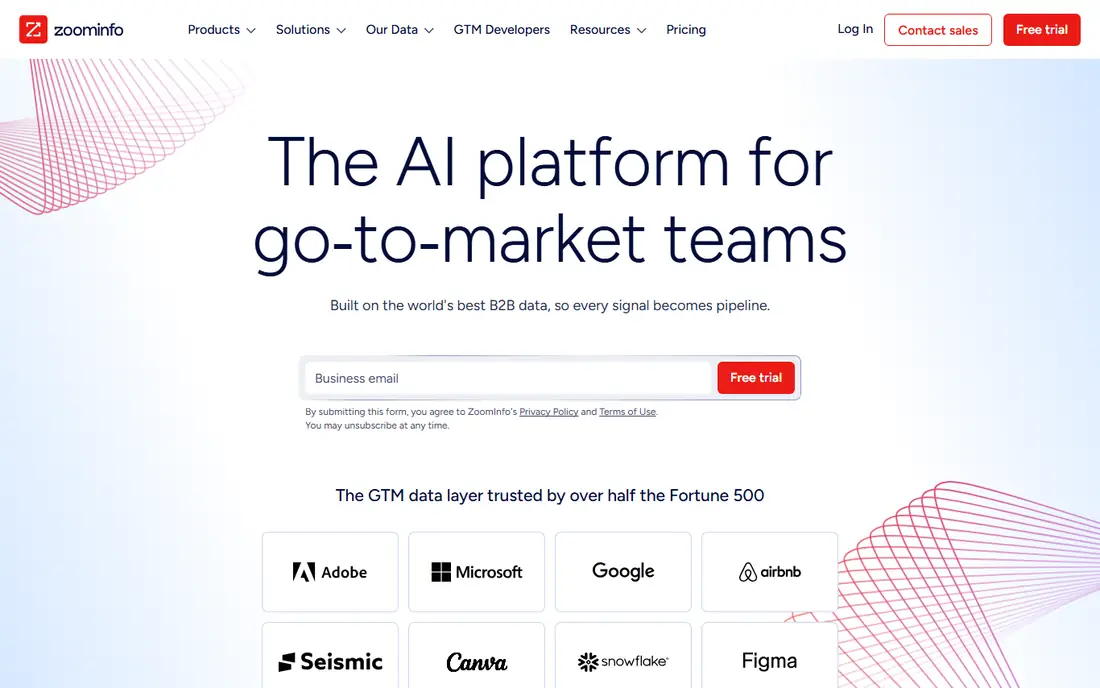
ZoomInfo Sales is the enterprise prospecting standard, with more than 400 million verified contacts, real-time intent signals, and native Salesforce and HubSpot integrations. Enterprise go-to-market teams use it to build lists, score accounts, and route outreach from one database.
Intent data is the differentiator. ZoomInfo tracks which accounts are researching topics related to your product, so reps prioritize in-market buyers instead of cold lists. That signal, plus contact accuracy, justifies the price for teams with large outbound motions.
Pricing is custom quote, with comparisons placing enterprise deals at $15,000-plus per year, and a free ZoomInfo Lite tier offers limited credits for evaluation. Pick ZoomInfo when enterprise prospecting and intent data justify the cost. Pick Apollo or UpLead when budget rules.
What we like- 400 million plus verified contacts
- Real-time intent data
- Native Salesforce and HubSpot integrations
Watch out for- Custom quote, often $15,000 plus per year
- Enterprise contracts
- Overkill for small teams
Starting priceFree
Free planYes
Apollo combines a contact database with outreach tools, so a small outbound team can find prospects and run sequences from one platform. The free plan gets teams started, and the Professional tier at $99 per user per month opens up the features most teams actually use, with month-to-month billing available.
That transparency contrasts with D and B's credit packages, which run $5,000 to $27,300 per year with dual-credit charges and a 6% annual escalator. Apollo's pricing is easy to model, and the platform covers contact search, enrichment, and sequencing without a second subscription.
Data accuracy is the trade. Users report bounce rates near 15 to 18 percent, higher than premium vendors, so verify key contacts before large campaigns. Pick Apollo when SMB outbound value matters most. Pick ZoomInfo when accuracy and intent justify enterprise cost.
What we like- Free plan available
- $99 per user per month Professional tier
- Contact database plus outreach tools
Watch out for- Reported bounce rates near 15 to 18 percent
- Credit limits on lower tiers
- Less enterprise depth than ZoomInfo
#5Cognism
Best for: EMEA prospecting, GDPR focus4.5/5 on
G2 (1,365 reviews, checked Oct 2026)
Visit cognism.com
Starting priceSee website
Free planNo
Cognism serves EMEA-focused teams with GDPR-compliant contact data, trigger events, and CRM integrations. For a team prospecting across Europe, compliance is not a nice-to-have: GDPR rules govern how contact data is collected, stored, and used, and Cognism builds its data practices around those rules.
Trigger events, such as funding rounds, hiring surges, and leadership changes, help reps time outreach to moments when buyers are receptive. That signal layer, plus EMEA depth, makes Cognism the default for European outbound teams.
Pricing is custom quote with an enterprise sales process, and US depth trails ZoomInfo. Pick Cognism when EMEA prospecting and GDPR compliance lead. Pick a US platform when domestic outbound dominates.
What we like- GDPR-compliant data
- Strong EMEA coverage
- Trigger events and CRM integrations
Watch out for- Custom quote
- EMEA focus means thinner US depth
- Enterprise sales process
#6Lusha
Best for: Individual sellers, fast discovery4.3/5 on
G2 (1,668 reviews, checked Oct 2026)
Visit lusha.com
Starting priceSee website
Free planYes
Lusha suits individual sellers who want fast contact discovery without an enterprise platform. A browser extension surfaces emails and phone numbers from LinkedIn profiles, and per-user pricing keeps costs low for solo reps and small teams. Reviewers rate Lusha higher than D and B Hoovers for value, citing affordability and ease of use.
The credit system is the limit. High-volume prospecting burns credits quickly, and users call the system restrictive at scale. Integrations are basic compared with ZoomInfo's native CRM sync, so larger teams may need workarounds.
Pick Lusha when a single rep or small team needs quick contact discovery at low cost. Pick Apollo when the team also needs outreach sequencing, and ZoomInfo when account depth matters.
What we like- Fast contact discovery
- Affordable per-user pricing
- Browser extension for LinkedIn prospecting
Watch out for- Credit system can feel restrictive at high volume
- Basic integrations
- Less account depth than ZoomInfo
#7UpLead
Best for: Budget SMB prospecting4.7/5 on
G2 (831 reviews, checked Oct 2026)
Visit uplead.com
Starting priceSee website
Free planYes
UpLead targets budget-conscious SMB teams with real-time verified emails, intent data, and a straightforward interface. Credits buy verified contacts, and the platform verifies emails in real time rather than serving stale records, which cuts bounce rates compared with cheaper lists.
Intent data comes included rather than as a premium add-on, which helps small teams prioritize in-market accounts without an enterprise contract. The interface stays simple, so a small team can build lists and export to a CRM without training.
Credit-based pricing caps volume, and integrations are basic next to ZoomInfo. Pick UpLead when a small team needs verified contacts and intent on a budget. Pick Apollo when outreach sequencing joins the brief, and ZoomInfo when scale demands it.
What we like- Real-time verified emails
- Intent data included
- Straightforward interface
- Credit-based pricing
Watch out for- Credit limits cap volume
- Basic integrations
- Smaller database than ZoomInfo
Starting priceFree
Free planYes
Nav monitors business credit across bureaus in one place, covering D and B, Experian, and Equifax, rather than issuing its own scores. That aggregation suits owners who want to watch their own business credit profile without subscribing to each bureau separately.
A free tier covers limited monitoring, and the Prime plan runs $29.99 per month with broader coverage. Nav also includes personal credit monitoring, which matters for owners whose personal and business credit intertwine.
Nav is an aggregator, not a bureau, so it cannot issue PAYDEX scores or pull full reports the way D and B or Experian can. Pick Nav when monitoring your own credit across bureaus is the job. Pick a bureau when you need to pull reports on other companies.
What we like- Monitors D and B, Experian, and Equifax in one place
- Free tier
- Prime plan at $29.99 per month
Watch out for- Aggregator, not a bureau
- Cannot issue scores
- Monitoring only, not full reports on free tier
How we chose
We compared tools that replace Dun and Bradstreet's two distinct jobs, credit risk and prospecting, using vendor pages and 2026 comparison data. We favored published prices where available and marked quote-based tools as such. We also flagged D and B's contract traps, dual-credit charges, credit expiration, and the 6% annual escalator, since those terms change the real cost more than the headline package price.
Credit risk versus prospecting: buying the right D and B replacement
D and B is not one product, and that confusion drives bad purchases. Hoovers is the sales intelligence piece, Connect handles data management, Credit covers risk assessment, and Rev.Up ABX serves account-based marketing. When teams compare D and B against a prospecting tool, they are really comparing Hoovers against a purpose-built database.
Credit teams need bureau data: PAYDEX scores, D-U-N-S numbers, payment history, and risk reports. Experian Business, Creditsafe, and Nav serve that job, with Nav aggregating rather than issuing. A prospecting tool cannot replace a credit report, and a credit report cannot find a decision-maker's email.
Prospecting teams need verified contacts, intent signals, and CRM sync. ZoomInfo, Apollo, Cognism, Lusha, and UpLead serve that job at very different price points, from free tiers to $15,000-plus enterprise deals. A team that buys D and B Hoovers for prospecting pays enterprise credit prices for contact data that prospecting specialists sell cheaper. Name the job first, then buy the tool built for it.
Frequently asked questions
Is Dun and Bradstreet still required for federal contracting?
No, D-U-N-S numbers are no longer required for federal contracting, since SAM UEI replaced them in 2022. Federal contractors should register for a SAM UEI directly rather than buying D and B products for that purpose.
How much does D and B Hoovers cost?
Hoovers runs credit-based packages from roughly $5,000 to $27,300 per year, with an Essentials pilot at $49 per month for 150 credits and an annual tier near $5,388 per year for 500 company and 500 contact credits. Contracts often include a 6% annual escalator and dual-credit charges.
What is the best free D and B alternative?
ZoomInfo Lite offers free verified contact and company data with monthly credits, and Apollo and Lusha offer free tiers. For credit monitoring, Nav's free tier covers multiple bureaus. No free tool matches D and B's full credit database.
Which alternative is best for international business data?
Creditsafe leads on international coverage with its own database outside the US. D and B itself covers 200-plus countries, so compare country coverage for your exact markets before switching.
Do I need D and B if I already use ZoomInfo?
Only if you need D and B-specific data such as D-U-N-S numbers, PAYDEX scores, or credit risk reports. For prospecting alone, ZoomInfo, Apollo, or UpLead cover the job, often at lower cost and with better contact accuracy for outbound.
What is the difference between a credit bureau and a data aggregator?
A bureau such as D and B or Experian issues scores and reports from its own database. An aggregator such as Nav monitors multiple bureaus in one place but cannot issue scores. Use a bureau to judge other companies, and an aggregator to watch your own profile.
Sources we checked (6)
- https://pipeline.zoominfo.com/sales/dun-and-bradstreet-competitors
- https://www.globaldatabase.com/best-company-data-apis-for-2026-a-buyers-guide
- https://ecommerceparadise.com/dun-bradstreet-review-2026-the-best-business-credit-platform-for-ecommerce-entrepreneurs/
- https://www.g2.com/compare/dun-bradstreet-d-b-hoovers-vs-lusha
- https://zoominfo.com
- https://apollo.io
Is your product missing or out of date?
We review this list regularly. Vendors can request a listing, send updated pricing or ask about featured placement.

Shihab Mia · Founder, Rankite
Shihab has 5+ years in B2B and SaaS SEO. He writes Rankite's software buying guides from pricing pages, documentation and public user reviews. More about Shihab.