How we make this list: we compare pricing pages, product documentation and public user reviews. Ratings come from G2, Capterra or Trustpilot, with the date we checked them.
Key takeaways
- LangGraph is the best alternative for production workflows that need branching, retries, human approval and resumable state.
- Microsoft Agent Framework suits .NET and Azure shops, and it is the successor to AutoGen and Semantic Kernel.
- Pydantic AI suits typed Python teams that want the smallest possible surface area.
- smolagents suits narrow code-writing agents with a tiny dependency footprint.
- Mastra suits TypeScript teams that want a full agent platform.
- n8n suits teams that want a visual, no-code builder rather than a code library.
Quick comparison
| Tool | Best for | Starting price | Free plan |
|---|
 LangGraph | Production workflows with state | $0 | Yes, free dev tier |
 Microsoft Agent Framework | .NET and Azure shops | $0 | Yes, open source |
 LlamaIndex | Data-grounded agents | $0 | Yes, open source |
 Pydantic AI | Typed Python agents | $0 | Yes, open source |
 smolagents | Tiny code agents | $0 | Yes, open source |
 Mastra | TypeScript agent platform | $0 | Yes, open source core |
 Google ADK | Google Cloud agents | $0 | Yes, open source |
 n8n | Visual no-code agents | $0 | Yes, self-hosted |
Is your product missing or out of date?
We review this list regularly. Vendors can request a listing, send updated pricing or ask about featured placement.
The best CrewAI alternatives
#1LangGraph
Best for: Production workflows with state4.4/5 on
G2 (35 reviews, checked Oct 2026)
Visit langchain.com
Starting price$0
Free planYes, free dev tier
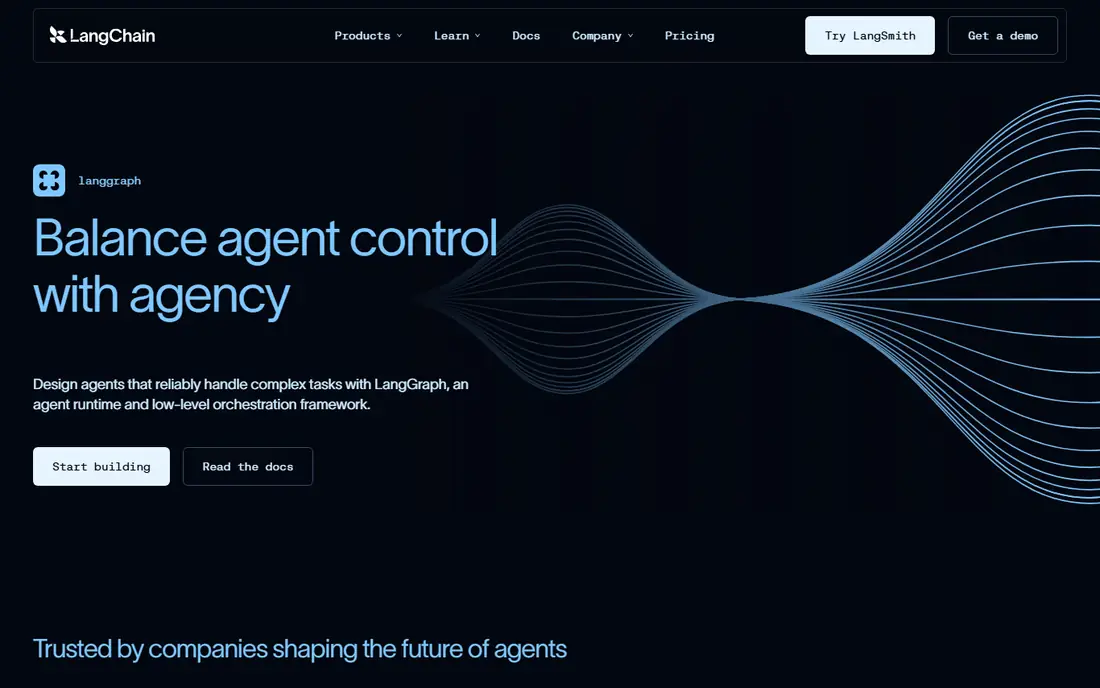
LangGraph is the best alternative for production workflows that need branching, retries, human approval and resumable state. Its mental model is a graph of steps with explicit state, so long-running, branching flows with human approvals are first-class rather than bolted on. LangGraph reached version 1.0 in October 2025, with no breaking changes promised until version 2.0, which gives production teams a stable target.
The trade-off is overhead: you define nodes, edges and state, so simple demos take the most code of any framework here, and you are programming a state machine. LangGraph Platform and LangSmith offer a free dev tier, with Plus near $49 per month per seat for hosted tracing. For a workflow that must survive failures and pause for approval, LangGraph is the default choice.
What we like- Highest control over flow
- Branching, retries and interrupts are explicit
- Resumable state
- Human-in-the-loop first-class
Watch out for- Graph thinking overhead on simple flows
- Most code to a first demo
Starting price$0
Free planYes, open source
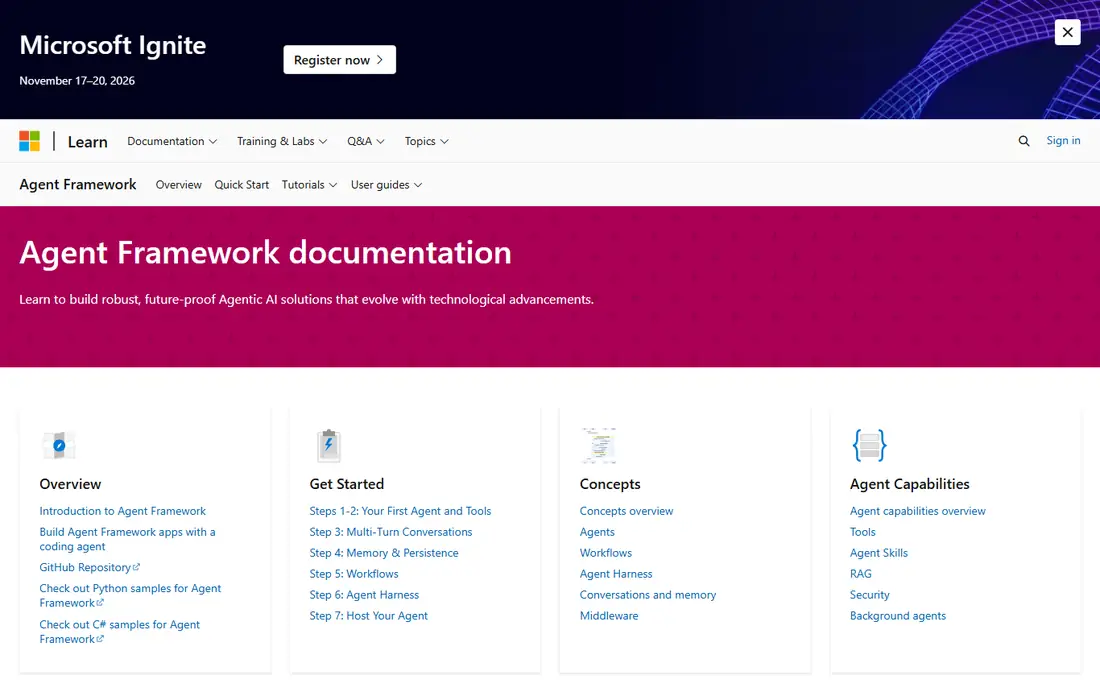
Microsoft Agent Framework is the successor to AutoGen and Semantic Kernel, reaching version 1.0 general availability in April 2026, while the old AutoGen and Semantic Kernel projects moved to maintenance mode with fixes only. It covers agents plus workflows in Python and .NET, so teams with existing AutoGen code have a supported path forward. The framework itself is free and open source; you pay for Azure hosting when you host there.
AutoGen's signature patterns remain available: group chats with a speaker selector, and agents that execute code the others wrote, which suit coding agents and critique loops. For a .NET or Azure shop, or a team with AutoGen code to maintain, Microsoft Agent Framework is the natural replacement for CrewAI.
What we like- Successor to AutoGen and Semantic Kernel
- Python and .NET
- Agents plus workflows
Watch out for- Old AutoGen code needs migration
- Best value inside Azure
Starting price$0
Free planYes, open source
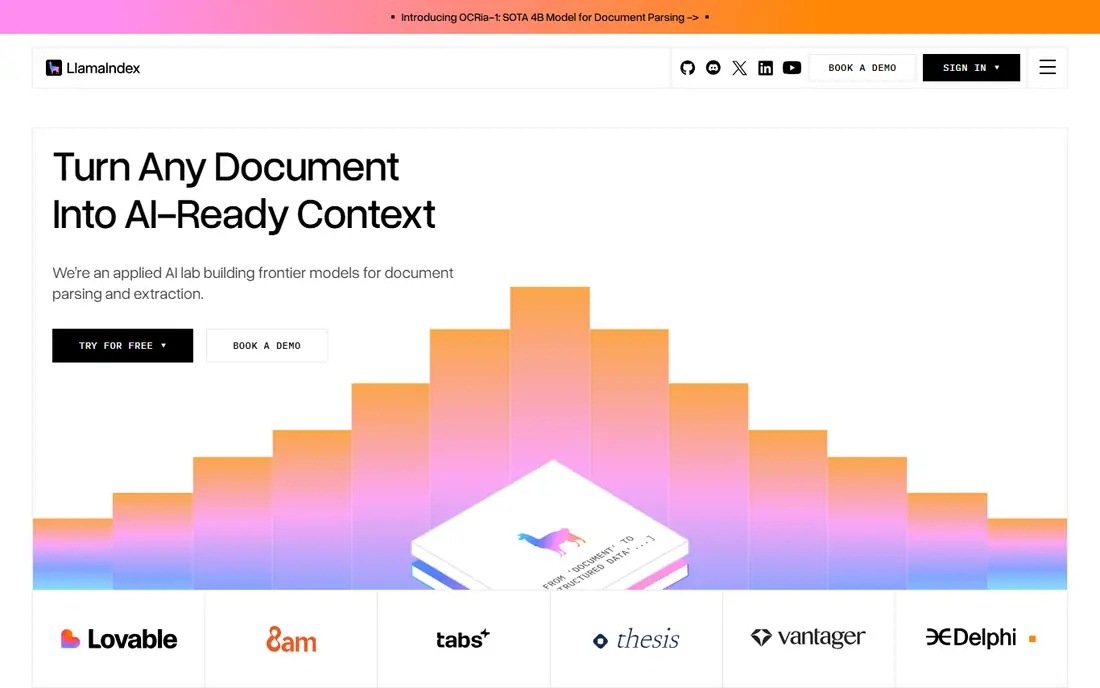
LlamaIndex suits agents that must ground answers in company data, with the strongest data ingestion, indexing and retrieval tooling of any framework here. Its agents work alongside workflows, and the agent surface area stays small, which suits teams that want retrieval quality without a heavy orchestration layer. For document question-answering and knowledge-base agents, LlamaIndex is the best foundation.
Multi-agent orchestration is thinner than CrewAI's crew model, so complex multi-role teams need extra design work. For a team whose agents mainly answer from documents and databases, LlamaIndex is the best pick.
What we like- Strongest data ingestion and retrieval
- Agents plus workflows
- Small agent surface area
Watch out for- Less multi-agent orchestration than CrewAI
- Retrieval focus needs pairing for complex crews
Starting price$0
Free planYes, open source
Pydantic AI suits typed Python teams that want the smallest possible surface area, with typed tool-calling agents built on the Pydantic validation library most Python teams already know. It is described by practitioners as underrated and boring in a good way: minimal, predictable, and easy to reason about. Hosted tracing through Logfire Team runs $49 per month, the lowest published team price for hosted tracing among these frameworks.
Minimal scaffolding means you own more of the workflow yourself, and the ecosystem is smaller than LangGraph's. For a Python team that values type safety and simplicity over a full platform, Pydantic AI is the best fit.
What we like- Typed tool-calling agents
- Smallest surface area
- Lowest published team price for hosted tracing
Watch out for- Minimal scaffolding means you own more
- Smaller ecosystem than LangGraph
Starting price$0
Free planYes, open source
smolagents from Hugging Face suits narrow code-writing agents that stay under 1,000 lines of dependencies, making it the lightest framework on this list. Agents write and run code to solve tasks, with Hugging Face model integration built in. That tiny footprint makes it ideal for embedded tools, demos and single-purpose agents where a full framework would be overkill.
State is in-memory only, and the scope is narrow, so long-running production crews with persistence and approval flows belong on LangGraph instead. For a focused code agent with minimal dependencies, smolagents is the best choice.
What we like- Tiny footprint under 1,000 lines of dependencies
- Code-writing agents
- Hugging Face integration
Watch out for- Narrow scope
- In-memory state only
- Not built for long-running production crews
Starting price$0
Free planYes, open source core
Mastra suits TypeScript teams that want a full agent platform rather than a plain library, with workflows, agents, tools and evals in one TypeScript-native package. It is the leading TypeScript answer to CrewAI's role-based model, and its platform adds hosting and observability for teams that want more than a library. For a TypeScript stack, Mastra is the most complete option.
Read the platform licensing carefully, since parts of the platform carry enterprise licensing terms, and the gateway adds market rate plus 5.5 percent to model tokens routed through it. For a TypeScript team that wants a platform rather than a library, Mastra is the best fit; for a plain Apache-2.0 library, the Vercel AI SDK is the lighter alternative.
What we like- Full TypeScript agent platform
- Workflows, agents and tools
- Gateway for model routing
Watch out for- Platform licensing needs reading
- Gateway adds market rate plus 5.5 percent to routed tokens
Starting price$0
Free planYes, open source
Google ADK, the Agent Development Kit, suits teams building on Google Cloud, with multi-agent design and native Vertex AI and Gemini integration. Agents compose into teams with clear roles, similar to CrewAI's crew model, while deployment targets Google Cloud services directly. That native integration shortens the path from prototype to production for Google Cloud shops.
Value is highest inside Google Cloud, and the community is smaller than LangGraph's. For a Google Cloud team that wants multi-agent development without leaving its cloud, Google ADK is the best pick.
What we like- Google Cloud native
- Multi-agent design
- Vertex AI and Gemini integration
Watch out for- Best value inside Google Cloud
- Smaller community than LangGraph
#8n8n
Best for: Visual no-code agents4.7/5 on
G2 (319 reviews, checked Oct 2026)
Visit n8n.io
Starting price$0
Free planYes, self-hosted
n8n suits teams that want a visual builder rather than a code library, with a drag-and-drop canvas for agents and workflows and a large library of integrations. Self-hosting is free, so a team can run agents without a subscription, and the visual model lets non-developers build and adjust workflows. That accessibility is why n8n appears wherever no-code agent building is the requirement.
Code control is weaker than a framework's, and visual flows get messy at large scale, so complex production logic still belongs in code. For a team that wants visual agent building without writing a framework, n8n is the best option.
What we like- Visual builder for agents and workflows
- Large node library
- Self-hosted free option
Watch out for- Less code control than frameworks
- Visual flows get messy at large scale
How we chose
We compared agent frameworks on mental model, control over flow, human-in-the-loop support, language support, ecosystem size and pricing transparency. We used vendor pages and recent comparison guides for facts, and we favored frameworks with a free tier or open-source core. We did not claim hands-on testing. Instead we weighed what each framework models best, whether it suits code or no-code teams, and what it costs to run, so teams can match a framework to their stack and workflow shape.
Choosing by workflow shape
Start with the shape of the work, then the team and cloud. One open-ended loop with a few tools points to a simple agent library such as Pydantic AI or the LangChain create_agent helper. Several specialists that collaborate point to CrewAI crews, or to Microsoft Agent Framework and Google ADK for multi-agent teams. Long-running, branching flows with human approvals that must resume point to LangGraph. A .NET and Azure shop points to Microsoft Agent Framework, and a Google Cloud shop points to Google ADK. A TypeScript stack points to Mastra.
Start with one agent and add more only when one agent measurably cannot do the job, since multi-agent systems add failure modes faster than they add capability. Map runs per day, days and sites onto the pricing unit before committing, since CrewAI charges per execution, LangGraph Platform charges per seat, and open-source frameworks charge only for model tokens and hosting. No single framework is best for every job, and the current convergence means a sane choice today rarely traps you. Keep evaluations in place from day one, since agent quality drifts as models change, and a regression caught by tests costs far less than one caught by customers. Log every agent run with inputs, outputs and costs, so failures can be replayed and fixed. Tracing is not optional for production agents, since silent failures are the most expensive kind. Budget tracing and evaluation time into every agent project from the very start, without any exception at all.
Frequently asked questions
What is the best CrewAI alternative?
LangGraph is the best alternative for production workflows with state, while Microsoft Agent Framework suits .NET and Azure shops. For quick role-based crews, CrewAI itself remains strong, with a hosted plan free to 50 executions per month.
Is AutoGen still maintained?
AutoGen and Semantic Kernel moved to maintenance mode with fixes only, and Microsoft Agent Framework is their successor, reaching version 1.0 general availability in April 2026. New projects should start on Microsoft Agent Framework.
How much does LangGraph cost?
LangGraph itself is open source and free, with a free dev tier on LangGraph Platform and LangSmith. Plus hosting runs near $49 per month per seat, and enterprise plans are custom.
Should I start with one agent or many?
Start with one agent and add more only when one agent measurably cannot do the job. Multi-agent systems add coordination failures, and a single well-tooled agent handles most workflows.
What is the cheapest agent framework?
All code frameworks here are open source and free, with costs limited to model tokens and hosting. smolagents and Pydantic AI have the smallest footprints, while n8n self-hosted is free for visual builders.
Sources we checked (8)
- https://www.langchain.com/langgraph
- https://learn.microsoft.com/en-us/agent-framework/
- https://www.llamaindex.ai
- https://ai.pydantic.dev
- https://huggingface.co/docs/smolagents
- https://mastra.ai
- https://google.github.io/adk-docs/
- https://n8n.io
Is your product missing or out of date?
We review this list regularly. Vendors can request a listing, send updated pricing or ask about featured placement.

Shihab Mia · Founder, Rankite
Shihab has 5+ years in B2B and SaaS SEO. He writes Rankite's software buying guides from pricing pages, documentation and public user reviews. More about Shihab.