How we make this list: we compare pricing pages, product documentation and public user reviews. Ratings come from G2, Capterra or Trustpilot, with the date we checked them.
Key takeaways
- Brave Search is the strongest free starting point, since it runs its own index and offers ranking controls called Goggles.
- DuckDuckGo is the easiest switch, with private search built into every major browser and no account needed.
- Startpage suits readers who want Google-quality results without a Google search profile attached to them.
- Mojeek is the most independent option, with its own index and no tracking, though its index is smaller than the big engines.
- Kagi is the only paid pick here, and it suits heavy searchers who want ad-free results they can tune themselves.
Quick comparison
| Tool | Best for | Starting price | Free plan |
|---|
 Brave Search | Independent free search | $0 | Yes |
 DuckDuckGo | Easiest private switch | $0 | Yes |
 Startpage | Google results, no profile | $0 | Yes |
 Mojeek | Fully independent index | $0 | Yes |
 Kagi | Ad-free tunable search | $5 per month | Free trial |
 Ecosia | Searches that fund tree planting | $0 | Yes |
 Qwant | European privacy search | $0 | Yes |
 SearXNG | Self-hosted metasearch | $0 | Yes |
Is your product missing or out of date?
We review this list regularly. Vendors can request a listing, send updated pricing or ask about featured placement.
The best conservative alternatives to Google
Starting price$0
Free planYes
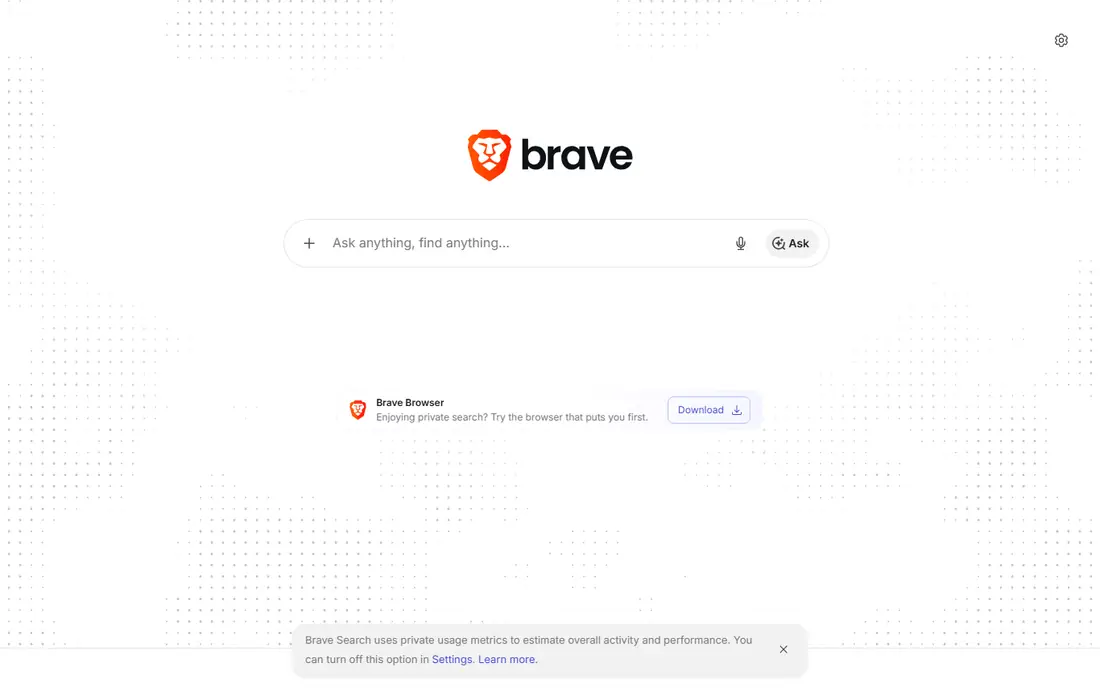
Brave Search is the closest free replacement for Google that does not depend on Google or Bing for results. It runs its own index, which now covers tens of billions of pages, and its policy states that it does not profile users or store search histories tied to identity. A paid Premium plan near $3 per month removes ads for readers who want a cleaner page.
The standout feature for readers who distrust ranking decisions is Goggles. Goggles let users apply community-made ranking rules that boost or demote chosen sources, so the same query can return different results under different Goggles. That control is unusual among search engines and directly answers the complaint that one company decides what ranks first. The trade-off is that free results include some ads, and an AI summary sits above many searches unless switched off.
What we like- Own index of tens of billions of pages
- No profiling by policy
- Goggles ranking controls
Watch out for- Free tier shows some ads
- AI summaries appear by default
Starting price$0
Free planYes
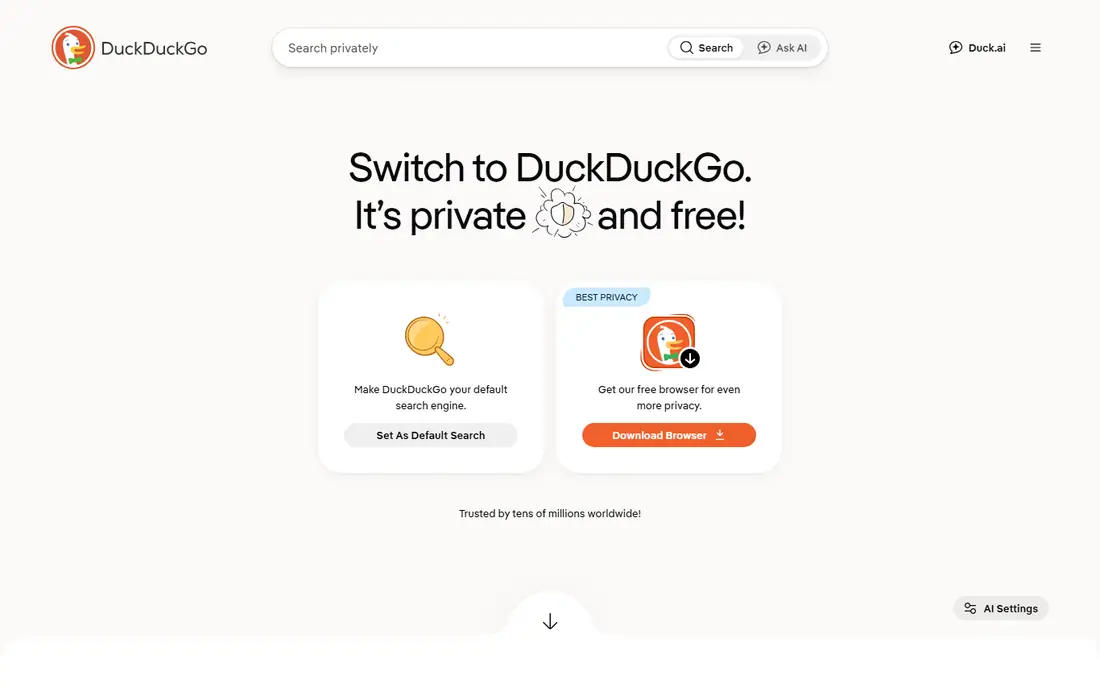
DuckDuckGo is the simplest switch on this list. It is built into Chrome, Firefox, Safari and Edge as a search option, so changing the default takes under a minute and no account is needed. Its policy states that it does not track users or store personal search histories, and its bang shortcuts let power users jump straight to a chosen site with a short code.
The honest limit is independence. Most DuckDuckGo results come from Microsoft Bing plus other partners, with only partial use of its own crawler, so readers who want to avoid Bing as well as Google should look at Brave or Mojeek instead. Ads also appear on shopping searches, though they are contextual rather than profiled. For a first step away from Google, DuckDuckGo remains the easiest and most familiar option.
What we like- Built into all major browsers
- No account needed
- Bang shortcuts to thousands of sites
Watch out for- Results largely sourced from Bing
- Ads on shopping searches
Starting price$0
Free planYes

Startpage takes a different approach: it fetches Google results and returns them to you without passing your identity to Google. Its policy states that it keeps no logs of searches, and its Anonymous View feature lets you open a result through a proxy so the destination site does not see your address either. For readers who like Google's result quality but not its profiling, that combination is appealing.
The trade-off is that the results still come from Google, so any ranking bias in Google's index carries over. Startpage also shows contextual ads, with a paid ad-free plan reported in the US. Readers who want full independence should prefer Brave or Mojeek. Readers who mainly want to break the link between their identity and their searches will find Startpage does that job well.
What we like- Google-quality results
- No logs by policy
- Anonymous View proxy browsing
Watch out for- Still relies on Google results
- Paid ad-free plan is US-only in some reports
Starting price$0
Free planYes
Mojeek is the most independent engine on this list. It builds its index with its own crawler, tracks no users by policy, and shows no ads at all. Its ranking is published and transparent, which appeals to readers who want to understand why a page ranks where it does rather than trusting a black box.
Independence has a cost. Mojeek's index is far smaller than Google's or Bing's, so niche queries, local businesses and map-style results are weaker. For everyday news and general questions it performs well, but for obscure technical queries you may need to try a second engine. Readers who rank independence above depth will accept that trade, and Mojeek is free, so trying it costs nothing.
What we like- Own index built from its own crawler
- No tracking
- No ads
Watch out for- Smaller index than Google or Bing
- Weaker local and map results
Starting price$5 per month
Free planFree trial
Kagi is the only paid search engine here, and its model explains its appeal: because users pay, Kagi does not need ads or sponsored results. Plans start near $5 per month, rising to $25 for heavy use, and the results page is clean and fast. Lenses let users focus searches on chosen source types, and ranking controls let them boost or block domains.
The account requirement is the main drawback for privacy purists, since Kagi ties searches to an account for billing even though its policy states it does not profile users. The paid model also means casual searchers may not see the value. For heavy searchers who run dozens of queries a day and want results they can shape themselves, Kagi is the most polished option available.
What we like- No ads at all
- Lenses and ranking controls
- Fast, clean results
Watch out for- Paid only beyond a trial
- Account required
Starting price$0
Free planYes
Ecosia turns an everyday habit into climate funding: its ad revenue pays for tree planting projects, and it publishes financial reports showing where the money goes. Search itself is free, with a privacy-friendly policy and no profile-based tracking. For readers who want their search habit to fund something tangible, Ecosia is the only engine here with that model.
Result quality depends on Bing, since Ecosia's results are Bing-powered, so it shares DuckDuckGo's independence limit. Features are also simpler than Google's, with no deep maps or shopping tools. Readers who care mainly about privacy and ranking control should pick Brave or Mojeek. Readers who like the tree-planting model and accept Bing-sourced results will find Ecosia an easy daily default.
What we like- Free
- Revenue funds tree planting
- Privacy-friendly policy
Watch out for- Results powered by Bing
- Smaller feature set
Starting price$0
Free planYes
Qwant is a European search engine that promises no tracking and no filter bubble, with its company and hosting based in Europe under European privacy law. That jurisdiction matters to readers who prefer their search provider to sit outside US tech companies and their data rules. Search is free, with no account needed for basic use.
Like several engines here, Qwant draws on Bing and other partners alongside its own technology, so it is not fully independent. Its index is also smaller than Google's, and local results outside Europe can be thin. For readers who value European hosting and a clear privacy stance over raw depth, Qwant is a solid daily choice.
What we like- Free
- European company and hosting
- No tracking by policy
Watch out for- Results draw on Bing and partners
- Smaller index
Starting price$0
Free planYes
SearXNG is the most control-heavy option on this list. It is open-source metasearch software that sends your query to many engines at once, strips identifying details, and returns combined results. You can run your own instance on a small server, which means no company at all sits between you and the results, or you can use a public instance run by someone else.
Self-hosting needs technical skill: a server, basic Linux knowledge and ongoing updates. Public instances are easier but vary in speed, uptime and trust, since the operator matters. For readers with the skills to run it, SearXNG offers more control than any hosted engine. For everyone else, Brave or DuckDuckGo gives most of the benefit with none of the setup.
What we like- Fully open source
- Aggregates many engines
- You control the instance
Watch out for- Needs technical setup
- Public instances vary in quality
How we chose
We compared engines on index independence, tracking policy, ranking control, cost and ease of switching. We used vendor policies and recent comparison guides for facts, and we favored engines that state their data practices plainly. We did not claim hands-on testing. Instead we weighed what each engine actually controls, from its own crawler to its ranking rules, so readers can judge independence claims rather than taking marketing at face value.
Testing engines before you commit
Do not switch on reputation alone. Run the same ten searches on two or three engines: a local business, a news topic, an obscure technical question, a product and a question where you already know the answer. Compare the first page for relevance, commercial clutter and whether primary sources appear, and note whether AI summaries hide ordinary results.
Also check the practical details. Confirm the engine works as your browser default on every device you use, since some engines need an extension on one browser and not another. If ranking control matters to you, test Brave Goggles or Kagi lenses directly, since that feature is the real difference between these engines and a plain private search box.
Frequently asked questions
Do these search engines really avoid Google?
Brave, Mojeek and SearXNG do not depend on Google for results, since Brave and Mojeek run their own indexes and SearXNG aggregates many sources you choose. Startpage deliberately uses Google results behind a privacy proxy, while DuckDuckGo, Ecosia and Qwant draw largely on Bing and partners.
Which alternative is best for complete beginners?
DuckDuckGo is the easiest first switch, since it is built into every major browser and needs no account. Brave Search is nearly as easy and adds an independent index, so try both for a week and keep the one whose results you trust more.
Are paid search engines worth it?
Kagi is worth it for heavy searchers who want ad-free, tunable results and run many queries daily. Casual searchers will likely be happy with free Brave, DuckDuckGo or Mojeek, since the paid advantage only shows up with heavy use.
Can I still use Google for some searches?
Yes. Many readers set a private engine as default and keep Google bookmarked for queries where it performs better, such as maps, flights or very local results. That split approach is practical and does not undermine the privacy gain on most searches.
Does switching search engines make me anonymous?
No. A private search engine stops that engine from profiling your searches, but your internet provider, browser and the sites you visit can still see activity. For stronger privacy, combine a private engine with a privacy-focused browser and a VPN.
Sources we checked (8)
- https://search.brave.com
- https://duckduckgo.com
- https://www.startpage.com
- https://www.mojeek.com
- https://www.kagi.com
- https://www.ecosia.org
- https://www.qwant.com
- https://docs.searxng.org
Is your product missing or out of date?
We review this list regularly. Vendors can request a listing, send updated pricing or ask about featured placement.

Shihab Mia · Founder, Rankite
Shihab has 5+ years in B2B and SaaS SEO. He writes Rankite's software buying guides from pricing pages, documentation and public user reviews. More about Shihab.