How we make this list: we compare pricing pages, product documentation and public user reviews. Ratings come from G2, Capterra or Trustpilot, with the date we checked them.
Key takeaways
- Elastic Path is the closest composable rival, and it bundles pieces such as search, a page builder, and B2B workflows that commercetools leaves you to assemble.
- Shopify Plus and BigCommerce trade some composable freedom for much faster launches, which suits teams without a dedicated platform group.
- Saleor and Medusa are open source, so the licence cost is zero and the real cost is the engineering team that runs them.
- Almost every enterprise platform here prices by quote, so total cost means licence plus implementation plus the integrations you still need to buy.
Quick comparison
| Tool | Best for | Starting price | Free plan |
|---|
 Elastic Path | Enterprise B2B composable commerce | See website | No |
 Adobe Commerce | Complex catalogs in the Adobe ecosystem | See website | No |
 Salesforce Commerce Cloud | Enterprises standardised on Salesforce | See website | No |
 BigCommerce | Headless SaaS without a platform team | $39 per month | No |
 Shopify Plus | Direct to consumer brands that need speed | $2,300 per month | No |
 Spryker | Marketplaces and modular B2B builds | See website | No |
 Saleor | Developer teams that want open source | Free | Yes |
 Medusa | JavaScript teams building custom stores | Free | Yes |
Is your product missing or out of date?
We review this list regularly. Vendors can request a listing, send updated pricing or ask about featured placement.
#1Elastic Path
Best for: Enterprise B2B composable commerce4.2/5 on
G2 (30 reviews, checked Oct 2026)
Visit elasticpath.com
Starting priceSee website
Free planNo
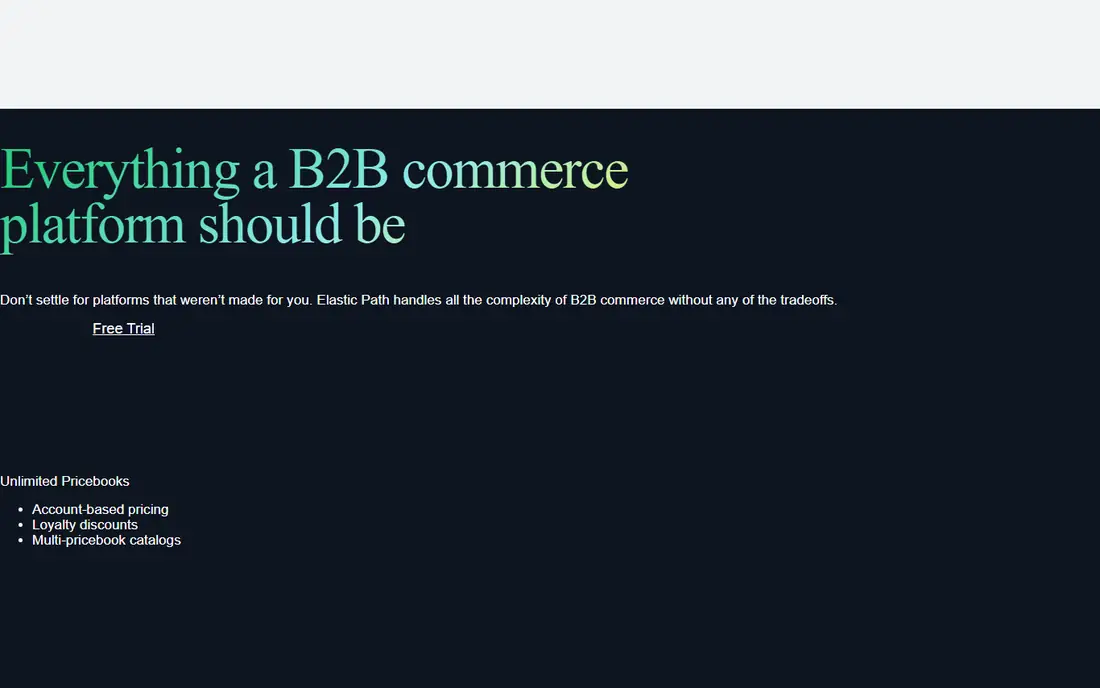
What we like- Elastic Path shares the API first composable philosophy but ships more of the stack in the box, including a storefront starter, content tools, search, subscriptions, and an integration layer. Its Product Experience Manager supports unlimited catalogues and price books, which suits manufacturers and distributors with complex account structures and contract pricing. For B2B and B2B2C sellers, less assembly means fewer vendors to manage.
Watch out for- Pricing is quote based and aimed at enterprise budgets, so smaller firms are out of scope. A full composable build still takes nine to eighteen months in typical estimates, so it does not fix a slow timeline by itself. You still need a capable technical team and strong governance to run it well.
#2Adobe Commerce
Best for: Complex catalogs in the Adobe ecosystem4.0/5 on
G2 (624 reviews, checked Oct 2026)
Visit business.adobe.com
Starting priceSee website
Free planNo
What we like- Adobe Commerce, built on Magento, handles very large and complex catalogues with a mature native B2B module covering quotes, company accounts, and custom price lists. A large extension marketplace fills gaps without custom code, and the open source Magento core gives developers a familiar starting point. Enterprises already using Adobe analytics, content, and marketing tools gain a connected stack.
Watch out for- Builds are long, typically nine to eighteen months, and the platform rewards experienced Magento teams rather than lean ones. The paid Adobe tiers and cloud hosting add up, and pricing is not published. Extension heavy builds can become hard to upgrade, so discipline in customisation matters.
#3Salesforce Commerce Cloud
Best for: Enterprises standardised on Salesforce4.1/5 on
G2 (7 reviews, checked Oct 2026)
Visit salesforce.com
Starting priceSee website
Free planNo
What we like- Commerce Cloud shares data with Salesforce CRM, service, and marketing products, so customer records, orders, and support history live in one system. Its AI tooling, including Agentforce agents, builds on that shared data for merchandising and service use cases. For an enterprise already paying for Salesforce across the business, adding commerce avoids a second vendor relationship.
Watch out for- Pricing is quote based and often tied to a share of gross merchandise value, which can grow expensive as sales scale. Outside the Salesforce estate, the case weakens, since much of the value is the shared data model. Implementation partners are costly, and deep customisation is harder than on open platforms.
#4BigCommerce
Best for: Headless SaaS without a platform team4.2/5 on
G2 (580 reviews, checked Oct 2026)
Visit bigcommerce.com
Starting price$39 per month
Free planNo
What we like- BigCommerce gives mid market brands an API first SaaS platform without the need to run a platform team. Its Catalyst storefront starter, built on Next.js, speeds up headless launches, and its B2B Edition adds quote workflows and buyer portals. Published plans start at 39 dollars a month for standard tiers, with enterprise pricing by quote, so costs are more predictable than most rivals here.
Watch out for- Deep enterprise B2B workflows are thinner than on commercetools or Elastic Path, so complex contract pricing may need workarounds. The app ecosystem is smaller than Shopify's, and some advanced features sit in higher tiers. Very large or unusual catalogues can hit platform limits.
#5Shopify Plus
Best for: Direct to consumer brands that need speed4.4/5 on
G2 (873 reviews, checked Oct 2026)
Visit shopify.com
Starting price$2,300 per month
Free planNo
What we like- Shopify Plus launches faster than any other platform here, with typical builds of five to eight months and a large app ecosystem of more than 8,000 apps. Checkout is a proven strength, hosting and security are handled for you, and the Hydrogen framework supports headless storefronts when you want a custom front end. Platform pricing is published and predictable, starting at 2,300 dollars a month.
Watch out for- B2B support is moderate rather than deep, with a native module that handles simpler account hierarchies but not the most complex contract structures. Transaction and platform fees apply on top of the subscription for some setups. Brands that need unusual checkout or pricing logic will meet platform boundaries sooner than on a fully composable engine.
Starting priceSee website
Free planNo
What we like- Spryker is a modular platform with B2B in its DNA, and it ships built in marketplace capability, which most rivals sell as an add on or leave to partners. Its module library lets teams assemble the exact capabilities they need, from quotes and approvals to subscriptions. It suits complex commerce ecosystems where one storefront model does not fit every channel.
Watch out for- Pricing is quote based and enterprise level, and the modular approach demands a strong engineering team to assemble and run. The partner and talent pool is smaller in North America than for Adobe or Salesforce. Simpler direct to consumer brands will pay for flexibility they never use.
Starting priceFree
Free planYes
What we like- Saleor is an open source, GraphQL native commerce platform, so there is no licence fee and the code is yours to extend. It supports account groups and channel pricing for B2B work, and a managed cloud option exists for teams that do not want to run infrastructure. Developer teams rate its API design highly, and build times of four to nine months are typical.
Watch out for- Free software is not a free programme: you pay for hosting, development, and maintenance yourself. Enterprise support and some operational tooling come from the cloud plans or your own team. The ecosystem of ready made integrations is smaller than the commercial platforms, so budget for building connectors.
Starting priceFree
Free planYes
What we like- Medusa is an open source commerce framework built on Node.js and TypeScript, designed as a modular starting point that JavaScript teams can shape freely. It carries an MIT licence, includes a B2B module, and lets you own the code outright rather than renting a platform. Typical build times of three to eight months are among the shortest for custom builds.
Watch out for- Medusa gives you a framework, not a finished platform, so your team builds and maintains more of the stack. The community and partner network are younger than Magento's or Saleor's. Large enterprises needing vendor accountability and formal support contracts may find the model uncomfortable.
How we chose
We selected platforms that appear consistently in 2026 headless and composable commerce comparisons and that a commercetools buyer would realistically shortlist. We compared architecture, B2B depth, typical launch time, and pricing transparency, and we favoured a spread across enterprise SaaS, composable suites, and open source so different team shapes can find a fit. Pricing is listed as see website wherever the vendor quotes individually, which is the honest position for most of this market. We excluded storefront only builders and small business website platforms that cannot support enterprise catalogues or B2B accounts.
Start with your team, not your feature list. A composable platform only pays back if you have the engineers to assemble and run it. If you do not, a SaaS platform such as Shopify Plus or BigCommerce will reach a working store months earlier, and the features you give up may be features you never needed. If you do have a platform team, the choice narrows to how much you want in the box: Elastic Path and Spryker ship more commerce capability prebuilt, while Saleor and Medusa hand you code and control.
Next, map your hardest requirement. For most enterprise buyers that is B2B: contract pricing, quotes, approval chains, and account hierarchies. Test your ugliest real pricing rule against each platform before you sign, because that rule decides the project. Then cost the whole programme over three years, licence, implementation, integrations, and run costs together, and get implementation partners to bid against the same scope. Finally, check the exit: open source and API first platforms make a future move cheaper, which is worth money even if you never use it.
Frequently asked questions
Why do companies move away from commercetools?
The common reasons are cost, build time, and team demands. commercetools is a strong platform, but typical builds take nine to eighteen months and assume an engineering led platform team. Buyers with simpler needs often find a SaaS or more prebuilt composable platform reaches the same result sooner.
Which alternative is best for B2B commerce?
Elastic Path and Spryker lead on B2B depth, with contract pricing, complex account structures, and marketplace capability. Adobe Commerce also has a mature B2B module. BigCommerce covers standard B2B well through its B2B Edition, while Shopify Plus handles simpler B2B models.
Are open source platforms really cheaper?
The licence is free, but hosting, development, security patching, and maintenance are your costs. Over three years an open source build can cost less than enterprise licences, especially for developer strong teams, but the saving depends entirely on how much you build and run yourselves.
How much do these platforms cost?
Shopify Plus publishes pricing from 2,300 dollars a month, and BigCommerce publishes standard plans from 39 dollars a month with enterprise tiers by quote. Elastic Path, Adobe Commerce, Salesforce Commerce Cloud, and Spryker all price by quote, and implementation commonly costs more than the first year licence.
Can I keep my current storefront if I switch back end platforms?
Often yes. Headless architecture separates the storefront from the commerce engine, so a storefront built on a framework such as Next.js can usually connect to a new back end through APIs. The work is in mapping data and integrations, not rebuilding the design.
Sources we checked (0)
Is your product missing or out of date?
We review this list regularly. Vendors can request a listing, send updated pricing or ask about featured placement.

Shihab Mia · Founder, Rankite
Shihab has 5+ years in B2B and SaaS SEO. He writes Rankite's software buying guides from pricing pages, documentation and public user reviews. More about Shihab.