How we make this list: we compare pricing pages, product documentation and public user reviews. Ratings come from G2, Capterra or Trustpilot, with the date we checked them.
Key takeaways
- The Search Monitor and AdPolice are the closest matches to Brandverity, because both focus on paid search, trademark bidding, and affiliate compliance.
- Corsearch, Red Points, and BrandShield suit brands whose main problem is counterfeits, impersonation, or phishing, not only paid search ads.
- MarkMonitor suits enterprises with large domain portfolios, where domain control and renewal governance matter as much as takedowns.
- ZeroFox and Semrush are broader tools: ZeroFox for external threat protection, Semrush for search intelligence and brand mention tracking on a smaller budget.
- Before buying, decide whether you need detection only, detection plus enforcement, or a managed service that handles takedowns for you. That choice changes the price and the team you need.
Quick comparison
| Tool | Best for | Starting price | Free plan |
|---|
 The Search Monitor | Direct Brandverity style paid search compliance | See website | No free plan listed |
 AdPolice | Automated affiliate fraud and ad hijacking detection | See website | Free brand check available |
 Corsearch | Trademark lifecycle plus brand protection | See website | No free plan listed |
 Red Points | Marketplace counterfeit takedowns at scale | See website | No free plan listed |
 BrandShield | Phishing, impersonation, and fake domains | See website | No free plan listed |
 MarkMonitor | Large corporate domain portfolios | See website | No free plan listed |
 ZeroFox | External threat and brand protection for SOC teams | See website | No free plan listed |
 Semrush | Budget search intelligence and brand monitoring | See website | Free trial available |
Is your product missing or out of date?
We review this list regularly. Vendors can request a listing, send updated pricing or ask about featured placement.
The best Brandverity alternatives
Starting priceSee website
Free planNo free plan listed
The Search Monitor suits a brand that wants to replace Brandverity without changing its workflow much. It monitors paid search ads for unauthorized trademark use, checks affiliates against your rules, and reports on paid, shopping, and organic listings in one place. Its SmartCrawler work decloaks URL hijackers and improper ad copy, which matters because many violations are hidden from a normal search: an affiliate may show a clean ad to most users while redirecting others to a different landing page.
The platform also automates trademark complaint submission to search engines, which saves the repetitive work that makes manual monitoring fail. The limit is scope. The Search Monitor is excellent at search, but it is not a marketplace takedown service or a phishing response team. If counterfeit listings are your main cost, pair it with Red Points or Corsearch. If paid search and affiliates are your main cost, it is the first tool to trial, and a demo should use your own brand terms and regions.
What we like- Dedicated brand protection, affiliate compliance, and SEM insights in one product
- Crawling across many countries, regions, and search engines
- Automatic trademark complaint submission
- Hourly crawling and custom alerts
Watch out for- Pricing is quote based
- Focused on search, so marketplace counterfeits need another tool
- Smaller brands may find the full platform more than they need
#2
AdPolice
Best for: Automated affiliate fraud and ad hijacking detection
Visit adpolice.com
Starting priceSee website
Free planFree brand check available
AdPolice suits a performance marketing team that suspects affiliates are taking commissions they did not earn. Rogue affiliates use cloaked links, geo targeting that hides ads from your office, cookie stuffing, and browser extensions that inject codes, all designed so the brand never sees the abuse. AdPolice scans search engines and traces redirect chains, then runs automation workflows that prepare cases, contact networks or publishers, and track outcomes.
That automation is the main reason to pick AdPolice over a manual monitoring spreadsheet. Once rules are set, cases move without daily human chasing, and the API lets you pull cases into your own reporting. The risk is over automation: a rule that is too broad can flag a legitimate partner, so start with alerts and review, then move to automated enforcement for clear cut cases. Use the free brand check first to see whether you have a problem worth paying to solve, and ask for a trial on your own affiliate program before signing.
What we like- Automation workflows that enforce across networks, publishers, and search engines
- Detection of link cloaking, geo targeting, cookie stuffing, and extension fraud
- Open API and plain language AI agent for queries
- Free brand check as a low risk starting point
Watch out for- Pricing is quote based
- Automation needs careful rules so legitimate affiliates are not flagged
- Brand protection beyond search and affiliates needs a broader platform
#3Corsearch
Best for: Trademark lifecycle plus brand protection4.6/5 on
G2 (24 reviews, checked Oct 2026)
Visit corsearch.com
Starting priceSee website
Free planNo free plan listed
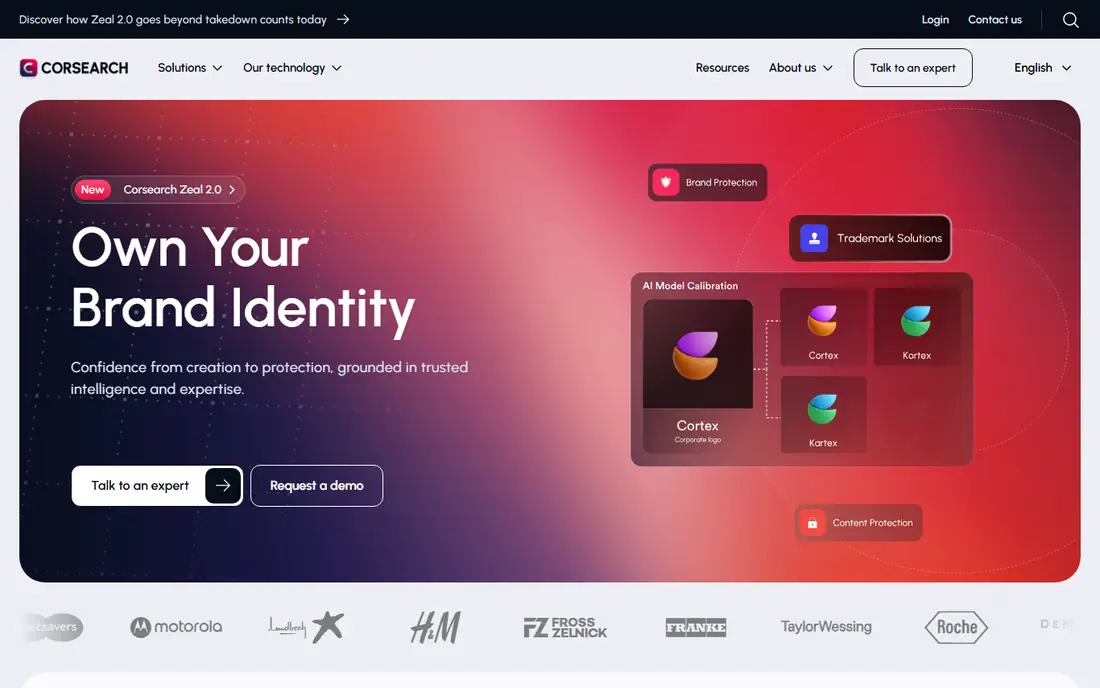
Corsearch suits a company where trademark work and brand protection sit in the same team, or where legal needs to own enforcement. Its TrademarkNow platform covers name generation, screening, clearance, and watching, while its brand protection side removes counterfeits, cleans online channels, and tracks the people and sellers behind threats. That link between a trademark record and an enforcement action is useful in court and in settlement talks, because you can show ownership, watching history, and removal evidence in one workflow.
The trade off is size and cost. Corsearch is built for enterprises and IP professionals, so a small brand with a single paid search problem will find it heavier than The Search Monitor or AdPolice. A large brand with many trademarks, many markets, and a legal team will find the opposite: a search only tool leaves trademark management to spreadsheets and outside counsel. Ask Corsearch to show a full case, from detection to takedown to reporting, for one of your own trademarks during a trial.
What we like- Trademark search, clearance, watching, and management alongside brand protection
- Marketplace, domain, and content enforcement
- Expert supported service, not only software
- Strong fit for legal and IP teams
Watch out for- Enterprise pricing is quote based
- Broader scope means longer onboarding than a search only tool
- Smaller brands may not need the full trademark platform
Starting priceSee website
Free planNo free plan listed
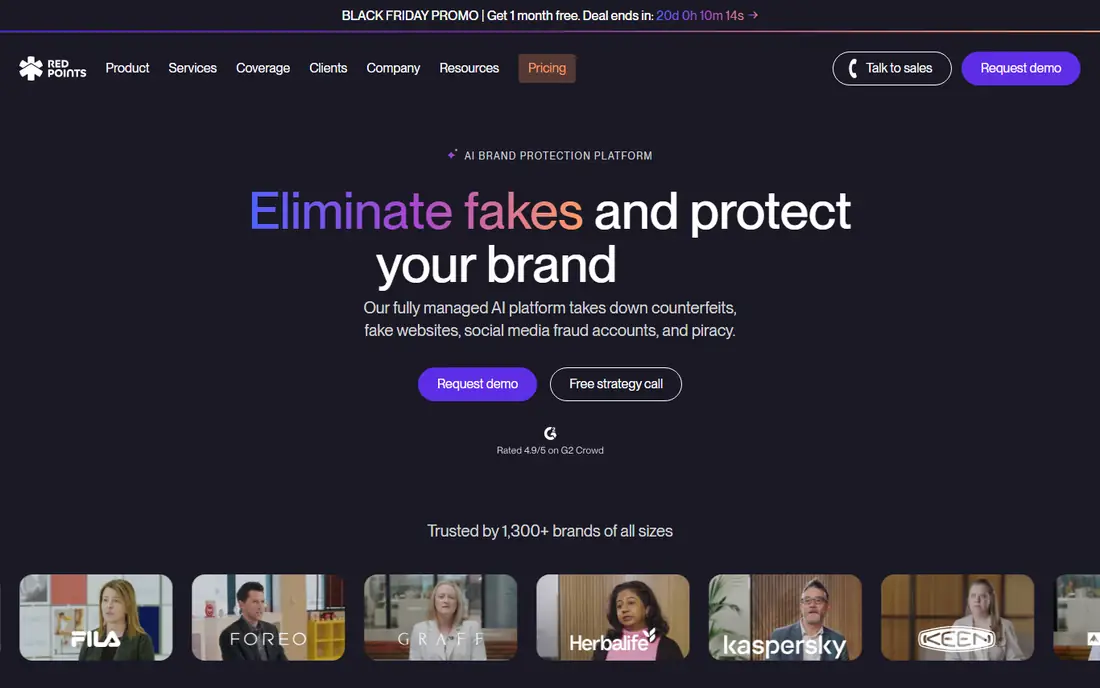
Red Points suits a consumer brand that is losing sales to counterfeit listings. Its platform detects fakes across marketplaces, websites, social media, domains, and ads, then enforces removals at scale, with AI models trained on brand protection data and human oversight for edge cases. Seller risk scores help a team focus on repeat infringers, while a revenue recovery program can pursue money back from counterfeiters in some cases.
That scale is the point: a brand with thousands of listings cannot remove them one by one, and Red Points is built for that volume. The limit is fit for a pure paid search buyer. If your only problem is affiliates bidding on your brand term, Red Points will solve it as part of a larger service, but you will pay for marketplace coverage you may not need. If counterfeits are eating your revenue, Red Points is the strongest takedown focused option on this list, and a trial should measure removal rate and time to removal on your own listings.
What we like- Managed AI platform for counterfeits, fake websites, social fraud, and piracy
- Coverage across thousands of marketplaces
- Unlimited detection and enforcement in its headline model
- Seller risk scoring and revenue recovery options
Watch out for- Pricing is quote based
- Managed service model means less hands on control than a self serve tool
- Paid search compliance is only part of a much larger product
Starting priceSee website
Free planNo free plan listed
BrandShield suits a brand whose customers are being scammed, not only outbid. Phishing sites, fake booking pages, spoofed support accounts, and fraudulent apps all use your name to steal money or credentials, and they move across channels fast. BrandShield monitors those channels together, clusters related assets into campaigns, and enforces removals with expert review, which helps when the same actor runs a fake site, a social profile, and a paid ad at the same time.
That cross channel view is the main advantage over a search only tool. A search monitor may catch a bad ad, but miss the fake domain behind it or the social profile driving traffic to it. The trade off is price and scope: BrandShield is an enterprise platform, and a small brand with a narrow paid search issue should start elsewhere. A bank, insurer, pharma company, or travel brand with active phishing should trial BrandShield on its own impersonation cases and measure time from detection to takedown.
What we like- Cross channel detection across websites, marketplaces, social media, domains, apps, and ads
- Phishing and impersonation focus with expert led enforcement
- Clustering that links related sellers, domains, and profiles
- Strong fit for finance, pharma, and travel brands
Watch out for- Pricing is quote based
- Broad coverage can mean a longer scoping conversation
- Paid search compliance alone is not its main selling point
Starting priceSee website
Free planNo free plan listed
MarkMonitor suits an enterprise that owns hundreds or thousands of domains and needs to govern them properly. Domains are brand assets, and a lapsed renewal, a parked domain without HTTPS, or a lookalike domain used for phishing can each cause real harm. MarkMonitor centralizes registration, renewal, security, and monitoring, with advisors who know corporate domain policy, and it watches for domain threats that exploit your brand.
The limit is that MarkMonitor is not a general brand protection suite. It will help with domain threats and recovery, but counterfeit listings on a marketplace or fake social profiles will still need Red Points, BrandShield, or Corsearch. That is fine if domain control is your gap: many brands discover, during a MarkMonitor review, that they do not know who owns which domains, when they renew, or who can change DNS records. Fixing that governance is often worth more than another detection dashboard.
What we like- Corporate domain management with centralized control
- Domain threat monitoring, enforcement, and recovery
- Dedicated advisors and global support
- Long track record with large brands
Watch out for- Pricing is quote based
- Domain focus means marketplace and social enforcement need another vendor
- Smaller portfolios will not use its full governance features
#7ZeroFox
Best for: External threat and brand protection for SOC teams4.4/5 on
G2 (170 reviews, checked Oct 2026)
Visit zerofox.com
Starting priceSee website
Free planNo free plan listed
ZeroFox suits a security team that already thinks in terms of external threats, not only marketing compliance. Its platform discovers your digital presence, validates threats with analysts, and disrupts abuse through takedowns and platform relationships. That cycle covers phishing, impersonation, leaked credentials, executive targeting, and brand abuse in one workflow, with feeds and integrations for a SOC that already runs a SIEM or threat intelligence platform.
For a marketing team, ZeroFox can feel heavy. Its strength is validation and disruption at scale, with human judgment on complex cases, which matters when a takedown could affect a legitimate account or a public figure. For a brand whose main pain is affiliate commissions, a search specialist will be simpler and cheaper. For a brand facing coordinated phishing, credential leaks, and impersonation, ZeroFox gives security and brand teams a shared view, and a trial should test how fast a validated threat moves from detection to disruption.
What we like- External attack surface discovery across domains, social accounts, credentials, and executives
- Dark web intelligence and threat feeds
- Human validated disruption workflows
- Integrations with SIEM, SOAR, and TIP tools
Watch out for- Pricing is quote based
- Security operations focus may be more than a marketing team needs
- Paid search and affiliate compliance are only part of a wider platform
#8Semrush
Best for: Budget search intelligence and brand monitoring4.4/5 on
G2 (4,035 reviews, checked Oct 2026)
Visit semrush.com
Starting priceSee website
Free planFree trial available
Semrush suits a small brand or agency that needs to see who is bidding on its name, but cannot justify an enterprise brand protection contract yet. Position tracking shows who ranks and advertises on your brand terms, advertising research exposes competitor ad copy, and brand monitoring alerts flag new mentions across the web. Those three features answer the first Brandverity question, who is using my brand in search, at a much lower cost, and they come with SEO, content, and social tools the same team may already use.
The limit is enforcement. Semrush can show you a problem, but it will not file a trademark complaint, contact an affiliate network, or remove a counterfeit listing for you. That work stays manual. Use Semrush as a stepping stone: monitor brand terms, build evidence of abuse, and move to The Search Monitor or AdPolice when the volume of violations, or the cost in lost clicks and commissions, justifies a dedicated tool. Confirm current pricing and trial terms on the Semrush site, since plans and limits change.
What we like- Position tracking and advertising research for brand terms
- Competitor ad copy and visibility data
- Brand monitoring alerts for mentions
- Free trial and a limited free tier, with broader SEO tools included
Watch out for- Not a dedicated brand protection or enforcement tool
- No automated takedown workflow for affiliates or counterfeits
- Data is search focused, so marketplace and phishing coverage is limited
How we chose
We compared vendor homepages, product documentation, and public reviews on G2, Capterra, and Reddit, and we checked each vendor homepage to confirm it loads and belongs to the named product. We favored tools that cover at least one core Brandverity job, paid search compliance, affiliate monitoring, trademark protection, or broader brand enforcement, and we included both narrow specialists and broad platforms so different budgets and team shapes are represented. We did not claim hands-on testing. Where a vendor does not publish a price, the article says See website. One candidate, BluePear, was excluded during checks because its domain now shows a for sale page, not the vendor product.
What to check before you pick a Brandverity alternative
Start with the abuse that costs you the most. Paid search and affiliate abuse shows up as higher cost per click, lost clicks, and unearned commissions. Counterfeits show up as lost sales and customer complaints. Phishing shows up as support tickets, fraud losses, and trust damage. Each problem points to a different tool, and buying a broad platform for a narrow problem wastes money, while buying a narrow tool for a broad problem leaves gaps.
Next, ask how enforcement actually works. Detection without enforcement is a report, not protection. Ask who files complaints, who contacts networks and platforms, how long takedowns take, what evidence is kept, and what happens when a complaint is rejected. Ask whether enforcement is automated, managed, or self serve, and who on your team approves actions. A trial should include a real case from detection to resolution, not only a dashboard demo.
Then check coverage for your markets. Confirm search engines, countries, regions, cities, devices, marketplaces, and social platforms that matter to you. Confirm crawl frequency, since a violation that appears for a few hours a day can be missed by a daily crawl. Confirm language support and local enforcement partners if you sell in many countries. Also confirm data export and reporting, since legal, finance, and marketing teams will each want different evidence.
Finally, compare total cost, not headline price. Quote based tools often price by brand terms, keywords, markets, or enforcement volume, so get a quote for the same scope from each vendor. Ask what counts as a billable term or case, what happens when you add a brand or market, and whether managed enforcement, legal support, or API access costs extra. A cheaper tool that needs a full time analyst can cost more than a managed service that runs itself.
Frequently asked questions
What is the closest alternative to Brandverity?
The Search Monitor is the closest direct match, because it covers brand protection, affiliate compliance, and SEM insights in one search focused product. AdPolice is the closest match for automated affiliate fraud detection and enforcement.
Can a small brand afford a Brandverity alternative?
Yes, but not always an enterprise platform. Semrush can monitor brand search terms on a budget, and AdPolice offers a free brand check to test whether affiliate abuse is a real problem. Move to a dedicated tool when violation volume or commission loss justifies the cost.
Do these tools remove counterfeit listings?
Red Points, Corsearch, and BrandShield all offer enforcement across marketplaces, websites, and other channels, with different levels of automation and managed service. Search only tools focus on ads and affiliates, so they are not the right choice for large scale counterfeit removal.
How do I prove affiliate fraud to a network?
Keep evidence from your monitoring tool: screenshots, ad copy, landing page URLs, redirect chains, timestamps, and location data. Tools such as The Search Monitor and AdPolice capture this evidence automatically, which makes network complaints faster and harder to dispute.
Should legal or marketing own brand protection?
Both, with clear roles. Marketing usually owns paid search and affiliate rules, legal owns trademark rights and enforcement decisions, and security owns phishing and impersonation response. Choose a tool that gives each team the reports and permissions it needs, rather than a single shared login.
How long should a trial last?
Long enough to cover a full affiliate payment cycle and a range of locations and devices, usually at least a few weeks. A one day demo will miss cloaked affiliates that hide from your office location and violations that only appear at certain times.
Sources we checked (8)
- https://thesearchmonitor.com/
- https://adpolice.com/
- https://corsearch.com/
- https://www.redpoints.com/
- https://www.brandshield.com/
- https://markmonitor.com/
- https://www.zerofox.com/
- https://www.semrush.com/
Is your product missing or out of date?
We review this list regularly. Vendors can request a listing, send updated pricing or ask about featured placement.

Shihab Mia · Founder, Rankite
Shihab has 5+ years in B2B and SaaS SEO. He writes Rankite's software buying guides from pricing pages, documentation and public user reviews. More about Shihab.