How we make this list: we compare pricing pages, product documentation and public user reviews. Ratings come from G2, Capterra or Trustpilot, with the date we checked them.
Key takeaways
- BILL charges $49 to $89 per user per month, while Melio starts free and its Core plan costs $25 a month.
- Melio sells an ACH allowance, so a low-volume business can pay almost nothing, while BILL charges per seat plus $0.59 per ACH payment.
- BILL syncs two-way with QuickBooks and Xero from its $65 Team plan, while Melio syncs with QuickBooks, Xero and NetSuite.
- Ramp bundles bill pay into a free spend platform, so a business that also needs corporate cards should compare it first.
- Tipalti and Stampli are built for higher volumes and global payouts, not for a small business paying domestic bills.
Which is better, BILL or Melio?
Melio is better for most small businesses, and BILL is better for finance teams with heavier approval and audit needs. The difference is the pricing model. BILL charges per user per month, so every approver adds $49 to $89 to the bill, and then it adds $0.59 for each ACH payment on top. Melio charges a flat monthly subscription with an ACH allowance included, so the bill grows with payment volume rather than headcount. For a business with one bookkeeper paying 50 bills a month, Melio Go is free and Melio Core is $25 a month, while BILL Essentials starts at $49 per user. BILL pulls ahead when the business needs custom approval policies, two-way sync with NetSuite or Sage Intacct, procurement workflows, or an audit trail that satisfies an external accountant.
How much does BILL cost compared with Melio?
BILL costs more than Melio at every comparable volume, because it charges per seat and per payment. A worked example shows the gap. Take a team of three people paying 100 bills a month by standard ACH. On BILL Essentials the seats cost 3 times $49, which is $147, and the ACH payments cost 100 times $0.59, which is $59, for a total of $206 a month before tax. On Melio Core the subscription costs $25 a month plus $10 for each of the two extra users, which is $45, and the plan includes 20 free ACH payments, so the remaining 80 cost $0.50 each, which is $40, for a total of $85 a month. The same work costs $121 a month less on Melio. The gap widens at low volume: a sole owner paying 10 bills a month pays $2.50 on Melio Go and $49 plus $5.90 on BILL Essentials. Card-funded payments cost 2.9 percent on both platforms, so paying by card does not change the comparison.
A small business should look for the pricing unit, the accounting sync, the approval workflow and the payment fees before choosing. The pricing unit decides the bill: per-seat tools like BILL get expensive as the team grows, while volume-priced tools like Melio stay cheap for small teams. The accounting sync decides the admin: two-way sync posts bills and payments back to QuickBooks or Xero automatically, while CSV import means retyping. The approval workflow decides control: even a three-person business needs a second pair of eyes on large payments. Payment fees decide the real cost: ACH, check, wire and card fees add up fast, so model a month of real payments before comparing headline prices.
When does it make sense to choose BILL over Melio?
It makes sense to choose BILL when approvals, audit trails or NetSuite and Sage Intacct sync matter more than the monthly fee. The clearest triggers are an external accountant who wants a full audit trail, a controller who needs custom approval policies by amount and department, or an ERP that only BILL connects to natively on the Team plan and above. Procurement is another trigger: BILL Corporate includes purchase requests, purchase orders and two-way matching, while Melio has no procurement module. Volume is the counter-trigger: once a business pays several hundred bills a month, BILL's per-payment fees add up, and a volume-priced tool or a card-funded platform like Ramp may cost less.
Quick comparison
| Tool | Best for | Starting price | Free plan |
|---|
 BILL | Finance teams that need approval controls, two-way sync and AP plus AR in one place | Essentials $49 per user per month, Team $65, Corporate $89, Enterprise custom | None; free trial available |
 Melio | Small businesses that want to pay vendors by ACH, card or check without per-seat pricing | Go $0, Core $25 per month ($20 annual), Boost $55 ($44 annual), Unlimited $80 ($64 annual), Platinum custom | Yes, Go is free for one user with 5 free ACH payments a month |
 Ramp | Businesses that want bill pay, corporate cards, expenses and travel in one free platform | Free $0 per user per month; Plus $15 per user per month plus an unpublished platform fee based on team size, 20 percent off with annual billing; Enterprise custom | Yes, Free plan at $0 per user per month |
 Tipalti | Finance teams paying many suppliers or contractors across borders | Accounts Payable plans from $99 per month; Mass Payments plans from $249 per month | None |
 Stampli | Mid-size AP teams that want invoice-centred collaboration and modular add-ons | Quote only; third-party estimates put typical costs at roughly $250 to $1,500 per month | None; no free trial |
 QuickBooks Online | Businesses that want bill pay inside the ledger they already use | Solopreneur $20 per month, Simple Start $38, Essentials $85, Plus $140, Advanced $340, after the 1 August 2026 rise; 70 percent off for 3 months until 29 November 2026 | None; 30-day free trial |
 Xero | Small businesses that want bill pay embedded in their accounting software | Early $27 per month, Growing $59 per month, Established $97 per month, after the 1 October 2026 rise | None; 30-day free trial |
 FreshBooks | Freelancers and service businesses that invoice by the hour and pay a small number of bills | Lite $23 per month, Plus $43, Premium $70, from 5 March 2026; annual billing $248.40, $464.40 and $756 | None; 30-day free trial |
Is your product missing or out of date?
We review this list regularly. Vendors can request a listing, send updated pricing or ask about featured placement.
#1BILL
Best for: Finance teams that need approval controls, two-way sync and AP plus AR in one place4.4/5 on
G2 (1,805 reviews, checked Oct 2026)
Visit bill.com
Starting priceEssentials $49 per user per month, Team $65, Corporate $89, Enterprise custom
Free planNone; free trial available
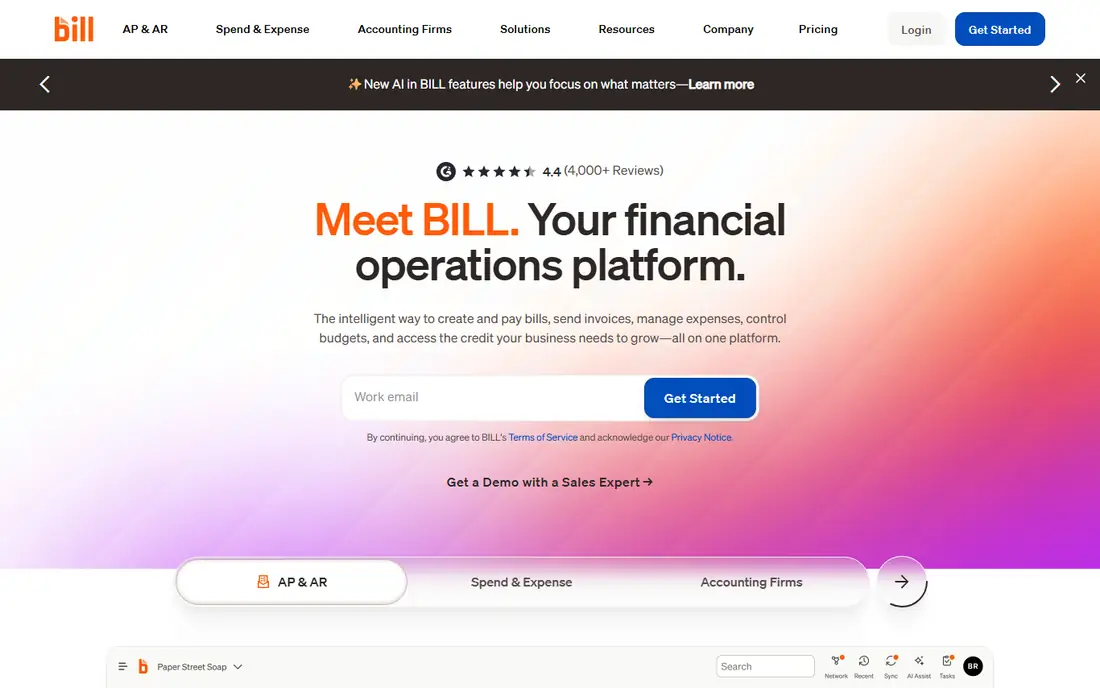
BILL is the default AP tool for many accounting firms and their clients. Bills arrive in a central inbox, approvers sign off in the app, and payments go out by ACH, card or check, while the same account sends customer invoices with reminders. The plan structure matters more than the headline price: Essentials at $49 per user only offers manual CSV import and export, so most companies need Team at $65 for automatic sync, and Corporate at $89 adds custom approval policies and procurement. Payment fees apply on every plan, so model monthly ACH and check counts before comparing BILL with free options.
What we like- Automatic two-way sync with QuickBooks and Xero from the Team plan
- Custom approval policies on Corporate
- AP and AR in one account
Watch out for- Per-seat pricing gets expensive as the team grows
- $0.59 per ACH and $1.99 per check add up on top of seats
- Essentials only offers manual CSV import and export
#2Melio
Best for: Small businesses that want to pay vendors by ACH, card or check without per-seat pricing4.4/5 on
G2 (248 reviews, checked Oct 2026)
Visit melio.com
Starting priceGo $0, Core $25 per month ($20 annual), Boost $55 ($44 annual), Unlimited $80 ($64 annual), Platinum custom
Free planYes, Go is free for one user with 5 free ACH payments a month
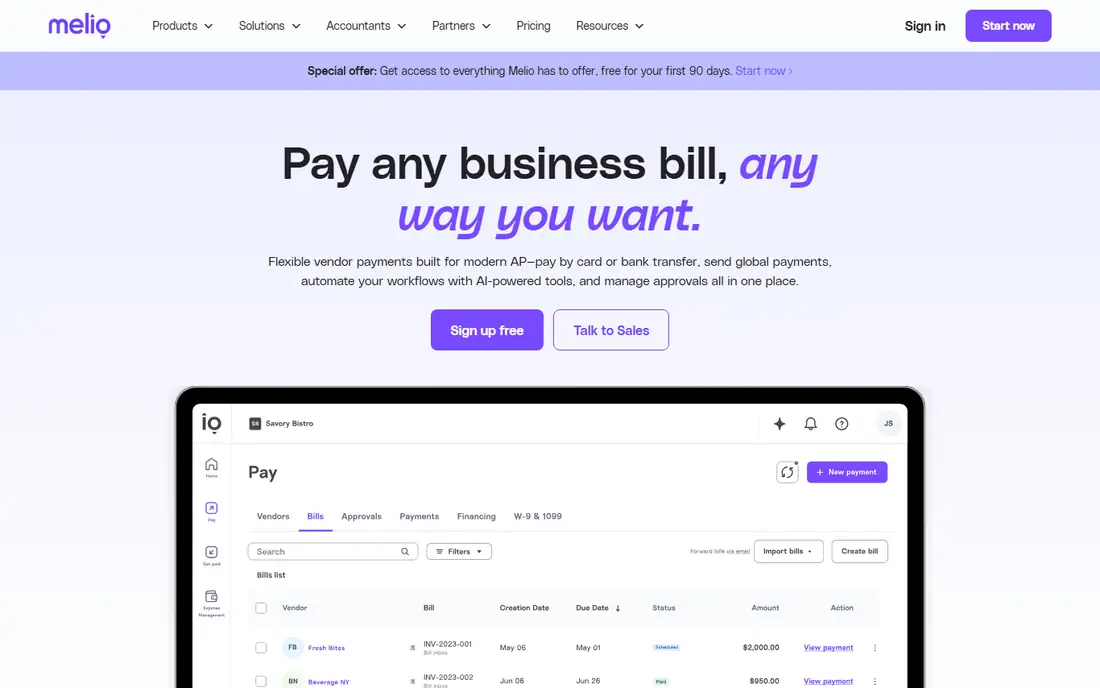
Melio is the cheapest way for a small business to pay its bills online. The Go plan costs nothing and covers one user, 5 free ACH payments a month, AI bill capture, invoicing and payment links, plus up to 10 QuickBooks or Xero syncs. Paid plans start with 90 days of unlimited free ACH, then Core at $25 a month adds 20 free ACH payments, batch payments and approval workflows, while Boost at $55 adds QuickBooks Desktop sync and advanced roles. Xero completed its acquisition of Melio on 15 October 2025, and Melio still runs as a standalone product with its own pricing. The catch is volume: past the allowance, every ACH costs $0.50.
What we like- Free Go plan covers a sole owner
- Flat subscription with an ACH allowance, not per-seat billing
- Card payments at 2.9 percent even when vendors do not take cards
- Syncs with QuickBooks, Xero and NetSuite
Watch out for- Go allows only one user and 5 free ACH payments a month
- ACH beyond the allowance costs $0.50 each
- Approval workflows need the Core plan
- No procurement module
#3Ramp
Best for: Businesses that want bill pay, corporate cards, expenses and travel in one free platform4.8/5 on
G2 (2,540 reviews, checked Oct 2026)
Visit ramp.com
Starting priceFree $0 per user per month; Plus $15 per user per month plus an unpublished platform fee based on team size, 20 percent off with annual billing; Enterprise custom
Free planYes, Free plan at $0 per user per month
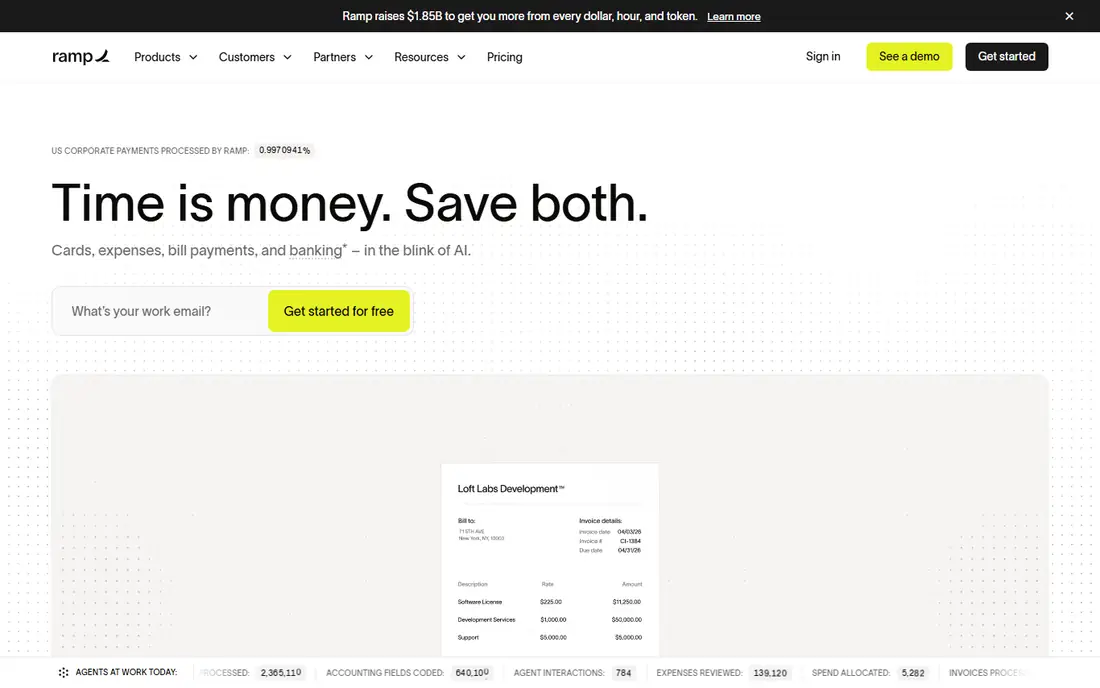
Ramp is the card-funded alternative to paying for AP software at all. The Free plan includes bill pay, corporate cards, expense reports, travel booking and a business checking account at $0 per user, because Ramp earns interchange when the business spends on its card. Plus at $15 per user a month adds NetSuite and Sage Intacct integrations, multi-entity support, AI coding and batch payment controls, plus a platform fee Ramp does not publish. The fine print matters: since 1 June 2026, paying a bill by ACH from an outside bank costs $0.59, and a domestic wire costs $15, so the free bill pay is only free from Ramp Checking.
What we like- Bill pay, cards, expenses and travel in one product with no software fee on the Free plan
- AI coding and batch payments
- NetSuite and Sage Intacct integrations on Plus
- 30-day free trial of Plus
Watch out for- Plus adds an unpublished platform fee on top of the $15 seat price
- ACH bills cost $0.59 and domestic wires $15 when paid from an outside bank
#4Tipalti
Best for: Finance teams paying many suppliers or contractors across borders4.5/5 on
G2 (419 reviews, checked Oct 2026)
Visit tipalti.com
Starting priceAccounts Payable plans from $99 per month; Mass Payments plans from $249 per month
Free planNone
Tipalti is built for volume and borders, not for a small business paying domestic bills. Its Accounts Payable plans start at $99 a month and Mass Payments at $249, both with unlimited users, and the platform handles supplier onboarding, invoice capture, PO matching, tax form collection and payouts in more than 200 countries. The published prices are floors: transaction fees per invoice and payment are not published, and third-party research puts real mid-market contracts at $20,000 to $43,000 a year including implementation. The absence of per-user fees is genuinely useful for companies with many occasional approvers.
What we like- No per-user or per-approver fees, so large approval teams cost nothing extra
- Payments in more than 200 countries and territories
- Supplier onboarding with W-9 and W-8 tax forms
- Strong ERP integrations with NetSuite, Sage Intacct and Dynamics
Watch out for- No free tier
- Transaction fees are not published, so the total is unknown until a quote
- Real mid-market contracts run far above the $99 floor
#5Stampli
Best for: Mid-size AP teams that want invoice-centred collaboration and modular add-ons4.6/5 on
G2 (2,069 reviews, checked Oct 2026)
Visit stampli.com
Starting priceQuote only; third-party estimates put typical costs at roughly $250 to $1,500 per month
Free planNone; no free trial
Stampli centres accounts payable on the invoice itself: capture, coding, approvals, matching and the whole conversation with the vendor live in one workspace, so nobody hunts through email for why a bill was held. The platform is modular, with AP as the mandatory core and payments, procurement, vendor management and cards added on top, and the quote includes unlimited users and entities plus a dedicated success manager. Pricing is the weak point: nothing is published, third-party estimates range from roughly $250 to $1,500 a month, and payments and procurement modules add cost.
What we like- Unlimited users, entities, locations and vendors in the quote
- Invoice-as-workspace discussion threads keep every conversation attached to the bill
- Dedicated customer success manager included
- Month-to-month terms with no forced annual contract
Watch out for- No published prices, so budgeting needs a sales conversation
- No free trial
- Payments and procurement are separate modules priced on top
#6QuickBooks Online
Best for: Businesses that want bill pay inside the ledger they already use4.0/5 on
G2 (3,871 reviews, checked Oct 2026)
Visit quickbooks.intuit.com
Starting priceSolopreneur $20 per month, Simple Start $38, Essentials $85, Plus $140, Advanced $340, after the 1 August 2026 rise; 70 percent off for 3 months until 29 November 2026
Free planNone; 30-day free trial
QuickBooks Online keeps bill pay inside the ledger, which removes the sync step entirely. The Bill Pay add-on lets a business schedule and pay bills from the same dashboard that holds the chart of accounts, and payments post automatically without a CSV export. The August 2026 price rise moved Plus to $140 a month and Advanced to $340, and Bill Pay costs extra on top, so the total is higher than Melio Go or Ramp Free. The trade-off is simplicity: one login, one vendor, one support line, and an accountant who already knows the software.
What we like- Bill Pay add-on posts bills and payments straight into the ledger with no separate sync
- Widest accountant familiarity of any small-business ledger
- Plus adds inventory and project profitability
- Large app marketplace
Watch out for- Bill Pay is a paid add-on
- Prices rose sharply in August 2026
- Per-user fees climb fast on higher plans
#7Xero
Best for: Small businesses that want bill pay embedded in their accounting software4.4/5 on
G2 (1,832 reviews, checked Oct 2026)
Visit xero.com
Starting priceEarly $27 per month, Growing $59 per month, Established $97 per month, after the 1 October 2026 rise
Free planNone; 30-day free trial
Xero is the ledger that Melio now belongs to, and the connection is starting to show. In March 2026 Xero launched embedded online bill payments in its US product, powered by Melio, which lets a business pay a bill by credit card from inside Xero. The core product is still the ledger: invoicing, bank feeds, reconciliation and expense claims in a clean interface with no per-user fees. The Established plan at $97 a month adds multi-currency, project tracking and expense claims. The limit is depth: Xero does not match BILL on approvals or Tipalti on global payouts, so a business with complex AP will still add a dedicated tool.
What we like- No per-user fees on any plan
- Online bill payments powered by Melio inside Xero in the US
- Clean interface that non-accountants learn quickly
- More than 1,000 app integrations
Watch out for- Bill pay depth is thinner than a dedicated AP tool
- Payroll is an add-on in many regions
- Inventory tracking is basic
#8FreshBooks
Best for: Freelancers and service businesses that invoice by the hour and pay a small number of bills4.5/5 on
G2 (981 reviews, checked Oct 2026)
Visit freshbooks.com
Starting priceLite $23 per month, Plus $43, Premium $70, from 5 March 2026; annual billing $248.40, $464.40 and $756
Free planNone; 30-day free trial
FreshBooks is built for people who sell their time, and its bill pay is correspondingly light. Invoicing takes minutes, time tracking feeds straight into the invoice, and automatic late-payment reminders chase clients so the owner does not have to. Underneath the simple interface sits real double-entry accounting, so the books stay correct without the owner thinking about debits and credits. The March 2026 prices put Lite at $23 a month, Plus at $43 and Premium at $70, with annual billing cutting roughly 10 percent. A freelancer who pays a handful of bills a month does not need BILL or Tipalti.
What we like- Fastest invoicing workflow of any tool here, with time tracking built in
- Client portal and late-payment reminders reduce chasing
- Double-entry accounting runs quietly underneath
- Good mobile app
Watch out for- No dedicated AP automation or approval workflows
- No inventory management
- Lite caps billable clients at 5
Comparison table
| Tool |
Best for |
Starting price |
Free plan |
| BILL |
Finance teams needing approvals and two-way sync |
$49 per user per month |
None, free trial |
| Melio |
Small businesses wanting volume-priced bill pay |
$0 |
Yes |
| Ramp |
Businesses wanting bill pay plus cards in one platform |
$0 |
Yes |
| Tipalti |
Finance teams paying across borders |
$99 per month |
None |
| Stampli |
Mid-size AP teams wanting invoice-centred collaboration |
Quote only |
None |
| QuickBooks Online |
Businesses wanting bill pay inside the ledger |
$20 per month |
None, 30-day trial |
| Xero |
Small businesses wanting bill pay in the ledger |
$27 per month |
None, 30-day trial |
| FreshBooks |
Freelancers invoicing by the hour |
$23 per month |
None, 30-day trial |
Frequently asked questions
Is Melio really free?
Melio Go is free, but only for one user and 5 free ACH payments a month. After the allowance, each ACH payment costs $0.50, and card payments cost 2.9 percent on every plan. Paid plans start with 90 days of unlimited free ACH, then Core costs $25 a month with 20 free ACH payments. A team paying 100 bills a month pays about $85 on Core.
Does BILL integrate with Xero?
Yes, BILL syncs two-way with Xero from its Team plan at $65 per user per month. Bills, payments and vendor records post automatically between the two systems, and the sync also covers QuickBooks Online. Essentials at $49 only offers manual CSV import and export, so a Xero user who wants automatic sync must pay for Team.
Is Melio owned by Xero?
Yes, Xero announced the acquisition on 25 June 2025 and completed it on 15 October 2025. Melio still operates as a standalone product with its own site, app and pricing, and it continues to sync with QuickBooks Online and QuickBooks Desktop as well as Xero.
What is the cheapest way to pay business bills?
For a small business, Melio Go or Ramp Free are the cheapest, because both start at $0. Melio Go suits a sole owner paying a few bills by ACH, while Ramp Free suits a business that also wants corporate cards, expenses and travel in one platform. Once volume grows past 50 bills a month, compare Melio Core at $25 a month with Ramp Plus.
Should a small business use Tipalti?
No, not for domestic bills. Tipalti is built for paying many suppliers or contractors across borders, with tax form collection and payouts in more than 200 countries. Its published prices start at $99 a month, but transaction fees are unpublished and real contracts run far higher. A small business paying local vendors gets better value from Melio, Ramp Free or BILL Essentials.
How we picked
We picked the eight tools by starting with the two products in the keyword, then adding the AP tools buyers most often compare against them: Ramp, Tipalti, Stampli, QuickBooks Online, Xero and FreshBooks. Prices were checked against vendor pricing pages on 20 November 2026.
Last verified: 20 November 2026
Sources we checked (8)
- https://www.bill.com
- https://www.melio.com
- https://www.ramp.com
- https://www.tipalti.com
- https://www.stampli.com
- https://quickbooks.intuit.com
- https://www.xero.com
- https://www.freshbooks.com
Is your product missing or out of date?
We review this list regularly. Vendors can request a listing, send updated pricing or ask about featured placement.

Shihab Mia · Founder, Rankite
Shihab has 5+ years in B2B and SaaS SEO. He writes Rankite's software buying guides from pricing pages, documentation and public user reviews. More about Shihab.