How we make this list: we compare pricing pages, product documentation and public user reviews. Ratings come from G2, Capterra or Trustpilot, with the date we checked them.
What is synthetic data generation software
Synthetic data generation software creates artificial data that behaves like real data without containing any real records. It learns the patterns, distributions and relationships in a real dataset, then generates new rows that keep those patterns while leaving the original people, customers and transactions out of it. Teams use it to build test databases, train machine learning models, share data with partners, and develop software when the real data is too sensitive to copy. The key test is fidelity: the synthetic data has to keep the statistical shape of the original, or the tests and models built on it will be wrong.
Direct answer: Tonic.ai is the top pick for most teams, with a free tier at $0 a month, Plus at $29 a month with $25 of credits, and a clear path to enterprise use. Mostly AI is the best pick for a team that wants a free tier with a marketplace of ready made synthetic datasets, from about $3,000 a month. YData, Synthea and SDV are the best picks for a team that wants free open source generation with no vendor at all. Syntho and K2view are the best picks for governed synthetic data at enterprise scale, at a quoted price. Start with Tonic.ai for a managed tool, or YData for free open source.
Key takeaways
- Tonic.ai Fabricate costs $0 a month on the Free plan with $5 to $10 of credits, and $29 a month on Plus with $25 of credits.
- Gretel was acquired by NVIDIA in March 2025, and its standalone status has changed, so check availability first.
- Mostly AI has a free tier with a few credits a day, a Marketplace from about $3,000 a month, and a free open source SDK.
- YData, Synthea and SDV are free and open source, with no licence cost and no vendor lock in.
- Syntho and K2view are quoted only, with no published prices, and both target enterprise buyers.
How we picked
We compared eight tools on five points: how the synthetic data is generated, how well it keeps the statistical shape of the original, how it handles privacy and compliance, the cost model, and how easy it is to leave. A tool scored well when a team could start free, generate data that kept the correlations of the original, and prove that no real records leaked into the output. Prices come from vendor pricing pages and vendor supplied directory listings, checked 21 November 2026. Where a vendor was acquired or a product changed status, that is flagged in the entry. Prices are search verified; vendor homepages were not individually opened in the browser for this guide. This guide covers tools that generate new synthetic datasets, distinct from data masking tools that transform real rows in place.
Comparison table
| Tool | Best for | Starting price | Free plan |
| Tonic.ai | Managed generation with a free tier | Free $0/mo; Plus $29/mo | Yes, Free plan |
| Gretel | Synthetic data with NVIDIA backing | Formerly free; Team $295/mo | Status changed |
| Mostly AI | Marketplace plus free SDK | Free tier; Marketplace from ~$3,000/mo | Yes, free tier |
| YData | Open source synthetic data | Free (open source) | Yes, self-hosted |
| Synthea | Synthetic patient data | Free (open source) | Yes, self-hosted |
| SDV | Open source tabular synthesis | Free (open source) | Yes, Community |
| Syntho | Enterprise governed synthesis | Quote | Free trial |
| K2view | Enterprise test data at scale | Quote | Free trial |
What a test database costs to fill with synthetic data
A team that needs synthetic data for a test database every month has three cost bands. The free band costs $0: YData, Synthea and SDV are open source, and Tonic.ai Free costs $0 a month with $5 to $10 of credits. The low paid band costs $29 a month: Tonic.ai Plus at $29 a month includes $25 of credits, which covers regular small to medium generation jobs for one team. The enterprise band is quoted: Mostly AI Marketplace starts from about $3,000 a month, and Syntho and K2view are quoted only, with the price depending on data volume and deployment. A team that generates data every week should budget $29 a month for Tonic.ai Plus, or $0 plus compute for an open source tool. Governed synthetic data across many systems needs an enterprise quote.
What is the difference between synthetic data and anonymised data
Synthetic data and anonymised data solve the same problem in different ways, and the difference matters for privacy. Anonymised data starts with real records and removes or masks the identifying fields: names, emails and account numbers are stripped or replaced. The risk is that the remaining fields can still identify someone when they are combined, which is why anonymisation is hard to prove. Synthetic data starts with no real records at all: it learns the patterns in the real data and generates new rows that follow those patterns. No real person appears in the output, though the team still has to check the generator did not memorise real rows. Use anonymisation when the real data must stay recognisable; use synthetic data when no real records may leave the building.
A team testing a database should pick the tool that matches the data it tests. Tonic.ai is the best pick for a relational database, because Fabricate generates referentially intact synthetic rows that keep foreign keys working, with a free tier at $0 a month and Plus at $29 a month. YData and SDV are the best picks for tabular data in Python, because both are open source and generate tables that keep the statistical shape of the original. Synthea is the best pick for healthcare data, with realistic synthetic patient records. Mostly AI is the best pick for ready made datasets, with a marketplace from about $3,000 a month. Syntho and K2view are the best picks for an enterprise that needs governed test data across many systems, at a quoted price.
How to choose synthetic data generation software
Choose by the data type, the privacy bar and the budget. If the team tests a relational database and wants a managed tool with a free tier, pick Tonic.ai, with Free at $0 a month and Plus at $29 a month. If the team wants a marketplace of ready made datasets, pick Mostly AI, with a free tier and Marketplace from about $3,000 a month. If the team wants free open source generation, pick YData for general tabular data, SDV for Python based synthesis, or Synthea for patient data. If the team needs governed synthetic data at enterprise scale, pick Syntho or K2view, both quoted. If the team was planning on Gretel, check its current status first: NVIDIA acquired it in March 2025. Test the fidelity of the output before trusting it: run the same queries on the synthetic and real data and compare.
Quick comparison
| Tool | Best for | Starting price | Free plan |
|---|
 Tonic.ai | Managed generation with a free tier | Fabricate Free $0/mo; Plus $29/mo | Yes, Free plan at $0 a month with $5 to $10 of credits |
 Gretel | Synthetic data with NVIDIA backing | Formerly free Developer; Team $295/mo (before acquisition) | Status changed after NVIDIA acquisition |
 Mostly AI | Marketplace plus free SDK | Free tier; Marketplace from ~$3,000/mo | Yes, free tier with a few credits a day |
 YData | Open source synthetic data | Free (open source) | Yes, ydata-synthetic is free and open source |
 Synthea | Synthetic patient data | Free (open source) | Yes, free and open source |
 SDV | Open source tabular synthesis | Free (open source) | Yes, Community edition free |
 Syntho | Enterprise governed synthesis | Quote | Free trial available |
 K2view | Enterprise test data at scale | Quote | Free trial available |
Is your product missing or out of date?
We review this list regularly. Vendors can request a listing, send updated pricing or ask about featured placement.
These eight tools cover the main ways teams generate synthetic data in 2026, from free open source libraries to enterprise platforms.
#1Tonic.ai
Best for: Managed generation with a free tier4.2/5 on
G2 (38 reviews, checked Oct 2026)
Visit tonic.ai
Starting priceFabricate Free $0/mo; Plus $29/mo
Free planYes, Free plan at $0 a month with $5 to $10 of credits
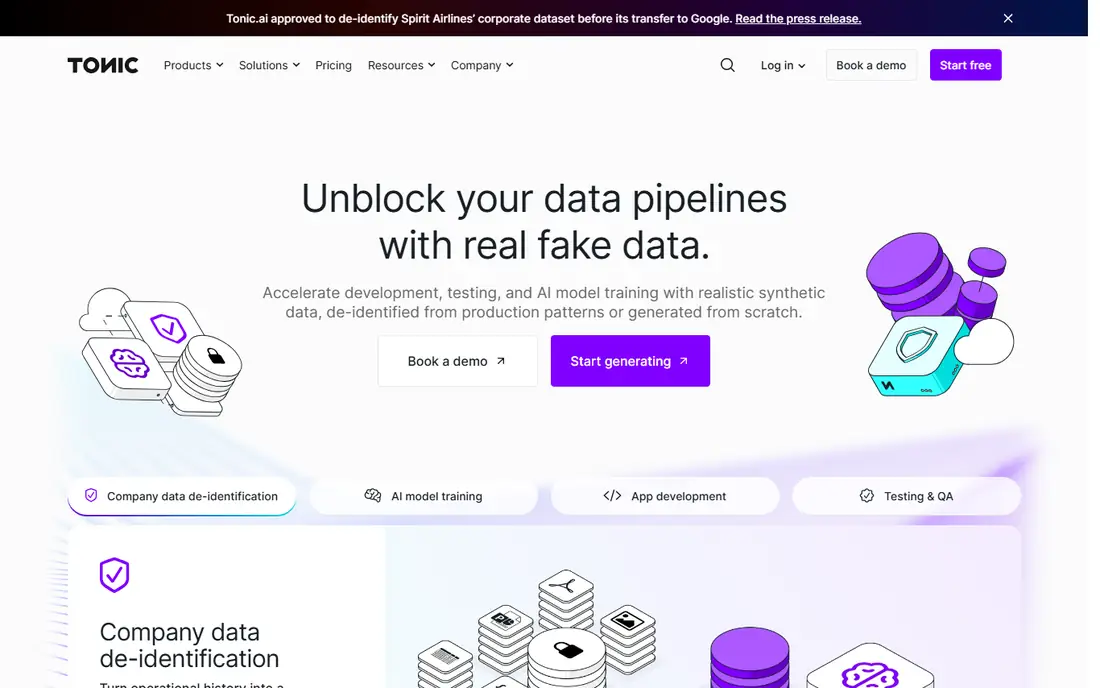
Tonic.ai is the top pick for a team that wants a managed synthetic data tool with a free start. Fabricate generates synthetic rows that keep referential integrity, so foreign keys still work in the test database, and the free plan costs $0 a month with $5 to $10 of credits. Plus costs $29 a month and includes $25 of credits, which covers regular small to medium jobs. Enterprise is custom. The honest catch is the credit model: a team that generates large volumes every week will use credits faster than Plus includes.
What we like- Free tier to start, Plus at $29 a month with $25 of credits, generates referentially intact rows for databases, clear upgrade path to Enterprise
Watch out for- Structural and Textual products are quote only, credits add up on large jobs, Enterprise is custom, the free tier credit limit is small
Starting priceFormerly free Developer; Team $295/mo (before acquisition)
Free planStatus changed after NVIDIA acquisition

Gretel was one of the best known synthetic data vendors, with a strong engine, differential privacy options and a good SDK. NVIDIA acquired Gretel in March 2025, and the standalone product status has changed since then. Former pricing was a free Developer plan and a Team plan at $295 a month, but those figures may no longer apply, and a team should check the current Gretel site before planning a project around it. Do not budget on the old prices.
What we like- Strong synthetic data engine with differential privacy, good documentation and SDK, NVIDIA backing after the March 2025 acquisition
Watch out for- Acquired by NVIDIA in March 2025 and the standalone product status has changed, former pricing may no longer apply, check availability before planning around it
Starting priceFree tier; Marketplace from ~$3,000/mo
Free planYes, free tier with a few credits a day
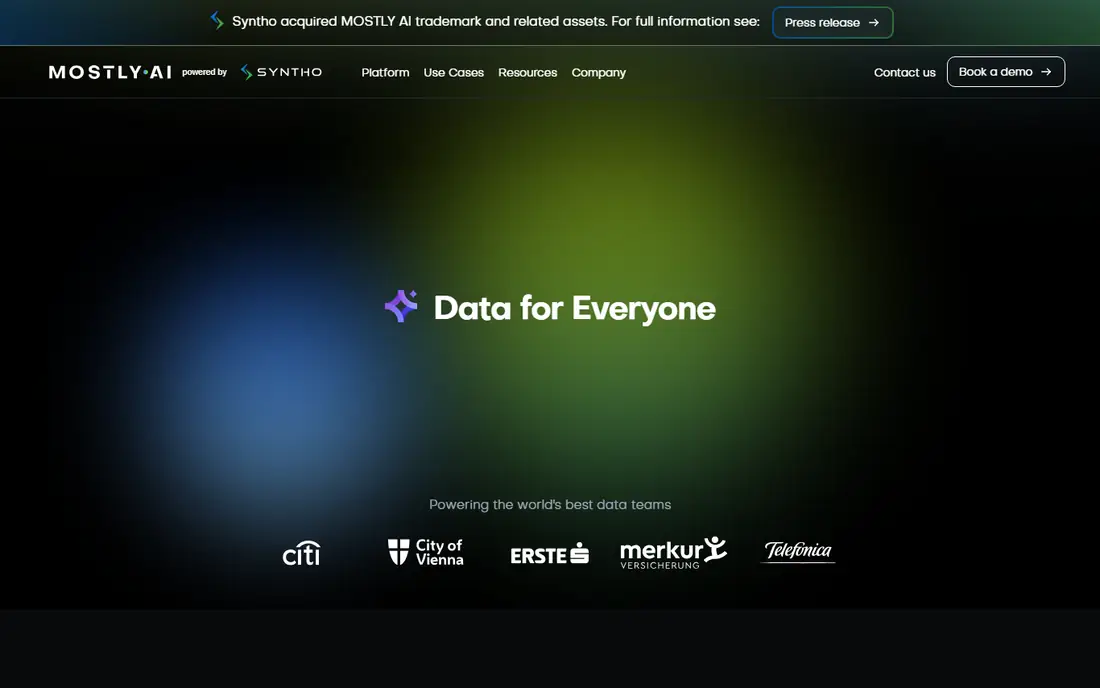
Mostly AI is the best pick for a team that wants ready made synthetic datasets as well as a generator. The open source SDK is free under Apache 2.0, so a team can generate data in its own environment without a vendor. The Marketplace sells ready made synthetic datasets from about $3,000 a month, which suits a team that needs data fast rather than a tool to build it. Enterprise is custom. Confirm the Marketplace price with the vendor, because the $3,000 figure comes from a third party listing.
What we like- Free tier to start, open source SDK under Apache 2.0, Marketplace of ready made synthetic datasets, strong privacy and compliance features
Watch out for- Marketplace starts from about $3,000 a month, the free tier gives only a few credits a day, Enterprise is custom, the marketplace price is a third party figure to confirm
Starting priceFree (open source)
Free planYes, ydata-synthetic is free and open source
YData is the open source pick for tabular synthetic data. The ydata-synthetic library is free, and it generates new tables that keep the distributions and correlations of the original data, in plain Python with pandas. A team can install it and generate a synthetic copy with no vendor, no account and no credit limit. The paid YData platform adds managed features, governance and support for enterprises. For a data science team that works in Python, YData is the fastest free start.
What we like- Free open source generation with no licence cost, works in Python with pandas, keeps the statistical shape of tabular data, no vendor lock in
Watch out for- Open source only, so no managed cloud or support contract, the team runs and maintains it, enterprise features depend on the paid YData platform
Starting priceFree (open source)
Free planYes, free and open source
Synthea is the open source pick for healthcare. It generates synthetic patient records with realistic clinical histories, all generated from models rather than copied from real patients. Health IT teams use it to test electronic health record integrations, build demos and train models without touching protected health information. It is free and open source, and the team runs it with no licence cost and no vendor. Synthea generates patients, not general tabular data, so a team outside healthcare should pick YData or SDV instead.
What we like- Free open source generation of realistic patient records, built for healthcare testing and research, no real patient data in the output, widely used in health IT
Watch out for- Healthcare only, so no use for other industries, synthetic patients only, no vendor support
Starting priceFree (open source)
Free planYes, Community edition free
SDV, the Synthetic Data Vault, is the open source pick for tabular and relational synthesis in Python. The Community edition is free, and it models single tables and multi-table databases, generating synthetic rows that keep the statistical relationships between tables. It is well documented, with a Python API, and it is backed by DataCebo, which sells a paid platform for enterprise use. Large relational databases with complex foreign keys need care to keep referential integrity in the output.
What we like- Free open source Community edition, strong for tabular and relational data, well documented with a Python API, backed by DataCebo with a paid platform for enterprise
Watch out for- Open source only for the Community edition, enterprise features are paid, the team runs and maintains it, large relational databases need care to keep referential integrity
Starting priceQuote
Free planFree trial available
Syntho is the enterprise pick for governed synthetic data. It generates synthetic data for tabular, time series and text use cases, with privacy controls and governance that suit regulated industries such as banking and healthcare. Privacy metrics, audit trails and approval workflows are built in. Pricing is quoted only, with a free trial available, and the quote depends on data volume and deployment. A team that needs a quick free start should pick YData or SDV.
What we like- Governed synthetic data with privacy controls, strong for regulated industries, supports tabular, time series and text data, free trial to test
Watch out for- Quote only with no published price, enterprise focus means a longer sales cycle, the team needs to scope the deployment, smaller community than the open source tools
#8K2view
Best for: Enterprise test data at scale4.6/5 on
G2 (55 reviews, checked Oct 2026)
Visit k2view.com
Starting priceQuote
Free planFree trial available
K2view is the enterprise pick for test data at scale. It combines synthetic data generation with masking and subsetting in one platform, so a team can generate synthetic rows, mask the real rows it must keep, and cut a database down to a test sized subset without breaking referential integrity. Pricing is quoted only, with a free trial available, and the quote depends on data volume and deployment. A team that only needs generation should pick a cheaper tool.
What we like- Enterprise test data management at scale, strong for telecom and financial services, synthetic data plus masking and subsetting in one platform, free trial to test
Watch out for- Quote only with no published price, enterprise focus means a longer sales cycle, the platform is broad and needs implementation, smaller community than the open source tools
Frequently asked questions
What is the best synthetic data generation software
Tonic.ai is the best pick for most teams, with a free tier at $0 a month and Plus at $29 a month with $25 of credits. Mostly AI is the best pick for ready made datasets, with a Marketplace from about $3,000 a month. YData, Synthea and SDV are the best picks for free open source generation. Syntho and K2view are the best picks for governed enterprise synthesis, at a quoted price. Check Gretel's status first: NVIDIA acquired it in March 2025.
How much does synthetic data generation software cost
Free open source tools cost $0: YData, Synthea and SDV are free to run, and the team pays only for its own compute. Tonic.ai Free costs $0 a month with $5 to $10 of credits, and Plus costs $29 a month with $25 of credits. Mostly AI has a free tier, and its Marketplace starts from about $3,000 a month. Syntho and K2view are quoted only. Gretel's former Team plan was $295 a month, but that may no longer apply after the NVIDIA acquisition.
Is synthetic data safe to use instead of real data
Synthetic data contains no real records, which makes the privacy case simpler than anonymisation, but the team still has to check the output. Run privacy checks to confirm the generator did not memorise real rows, and run the same queries on the synthetic data and the real data to confirm the statistical shape matches. Regulated teams should check that their compliance team accepts synthetic data for the use case, because the rules differ by industry and country.
What is the difference between synthetic data and data masking
Data masking transforms real rows in place: it replaces names, emails and account numbers in a copy, and the rest of the row stays real. Synthetic data generates entirely new rows that follow the patterns of the real data, with no real records in the output. Masking is faster when the team needs the real data structure unchanged. Synthetic data is safer when the team needs to share data outside the company, because no real record leaves the building.
Can synthetic data replace real data for machine learning
Often, yes, for training and testing, when the generator keeps the statistical shape of the original, including the correlations between columns. Models trained on good synthetic data usually perform close to models trained on real data. The risk is fidelity: if the generator misses a rare pattern or a correlation, the model will miss it too. Validate the model on real data before deploying it.
Sources we checked (8)
- https://www.tonic.ai
- https://gretel.ai
- https://mostly.ai
- https://ydata.ai
- https://synthetichealth.github.io/synthea/
- https://sdv.dev
- https://www.syntho.ai
- https://www.k2view.com
Is your product missing or out of date?
We review this list regularly. Vendors can request a listing, send updated pricing or ask about featured placement.

Shihab Mia · Founder, Rankite
Shihab has 5+ years in B2B and SaaS SEO. He writes Rankite's software buying guides from pricing pages, documentation and public user reviews. More about Shihab.