How we make this list: we compare pricing pages, product documentation and public user reviews. Ratings come from G2, Capterra or Trustpilot, with the date we checked them.
Key takeaways
- Motley Fool Stock Advisor is the simplest picks service: two recommendations a month, $199 a year at list, usually $99 for the first year.
- Morningstar Investor is research, not picks. You pay $249 a year for analyst reports and fair value estimates and do your own choosing.
- Seeking Alpha Premium sits between the two, with crowd written analysis and a quant rating on thousands of stocks for $299 a year.
- Read every performance claim with suspicion. Headline returns are usually the publisher's own calculation, over a cherry friendly period, before your fees, taxes, and timing.
- Nothing here is financial advice. These services are publishers, not your adviser, and no service can promise that its picks will beat the market for you.
Quick comparison
Is your product missing or out of date?
We review this list regularly. Vendors can request a listing, send updated pricing or ask about featured placement.
The best stock advisory services
Starting price$99 for the first year
Free planNo
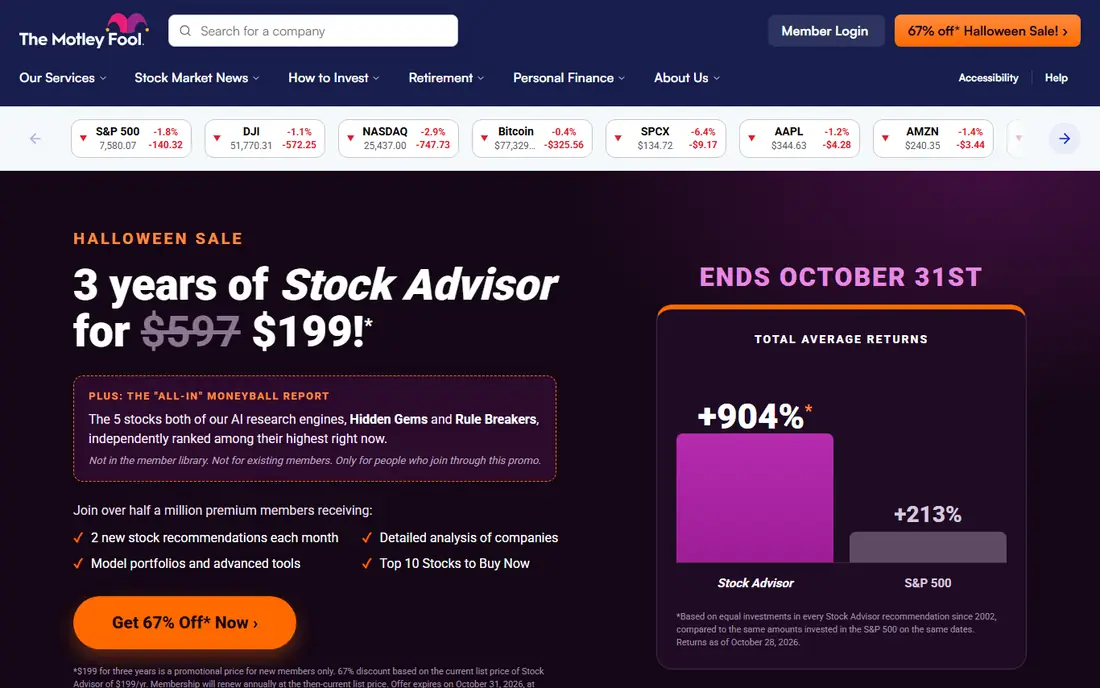
Stock Advisor is the best known picks service in the US. Analysts publish two recommendations a month with the reasoning written out, plus a list of starter stocks for new money. List price is $199 a year; new members are routinely offered $99 for the first year, and renewals bill at the then current list price.
The trade off is convenience against style risk. The service leans to growth companies held for five years or more, which means deep drawdowns along the way, and its marketing returns assume a discipline most subscribers do not keep. Stock Advisor fits investors who want a short list handed to them and can genuinely hold through a 40 percent fall in a single pick.
What we like- Two new picks a month plus a starter list
- Long published track record
- Simple to follow
- 30 day membership refund window
Watch out for- Renews at the $199 list price
- Growth heavy style swings hard in down markets
- Upsells to far pricier tiers are constant
Starting price$249 per year
Free planNo
Morningstar is the research house behind the star ratings your fund statements already show. Investor, at $249 a year or $34.95 a month, opens its analyst reports, moat ratings, and fair value estimates, plus portfolio tools that X-ray your holdings. Pay yearly if you join; the monthly rate nearly doubles the annual cost.
The trade off is depth against effort. There is no monthly pick to copy, so the value only arrives if you read and decide. Morningstar fits self directed investors who want one consistent, conservative house view and invest across funds and stocks rather than in single names alone.
What we like- Analyst written reports with fair value estimates
- Covers funds, ETFs, and bonds as well as stocks
- Portfolio analysis tools
- 7 day free trial
Watch out for- No pick list, you do the choosing
- Monthly billing at $34.95 makes a year cost $419
- Assumes you can read a research report
Starting price$299 per year
Free planNo
Seeking Alpha sells the debate. Premium, listed at $299 a year with first year offers reported around $269, opens contributor analysis on thousands of stocks and puts three ratings on each: the quant model, Wall Street analysts, and the site's own authors. Reading bull and bear cases side by side is a genuinely useful discipline.
The trade off is range against consistency. Contributors range from professionals to hobbyists, and the quant rating is a model, not a promise. Seeking Alpha Premium fits active investors who enjoy research, want several views before deciding, and will use the screeners rather than just the headlines.
What we like- Analysis from thousands of contributors on 4,000 plus stocks
- Quant rating beside every article
- Strong screeners
- First year often discounted to $269
Watch out for- Contributor quality varies widely
- More content than most people can use
- Renewal at full list price
Starting price$249 per year
Free planNo
Zacks built its name on one idea: stocks whose earnings estimates are rising tend to outperform, and its Rank scores that revision trend from 1 to 5. Premium at $249 a year opens the Rank on thousands of stocks plus research and screens. The methodology is old, published, and testable, which puts it ahead of most signal services.
The trade off is signal against activity. A rank driven approach rebalances often, and in a taxable account the gains arrive short term while the subscription and trading costs compound. Zacks Premium fits investors who believe in earnings momentum and are comfortable acting on changes several times a year.
What we like- The Zacks Rank is built on earnings estimate revisions, a studied signal
- 37 plus years of methodology
- Screens and research included
Watch out for- Shorter holding horizons than buy and hold services
- Rank changes can mean frequent trading
- Tax and cost drag on turnover
Starting priceSee website
Free planNo
Alpha Picks is Seeking Alpha's picks product: the quant engine selects two stocks a month, and subscribers get the buy list without a human analyst in the loop. Sources disagree on the current price, reporting $449 to $499 a year, so we list See website and you should confirm at checkout.
The trade off is system against history. A rules based service removes emotion, but its public record starts in 2022 and has not been through a grinding multi year decline. Alpha Picks fits investors who distrust individual stock pickers, trust backtested systems, and size positions knowing the record is short.
What we like- Two picks a month chosen by Seeking Alpha's quant system
- Rules are published
- No analyst discretion in selection
Watch out for- Track record only runs from 2022, untested by a long bear market
- Pricing reported between $449 and $499 a year
- Pure model risk
Starting priceSee website
Free planYes
TipRanks answers a narrow, valuable question: when an analyst rates a stock, has that analyst been right before? The platform tracks thousands of analysts and bloggers, measures their returns, and shows consensus beside track record. A free tier covers the basics, and premium pricing varies enough by offer that we list See website.
The trade off is context against action. Knowing the best analyst on a stock still leaves the decision, sizing, and timing with you. TipRanks fits investors who read analyst news and want a quick credibility check before acting on any single call.
What we like- Ranks Wall Street analysts by their measured past accuracy
- Consensus and price targets in one view
- Usable free tier
- Smart score per stock
Watch out for- Premium pricing varies by promotion
- Analyst targets are opinions with wide error bars
- Data heavy interface

#7Simply Wall St
Best for: Visual research for beginners4.5/5 on
G2 (12 reviews, checked Oct 2026)
Visit simplywall.st
Starting priceFree
Free planYes
Simply Wall St renders each company as a visual report: a snowflake diagram scoring value, future growth, past performance, health, and dividends, backed by discounted cash flow estimates. The free plan is generous, and paid plans have been reported around $120 a year.
The trade off is clarity against nuance. A diagram cannot show management quality or a looming lawsuit, and the fair value figure is a model output with wide error bars. Simply Wall St fits newer investors who learn visually and want a fast first pass before reading the filings themselves.
What we like- Infographic reports turn financials into pictures
- Valuation, health, and dividend checks per stock
- Genuinely useful free plan
- Global coverage
Watch out for- Visual scores simplify messy realities
- Paid plan needed for full portfolio features
- No human analyst picks
How we chose
We compared the advisory services US retail investors actually subscribe to, favouring services with published methods, checkable track records, and clear pricing. We left out day trading rooms and options alert services, which answer a different question, and social media tipsters, whose records cannot be verified. Prices are list or widely reported introductory figures checked in October 2026, and we wrote See website where sources disagreed. Track records quoted in marketing were treated as claims, not facts, and this article makes none of its own.
How to choose a stock advisory service
Decide first whether you want picks or research. Picks services such as Stock Advisor and Alpha Picks save time and demand trust; research platforms such as Morningstar and Seeking Alpha keep the decisions, and the responsibility, with you. Then audit the track record like an accountant: ask for the full pick history including the losers, check whether returns assume equal weighting and instant execution, and compare against the S&P 500 over the same dates rather than the dates in the advert. Confirm the legal status: a publisher is not a fiduciary, and in the US a registered investment adviser has duties a newsletter does not. Finally, run the total cost test. A $249 subscription on a $5,000 portfolio is a 5 percent annual drag that the picks must beat before you gain a cent, which is why small accounts are usually better served by low cost index funds while you learn. Never invest money you need within five years on the strength of a newsletter pick, and never borrow to invest.
Frequently asked questions
Are stock advisory services worth it?
They can be, as paid research and idea generation, if the subscription is small next to your portfolio and you follow the method for years. They are not worth it as a shortcut to guaranteed returns, because no such thing exists and any service implying otherwise is marketing, not advising.
How do I check a service's track record?
Ask for the complete recommendation history with dates and prices, including closed losers. Compute the return of equal sized buys against the S&P 500 total return over the same period. If a service will not show its full history, treat its headline return as advertising.
Is a newsletter the same as a financial adviser?
No. In the US, most newsletters are publishers, not SEC registered investment advisers, and they owe you no fiduciary duty and know nothing about your situation. A registered adviser must act in your interest and will ask about your goals, debts, and taxes before recommending anything.
What does Stock Advisor cost in 2026?
List price is $199 a year, with first year offers commonly at $99. Renewals bill at the then current list price, and the company sells higher tiers at $499 and above, which most subscribers do not need.
Can a service guarantee it beats the market?
No, and in the US it would breach securities advertising rules to promise returns. Past performance, even when honestly calculated, does not predict future results. Most professional fund managers trail the index over long periods, which is the honest benchmark for any picker.
Should beginners use a stock picking service?
Beginners are usually better served by a diversified low cost index fund while they learn how markets behave. If you do subscribe, use a research platform such as Morningstar or the free tier of Simply Wall St to learn how to judge a company, rather than copying picks you do not understand.
Sources we checked (0)
Is your product missing or out of date?
We review this list regularly. Vendors can request a listing, send updated pricing or ask about featured placement.

Shihab Mia · Founder, Rankite
Shihab has 5+ years in B2B and SaaS SEO. He writes Rankite's software buying guides from pricing pages, documentation and public user reviews. More about Shihab.
 Motley Fool Stock Advisor
 Morningstar Investor
 Seeking Alpha Premium
 Zacks Premium
 Alpha Picks
 TipRanks