How we make this list: we compare pricing pages, product documentation and public user reviews. Ratings come from G2, Capterra or Trustpilot, with the date we checked them.
Key takeaways
- The best stargazing app is the one you actually take outside, so a clear point-at-the-sky mode matters more than a huge catalog you never open.
- Stellarium is the best free planetarium for desktop and mobile, with a deep catalog and realistic skies.
- Sky Tonight and Star Walk 2 are the best all-round phone apps for beginners, with event calendars and easy sky identification.
- SkySafari is the best choice for telescope owners, while Heavens-Above is the best free tool for satellite passes like the ISS.
Quick comparison
| Tool | Best for | Starting price | Free plan |
|---|
 Stellarium | A free planetarium with a deep sky catalog | Free | Yes |
 Sky Tonight | The best all-round stargazing app on your phone | Free | Yes |
 Star Walk 2 | Beautiful sky maps, 3D models and planet walks | Free | Yes |
 SkySafari | Telescope owners and the largest object database | See website | No |
 Star Chart | Simple, instant point-and-identify stargazing | Free | Yes |
 Night Sky | Apple users who want an immersive planetarium | Free | Yes |
 Sky Guide | Fast, polished stargazing on Apple devices | See website | No |
 Heavens-Above | Satellite passes, ISS tracking and free sky charts | Free | Yes |
Is your product missing or out of date?
We review this list regularly. Vendors can request a listing, send updated pricing or ask about featured placement.
The best stargazing app
Starting priceFree
Free planYes
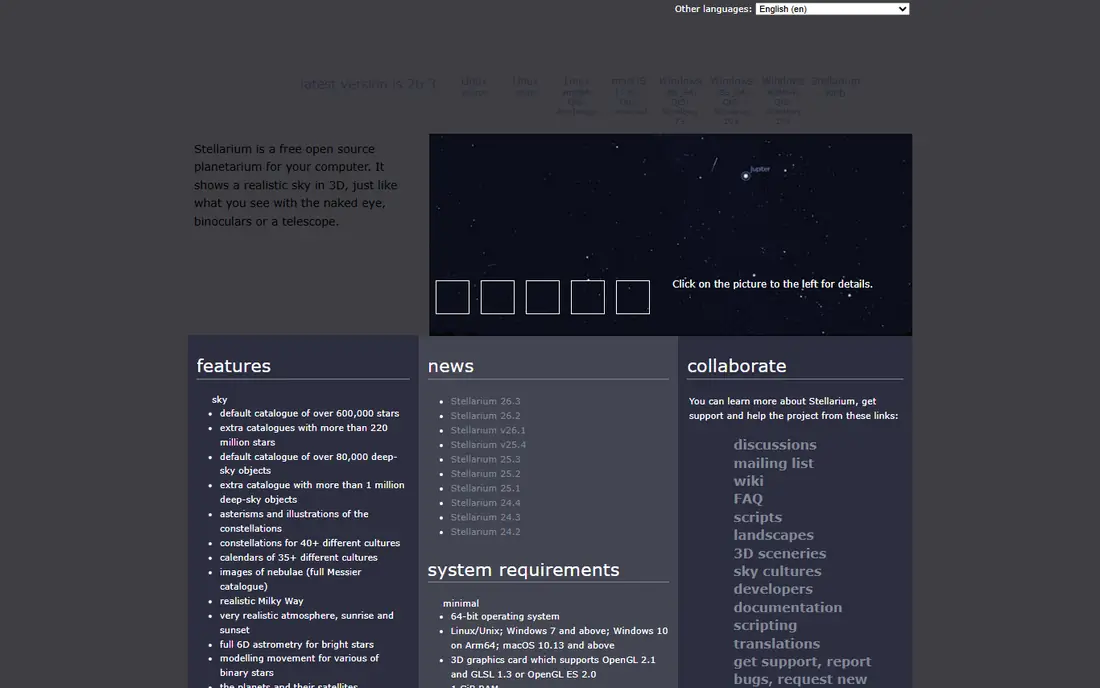
Stellarium is a free, open-source planetarium that renders a realistic sky on your computer, phone or the web. The default catalog holds more than 600,000 stars and 80,000 deep-sky objects, with extra catalogs reaching more than 220 million stars and 1 million deep-sky objects. Constellations come with art and illustrations from more than 40 cultures, and the sky shows realistic atmosphere, sunrises, sunsets, twinkling stars, comets, eclipses and even supernova simulations.
You can control time to see the sky on any date, simulate telescope views, and drive a connected telescope. The current release is version 26.3, and the project is supported by donations rather than subscriptions. For anyone who wants a serious, free planetarium without ads or paywalls, Stellarium is the benchmark, and it works on Linux, Windows and macOS as well as mobile.
What we like- Free and open source
- 600,000-plus stars by default with extra catalogs over 220 million
- Realistic atmosphere, Milky Way and eclipses
- Telescope control
Watch out for- Desktop interface takes learning
- Mobile app is a separate experience
- No built-in event news feed like phone-first apps
Starting priceFree
Free planYes
Sky Tonight answers the key question for a night outside: what is in the sky tonight. Point your phone at the sky and the interactive map labels stars, planets, constellations, comets and satellites in real time, with augmented reality overlaying the map on your camera view. The Visible Tonight section lists what you can actually see from your location, and the stargazing index combines moon phase, light pollution, cloud cover and visibility times into one forecast score.
The astronomy calendar tracks lunar phases, meteor showers, eclipses, oppositions and conjunctions, with reminders so you do not sleep through a highlight. A time machine shows the sky on any past or future date, and a photo editor helps with mobile astrophotography. The app is free to download, with an optional subscription for an ad-free experience. For most beginners and casual observers, Sky Tonight is the single best app to install first.
What we like- Point-at-the-sky AR identification
- Stargazing index combining moon, clouds and light pollution
- Astronomy calendar with reminders
- Time machine for any date
Watch out for- Optional subscription removes ads and unblurs extended object lists
- Some advanced tools take time to discover
Starting priceFree
Free planYes
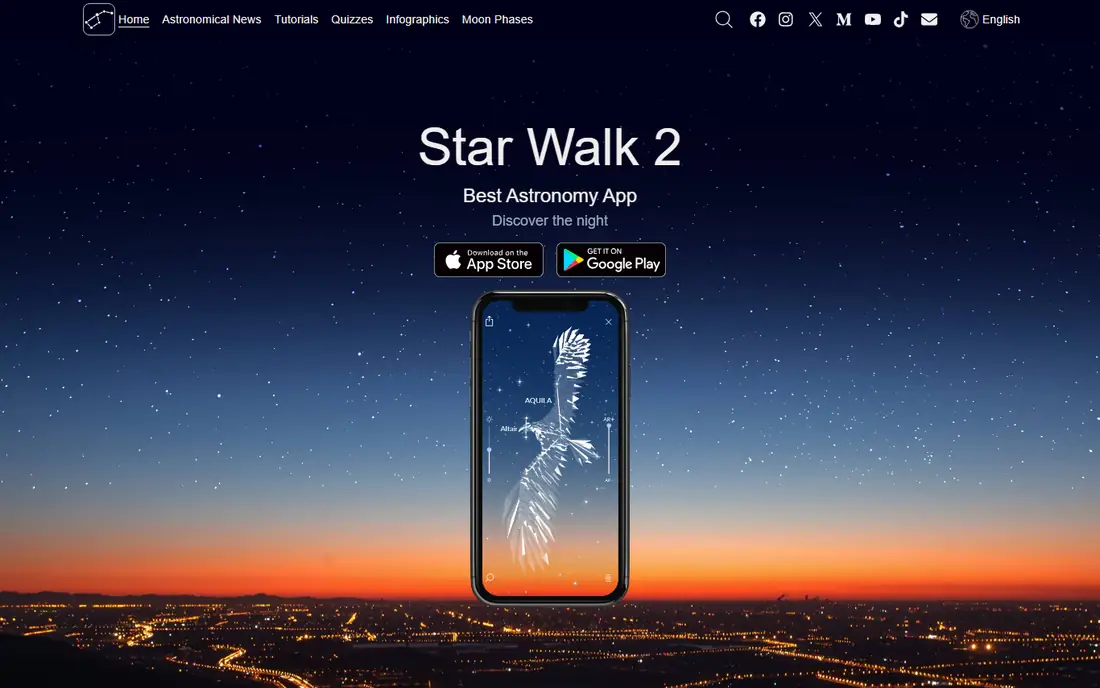
Star Walk 2, from the same maker as Sky Tonight, leans into beauty: a real-time interactive sky map with elaborate graphics, an encyclopedia of sky objects with photos and 3D models, and a Planet Walk feature that lets you track several planets at once. Point your phone at the sky to identify stars, planets and constellations, check what is visible from your location and the best observation times, and travel through time to see the sky on any date.
Where Sky Tonight is the practical planner, Star Walk 2 is the immersive guide, with music and visual effects that suit sharing the sky with kids or guests. Both apps are free to download with in-app purchases, and many households end up with both: Sky Tonight for planning, Star Walk 2 for exploring.
What we like- Real-time interactive sky map
- Encyclopedia with 3D models of sky objects
- Planet Walk tracks multiple planets at once
- Time travel to any date
Watch out for- Full features need in-app purchases
- Interface prioritizes visuals over dense data
Starting priceSee website
Free planNo
SkySafari is the app serious observers reach for. SkySafari 8 Pro includes more than 100 million stars, 3 million galaxies down to 18th magnitude and 750,000 solar system objects, including every comet and asteroid ever discovered, plus GAIA and PGC data on demand. Planning tools show exactly how a nebula or galaxy fits your telescope and eyepiece combination, and the Observe menu handles planning, logging and equipment.
Newer features include pinning your astrophotos to the sky chart with plate solving, syncing observations through LiveSky, and a daily calendar of events from meteor showers to deep-sky targets. Telescope control is a core strength, including support for StarSense Explorer push-to telescopes. SkySafari is a paid app, so check the current version tiers on its site, but for telescope owners it is the deepest tool here.
What we like- SkySafari 8 Pro holds over 100 million stars and 3 million galaxies
- Telescope control
- Planning, logging and plate-solving tools
- LiveSky sync
Watch out for- Paid app with tiered versions
- Depth can overwhelm casual users
- Pricing not shown on the homepage
Starting priceFree
Free planYes
Star Chart is one of the original stargazing apps, with more than 12 million downloads across mobile platforms. Point your phone at the sky and it shows a virtual window into the visible universe, calculating the real-time position of every star and planet visible from Earth. Point it down and you see the sky as it appears on the other side of the planet, and point it at a bright star to learn whether it is actually a planet.
The developer page on escapistgames.com is the official home for the app, though its content is dated, with announcements from the VR and Google Glass era still prominent. The app itself remains a simple, effective identifier for beginners who want instant answers without menus. For planning, calendars and telescope control, pair it with Sky Tonight or SkySafari.
What we like- Point your device at the sky to identify stars and planets instantly
- Works even in daylight or below the horizon view
- Long-running app with millions of downloads
Watch out for- Developer page content is dated, with older VR and Glass announcements
- Fewer planning features than Sky Tonight or SkySafari
Starting priceFree
Free planYes
Night Sky turns Apple devices into a personal planetarium. Raise your iPhone or iPad to identify stars, planets, satellites and constellations, explore deep-sky objects with Deep Sky Zoom, and check stargazing conditions, planet rise times and events for your location with Night Sky Tonight. The app also runs on Mac, Apple Watch, Apple TV and Vision Pro, where it becomes an immersive planetarium you can step inside.
Version 27 adds Aura, a personal AI astronomer that answers questions about the sky and offers voice-guided tours, though Aura needs a Night Sky Plus Aura subscription. Connected stargazing over FaceTime with SharePlay, Sky Tags for saving discoveries, and AR features like the Grand Orrery round out the experience. Accessibility is a genuine strength, with VoiceOver, magnified labels and audio navigation. For Apple households, Night Sky is the most polished stargazing app available.
What we like- Free to download
- Works across iPhone, iPad, Mac, Apple Watch, Apple TV and Vision Pro
- AR Grand Orrery and Sky Window
- Accessibility features
Watch out for- Apple devices only
- Night Sky Plus and Aura features need subscriptions
- Best experience needs newer Apple hardware
Starting priceSee website
Free planNo
Sky Guide from Fifth Star Labs is built for speed and polish on Apple hardware, with ultra-responsive deep-sky browsing and augmented reality that takes advantage of newer iPhones and iPads. Point it at the sky to identify objects, use the calendar for eclipses, alignments and meteor showers, travel through time to plan a moon photo or revisit a historic comet, and switch on night vision red mode to protect your dark-adapted eyes.
A practical strength is offline use: Sky Guide works where signals will not, which matters for camping and backcountry observing. Siri Shortcuts let you ask what star that is without even launching the app, and family sharing and educational discounts make it good value for households and classrooms. Pricing is set in the App Store rather than on the developer homepage, so check there before buying.
What we like- Very fast, responsive sky browsing
- Works offline for backcountry trips
- Night vision red mode
- Siri Shortcuts for instant identification
- Calendar of events
Watch out for- Apple devices only
- Paid app with pricing on the App Store rather than the homepage
- Smaller catalog emphasis than SkySafari
Starting priceFree
Free planYes
Heavens-Above is the specialist for everything orbiting overhead. Set your observing location and you get 10-day predictions for the International Space Station, Starlink trains, Hubble, Tiangong and thousands of other satellites, plus daily predictions for brighter passes, an interactive sky chart, and charts for the Sun, Moon, planets, comets, asteroids and constellations.
The site also offers live sky views, an interactive 3D visualization of the ISS, Starlink orbit displays and eclipse information. An Android app is available, while iOS users use the mobile website. The design is functional rather than beautiful, but for the question "when will the ISS pass over my house tonight," no app on this list beats Heavens-Above, and it costs nothing.
What we like- Free
- 10-day predictions for ISS, Starlink and other satellites
- Interactive sky charts and solar system charts
- Android app available
Watch out for- Website-first design rather than a polished AR app
- Interface looks dated
- IOS users rely on the website
How we chose
We compared vendor homepages, app store listings and astronomy guides in October 2026, and opened each homepage to confirm it loads and belongs to the app named. One planned pick, SkyView, was dropped because its homepage domain failed to resolve, and it was not retried. We weighted sky identification ease, catalog depth, event planning, telescope support, offline use and price, since the best stargazing app is the one that works in the dark, away from wifi.
What to look for in a stargazing app
Start with your device and your experience level. Apple users can choose Night Sky or Sky Guide for polish, while Android users should start with Sky Tonight or Star Walk 2. Beginners need point-and-identify plus a visible-tonight list, which Sky Tonight does best. Experienced observers need catalog depth and telescope control, which points to SkySafari or Stellarium.
Then think about where you observe. If you travel to dark sites without signal, offline apps like Sky Guide and Stellarium matter. If you observe from a city balcony, a stargazing index that factors in light pollution and clouds, like the one in Sky Tonight, saves wasted trips outside.
Finally, add a satellite tool. Even the best sky map apps treat satellites as an afterthought, while Heavens-Above gives precise ISS and Starlink pass times free. Pair any app on this list with Heavens-Above and you will never again miss a bright station pass overhead.
Frequently asked questions
What is the best stargazing app for beginners?
Sky Tonight, for its point-at-the-sky identification, visible-tonight list and stargazing index. Stellarium is the best free alternative if you prefer a desktop planetarium.
What is the best free stargazing app?
Stellarium for a full planetarium, Sky Tonight for phone-first observing, and Heavens-Above for satellite passes. All three are free and cover different jobs.
Which stargazing app is best for telescopes?
SkySafari, for its huge catalog, telescope control, planning tools and eyepiece views. Stellarium also offers telescope control free on desktop.
Can I use a stargazing app without internet?
Yes, with the right app. Sky Guide and Stellarium work offline once installed, which suits remote dark-sky trips. Most AR phone apps need a location fix but not a live connection for basic sky maps.
How do I see the ISS with an app?
Use Heavens-Above for precise 10-day ISS pass predictions for your location, or check satellite predictions in Sky Tonight, Star Walk 2 or SkySafari. Bright passes are visible to the naked eye shortly after sunset or before sunrise.
Sources we checked (8)
- https://stellarium.org
- https://vitotechnology.com/apps/sky-tonight
- https://starwalk.space
- https://www.skysafariastronomy.com
- https://escapistgames.com/apps.html
- https://nightsky.com
- https://www.fifthstarlabs.com
- https://www.heavens-above.com
Is your product missing or out of date?
We review this list regularly. Vendors can request a listing, send updated pricing or ask about featured placement.

Shihab Mia · Founder, Rankite
Shihab has 5+ years in B2B and SaaS SEO. He writes Rankite's software buying guides from pricing pages, documentation and public user reviews. More about Shihab.