How we make this list: we compare pricing pages, product documentation and public user reviews. Rankite is independent; if a vendor ever pays for a featured spot, that listing is clearly labeled Partner.
Key takeaways
- Stessa, Baselane, Landlord Studio and Wave all offer genuinely free plans that cover expense tracking for small portfolios.
- REI Hub is the specialist pick for investor-grade bookkeeping at $15 a month for up to 3 units, with Schedule E and depreciation tracking built in.
- General accounting tools (QuickBooks Online, Xero) work but need manual property-level setup that landlord-specific software includes by default.
- Match the tool to your tax situation: Schedule E reporting, multi-entity books and 1099 filing are where landlord tools beat generic accounting.
Quick comparison
| Tool | Best for | Starting price | Free plan |
|---|
 Stessa Stessa | Free expense tracking for landlords | Free (Essentials) | Free plan |
 Baselane Baselane | Banking plus bookkeeping in one | Free (Core) | Free plan |
 Landlord Studio Landlord Studio | Mobile-first expense tracking | Free (Go, up to 3 units) | Free plan |
 Wave Wave | Free general accounting | Free (Starter) | Free plan |
 REI Hub REI Hub | Investor-grade real estate bookkeeping | $15/month (up to 3 units, billed monthly) | Free trial (14 days) |
 QuickBooks Online QuickBooks Online | Accounting your CPA already knows | See website | Free trial (30 days) |
 Xero Xero | Multi-user cloud accounting | See website | Free trial (30 days) |
 Rentec Direct Rentec Direct | Full accounting inside property management | See website | Free trial (14 days) |
Is your product missing or out of date?
We review this list regularly. Vendors can request a listing, send updated pricing or ask about featured placement.
The best software to track rental property expenses
Starting priceFree (Essentials)
Free planFree plan
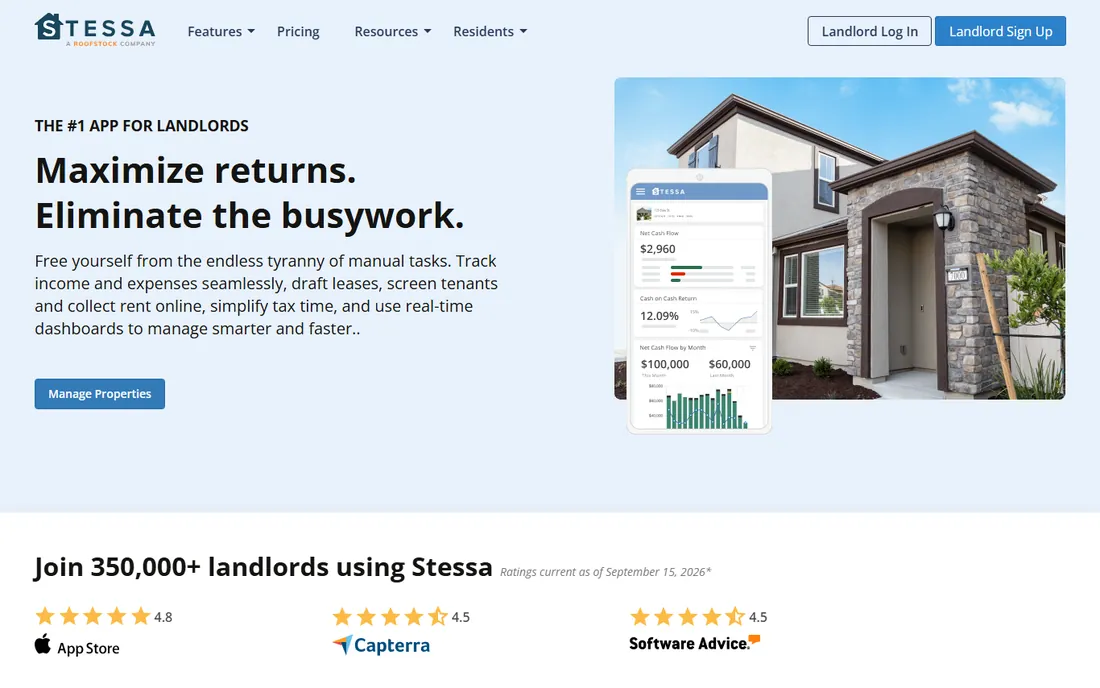
Stessa (part of the Roofstock family) is the best-known free tool for landlords, with its Essentials plan covering unlimited properties, manual expense tracking, automated bank feeds, receipt scanning (up to 5 smart scans a month), basic reporting, rent collection and document storage at no cost. Paid tiers run Manage at $15 a month ($12 annually) and Pro at $35 a month ($28 annually).
The investor focus shows in the reporting: net cash flow, cap rate, cash-on-cash return and rent rolls, plus an accountant tax package that graduates from basic to Schedule E and CapEx tracking on higher plans. Connecting bank and credit accounts means transactions flow in automatically for categorization by property.
The honest limits: the free plan's tax reporting is basic, Schedule E reporting requires Manage, and advanced transaction tracking and budgeting sit on Pro. It is also not built for trust accounting or third-party owner reporting. For self-managing landlords who want free, property-level expense tracking, Stessa is the starting point.
What we like- Free for unlimited properties
- Bank feeds
- Investor-focused reporting
Watch out for- Schedule E needs a paid plan
- Advanced accounting on Pro only
- Tax package is basic on free tier
Starting priceFree (Core)
Free planFree plan

Baselane combines landlord banking with bookkeeping, and its Core plan is free: integrated bank accounts, rent collection, bookkeeping with real estate-specific categories, financial dashboards and tax reports with no per-unit fee. The Smart plan at $20 a month adds custom categories, AI transaction tagging, auto-receipt matching, automated transfers and faster deposits.
The banking integration is the differentiator. Expenses paid from Baselane accounts are categorized automatically by property and tax category, so the books stay current without imports or spreadsheets, and the year-end tax package comes from the same system. It syncs with QuickBooks and Xero if your accountant prefers those.
The honest caveats: Baselane is banking-first, so leasing, maintenance and tenant workflows are lighter than full property management suites; the free plan lacks the AI automation of Smart; and it is a younger company than the accounting giants. For landlords who want money and books in one place at zero cost, it is compelling.
What we like- Free banking and bookkeeping
- Automated expense categorization
- Schedule E tagging
Watch out for- Newer platform
- Lighter property management features
- Smart plan needed for automation
Starting priceFree (Go, up to 3 units)
Free planFree plan
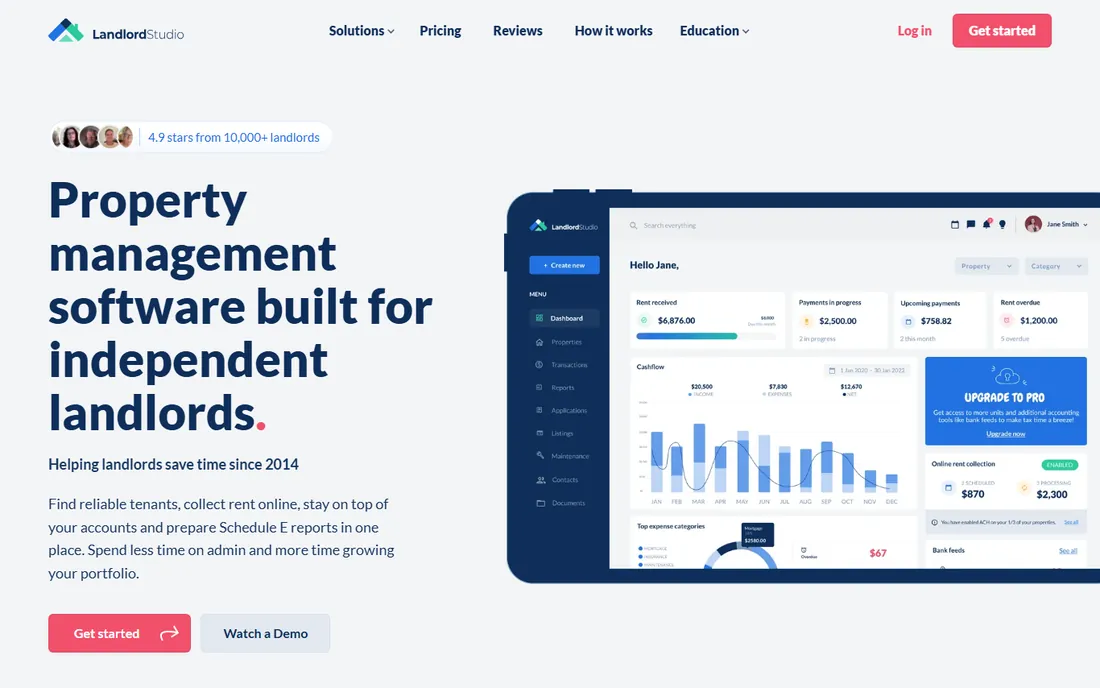
Landlord Studio is the mobile-first accounting app for landlords, with a GO plan that is free forever for the first 3 units, including manual income and expense tracking, online rent collection, maintenance tracking, basic reports, a GPS mileage tracker and receipt scanning. Pro starts at $12 a month and Pro Plus at $28, with extra units at $1 each per month.
The app experience is the selling point: log an expense, snap a receipt, track mileage to a property, all from the phone, with bank feeds, recurring expenses, multi-user access and AI-assisted bookkeeping on Pro. More than 18 accountant-approved reports cover income statements, rent ledgers and Schedule E.
The honest limits: the free GO plan allows one user and only 10 stored documents, so growing portfolios move to Pro quickly; bank feeds are a Pro feature; and the $1-per-unit scaling, while fair, adds up on large portfolios. For landlords who run the business from their phone, it is the best mobile option here.
What we like- Excellent mobile app
- Receipt scanning
- Free for up to 3 units
Watch out for- GO plan limited to one user and 10 documents
- $1 per extra unit on paid plans
- Bank feeds need Pro
Starting priceFree (Starter)
Free planFree plan

Wave's Starter plan is free accounting software in the true sense: unlimited expense and income tracking, unlimited bank and credit card connections, invoicing, basic financial reports and double-entry books, with no time limit. The Pro plan at $19 a month adds automatic bank transaction imports, receipt scanning and auto-categorization; payroll is a separate add-on.
The case for landlords is cost: it is a real general ledger your accountant understands, free forever. For a small portfolio, you can set up properties as customers or classes and track expenses per property with discipline, and the financial reports are solid basics.
The honest reality: Wave knows nothing about rentals. There is no property-level P&L, no Schedule E mapping, no rent collection and no depreciation workflow; property tracking is a manual workaround. Bank auto-import requires Pro. Landlords who want free books and will structure the chart of accounts themselves get genuine value; landlords who want rental-native reporting should pick Stessa or REI Hub instead.
What we like- Truly free accounting
- Double-entry books
- Unlimited invoices
Watch out for- Not landlord-specific
- No property-level reporting
- Bank auto-import needs Pro
Starting price$15/month (up to 3 units, billed monthly)
Free planFree trial (14 days)
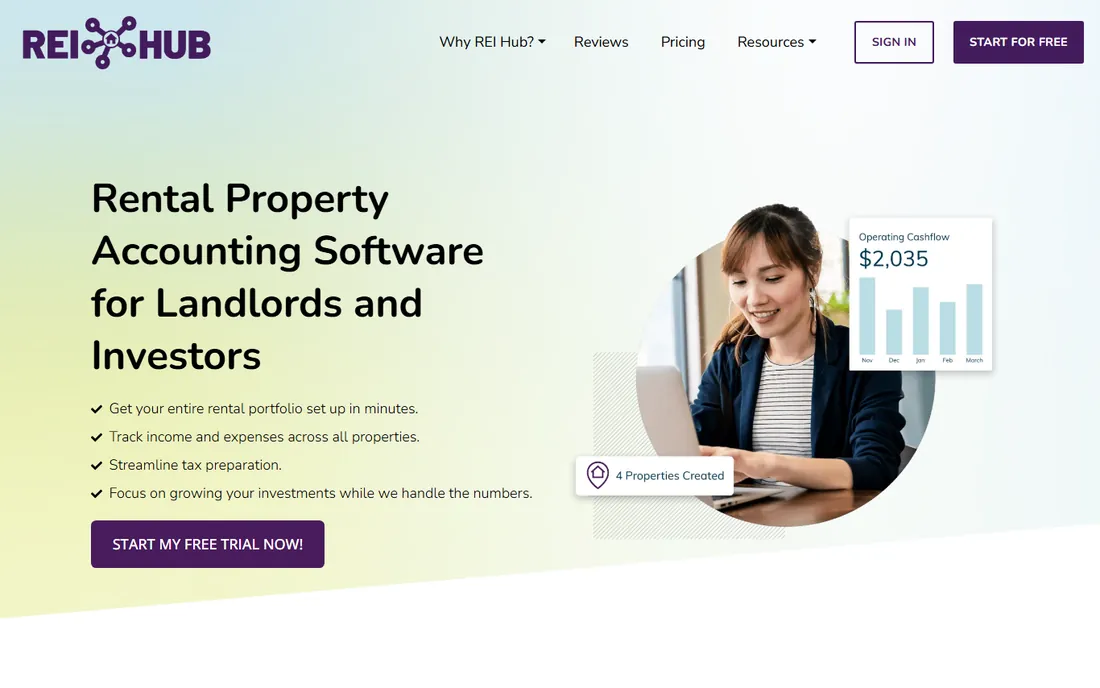
REI Hub is purpose-built rental accounting: double-entry books with a real estate-specific chart of accounts pre-mapped to IRS Schedule E, automatic transaction import via bank connections, mortgage and fixed-asset tracking with depreciation, 1099 vendor tracking and portfolio-level reporting. Plans start at $15 a month billed monthly for up to 3 units ($9 on annual billing), rising to $25, $45 and $80 for larger portfolios, with a 14-day free trial.
The depth is the point. Multi-entity investors get separate books per LLC with a combined portfolio view, asset basis and depreciation track by property, and tax-season reports that generic tools make you build by hand. Every plan includes all features; you only pay for unit count. Support is US-based and well reviewed.
The honest caveats: there is no free plan; receipt capture is manual data entry (a real gap against Landlord Studio and Stessa); and initial setup takes more care than the simpler apps. For serious investors who need real estate accounting rather than expense lists, REI Hub is the specialist choice.
What we like- Double-entry accounting built for rentals
- Schedule E and depreciation
- Multi-entity support
Watch out for- No free plan
- Receipt capture is manual
- Setup learning curve
Starting priceSee website
Free planFree trial (30 days)
QuickBooks Online is the accounting software most CPAs already use, which is its core argument for landlords: your accountant can take your books without translation. It offers invoicing, expense tracking, bank feeds, receipt capture, mileage tracking and strong reporting, with a 30-day free trial. Published list prices have moved several times, most recently in the 2026 increase, so check the current page.
The ecosystem is unmatched: thousands of integrations, an enormous accountant network, and payroll, payments and lending built around the same ledger. For landlords whose CPA insists on QuickBooks, compliance beats convenience.
The honest reality: QuickBooks knows nothing about rentals. Property-level P&L requires class or location workarounds, depreciation tracking needs the Advanced plan, and Schedule E reporting is manual. Recent price increases have made it the most expensive option here for what landlords actually use. Pick it for accountant compatibility; pick a landlord tool for landlord workflows.
What we like- Universal accountant compatibility
- Deep ecosystem
- Strong bank feeds
Watch out for- Not rental-specific
- Property tracking is manual
- Prices have risen sharply
Starting priceSee website
Free planFree trial (30 days)

Xero is the leading QuickBooks alternative: cloud accounting with invoicing, bank reconciliation, expense claims, reporting and a 30-day free trial, sold in Starter, Standard and Premium tiers. Its standout policy is unlimited users on every plan, so your bookkeeper, CPA and partners all get access at no extra seat cost. Pricing has changed multiple times, so verify the current page.
The strengths for landlords are the interface (cleaner than QuickBooks for non-accountants), the integration marketplace, and multi-currency support on higher plans. Accountants increasingly support it, and bank feeds are reliable.
The honest limits mirror QuickBooks: no rental-native features, so property-level tracking and Schedule E reporting are manual setups; there is no free plan; and prices have crept upward. For landlords who want modern cloud accounting with unlimited users and will structure the books themselves, Xero works well.
What we like- Unlimited users on every plan
- Clean interface
- 1,000-plus app integrations
Watch out for- Not rental-specific
- No free plan
- Recent price increases
Starting priceSee website
Free planFree trial (14 days)

Rentec Direct bundles full accounting into its property management platform: general ledger, bank reconciliation, owner statements, 1099 e-file, Schedule E tax reports and customizable financial reporting, with trust accounting on the PM plan. Pricing is sold as Rentec Pro for landlords and Rentec PM for managers; published figures vary across sources, so confirm on the pricing page. A free trial covers the first two weeks.
The argument is consolidation. Instead of syncing a separate accounting tool, the ledger lives with rent collection, maintenance, tenant screening and owner portals, and the reports tie operations to finances directly. QuickBooks integration exists for accountants who want it.
The honest caveats: the interface shows the product's age, mobile capabilities trail the web app, and the pricing ambiguity means budgeting by quote or the current page. For landlords and managers who want one system for operations and books, Rentec Direct is the established value option.
What we like- Full general ledger accounting
- Trust accounting on PM plan
- Customizable reports
Watch out for- Interface feels dated
- Published pricing varies by source
- No free plan
What to compare before you buy
Schedule E and tax readiness
The difference between landlord software and generic accounting is tax time. Landlord tools map expenses to IRS Schedule E categories by default and produce tax packets; generic tools make you build that mapping yourself. If you file Schedule E, prioritize Stessa (paid), Baselane, Landlord Studio or REI Hub over the general ledgers.
Free plans have real limits
Free tiers here are genuinely useful but bounded: Landlord Studio's GO covers 3 units with one user, Stessa's Essentials gates Schedule E behind paid plans, and Wave's Starter lacks auto-import. Model your unit count and tax needs against the limits before committing your books to a free tier.
How we chose
We built this list from vendor pricing pages and 2026 industry coverage, cross-checking published prices against at least two sources. Every tool had to track rental income and expenses with property-level reporting and be live today. Prices are stated exactly as vendors publish them; where published figures conflicted or were quote-only, we wrote "See website". We did not run hands-on trials; this guide reflects documented capabilities as each vendor presents them.
Frequently asked questions
What is the best free software to track rental property expenses?
Stessa, Baselane, Landlord Studio and Wave all offer free plans. Stessa's free Essentials covers unlimited properties with bank feeds; Baselane's free Core adds landlord banking; Landlord Studio's free GO covers 3 units with the best mobile app; Wave's free Starter is general accounting. Pick by your unit count and whether you want banking included.
How do landlords track expenses for taxes?
Landlord software categorizes expenses by property and maps them to IRS Schedule E categories, then produces a tax packet for your CPA. Stessa, Baselane, Landlord Studio and REI Hub all do this; generic tools like QuickBooks and Xero require manual setup. Keep receipts attached to transactions for audit readiness.
Should I use QuickBooks or landlord software for rentals?
If your CPA requires QuickBooks, use it; compatibility matters. Otherwise, landlord software tracks expenses by property automatically, produces Schedule E reports and handles rent collection, which QuickBooks does not do natively. Many landlords run landlord software for operations and export to QuickBooks for the accountant.
What expense categories should landlords track?
Typical Schedule E categories include advertising, cleaning and maintenance, insurance, mortgage interest, property taxes, repairs, utilities, management fees, depreciation and travel. Landlord tools pre-build these categories; generic accounting requires you to create them. Consistent categorization is what makes tax time painless.
Do I need separate books per property or per LLC?
Track income and expenses per property at minimum, since Schedule E is filed per property. If you hold properties in multiple LLCs, keep separate books per entity for liability protection; REI Hub and Baselane support multi-entity structures natively. Ask your CPA before commingling entity funds.
Can expense tracking software handle 1099s?
Rentec Direct and REI Hub include 1099 vendor tracking and filing workflows. Stessa's higher plans include tax packages. Generic tools need add-ons or your CPA's help. If you pay contractors $600 or more per year, confirm 1099 support before tax season.
Sources we checked (8)
- https://www.stessa.com/pricing/
- https://www.baselane.com/pricing/
- https://www.reihub.net/pricing
- https://www.landlordstudio.com/pricing/
- https://www.waveapps.com/pricing
- https://quickbooks.intuit.com/pricing/
- https://www.xero.com/us/pricing/
- https://www.rentecdirect.com/pricing
Is your product missing or out of date?
We review this list regularly. Vendors can request a listing, send updated pricing or ask about featured placement.

Shihab Mia · Founder, Rankite
Shihab has spent more than a decade helping SaaS and e-commerce brands grow through search. He writes Rankite's software buying guides from pricing pages, documentation and public user reviews. More about Shihab.