How we make this list: we compare pricing pages, product documentation and public user reviews. Ratings come from G2, Capterra or Trustpilot, with the date we checked them.
Key takeaways
- SMTP services differ mainly in who they serve: developer APIs like Resend and Postmark suit app teams, while Brevo and Mailjet suit teams that send marketing and transactional mail from one account.
- Free tiers are real but small: Resend allows 3,000 emails a month, Mailjet 6,000 a month, and Brevo 300 a day, while SendGrid now offers only a 60-day trial instead of a permanent free plan.
- Amazon SES has the lowest raw sending cost of the services here, but it is a bare infrastructure service, so expect more setup work than with a full platform.
- Deliverability depends more on your sending habits than on your provider: authenticated domains, clean lists, and steady volume matter more than any single feature claim.
Quick comparison
| Tool | Best for | Starting price | Free plan |
|---|
 SendGrid | High-volume transactional email at scale | See website | No |
 Mailgun | Developer-led sending with validation tools | See website | No |
 Postmark | Fast transactional delivery with separate message streams | See website | Yes |
 Amazon SES | Lowest-cost high-volume sending inside AWS | See website | No |
 Brevo | Marketing and transactional mail plus SMS in one account | See website | Yes |
 Mailjet | Teams building campaigns and transactional mail together | See website | Yes |
 Resend | Developer teams using React Email templates | See website | Yes |
 SMTP.com | Dedicated-instance relay with reputation protection | From $25/month | No |
Is your product missing or out of date?
We review this list regularly. Vendors can request a listing, send updated pricing or ask about featured placement.
The best SMTP services
Starting priceSee website
Free planNo
SendGrid is the largest name on this list, and its homepage now points visitors to Twilio, which owns the product. The SendGrid Email API and SMTP service remain fully supported, and the platform reports sending more than 200 billion emails every month. That scale is the main reason large senders choose it: the infrastructure is built for high volume, and the same account can handle transactional mail, marketing campaigns, and delivery analytics.
The trade-off is that SendGrid no longer offers a permanent free tier. What remains is a free trial, and senders who need a dedicated IP for reputation isolation must move to a higher-priced plan. For a small project that sends a few hundred emails a month, the free tiers at Resend or Mailjet are a better fit. For a business already sending at scale, or one that wants Twilio verification and messaging products alongside email, SendGrid is a proven choice. Check the current pricing page before committing, since plan names and limits have changed since the Twilio move.
What we like- Sends more than 200 billion emails a month
- Email API and SMTP relay in one platform
- Now backed by Twilio with added verification and messaging products
Watch out for- No permanent free plan, only a free trial
- Pricing and dedicated IP options require higher tiers
#2Mailgun
Best for: Developer-led sending with validation tools4.2/5 on
G2 (322 reviews, checked Oct 2026)
Visit mailgun.com
Starting priceSee website
Free planNo
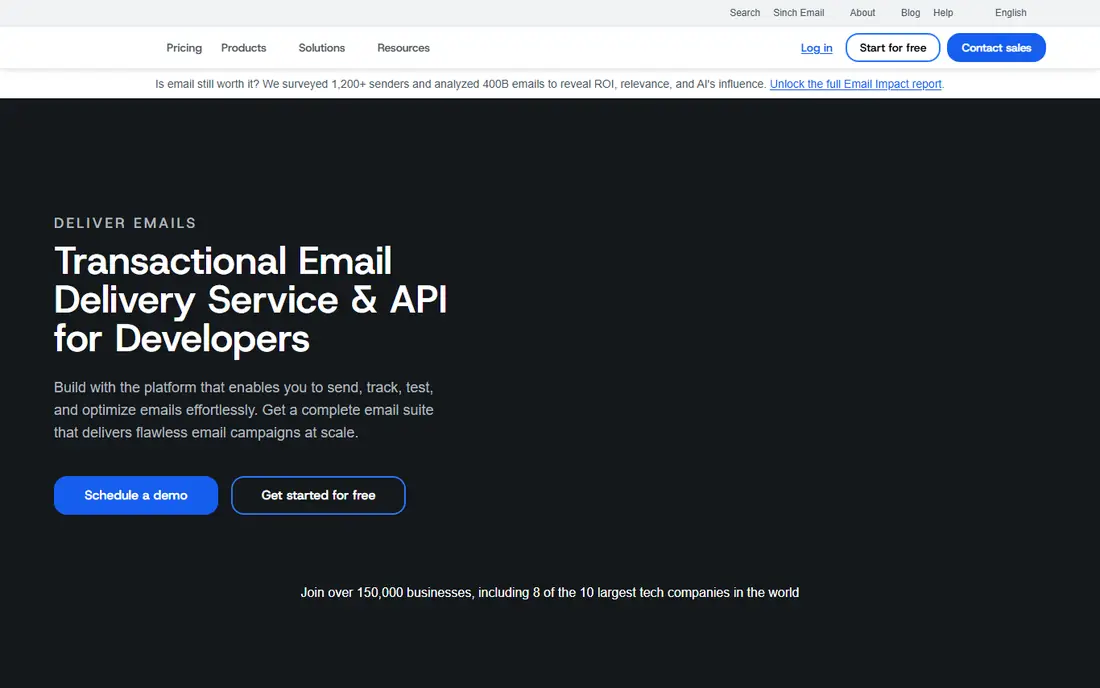
Mailgun positions itself as a developer-first email service, and its product line reflects that: a Send product for delivery, an Optimize product for deliverability and engagement, a Validate product for list cleaning, and an Inspect product for previewing messages before they go out. The homepage reports customer results such as 21 percent fewer bounces and 65 percent higher open rates, and it stresses compliance and reliability for senders moving from thousands to millions of emails.
Mailgun suits teams that want control over their email program and are comfortable wiring APIs into their stack. It is less suited to marketers who want a drag-and-drop campaign builder, since Mailgun's strength is infrastructure rather than campaign design. There is no permanent free plan, so budget for a paid tier from the start, and confirm which add-ons your plan includes, because validation and preview tools may be priced separately from basic sending.
What we like- Built by developers for developers
- Email validation and preview tools included
- Flexible sending, optimization, and validation products
Watch out for- No permanent free plan
- Validation and optimization features sit in separate products that add cost
#3Postmark
Best for: Fast transactional delivery with separate message streams4.6/5 on
G2 (32 reviews, checked Oct 2026)
Visit postmarkapp.com
Starting priceSee website
Free planYes
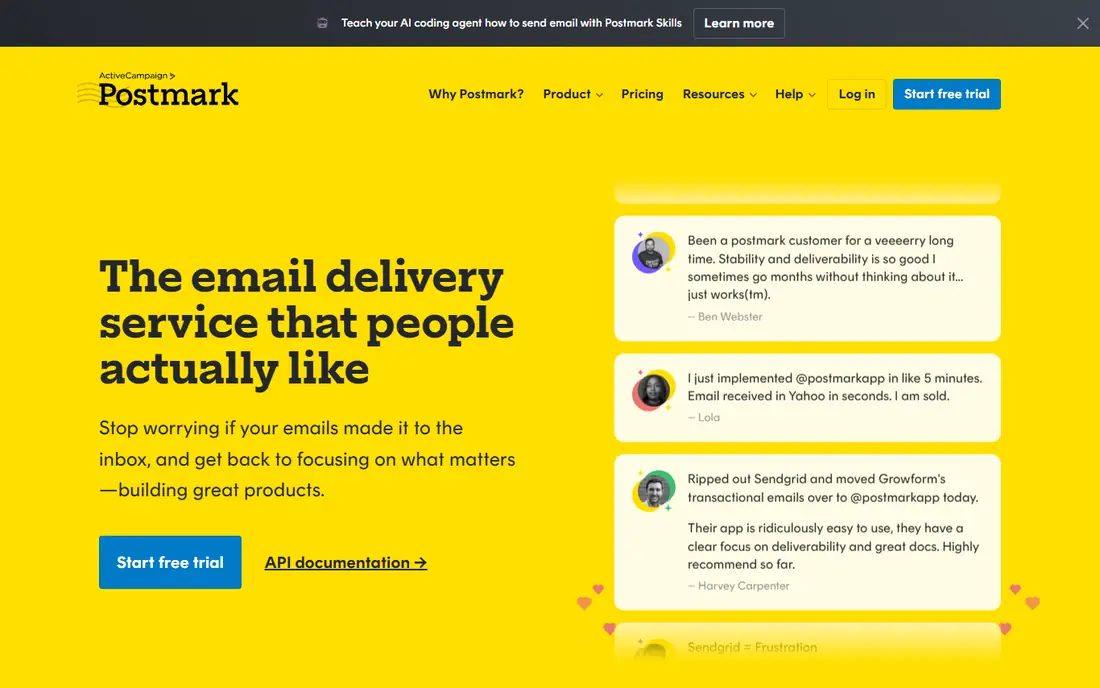
Postmark has sent transactional email since 2010, and its defining design choice is message streams: transactional mail and promotional mail travel through separate sending infrastructure, so a large newsletter can never slow down a password reset. Its homepage reports billions of emails delivered for companies including IKEA, Asana, and 1Password, and it shows a 95 percent customer happiness rating over the past 60 days.
The free plan is real but tiny at 100 emails a month, which makes Postmark a testing-first choice rather than a free production tier. Paid plans start at a published monthly rate for 10,000 emails, with overage charged per thousand. Postmark is the pick for teams whose transactional mail must arrive in seconds and who are willing to pay for that focus, rather than for teams that want one cheap account for both marketing blasts and app mail.
What we like- Transactional and promotional mail run on separate infrastructure
- Fast delivery times
- Strong support reputation with a 95 percent happiness rating
Watch out for- Free allowance is only 100 emails a month, so it covers testing rather than production
- Pricing rises steeply at higher volumes
#4Amazon SES
Best for: Lowest-cost high-volume sending inside AWS4.3/5 on
G2 (205 reviews, checked Oct 2026)
Visit aws.amazon.com
Starting priceSee website
Free planNo
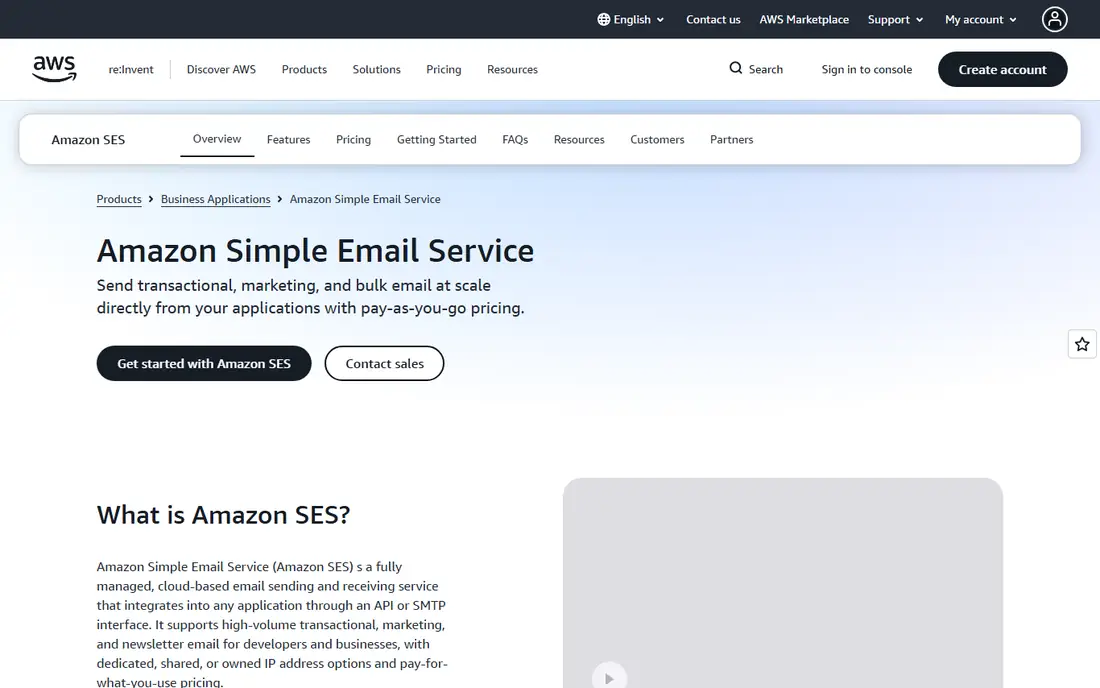
Amazon Simple Email Service is the cheapest raw sending option on this list, and AWS reports that it transacts more than a trillion emails each year for customers including Netflix and Duolingo. It supports transactional mail, marketing campaigns, and newsletters, with dedicated, shared, or owned IP addresses and deliverability tools for managing sender reputation. Mail Manager adds inbound mail handling with security and compliance controls.
The cost of that low price is effort. SES is an infrastructure primitive, not a full marketing platform, so templating, list management, and detailed reporting are things you build yourself or add through other AWS services. New accounts start in a sandbox that only sends to verified addresses until AWS approves production access, and there is no permanent free tier for new signups. SES fits teams already running on AWS with engineering time to spare, not teams that want a ready-made campaign tool.
What we like- Very low per-email cost
- Transacts more than a trillion emails a year
- Dedicated, shared, or owned IP options
- Mail Manager for inbound mail
Watch out for- Bare infrastructure with more setup work
- No permanent free tier for new accounts
- Sandbox limits apply until production access is approved
#5Brevo
Best for: Marketing and transactional mail plus SMS in one account4.5/5 on
G2 (2,747 reviews, checked Oct 2026)
Visit brevo.com
Starting priceSee website
Free planYes
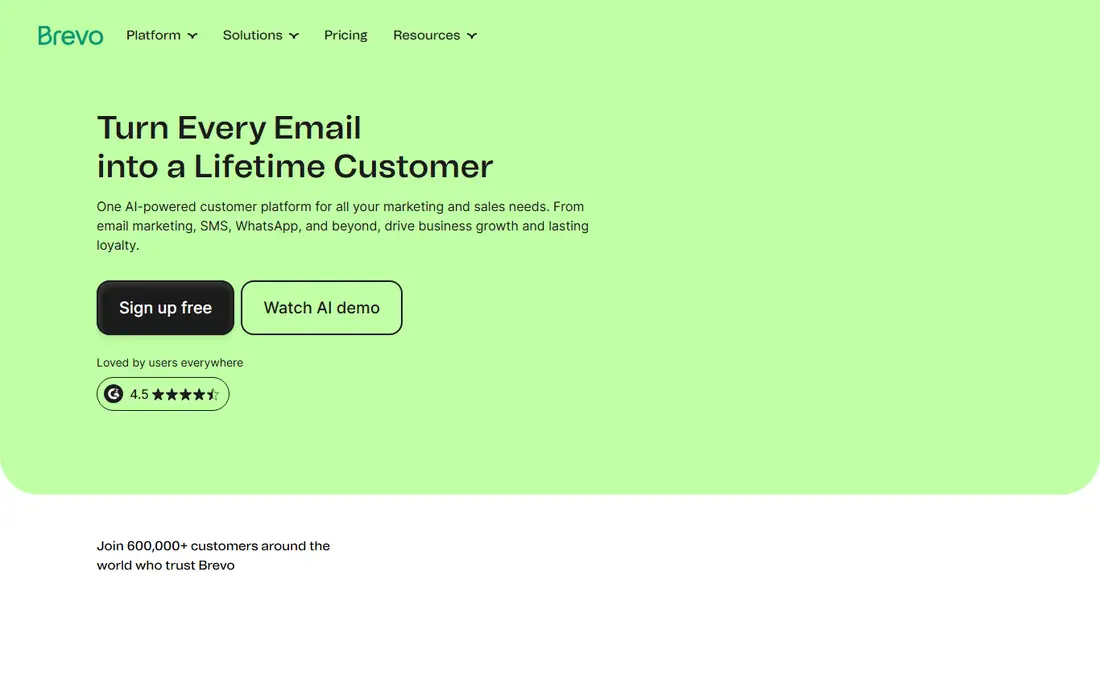
Brevo, formerly Sendinblue, is an all-in-one customer platform used by more than 600,000 customers. Its free plan sends 300 emails a day with unlimited contact storage, which suits a small business starting out, and paid plans charge by emails sent rather than by contacts stored, which favors businesses with large lists they mail infrequently. Beyond email, the same account covers SMS, WhatsApp, live chat, a basic CRM, and marketing automation.
The main limits are on the free tier: the 300-a-day cap, Brevo branding on messages, and no automation until a paid plan. Starter plans remove the daily cap, while automation, A/B testing, and landing pages arrive on higher tiers. Brevo is the strongest pick here for a small business that wants marketing campaigns, transactional mail, and text messaging under one login and is willing to pay once automation becomes essential.
What we like- Free plan with 300 emails a day
- Email, SMS, WhatsApp, CRM, and automation in one platform
- Pricing based on emails sent, not contacts stored
Watch out for- Daily free cap is tight for larger lists
- Automation requires a paid plan
- Branding appears on free-plan emails
#6Mailjet
Best for: Teams building campaigns and transactional mail together3.9/5 on
G2 (176 reviews, checked Oct 2026)
Visit mailjet.com
Starting priceSee website
Free planYes
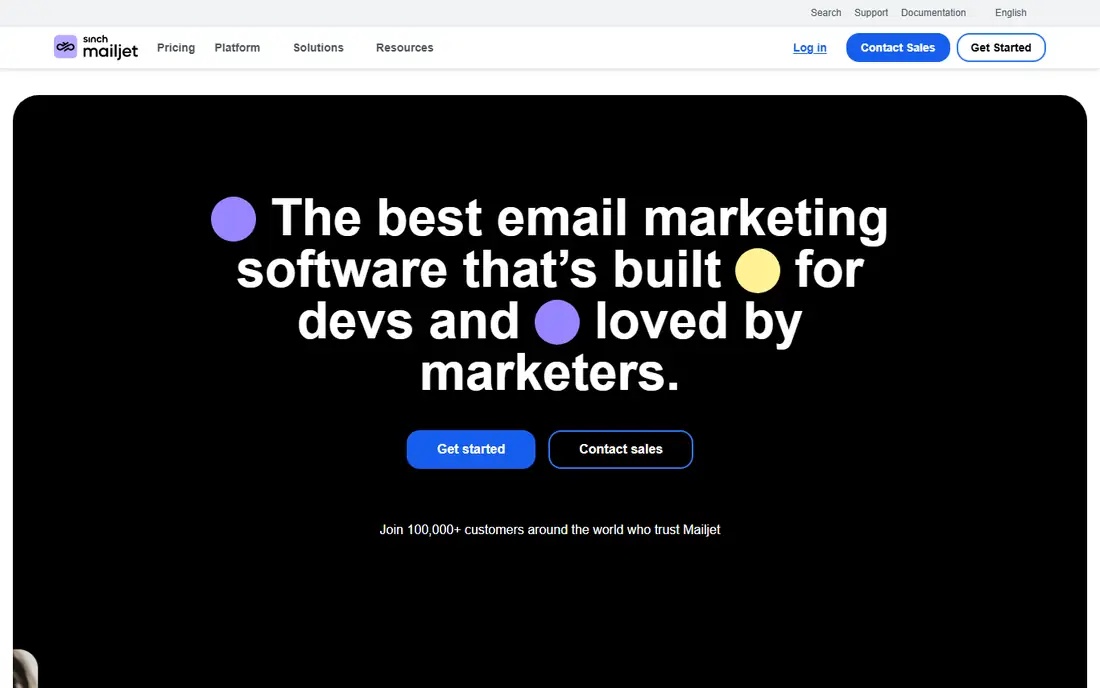
Mailjet serves more than 100,000 brands and is built around one idea: marketers, developers, and teams should work in the same platform. Its drag-and-drop editor supports real-time co-editing, shared templates, and approval flows, while developers get a RESTful Email API, SMTP relay, SDKs for PHP, Python, Node, and more, plus a sandbox mode for safe testing. Deliverability tools include inbox preview, address validation, dedicated IPs, and domain authentication.
The free plan is generous at 6,000 emails a month with up to 1,000 contacts, but it caps daily sending at 200 emails, so a large one-day campaign will not fit. Paid plans are priced by sending volume rather than contacts, which keeps budgeting simple. Mailjet fits teams where marketers and developers share email work and where collaboration features matter as much as raw delivery.
What we like- Free plan with 6,000 emails a month
- Real-time collaboration and approval flows
- Drag-and-drop editor with AI assistance
- EU data centers with 99.99 percent uptime SLA
Watch out for- Free plan caps sending at 200 emails a day
- Advanced automation and statistics require higher tiers
#7Resend
Best for: Developer teams using React Email templates4.8/5 on
G2 (10 reviews, checked Oct 2026)
Visit resend.com
Starting priceSee website
Free planYes
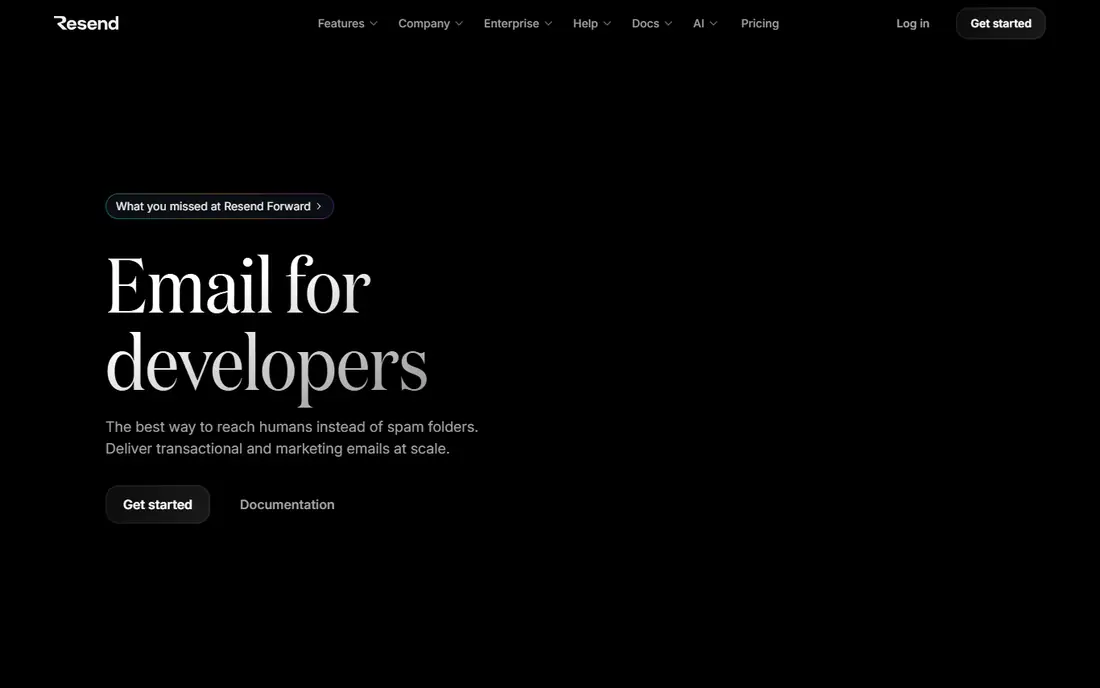
Resend is built for developers who want email to feel like the rest of their codebase. Its headline feature is React Email, an open-source component library that lets teams write templates as React components, share parts with the product codebase, and preview locally instead of maintaining templates in a separate editor. The platform adds test mode for safe experiments, modular webhooks for delivery events, multi-region sending for lower latency, and managed dedicated IPs that warm up automatically.
The free plan covers 3,000 emails a month across 3 domains, but the 100-a-day cap means a launch-day burst will hit the limit fast. Marketing email is sold separately from sending, priced by contacts, so teams that also run newsletters should budget for both. Resend is the pick for React and Next.js teams that value developer experience above all else, and it is less suited to marketers who want a visual campaign builder.
What we like- Free plan with 3,000 emails a month
- React Email templates written in code
- Test mode, modular webhooks, and multi-region sending
- Managed dedicated IPs
Watch out for- 100-a-day cap on the free plan
- Marketing email is a separate subscription
- Newer service with a shorter operating record than rivals
#8
SMTP.com
Best for: Dedicated-instance relay with reputation protection
Visit smtp.com
Starting priceFrom $25/month
Free planNo
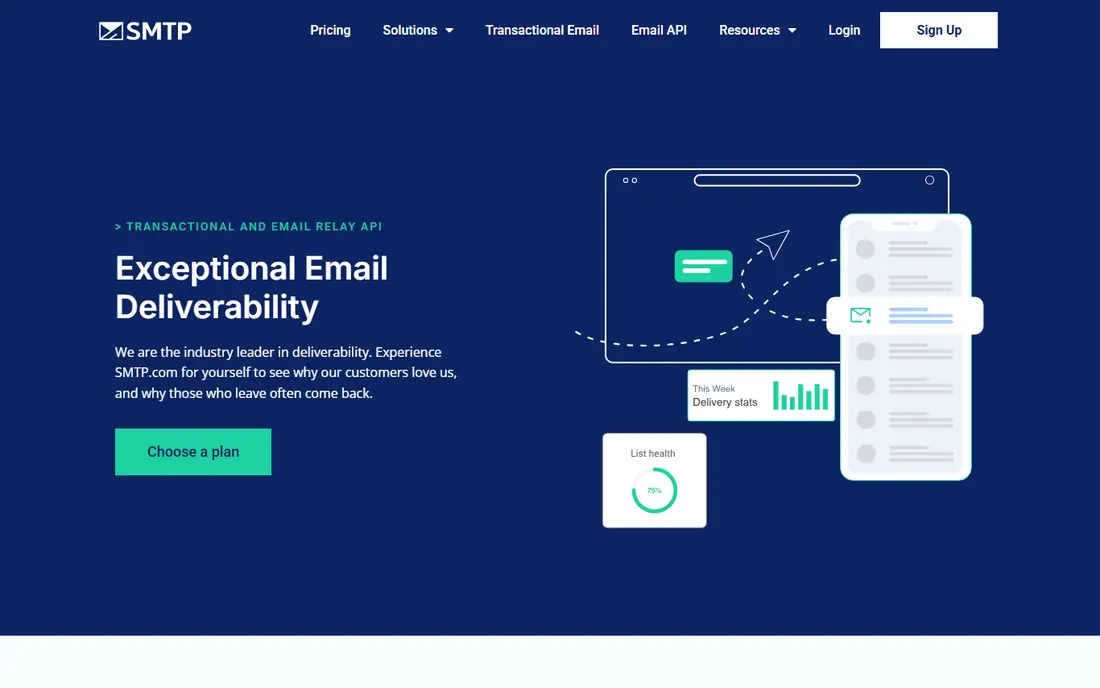
SMTP.com takes a different approach from the shared-pool services on this list: each customer gets a dedicated instance in a private and secure cloud environment, with volume that can scale up or down quickly for seasonal sending. Its Reputation Defender add-on monitors list health and suppresses invalid addresses before they go out, protecting domain and IP reputation over time. The homepage notes that plans start at $25 a month for 50,000 emails, and the company reports more than two decades in email delivery.
That dedicated setup suits high-volume senders and businesses whose reputation cannot afford a shared pool's bad neighbors. The trade-off is price and scope: there is no free plan, and SMTP.com is a delivery service rather than a marketing suite, so campaign design and automation are thinner than at Brevo or Mailjet. For a business that treats email as critical infrastructure and wants isolation plus expert support, SMTP.com is worth the premium.
What we like- Every customer gets a dedicated instance in a private cloud environment
- Reputation Defender suppresses invalid addresses before sending
- More than 20 years of deliverability experience
Watch out for- No free plan
- Pricing starts higher than the cheapest pay-as-you-go options
- Marketing features are thinner than full platforms
How we chose
We compared services that offer a real SMTP relay or email API, not just a newsletter builder, and we opened each vendor homepage to confirm it loads and belongs to that product. We weighed deliverability features such as dedicated IPs, domain authentication, and separate transactional streams, alongside free tiers, published starting prices, API quality, and support reputation. Where a price could not be confirmed on the vendor's own page, we list "See website" rather than repeating a third-party figure. Services that failed to load or belonged to a different product were left out.
Buying guide: how to pick an SMTP service
Start with your monthly volume and your daily peak, not just your average. A free tier with a daily cap, such as Resend at 100 a day or Mailjet at 200 a day, can look generous on a monthly basis and still block a launch-day campaign. Next, separate your mail types: if password resets and receipts share infrastructure with newsletters, a single spam complaint wave can delay critical messages, which is why Postmark's separate streams appeal to app teams.
Then check authentication and reputation controls. Every serious provider supports SPF, DKIM, and DMARC, but dedicated IPs, IP warm-up plans, and suppression lists are what protect a growing sender. Ask whether your plan includes them or charges extra. Also confirm the sandbox and approval rules: Amazon SES and Postmark both gate new senders until accounts are reviewed, which can delay a launch if you sign up the same week you need to send.
Finally, weigh total cost, not the headline rate. A low per-thousand price means little if you pay for validation, dedicated IPs, or a separate marketing subscription on top. Run a small pilot on your top two choices with real templates and real lists, measure inbox placement and delivery speed over two weeks, and only then move production traffic.
Frequently asked questions
What is an SMTP service?
An SMTP service is a provider that sends email from your app or website through the Simple Mail Transfer Protocol, handling delivery, bounces, and reputation so your own server does not have to. Most modern providers also offer an API alongside SMTP.
Is SMTP or API better for sending email?
SMTP is the simplest to set up, since most apps and platforms already support it with a host, port, username, and password. An API gives more control over templates, tracking, and error handling, so developer teams often prefer it once volume grows.
How much does an SMTP service cost?
Costs range from free tiers of a few thousand emails a month to pay-as-you-go rates near a tenth of a cent per email at Amazon SES, up to flat monthly plans starting around $25 a month at SMTP.com. Your volume, daily peaks, and add-ons decide the real bill.
Do I need a dedicated IP address?
A dedicated IP gives you full control over your sender reputation, which helps at high volume or after deliverability problems. At low volume, a shared IP pool from a reputable provider usually performs fine and warms up faster.
How do I improve email deliverability?
Authenticate your domain with SPF, DKIM, and DMARC, send only to people who asked for your mail, remove bounced and unengaged addresses promptly, keep volume steady rather than spiky, and warm up new domains and IPs gradually.
Sources we checked (0)
Is your product missing or out of date?
We review this list regularly. Vendors can request a listing, send updated pricing or ask about featured placement.

Shihab Mia · Founder, Rankite
Shihab has 5+ years in B2B and SaaS SEO. He writes Rankite's software buying guides from pricing pages, documentation and public user reviews. More about Shihab.