How we make this list: we compare pricing pages, product documentation and public user reviews. Ratings come from G2, Capterra or Trustpilot, with the date we checked them.
HashiCorp Vault is the best pick for most DevOps teams that need multi-cloud secrets, dynamic credentials, and fine-grained policy control. It runs in more places than any cloud vault in this guide. For a team that wants a fast start with no cluster to run, Doppler is the best alternative, with a clean CLI and per-seat pricing.
Key takeaways:
- Pick a cloud vault when your workloads live in one cloud, and a multi-cloud vault when they do not.
- Price by the unit that matches your growth: per secret, per seat, or per identity.
- Dynamic secrets beat long-lived static secrets because a leaked credential stops working within minutes.
- Rotation, audit logs, and scoped access matter more than the size of the feature list.
- Test secret injection in CI before you migrate production.
What is secrets management for DevOps, and why does it matter now?
Secrets management for DevOps is the practice of storing, issuing, rotating, and auditing credentials that applications and pipelines need to run. It covers API keys, database passwords, tokens, certificates, and cloud credentials. The goal is simple: no secret should sit in plain text in code, in a chat message, or in a shared document. One deploy can call a cloud API, a database, and a payment provider, and each call needs a credential. When teams copy credentials into environment files, they spread into logs and old branches. A central vault stops that spread and can rotate credentials without a redeploy.
The best tool for a small DevOps team is the one the team will actually use every day, not the one with the longest feature list. Doppler and Infisical fit that shape best. Doppler gives a polished CLI and a free Developer plan for three users. Infisical gives a free plan for five identities and an open-source core that a team can self-host later. If every workload runs on AWS, AWS Secrets Manager is the lowest-friction pick. The same logic holds for Azure Key Vault on Azure. Multi-cloud Kubernetes teams should look at HashiCorp Vault or Akeyless first.
How do you choose between a cloud vault and a self-hosted vault?
Choose a cloud vault when your team is small, your workloads are in one cloud, and you want someone else to handle patching, backups, and uptime. AWS Secrets Manager, Azure Key Vault, Doppler, and the managed tiers of Vault and Infisical all fit this model. You get started in an afternoon. The cost is less control over where data lives and less freedom to change the billing unit later. Choose a self-hosted vault when you need data residency, air-gapped networks, or custom policy logic. HashiCorp Vault Community Edition and the open-source core of Infisical are the realistic self-hosted picks. Self-hosting is free in licence terms only, but you still pay for servers, backups, and engineer time.
Check secret injection in your real CI system before you move anything that matters. Build one pipeline that reads a test secret, injects it at run time, and never prints it to a log. AWS Secrets Manager rotates common databases with Lambda functions. Doppler rotates secrets on its Team plan. Vault and Akeyless issue dynamic secrets that expire on their own. Check access control at the level of one secret, not only at the level of one project. Look for scoped service accounts, per-environment permissions, and approval steps for production access. Check how secrets leave the vault, and test the exit path.
How much does secrets management cost for a 20-developer team with 500 secrets?
Worked example: a team of 20 developers stores 500 secrets and runs about 40 machine identities. AWS Secrets Manager costs 200 dollars per month for 500 secrets at 0.40 dollars each, plus 5 dollars for 1 million API calls, for a total near 205 dollars. Azure Key Vault costs about 3 dollars for 1 million secret operations at 0.03 dollars per 10,000, with no charge per stored secret, which makes it the cheapest option here for Azure-only teams. Doppler on Team at 21 dollars per user per month is 420 dollars for 20 users, with no per-secret charge. Infisical Pro at 20 dollars per identity is 1,200 dollars if all 60 identities are billed, so count machines before you compare seat and identity prices. 1Password Business at 8.99 dollars per user per month is about 180 dollars for 20 users, before any separate Secrets Automation charge. HashiCorp Vault Development at 0.62 dollars per cluster hour is about 453 dollars per month for one cluster, before client fees. Akeyless and CyberArk Conjur are quote only.
Decision table by team size and cloud:
| Team shape | Best first pick | Why |
| Solo developer or 3-person team | Doppler Developer or Infisical Free | Free tiers cover the team |
| 20 developers, one cloud (AWS) | AWS Secrets Manager | Native rotation, about 205 dollars a month |
| 20 developers, one cloud (Azure) | Azure Key Vault | Per-operation billing is very low |
| 20 developers, multi-cloud | HashiCorp Vault or Akeyless | One control plane for every cloud |
| Regulated enterprise, existing PAM | CyberArk Conjur (Idira Secrets Manager) | Policy as code and audit depth |
| Team already on 1Password Business | 1Password Secrets Automation | Uses the vault the team already has |
Quick comparison
| Tool | Best for | Starting price | Free plan |
|---|
 HashiCorp Vault | Multi-cloud teams that need dynamic secrets and policy as code | From $0.62 per cluster per hour for HCP Vault Dedicated Development (about $453 per month); Vault Community is free to self-host | Vault Community Edition is free to self-host; HCP offers a $500 trial credit |
 AWS Secrets Manager | Teams whose workloads already run on AWS and need native rotation | $0.40 per secret per month, plus $0.05 per 10,000 API calls | No permanent free tier; new AWS accounts receive up to $200 in general AWS credits |
 1Password | Teams already on 1Password Business that want developer secrets in the same vault | $8.99 per user per month billed annually for Business; Teams Starter Pack is $24.95 per month flat | No free plan; 14-day trial only |
 Doppler | Small and mid-size teams that want a polished SaaS vault with per-seat pricing | Team $21 per user per month; Developer is free for 3 users, then $8 per additional user per month | Developer plan is free for up to 3 users |
 Akeyless | Multi-cloud and hybrid teams that want a SaaS vault with zero-knowledge encryption | Quote (paid plans are custom; no published per-secret or per-user list price) | Free tier with 500 static secrets, 5 dynamic secrets, and 5 clients |
 CyberArk Conjur | Regulated enterprises that need policy as code for machine identities | Quote (commercial editions are quote only; Conjur Open Source is free to self-host) | Conjur Open Source is free to self-host under an open-source licence |
 Infisical | Small teams that want an open-source core and the option to self-host | Pro $20 per identity per month billed annually ($23 billed monthly); Advanced $40 per identity per month billed annually | Free plan for up to 5 identities; open-source core is free to self-host |
 Azure Key Vault | Teams whose workloads already run on Azure and need keys, secrets, and certificates | $0.03 per 10,000 secret operations; Premium adds $1 per HSM-protected key per month | No permanent free tier; new Azure accounts get 12 months of free services |
Is your product missing or out of date?
We review this list regularly. Vendors can request a listing, send updated pricing or ask about featured placement.
#1
HashiCorp Vault
Best for: Multi-cloud teams that need dynamic secrets and policy as code
Visit hashicorp.com
Starting priceFrom $0.62 per cluster per hour for HCP Vault Dedicated Development (about $453 per month); Vault Community is free to self-host
Free planVault Community Edition is free to self-host; HCP offers a $500 trial credit
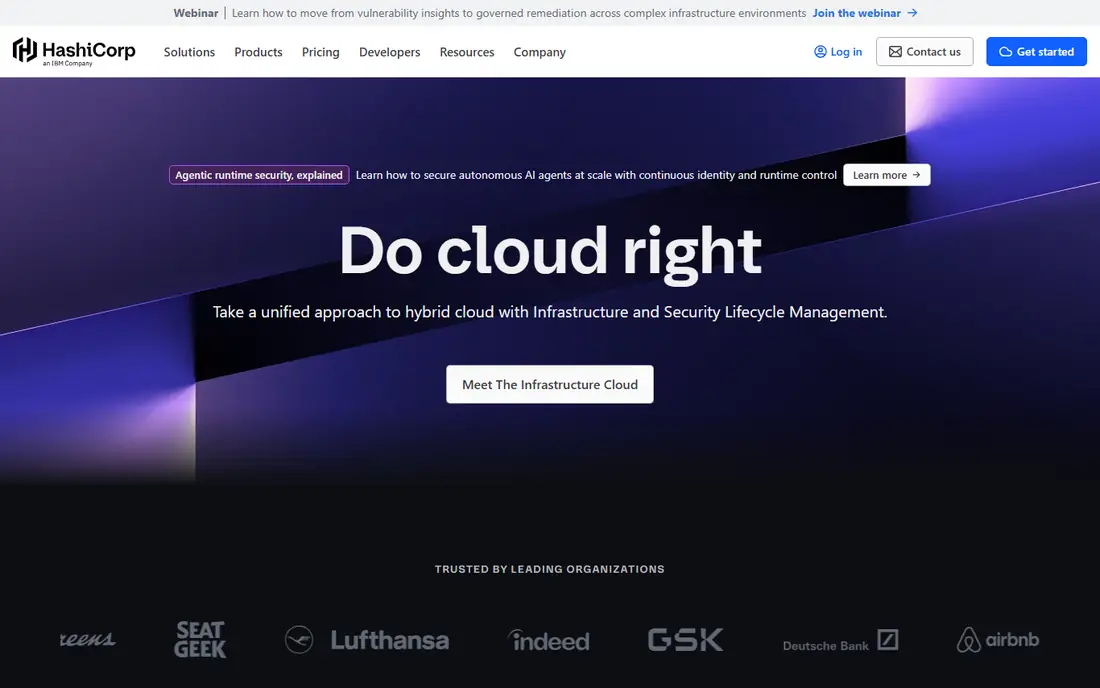
HashiCorp Vault is the reference vault for DevOps teams that run workloads in more than one place. It stores static secrets, issues short-lived dynamic credentials, and lets teams write access rules as code. The Kubernetes integration is mature, and Terraform can read secrets at plan time without storing them in state files. The managed service removes the need to run clusters, but buyers should model the client fee, because every service that authenticates can count as a client.
What we like- Works across clouds and on premises, dynamic secrets, policy as code, strong Kubernetes integrations
Watch out for- Self-hosted Vault needs real operations work, and managed tiers add $72.92 per client per month
#2
AWS Secrets Manager
Best for: Teams whose workloads already run on AWS and need native rotation
Visit aws.amazon.com
Starting price$0.40 per secret per month, plus $0.05 per 10,000 API calls
Free planNo permanent free tier; new AWS accounts receive up to $200 in general AWS credits
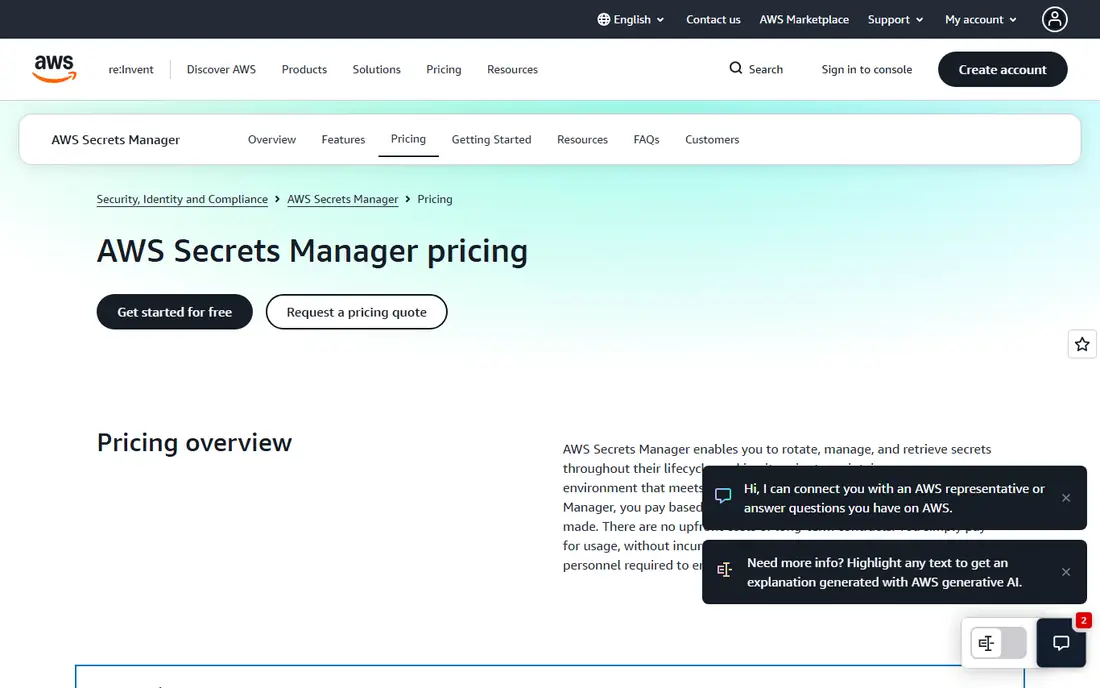
AWS Secrets Manager is the simplest choice for an AWS-native team. A secret is stored once, access is granted through IAM roles, and rotation is handled by Lambda functions that AWS supplies for supported databases. Applications read secrets through the AWS SDK or the Parameters and Secrets Lambda Extension, which caches values and cuts API calls. Replicas in another region bill as separate secrets, so cross-region setups cost double for storage.
What we like- Native IAM access control, built-in rotation for RDS, Redshift, and DocumentDB, simple pay-per-use billing
Watch out for- It is tied to AWS, so multi-cloud teams need a second vault, and costs scale with secret count
#31Password
Best for: Teams already on 1Password Business that want developer secrets in the same vault4.7/5 on
Capterra (2,132 reviews, checked Oct 2026)
Visit 1password.com
Starting price$8.99 per user per month billed annually for Business; Teams Starter Pack is $24.95 per month flat
Free planNo free plan; 14-day trial only
This entry covers 1Password Secrets Automation and its developer tools, not the personal password manager. Service accounts get scoped tokens for specific vaults, Connect serves secrets to infrastructure, and the op CLI injects secrets into local runs and CI jobs. Pricing needs care. 1Password raised prices on 30 June 2026, so older guides still list Business at 7.99 dollars per user per month and Teams Starter Pack at 19.95 dollars. The current vendor figures are 8.99 dollars and 24.95 dollars. Third-party reports cite Secrets Automation from about 1,000 dollars per year, but 1Password does not publish that figure.
What we like- Familiar vault interface, service accounts with scoped access, Connect server, official Kubernetes operator
Watch out for- Secrets Automation has no published standalone list price
#4
Doppler
Best for: Small and mid-size teams that want a polished SaaS vault with per-seat pricing
Visit doppler.com
Starting priceTeam $21 per user per month; Developer is free for 3 users, then $8 per additional user per month
Free planDeveloper plan is free for up to 3 users
Doppler is the easiest tool in this guide to start with. A developer installs the CLI, runs doppler run before a command, and the right secrets arrive as environment variables for that project and environment. No cluster, no agent, and no server to patch. The Team plan adds SAML SSO, role-based access, automatic rotation, and 90 days of audit logs. Non-human identities ride free, which keeps the bill tied to headcount. Price conflict: most Doppler pages value Team at 21 dollars per user per month, but one student page values it at 18 dollars.
What we like- Clean CLI with doppler run, non-human identities do not count as seats, config syncs to many platforms
Watch out for- It is closed source and cloud hosted, so teams cannot self-host it
#5
Akeyless
Best for: Multi-cloud and hybrid teams that want a SaaS vault with zero-knowledge encryption
Visit akeyless.io
Starting priceQuote (paid plans are custom; no published per-secret or per-user list price)
Free planFree tier with 500 static secrets, 5 dynamic secrets, and 5 clients
Akeyless is a SaaS vault platform built for teams whose secrets live in more than one cloud and on premises. Its zero-knowledge design means Akeyless itself cannot decrypt customer secrets, which matters for teams with strict data control rules. Gateways run inside the customer network and broker access to targets. The platform covers secrets, rotation, certificates, and privileged access, so a team can replace several tools with one contract. The free tier is usable for evaluation, but it lacks SAML, OIDC, and LDAP login and keeps audit logs for only three days.
What we like- Zero-knowledge architecture, SaaS control plane with self-hosted gateways, dynamic and rotated secrets
Watch out for- No published paid price, so budgeting needs a sales conversation
#6
CyberArk Conjur
Best for: Regulated enterprises that need policy as code for machine identities
Visit conjur.org
Starting priceQuote (commercial editions are quote only; Conjur Open Source is free to self-host)
Free planConjur Open Source is free to self-host under an open-source licence
CyberArk Conjur is a secrets platform built for non-human identities: containers, microservices, CI jobs, and service accounts. Policy is written in YAML and checked into source control, so access rules get the same review as application code. When an application asks for a secret, Conjur authenticates it, checks the policy, and logs the access. Palo Alto Networks completed its acquisition of CyberArk on 11 February 2026 and relaunched the portfolio as Idira on 12 May 2026. The commercial editions are now sold as Idira Secrets Manager, while the open-source core keeps the name Conjur Open Source. Third-party guides cite 40 to 180 dollars per workload identity, but that figure is not published by the vendor.
What we like- Policy as code for applications, containers, and CI jobs, strong audit and RBAC, Kubernetes integrations
Watch out for- Commercial pricing is opaque and quote only
#7
Infisical
Best for: Small teams that want an open-source core and the option to self-host
Visit infisical.com
Starting pricePro $20 per identity per month billed annually ($23 billed monthly); Advanced $40 per identity per month billed annually
Free planFree plan for up to 5 identities; open-source core is free to self-host
Infisical is an open-core secrets platform that has grown fast by being easy to start and easy to leave. The free tier on Infisical Cloud covers five identities, three projects, and three environments, with the dashboard, CLI, and Kubernetes operator included. Self-hosting the open-source core costs no licence fee. Pro adds secret versioning, point-in-time recovery, RBAC, rotation, temporary access, SAML SSO, IP allowlisting, and 90-day audit logs. Price conflict: the Infisical blog still lists Pro at 18 dollars per identity per month in places, while the current pricing page lists 20 dollars billed annually.
What we like- Open-source core under MIT, clean CLI and SDKs, Kubernetes operator, secret referencing and versioning
Watch out for- Per-identity billing counts every machine identity, so costs rise fast
#8
Azure Key Vault
Best for: Teams whose workloads already run on Azure and need keys, secrets, and certificates
Visit azure.microsoft.com
Starting price$0.03 per 10,000 secret operations; Premium adds $1 per HSM-protected key per month
Free planNo permanent free tier; new Azure accounts get 12 months of free services
Azure Key Vault stores secrets, keys, and certificates behind Entra ID, so access follows the same Entra ID roles as the rest of Azure. There is no charge per stored secret. The Standard tier bills 0.03 dollars per 10,000 secret operations, and the Premium tier adds HSM-protected keys at 1 dollar per key per month for RSA 2048-bit keys. Certificate renewals bill at 3 dollars per renewal request. That model keeps the bill tiny for teams that read secrets at startup and cache them. One million operations cost about 3 dollars.
What we like- Native Entra ID access control, no charge per stored secret, managed HSM option on Premium
Watch out for- It is tied to Azure, and per-operation billing can surprise teams that poll for secrets
Comparison table
| Tool | Starting price | Billing unit | Deployment | Free plan | Dynamic secrets | Best for |
| HashiCorp Vault | From $0.62 per cluster hour | Per cluster hour | Self-hosted, managed | Vault Community free | Yes | Multi-cloud teams |
| AWS Secrets Manager | $0.40 per secret per month | Per secret, API calls | Managed AWS | No permanent free tier | Rotation, not dynamic | AWS-native teams |
| 1Password | $8.99 per user per month | Per user | Managed SaaS | No, 14-day trial | No, service accounts | 1Password users |
| Doppler | $21 per user per month | Per user | Managed SaaS | Free for 3 users | On Enterprise | Small teams |
| Akeyless | Quote | Custom | SaaS plus gateways | Free tier, 500 secrets | Yes | Multi-cloud teams |
| CyberArk Conjur | Quote | Per workload identity | Self-hosted or SaaS | Conjur Open Source free | Yes | Regulated enterprises |
| Infisical | $20 per identity per month | Per identity | Cloud or self-hosted | Free for 5 identities | On Advanced | Small teams |
| Azure Key Vault | $0.03 per 10,000 operations | Per operation | Managed Azure | Limited 12-month free use | Scheduled rotation | Azure-native teams |
Frequently asked questions
What is the best secrets management tool for DevOps?
HashiCorp Vault is the best pick for most DevOps teams that need multi-cloud secrets, dynamic credentials, and policy as code. It works across clouds and in Kubernetes, and it fits teams that already use Terraform. Doppler is the best alternative for teams that want a fast SaaS start with no cluster to run. AWS Secrets Manager is the best pick for AWS-only teams.
How much does secrets management cost for a small team?
A small team can start at zero on the free tiers of Doppler, Infisical, Akeyless, or Vault Community Edition. A paid plan for 10 developers costs about 180 dollars per month on 1Password Business, 210 dollars on Doppler Team, or 200 dollars on Infisical Pro if only 10 identities are billed. At low volume, 100 secrets on AWS Secrets Manager cost 40 dollars per month before API calls.
Do I need dynamic secrets, or is rotation enough?
Rotation is enough for many teams, because it limits how long a leaked credential stays valid. Dynamic secrets are better when the risk is higher, because each credential is issued for one workload and expires within minutes or hours. Vault, Akeyless, Conjur, and Infisical Advanced support dynamic secrets. Cloud vaults and Doppler rely on scheduled rotation instead, which leaves a longer window after a leak.
Can I self-host a secrets manager for free?
Yes, HashiCorp Vault Community Edition and the open-source core of Infisical are free to self-host, and Conjur Open Source is also free. You still pay for servers, storage, backups, and the engineer time to patch and monitor the vault. A self-hosted vault also needs a tested backup plan, because losing the vault can lock a team out of production.
How do I move secrets into a new tool without breaking production?
Move one low-risk service first, and keep the old secret store as a fallback until the new path has run in production for a full deploy cycle. Inject secrets at run time, and rotate each secret after the move. Test the rollback for every service before you move it, and keep a written runbook.
Sources we checked (9)
- https://www.hashicorp.com/en/pricing/consumption-table
- https://aws.amazon.com/secrets-manager/pricing/
- https://support.1password.com/cs/business-pricing-faq/
- https://infisical.com/blog/secrets-manager-pricing
- https://www.akeyless.io/blog/compare-akeyless-vs-aws-secrets-manager-in-2026/
- https://infisical.com/blog/cyberark-conjur-pricing
- https://infisical.com/pricing
- https://www.akeyless.io/blog/azure-key-vault-pricing/
- https://rankite.com
Is your product missing or out of date?
We review this list regularly. Vendors can request a listing, send updated pricing or ask about featured placement.

Shihab Mia · Founder, Rankite
Shihab has 5+ years in B2B and SaaS SEO. He writes Rankite's software buying guides from pricing pages, documentation and public user reviews. More about Shihab.