How we make this list: we compare pricing pages, product documentation and public user reviews. Rankite is independent; if a vendor ever pays for a featured spot, that listing is clearly labeled Partner.

Key takeaways
- ReferralCandy at $39 per month plus a success fee is the fastest launch for Shopify and WooCommerce stores.
- Referral Rock at $250 per month offers flat-rate pricing with no per-referral cut for mid-market teams.
- GrowSurf at $179 per month is the SaaS-first option with participant-based pricing.
- Viral Loops at $49 per month suits pre-launch waitlists and viral campaigns.
- Friendbuy, Talkable, and Extole serve enterprise programs with quote-based pricing; InviteReferrals at $99 per month covers SMB multi-channel needs.
Quick comparison
| Tool | Best for | Starting price | Free plan |
|---|
 ReferralCandy ReferralCandy | Shopify and WooCommerce stores launching fast | $39 per month + success fee | Free trial |
 Referral Rock Referral Rock | mid-market teams wanting predictable costs | $250 per month | Free trial |
 GrowSurf GrowSurf | SaaS companies running referral programs | $179 per month | Free trial |
 Viral Loops Viral Loops | pre-launch waitlists and viral campaigns | $49 per month | Free trial |
 Friendbuy Friendbuy | enterprise brands unifying referral and loyalty | See website | No |
 Talkable Talkable | enterprise DTC brands optimizing referral funnels | See website | No |
 Extole Extole | large organizations with complex incentive programs | See website | Yes |
 InviteReferrals InviteReferrals | SMBs wanting multi-channel referral campaigns | $99 per month | Free trial |
Is your product missing or out of date?
We review this list regularly. Vendors can request a listing, send updated pricing or ask about featured placement.
The best referral management software
Starting price$39 per month + success fee
Free planFree trial
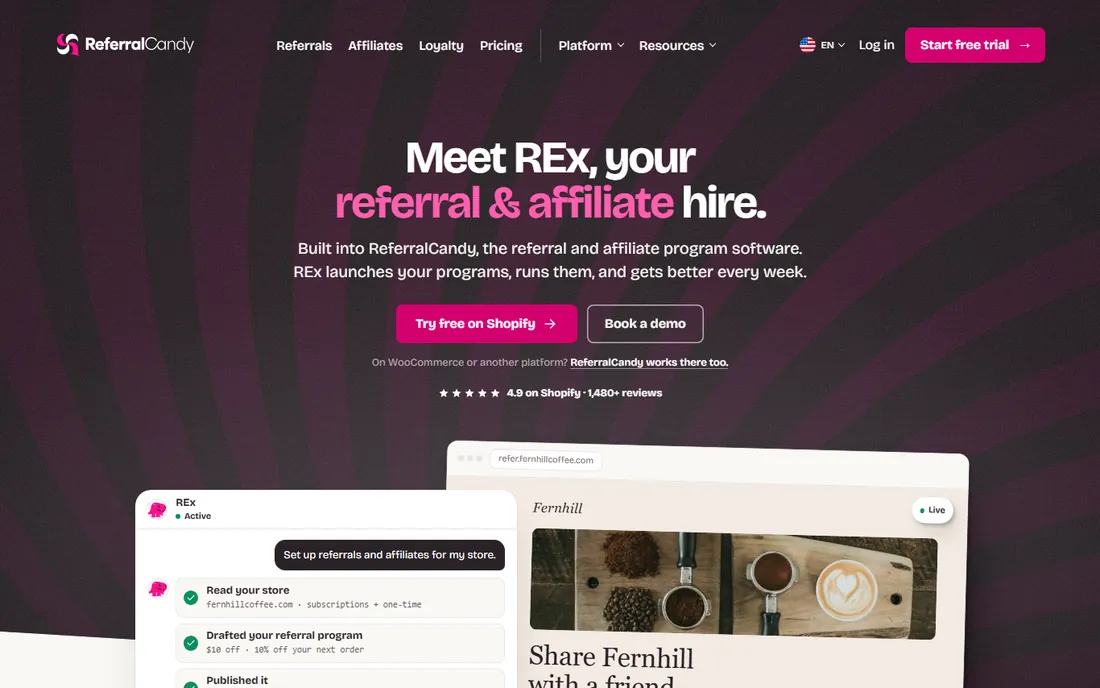
ReferralCandy is the boring-but-correct starting point for online stores. Connect Shopify or WooCommerce, set rewards, and the refer-a-friend program runs itself: referral links, automated emails, fraud checks, and reward payouts through PayPal, gift cards, or store credit. The $39 per month base plus a success fee of up to 10.5% on referred sales keeps the entry cost low.
The success fee is the catch to model. A store generating significant referral revenue can pay thousands annually in fees, at which point flat-rate alternatives cost less. The crossover typically sits around $30,000 to $60,000 in monthly referral revenue.
For stores doing under that threshold, ReferralCandy's speed and Shopify depth are unmatched. Launch in an afternoon, measure for a quarter, and reconsider the pricing model when the fees start to sting.
What we like- Fastest setup for ecommerce
- Deep Shopify and Klaviyo integrations
- Automated rewards and payouts
Watch out for- Success fee of up to 10.5% adds up at scale
- Ecommerce-focused, weak for SaaS
Starting price$250 per month
Free planFree trial
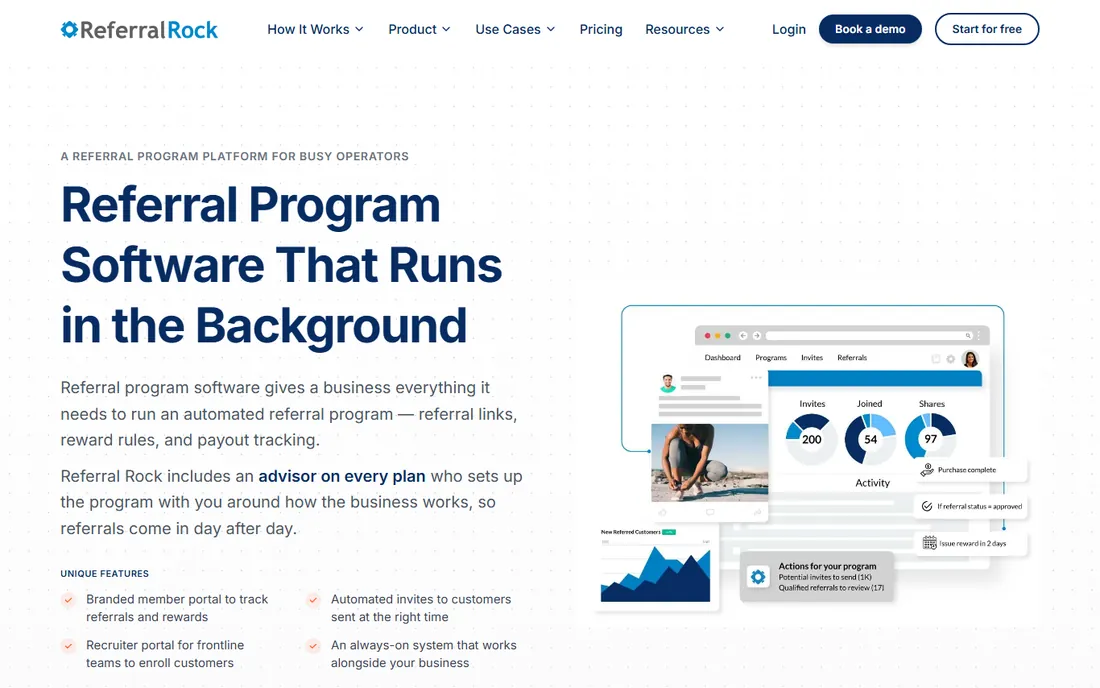
Referral Rock takes the opposite pricing approach: a flat $250 per month with unlimited referrals and no per-sale cut. For businesses where referral volume is high or growing, the flat rate becomes cheaper than success-fee models quickly. The platform covers customer referrals, ambassador programs, and partner referrals in one system.
The B2B and service-business fit is strong, with Salesforce and HubSpot integrations and program structures for non-transactional referrals like booked meetings. Ecommerce is supported but the template library is thinner than ReferralCandy's.
The $250 floor prices out small stores. But for mid-market companies where referrals are a real channel, predictable flat pricing beats watching a success fee grow with your success.
What we like- Flat monthly rate with no success fees
- Handles referrals, ambassadors, and partners
- Strong HubSpot and Salesforce integrations
Watch out for- $250 entry is steep for small stores
- Less ecommerce-template depth than ReferralCandy
Starting price$179 per month
Free planFree trial
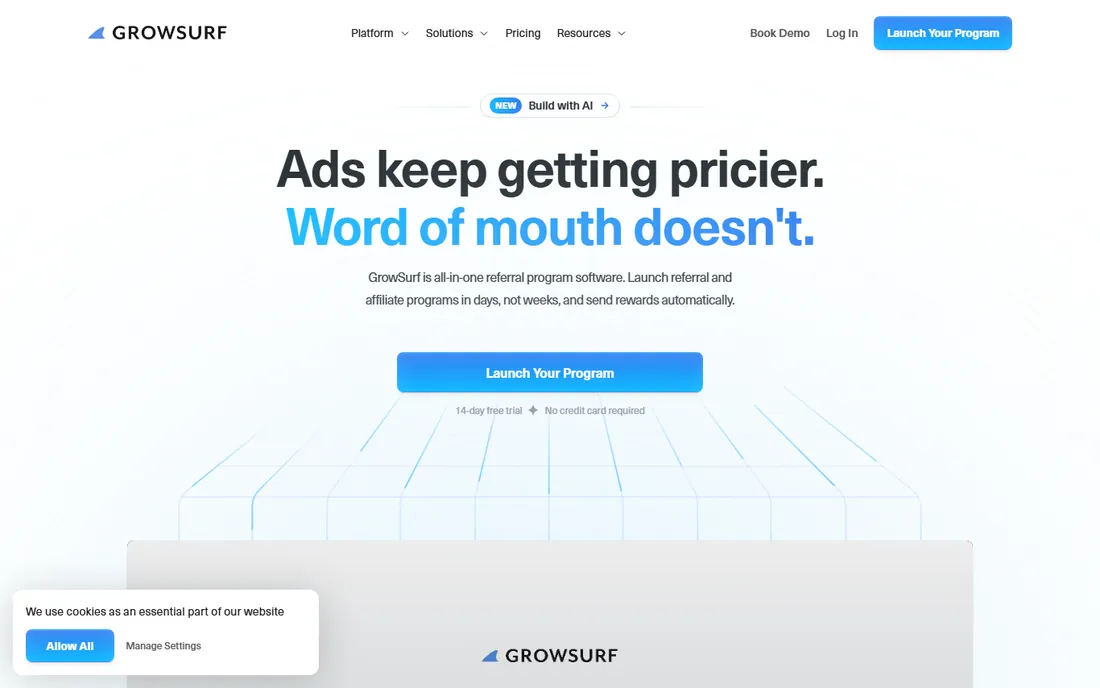
GrowSurf is the referral platform built for software companies. The API-first design embeds referral programs directly in the product, with webhooks, Stripe integration, and programmatic reward handling that developers can wire up in a day. Participant-based pricing means you pay for program size, not for each referral.
The Startup plan at $179 per month covers up to 10,000 participants with one program; annual billing brings the effective cost down. There are no per-referral fees, so a viral loop does not punish you financially.
Ecommerce brands will find the feature set thin compared to ReferralCandy. But for SaaS, fintech, and subscription businesses that want referrals inside the product experience, GrowSurf is the purpose-built choice.
What we like- Built for SaaS with API-first design
- Participant-based pricing, no per-referral fees
- Launches in under a day
Watch out for- $179 entry is high for tiny startups
- Ecommerce features are thin
Starting price$49 per month
Free planFree trial
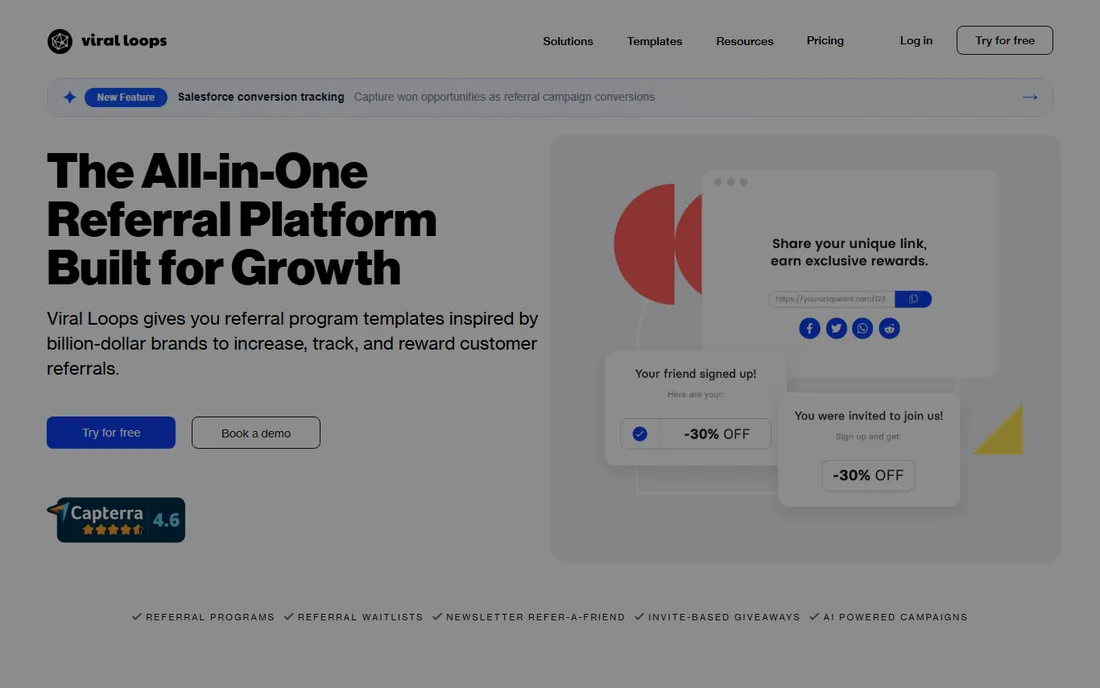
Viral Loops productized the famous referral playbooks: the Dropbox-style milestone rewards, the Harry's-style waitlist, the Robinhood giveaway mechanics. Pick a template, customize, and launch a campaign designed to go viral, with leaderboards, milestone rewards, and referral tracking built in.
The Startup plan at $49 per month covers up to 1,000 participants, scaling to $399 for 25,000, with no success fees. That makes it affordable for launches and campaigns where referral volume is unpredictable.
It is a campaign tool more than an always-on program platform. Businesses wanting a permanent post-purchase refer-a-friend widget will find ReferralCandy or Referral Rock more fitting. For launches, waitlists, and viral pushes, Viral Loops' templates are the fastest path.
What we like- Template-driven campaigns modeled on famous launches
- Affordable entry
- No success fees
Watch out for- Lighter integration set
- Less suited to always-on post-purchase programs
Starting priceSee website
Free planNo
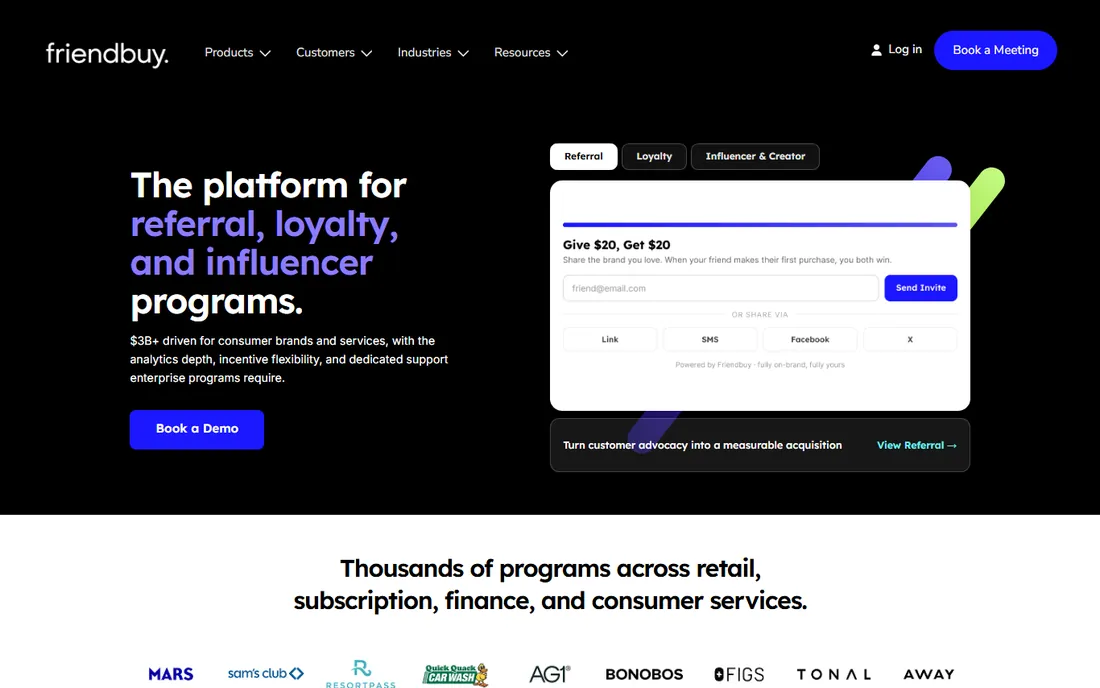
Friendbuy serves enterprise retail and DTC brands that run referral as part of a larger customer marketing operation. Referral, loyalty, and creator programs share one platform with unified customer data, and the A/B testing lets teams optimize offers scientifically rather than guessing.
The 90-day attribution window and detailed analytics suit brands where referred customers have high lifetime value and the program needs to prove ROI. Integrations with Klaviyo, HubSpot, and Salesforce connect referrals to the rest of the marketing stack.
Pricing is enterprise with annual contracts, which prices out everyone but serious programs. For brands where referrals are a strategic channel worth dedicated management, Friendbuy's depth justifies the enterprise motion.
What we like- Referral, loyalty, and creator programs in one platform
- Advanced A/B testing
- Deep Klaviyo and HubSpot integrations
Watch out for- Enterprise pricing with 12-month contracts
- Overkill for small programs
Starting priceSee website
Free planNo
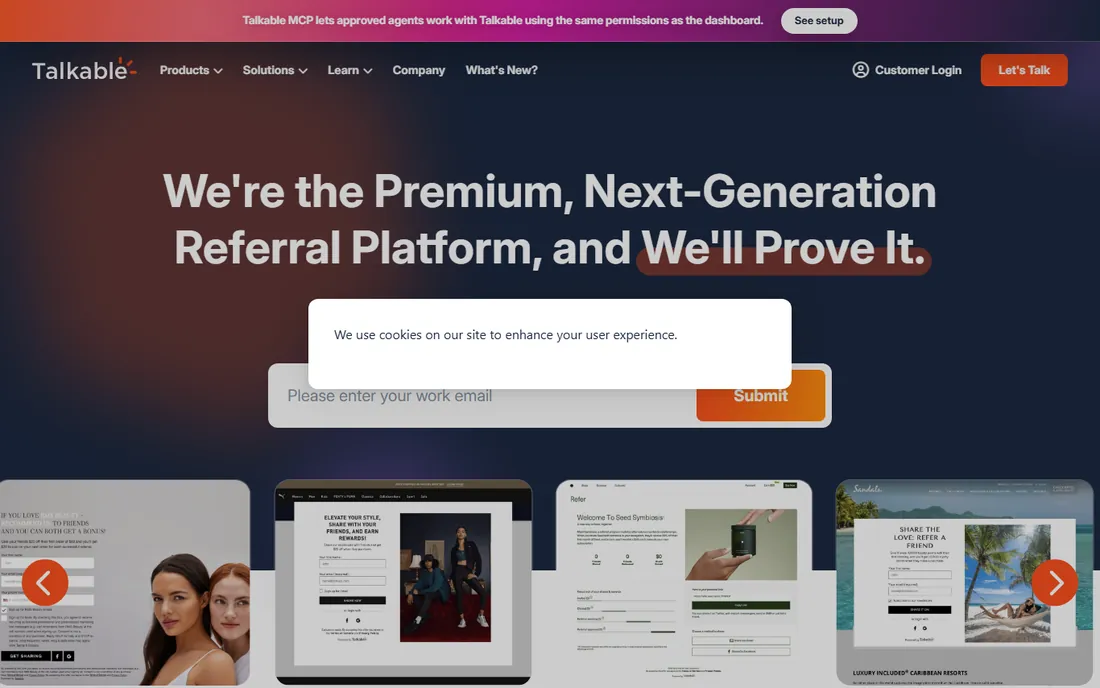
Talkable is the managed enterprise option for DTC brands. Beyond the software, the company provides consultative program design: strategists who help structure offers, targeting, and creative for maximum referral yield. The platform supports advanced rules, segmentation, and testing that self-serve tools cannot match.
Shopify Plus brands are the core audience, with the integration depth and scale to match. Reward options span discounts, store credit, and gift cards through multiple providers, with fraud controls for high-volume programs.
This is enterprise software with enterprise pricing and expectations. Brands doing modest referral volume will not justify it. For DTC companies where referrals drive meaningful revenue and deserve dedicated optimization, Talkable's managed approach delivers.
What we like- Advanced targeting and offer rules
- Consultative program design
- Strong Shopify Plus support
Watch out for- Enterprise pricing
- Requires dedicated management to justify cost
#7
Extole
Best for: large organizations with complex incentive programs
Visit extole.com
Starting priceSee website
Free planYes
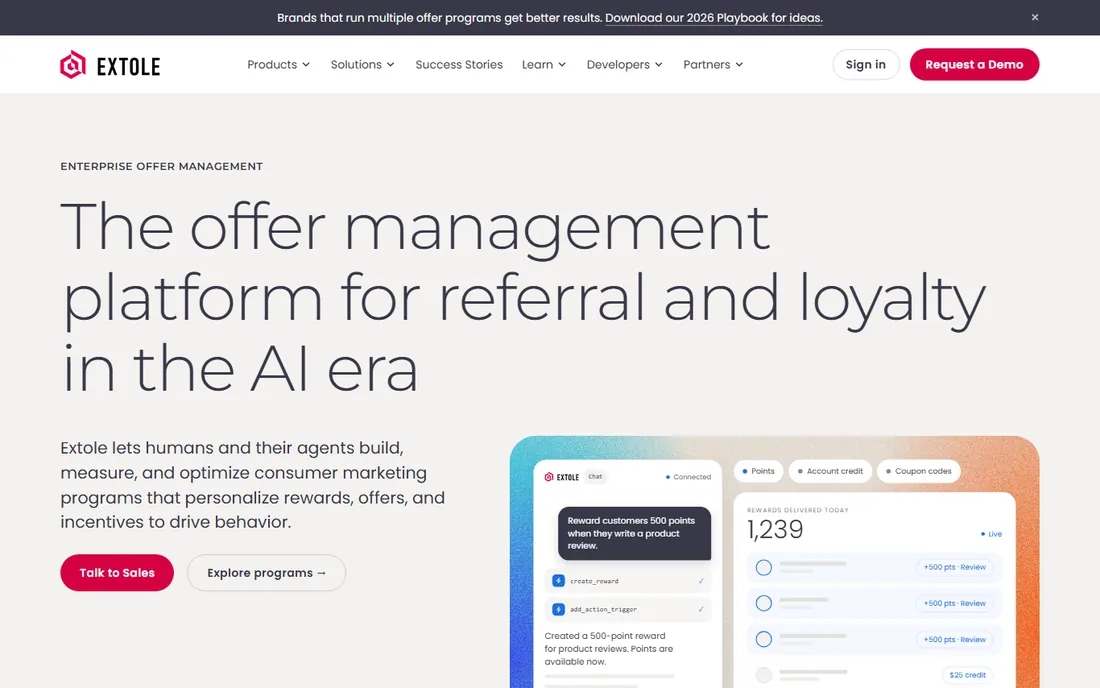
Extole is the enterprise incentive platform for organizations running referral at serious scale: complex reward structures, multi-brand programs, and the compliance requirements of finance and large retail. The platform's flexibility handles program designs that simpler tools cannot express.
The client list skews to large enterprises where referral programs involve legal review, tax handling of rewards, and integration with legacy systems. The platform is built for those realities.
Small and mid-size businesses should not be here; the sales motion and complexity assume enterprise resources. But it is notable that Extole offers a free plan, rare in the enterprise tier. For large organizations with complicated incentive needs, it is the natural fit.
What we like- Handles the most complex incentive structures
- Enterprise retail and finance track record
- Free plan available
Watch out for- Enterprise sales motion
- Complexity exceeds most SMB needs
Starting price$99 per month
Free planFree trial
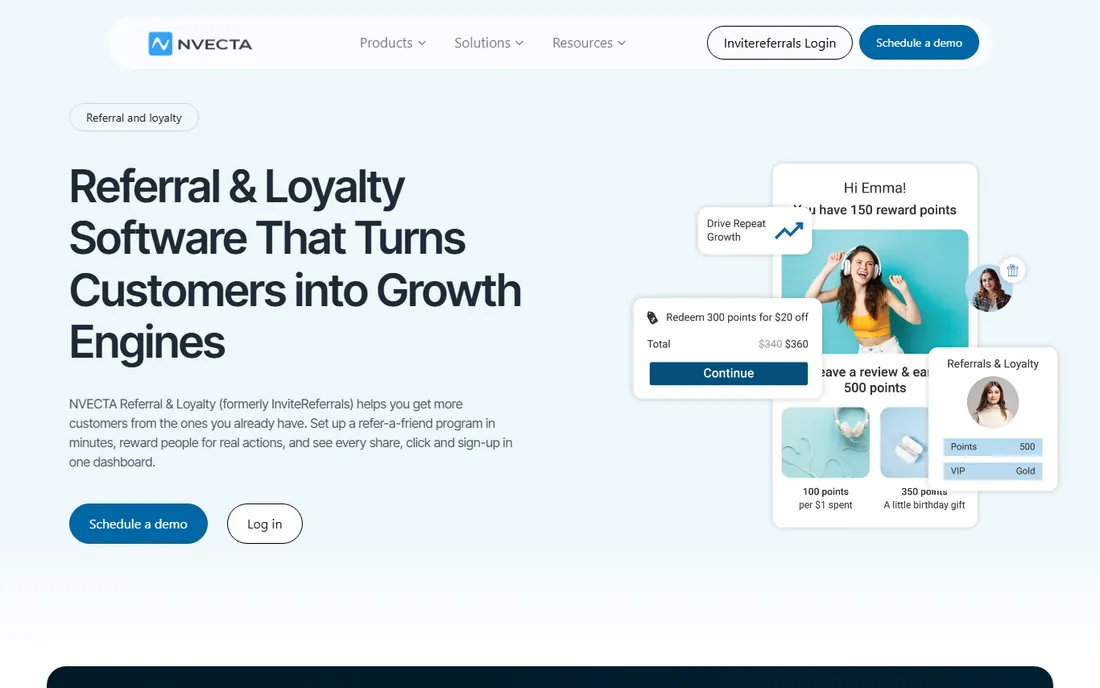
InviteReferrals gives small and mid-size businesses a multi-channel referral platform at $99 per month. Campaigns run across web, mobile, and social with flexible reward structures, and the Shopify and WooCommerce integrations cover the ecommerce base.
The platform sits between the entry-level tools and the enterprise tier: more capable than basic widgets, more affordable than Friendbuy or Talkable. For SMBs that need referral across multiple touchpoints without enterprise contracts, it fills the gap.
Brand recognition trails the category leaders, which matters less than the product working. For growing businesses outgrowing ReferralCandy's success fees but not ready for enterprise contracts, InviteReferrals is a sensible middle step.
What we like- Multi-channel campaigns across web, mobile, and social
- Flexible rewards
- Shopify and WooCommerce integrations
Watch out for- Less brand recognition than leaders
- Analytics less deep than enterprise tools
How we chose
We compared referral program platforms on campaign types, reward flexibility, fraud controls, integrations with ecommerce and CRM stacks, pricing model fairness, and fit for businesses of different sizes. We checked each vendor's pricing page and current 2026 roundups, read marketer reviews on G2 and Reddit, and weighed the total cost including success fees, not just the subscription. We did not run live referral campaigns; assessments reflect current documentation and user consensus as of October 2026.
Success fees vs flat rates: the math that decides
Referral platforms bill two ways, and the choice matters more than features. Success-fee models like ReferralCandy charge a base subscription plus a percentage of referred sales, cheap to start, expensive at scale. Flat-rate models like Referral Rock charge one monthly price regardless of volume.
Do the crossover math with your numbers. A store generating $80,000 monthly in referral revenue pays roughly $8,400 a year on a 10.5% success fee versus $3,000 on a flat $250 plan. Below about $30,000 in monthly referral revenue, success fees usually win on total cost. Above $60,000, flat rates almost always win. Between those lines, model both.
The strategic point: success fees tax your growth. Every additional referral dollar costs you a cut, which discourages the aggressive promotion that grows the program. Flat rates align incentives: the vendor profits when you stay, not when you grow. Start with success fees for the low entry cost, and switch to flat rates when the fees exceed the alternative.
How to design referral rewards that do not lose money
The reward economics decide whether the program works. The classic structure, give $20, get $20, works because both sides have a reason to act and the amounts are easy to understand. Complexity kills participation: tiered points, expiring credits, and conditional bonuses confuse customers into inaction.
Cap your exposure before launching. Set a maximum reward per referrer per month, exclude sale items if margins demand it, and require the referred purchase to clear the return window before paying out. Fraud is real: self-referrals, coupon abuse, and fake accounts will find your program within weeks. Every platform here includes fraud controls; configure them before launch, not after the first abuse.
Finally, measure the right number: cost per acquired customer through referrals versus your other channels. If referral CAC exceeds paid search CAC, the program is a feel-good expense, not a growth channel. Adjust rewards down until the math works, or shut it down. A referral program that loses money per customer is worse than no program.
Frequently asked questions
What is referral management software?
Referral management software runs refer-a-friend programs: it generates referral links, tracks who referred whom, prevents fraud, and automates reward payouts. It turns word-of-mouth into a measurable acquisition channel with attribution, analytics, and integrations to your store or CRM.
How much does referral software cost?
Entry pricing runs $39 to $250 per month: ReferralCandy from $39 plus a success fee, Viral Loops from $49, InviteReferrals at $99, GrowSurf at $179, Referral Rock at $250 flat. Enterprise platforms like Friendbuy, Talkable, and Extole are quote-based. Factor in success fees and reward costs, not just the subscription.
What is the best referral software for a Shopify store?
ReferralCandy is the fastest and most integrated option for Shopify, with deep Klaviyo integration and automated everything. Friendbuy and Talkable suit larger Shopify Plus brands. Yotpo works when referrals sit inside a broader loyalty program. Start with ReferralCandy unless referral revenue already justifies enterprise tooling.
ReferralCandy vs Referral Rock: which is better?
Choose ReferralCandy for the fastest launch and lowest entry cost, accepting the success fee. Choose Referral Rock for flat $250 monthly pricing with no per-referral cut, which wins once referral revenue passes roughly $30,000 to $60,000 monthly. Many stores start with ReferralCandy and migrate to Referral Rock as volume grows.
How do I prevent referral fraud?
Use the platform's built-in controls: require email verification, block self-referrals by matching payment details, set reward caps per referrer, delay payouts past the return window, and monitor for abnormal patterns. Fraud typically appears within weeks of launch; configure defenses before going live.
What referral rewards work best?
Simple, symmetric rewards: give $20, get $20, or 20% off for both sides. Cash, store credit, and discounts all work; the key is instant comprehensibility. Avoid complex tiered structures. Test reward size against customer acquisition cost: the reward should cost less than acquiring the same customer through paid channels.
Sources we checked (6)
- https://albato.com/blog/publications/best-referral-program-software
- https://www.itechguides.com/best/referral-marketing-software/
- https://adtools.org/buyers-guide/viral-loops-vs-referralcandy-vs-growsurf-vs-referral-rock-referral-marketing-buyer-s-guide
- https://kickofflabs.com/blog/viral-loops-alternatives/
- https://blog.zumvu.com/referral-marketing-software
- https://github.com/ishandutta2007/awesome-referral-marketing-platform/blob/HEAD/README.md
Is your product missing or out of date?
We review this list regularly. Vendors can request a listing, send updated pricing or ask about featured placement.

Shihab Mia · Founder, Rankite
Shihab has spent more than a decade helping SaaS and e-commerce brands grow through search. He writes Rankite's software buying guides from pricing pages, documentation and public user reviews. More about Shihab.