How we make this list: we compare pricing pages, product documentation and public user reviews. Ratings come from G2, Capterra or Trustpilot, with the date we checked them.
Key takeaways
- Workable and Zoho Recruit give small teams the fastest path to automated posting, screening, and scheduling without enterprise cost.
- Greenhouse and Lever suit mid-size and larger teams that need structured hiring, scorecards, and approval workflows.
- Paradox and GoodTime solve specific bottlenecks: high-volume screening and interview scheduling, which often cost recruiters the most time.
- Fetcher and LinkedIn Recruiter focus on sourcing, which matters most when inbound applications are not enough for hard roles.
- Automation works best for repetitive steps. Keep human judgment for interviews, offers, and final decisions.
Quick comparison
| Tool | Best for | Starting price | Free plan |
|---|
 Workable | Small team hiring automation | See website | Free trial |
 Greenhouse | Structured enterprise hiring | See website | No |
 Lever | Sourcing plus ATS automation | See website | No |
 Zoho Recruit | Budget ATS automation | See website | Yes |
 Manatal | Budget AI ranking and sourcing | See website | Free trial |
 Paradox | High-volume chatbot screening | See website | No |
 GoodTime | Interview scheduling automation | See website | No |
 Fetcher | Automated sourcing outreach | See website | No |
 LinkedIn Recruiter | Sourcing from LinkedIn network | See website | No |
Is your product missing or out of date?
We review this list regularly. Vendors can request a listing, send updated pricing or ask about featured placement.
#1Workable
Best for: Small team hiring automation4.4/5 on
G2 (706 reviews, checked Oct 2026)
Visit workable.com
Starting priceSee website
Free planFree trial
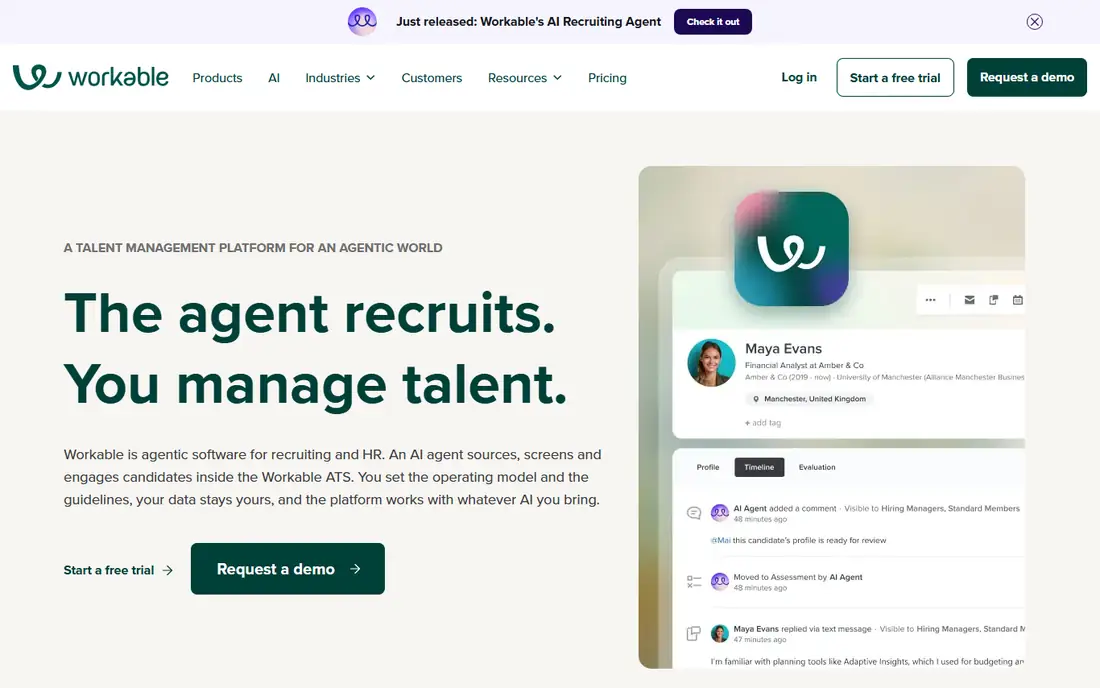
Workable is a practical starting point for small teams that hire regularly but do not have a large recruiting staff. It posts jobs to multiple boards, parses resumes, moves candidates through a visual pipeline, and automates messages and interview scheduling. That combination removes the manual work that slows small teams most.
Larger organizations may outgrow Workable when they need complex approvals, deep reporting, or heavy customization. For teams hiring a few roles at a time, the simplicity is a benefit, not a limit, because recruiters can set it up and use it without a long implementation.
What we like- Easy job posting to many boards
- Automated screening and candidate messaging
- Useful AI help for job descriptions and sourcing
Watch out for- Advanced reporting is limited on lower plans
- Enterprise customization is less deep than Greenhouse
#2Greenhouse
Best for: Structured enterprise hiring4.4/5 on
G2 (4,033 reviews, checked Oct 2026)
Visit greenhouse.com
Starting priceSee website
Free planNo
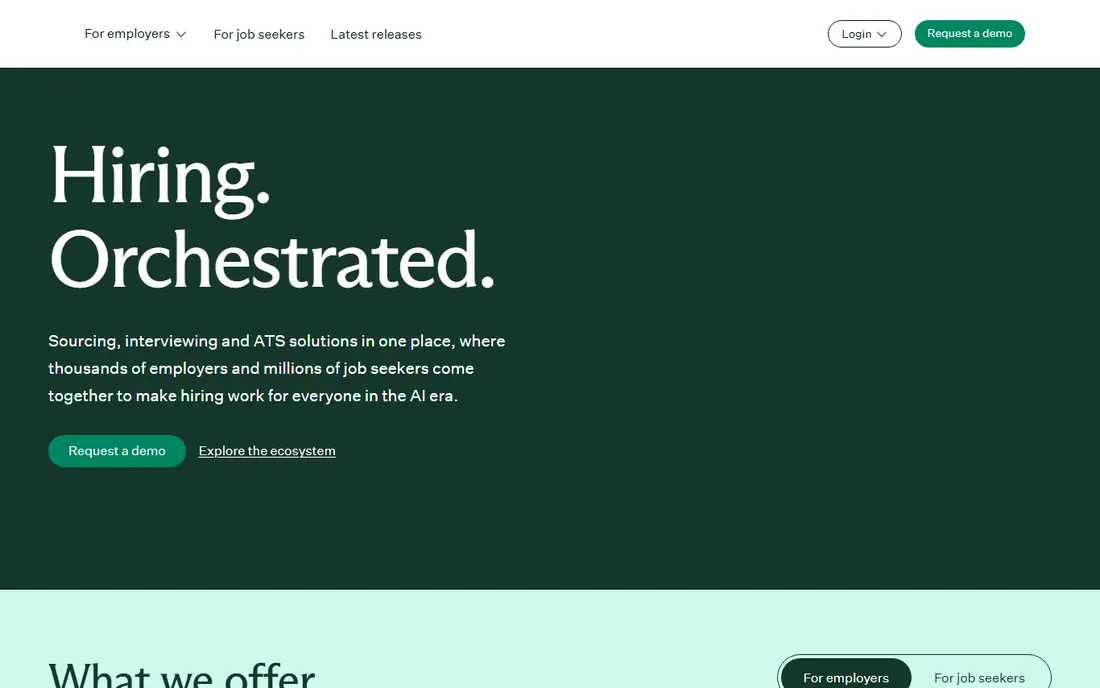
Greenhouse suits companies where hiring has become a formal process, with multiple interviewers, hiring managers, and compliance needs. Scorecards, structured interview kits, and stage approvals help teams compare candidates fairly and defend decisions. Automation triggers move candidates, send messages, and collect feedback without manual chasing.
The cost and setup reflect that depth. Greenhouse is not a quick tool for a single hire, and smaller teams may find it more process than they need. For scaling companies that need consistency across many hires, the structure pays off in better decisions and clearer data.
What we like- Structured interviews and scorecards
- Strong approval and reporting workflows
- Broad integrations
Watch out for- Quote-based pricing
- Implementation takes more time than simpler ATS tools
#3Lever
Best for: Sourcing plus ATS automation4.3/5 on
G2 (2,123 reviews, checked Oct 2026)
Visit lever.co
Starting priceSee website
Free planNo
Lever is built for teams that source actively, not only wait for applications. The CRM side tracks passive candidates, runs nurture campaigns, and keeps sourcing pipelines visible beside active job pipelines. Automation helps recruiters follow up at the right time, rather than letting good candidates go cold.
Lever pricing is quote-based, and the platform rewards teams that invest in sourcing as a routine. Companies that hire only from inbound applications may not use its strongest features. For teams with dedicated sourcers, Lever ties sourcing and hiring into one workflow.
What we like- Combines ATS and CRM for sourcing
- Nurture campaigns for passive candidates
- Strong analytics for pipeline health
Watch out for- Quote-based pricing
- Some teams find the interface takes time to learn
#4Zoho Recruit
Best for: Budget ATS automation4.4/5 on
G2 (1,867 reviews, checked Oct 2026)
Visit zoho.com
Starting priceSee website
Free planYes
Zoho Recruit is the budget pick for small teams and startups that need automation without a large contract. It offers job posting, resume parsing, pipeline automation, and candidate messaging, with a free plan for one recruiter. Teams already using Zoho CRM or other Zoho apps get cleaner integration.
The trade-off is polish. Some workflows take more clicks than Workable, and AI matching is useful but not best in class. For cost-conscious teams that need core automation and can accept a learning curve, Zoho Recruit delivers strong value.
What we like- Free plan for a single recruiter
- Automation rules and resume parsing
- Integrates with other Zoho apps
Watch out for- Interface feels dated in places
- Advanced AI features are less polished than rivals
#5Manatal
Best for: Budget AI ranking and sourcing4.8/5 on
G2 (147 reviews, checked Oct 2026)
Visit manatal.com
Starting priceSee website
Free planFree trial
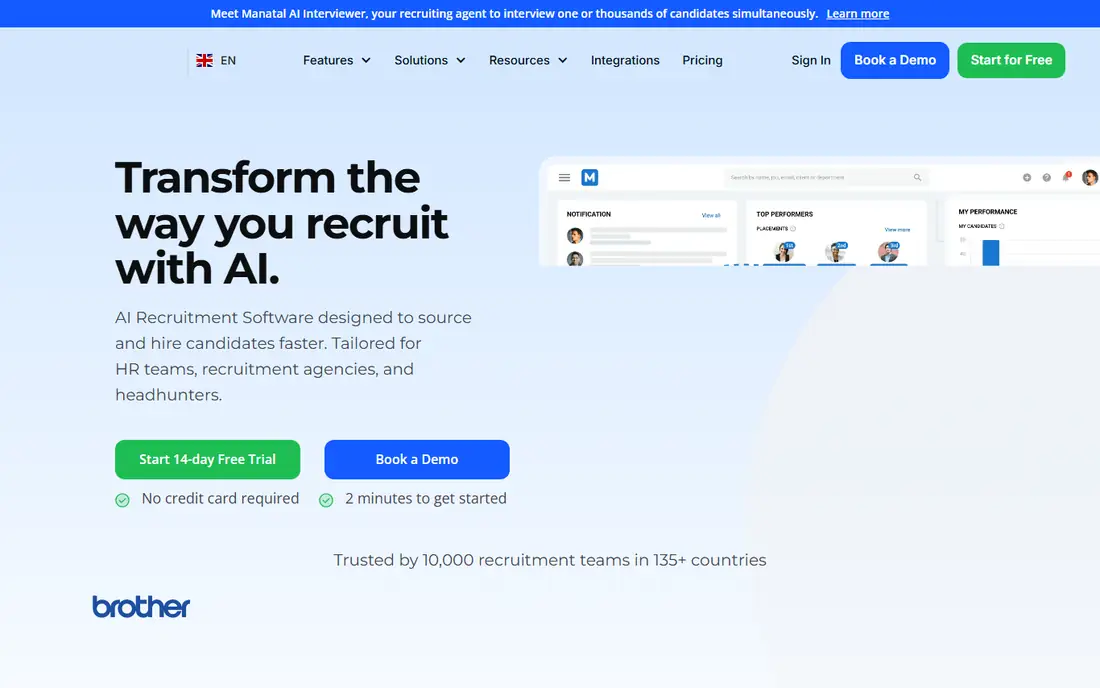
Manatal targets small agencies and small businesses that want AI ranking without enterprise pricing. It parses resumes, ranks candidates against a job, enriches profiles from public sources, and supports sourcing and outreach in the same tool. That bundle is rare at its price point.
Manatal is less proven for large corporate hiring, and its integrations are fewer than those of Greenhouse or Lever. For solo recruiters, small agencies, and startups hiring on a budget, it offers automation that would otherwise require several tools.
What we like- Low per-user pricing
- AI candidate ranking and enrichment
- Sourcing tools included
Watch out for- Smaller integration library than Workable
- Reporting is basic on lower plans
#6Paradox
Best for: High-volume chatbot screening4.5/5 on
G2 (94 reviews, checked Oct 2026)
Visit paradox.ai
Starting priceSee website
Free planNo
Paradox, known for its Olivia assistant, automates the front end of high-volume hiring. Candidates can apply, answer screening questions, and book interviews by text at any hour, without waiting for a recruiter. That speed matters for retail, hospitality, warehouses, and other hourly hiring, where candidates often take the first offer they receive.
Paradox is less useful for senior roles that need nuanced conversation and judgment. Pricing is enterprise-level, so small teams hiring a few people a year will not see a return. For high-volume teams, the time saved on screening and scheduling is the main value.
What we like- 24/7 chatbot screening by text
- Automated interview scheduling
- Strong for hourly and high-volume roles
Watch out for- Enterprise pricing
- Less suited to senior or highly specialized hiring
#7GoodTime
Best for: Interview scheduling automation4.4/5 on
G2 (117 reviews, checked Oct 2026)
Visit goodtime.io
Starting priceSee website
Free planNo
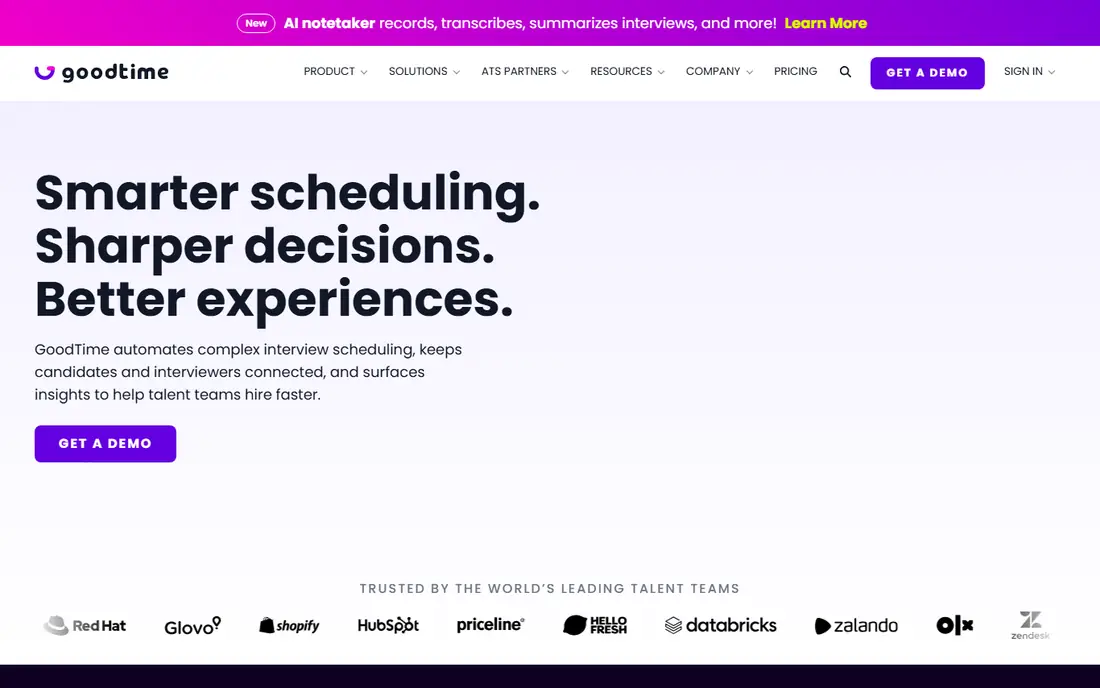
GoodTime solves one painful problem well: scheduling interviews with several people across time zones. It checks calendars, proposes times, sends invites, and handles rescheduling, which removes dozens of emails per hire. For companies running many interviews each week, that saving adds up quickly.
GoodTime is not a full applicant tracking system, so teams still need an ATS beside it. Pricing is quote-based and aimed at companies with meaningful interview volume. Teams with light scheduling needs can use built-in ATS scheduling instead.
What we like- Automates panel and multi-time-zone scheduling
- Integrates with calendars and ATS tools
- Reduces back-and-forth emails
Watch out for- Focused on scheduling, not full ATS
- Pricing is quote-based
#8Fetcher
Best for: Automated sourcing outreach4.6/5 on
G2 (28 reviews, checked Oct 2026)
Visit fetcher.ai
Starting priceSee website
Free planNo
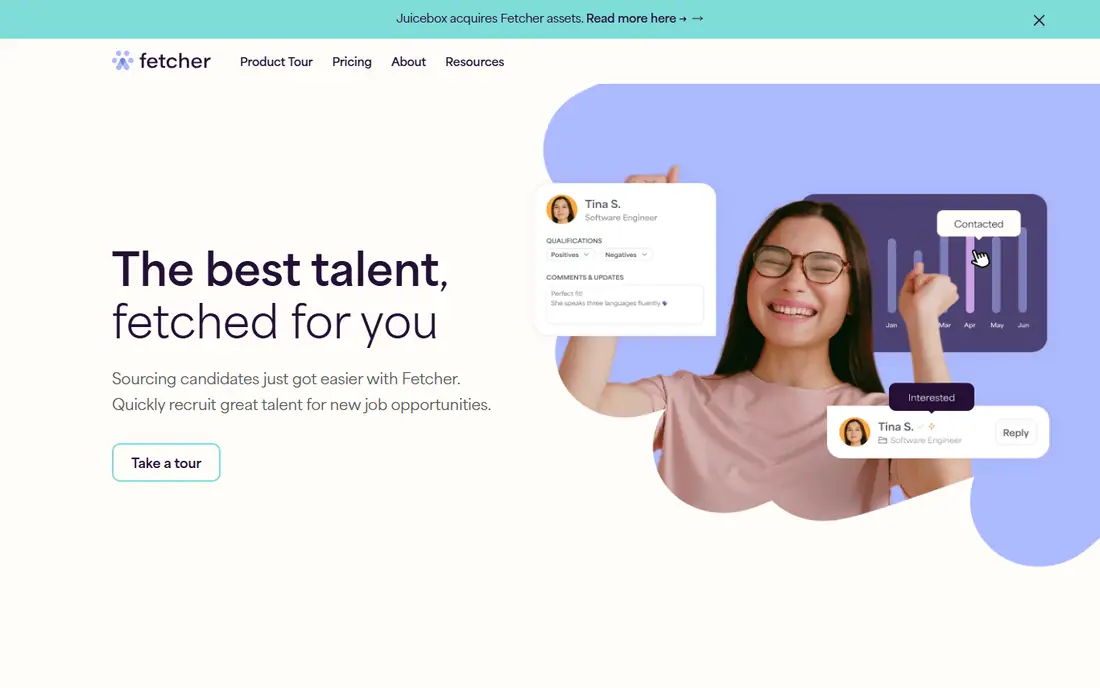
Fetcher automates the top of the funnel for teams that struggle to find candidates. It searches for matching profiles, sends personalized outreach, and tracks responses, which helps for technical and niche roles where inbound applications are thin. Recruiters spend more time talking to interested candidates and less time searching.
Automation does not fix a weak job description or unrealistic requirements. Outreach results depend on targeting, message quality, and follow-up, so teams should review Fetcher campaigns rather than running them blind. For hard-to-fill roles, it adds pipeline that an ATS alone cannot create.
What we like- Automated candidate discovery and outreach
- AI matching for technical and niche roles
- Saves sourcer time
Watch out for- Quote-based pricing
- Outreach quality depends on targeting and message setup
Starting priceSee website
Free planNo
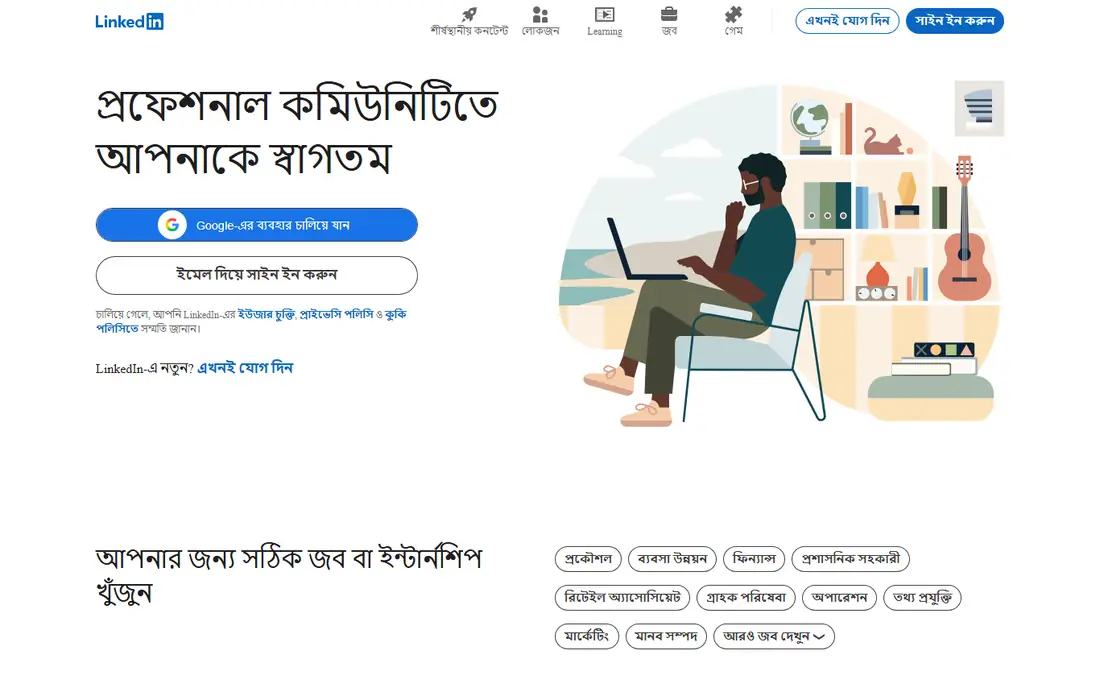
LinkedIn Recruiter remains the standard sourcing tool for professional and specialized roles, because so many candidates keep profiles on LinkedIn. Advanced filters, saved searches, and candidate insights help recruiters find people who are not actively applying. InMail gives a direct channel to passive candidates.
Cost is the main barrier, especially for small teams, and pricing varies by plan and region. LinkedIn Recruiter also works best as a sourcing layer beside an ATS, not as a replacement for one. For teams hiring professional roles regularly, it is often the first sourcing investment.
What we like- Access to the largest professional network
- Advanced search filters and candidate insights
- InMail outreach built in
Watch out for- Expensive for small teams
- Candidate data depends on LinkedIn profiles
How we chose
We compared pricing pages, product documentation, and public reviews on G2, Capterra, and Reddit, and checked each tool for automation depth, sourcing, screening, scheduling, and fit for different team sizes. We kept tools with current automation features for US hiring, and we excluded tools that were discontinued or offered only manual tracking. We did not claim hands-on testing.
Automating hiring without losing the human part
Automation should remove repetitive work, not remove judgment from hiring. The best teams automate the steps that are the same every time, and keep people involved where context and fairness matter.
Automate posting, screening, and scheduling first
These steps are repetitive, time-sensitive, and easy to measure. Automated posting reaches more boards, screening questions filter clearly unqualified applicants, and scheduling tools remove email delays. Start here, and measure time saved before you add AI ranking or outreach.
Keep interviews and offers human
AI ranking and chatbots can help, but they should not make final hiring decisions alone. Review ranked lists for bias, check chatbot screening questions for fairness, and keep a human in charge of interviews, references, and offers. Document how automation is used, so candidates and hiring managers understand the process.
Measure quality, not just speed
Faster hiring is not better hiring if new hires leave quickly or perform poorly. Track time to hire beside offer acceptance, hiring manager satisfaction, and early retention. If automation speeds hiring but lowers quality, adjust screening criteria and human review steps before you scale it further.
Frequently asked questions
What is the best recruiting automation tool for small businesses?
Workable and Zoho Recruit are the strongest small-business picks, with Manatal close behind for budget AI ranking. Workable is easier to set up, Zoho Recruit is cheaper for a single recruiter, and Manatal offers strong value for small agencies. Choose based on budget, hiring volume, and whether you already use Zoho apps.
Can recruiting automation replace recruiters?
No, automation replaces repetitive tasks, not recruiter judgment. It helps with posting, sourcing, screening, and scheduling, but interviews, relationship building, and final decisions still need people. Teams that use automation well free recruiters to spend more time with candidates, not less.
Which tool is best for high-volume hiring?
Paradox is best for high-volume hourly hiring, because its chatbot screens and schedules candidates around the clock. GoodTime helps with interview scheduling at volume, and Workable or an enterprise ATS handles the pipeline behind them. Combine a screening tool with a scheduling tool for the best result.
How much does recruiting automation software cost?
Costs range from free for a single Zoho Recruit user to quote-based enterprise contracts for Greenhouse, Lever, and Paradox. Mid-range tools often start at low per-user monthly rates, with higher tiers for advanced reporting and integrations. Request a quote based on recruiter count and hiring volume, not just a headline price.
Is AI candidate ranking fair?
AI ranking can help, but it can also repeat bias from past hiring data if it is not checked. Review ranked lists, test screening criteria, and keep human review for shortlists. Vendors should explain what data their models use, and teams should monitor outcomes by group where legally allowed.
Do I need an ATS and a sourcing tool?
Many teams need both, because an ATS manages applicants while a sourcing tool finds passive candidates. Workable, Lever, and Manatal bundle some sourcing into the ATS, while Fetcher and LinkedIn Recruiter add deeper sourcing. Start with an ATS, then add sourcing when inbound applications are not enough.
Sources we checked (9)
- https://www.workable.com
- https://www.greenhouse.com
- https://lever.co
- https://www.zoho.com
- https://www.manatal.com
- https://www.paradox.ai
- https://www.goodtime.io
- https://www.fetcher.ai
- https://www.linkedin.com
Is your product missing or out of date?
We review this list regularly. Vendors can request a listing, send updated pricing or ask about featured placement.

Shihab Mia · Founder, Rankite
Shihab has 5+ years in B2B and SaaS SEO. He writes Rankite's software buying guides from pricing pages, documentation and public user reviews. More about Shihab.