How we make this list: we compare pricing pages, product documentation and public user reviews. Ratings come from G2, Capterra or Trustpilot, with the date we checked them.
What is the best private equity software for deal sourcing?
Grata is the best starting point for most private equity firms because it pairs a large private-company database with natural-language search at a reported starting price near $15,000 per year. Firms that need transaction data and comps should add PitchBook, while smaller teams that source through relationships should look at Affinity. No single tool covers discovery, data and workflow on its own.
Key takeaways
- Grata and SourceScrub lead on proprietary discovery of founder-owned and lower-middle-market companies, with SourceScrub now being folded into Grata after the Datasite acquisition.
- PitchBook remains the reference for transaction data, valuations and comps, but it is weaker at finding companies that have never appeared on a deal tape.
- Inven and Gain.pro are the challengers: Inven for AI-native global search, Gain.pro for analyst-verified European financials.
- Affinity and 4Degrees do not hold company databases. They turn the relationships a firm already has into sourced deals through automatic activity capture.
- Expect quote-based pricing almost everywhere. Reported ranges run from about $10,000 per year for Inven to $25,000 to $50,000 or more per seat per year for PitchBook.
Quick comparison
| Tool | Best for | Starting price | Free plan |
|---|
 Grata | Private equity teams that want AI search across millions of private companies | From $15,000/yr (third-party reported; vendor quotes on request) | Free trial via sales |
 SourceScrub | Firms sourcing founder-owned companies through conferences and associations | Quote; reported $20,000-$60,000/yr | No |
 PitchBook | Transaction data, valuations, comps and fund performance | Quote; reported $25,000-$50,000+/seat/yr | Demo only |
 Inven | AI-native global search and fast buyer lists for lean teams | From ~$10,000/yr (reported) | Free trial |
 Gain.pro | European buyout and add-on sourcing with verified financials | Quote; reported low-to-mid five figures/yr | No |
 Axial | Lower-middle-market deal flow from intermediaries and business owners | Quote; reported $5,000-$25,000/yr | No |
 Affinity | Relationship intelligence and warm introductions for VC and PE teams | $2,000/user/yr (Essential, published) | Free trial |
 4Degrees | Small PE and VC teams that want relationship intelligence without enterprise overhead | Quote; third-party $100-$250/user/mo, conflicting | No |
Is your product missing or out of date?
We review this list regularly. Vendors can request a listing, send updated pricing or ask about featured placement.
The best private equity software for deal sourcing
#1
Grata
Best for: Private equity teams that want AI search across millions of private companies
Visit grata.com
Starting priceFrom $15,000/yr (third-party reported; vendor quotes on request)
Free planFree trial via sales
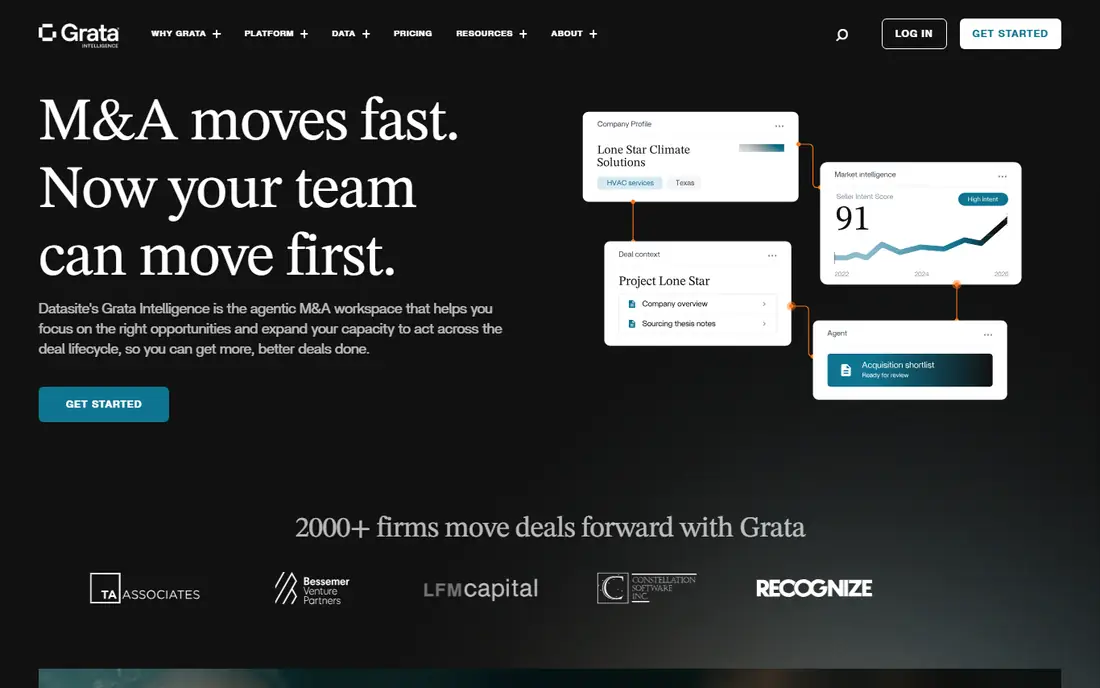
Grata makes the private-company universe searchable. Its database covers millions of private companies, with keyword and natural-language search, firmographic filters and ownership data. The similarity feature is the practical differentiator: give it a company that fits the thesis and it returns lookalikes, which is how most sourcing work actually starts. Conference attendee data is another genuine edge, because it tells a deal team when decision makers are gathered in one place. The platform expanded into the UK, Germany, France and Australia using registry-sourced data, and added filings lookup across more than 25 countries. The pricing page shows plan tiers but no dollar figures, so a sales call is required. Third-party reports put the basic plan near $15,000 per year, with mid-market quotes landing near $40,000 per year once CRM integrations and extra seats are included. The range across sources runs from about $15,000 to $100,000 per year depending on team size and modules. Grata is also the official successor to SourceScrub, since Datasite owns both products and is integrating SourceScrub data into Grata.
What we like- Large private-company database with natural-language search
- Similarity search finds companies like a known target
- Conference attendee data helps time outreach
Watch out for- Contact data is thin compared with dedicated contact providers, so most teams pair it with an enrichment tool
#2
SourceScrub
Best for: Firms sourcing founder-owned companies through conferences and associations
Visit sourcescrub.com
Starting priceQuote; reported $20,000-$60,000/yr
Free planNo
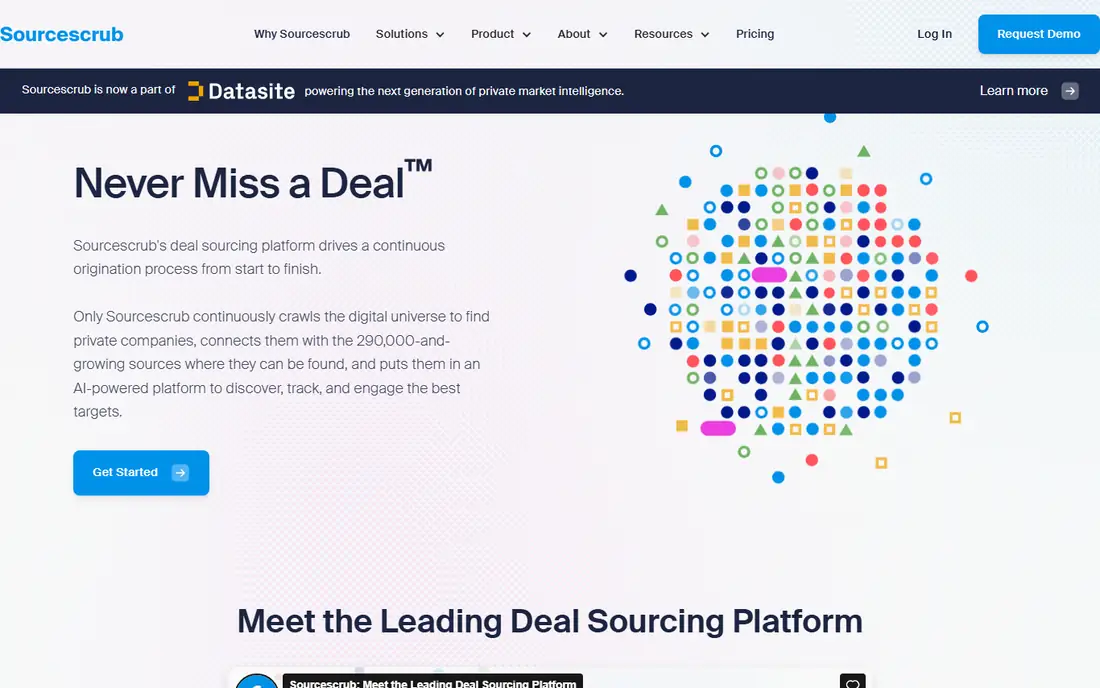
SourceScrub takes a different approach from Grata. Instead of crawling the web, it curates data from conferences, trade associations and niche industry events, which makes it strong on founder-owned businesses that barely exist online. The database covers more than 15 million company profiles, with packages from Discovery Essentials to Winning Professional and company limits scaling from 250 to more than 1,000. Reviewers on G2 rate it 4.5 out of 5 across 56 reviews, but flag data inaccuracy and usability issues, and contact bounce rates can run near 15 percent. Pricing is quote-based across three tiers, with reported ranges of $20,000 to $60,000 per year depending on tier and team size. The important change for buyers is the August 2025 Datasite acquisition: SourceScrub data is being integrated into Grata, and Grata is described by the vendor as the successor product. A firm buying SourceScrub today should get the migration path and support commitments in writing.
What we like- Human-enriched data from conferences, trade associations and niche events
- Strong on bootstrapped companies with little online presence
Watch out for- Datasite acquired SourceScrub in August 2025 and is folding its data into Grata, so buyers should confirm the standalone product roadmap before signing
#3PitchBook
Best for: Transaction data, valuations, comps and fund performance4.5/5 on
G2 (261 reviews, checked Oct 2026)
Visit pitchbook.com
Starting priceQuote; reported $25,000-$50,000+/seat/yr
Free planDemo only
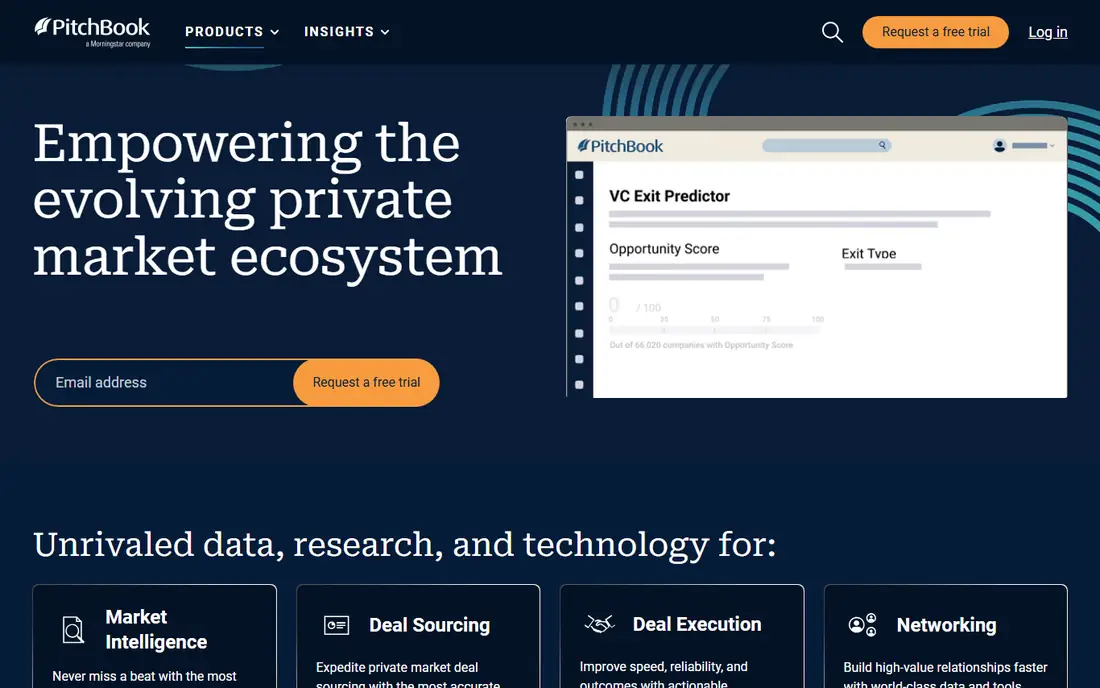
PitchBook is the default reference in private markets. It covers deal histories, valuations, investors and fund data on more than 3 million companies, concentrated on names that have raised capital or transacted. For comps, valuation work and validating a deal, nothing else in this list matches its depth. Add-on modules such as PitchBook News, the Excel plugin and the LP and GP dataset run $3,000 to $8,000 each on top of the base license. Customer-reported pricing puts single seats at $12,000 to $13,500 per year in some reports and $25,000 to $30,000 per year in others, with multi-seat deals ranging from $18,000 to $24,000 per year and a reported five-seat minimum. Treat the wide range as a warning: the price depends heavily on seats, modules and negotiation. The honest limitation is discovery. PitchBook excels at companies already on a deal tape and is thinner as a way into companies that have never appeared on one. Most firms use it alongside a discovery tool such as Grata or Inven rather than instead of one.
What we like- Broadest private markets data set for deals, funds and valuations
- Excel plugin fits existing workflows
- PitchBook AI adds natural-language search
Watch out for- Weaker at granular discovery of companies that have never raised or transacted, and the per-seat cost is the highest in this list
#4
Inven
Best for: AI-native global search and fast buyer lists for lean teams
Visit inven.ai
Starting priceFrom ~$10,000/yr (reported)
Free planFree trial
Inven is the AI-native challenger in this list, built specifically for private-market deal sourcing. It holds data on more than 28 million companies and 430 million executives, and the search works in plain language: describe the ideal target and it returns matches, rather than asking the user to build Boolean strings. The output is the differentiator. It produces buyer lists, market maps and company one-pagers in the firm own PowerPoint template, and runs saved workflows such as watchlist refreshes. More than 1,000 investment banks, private equity firms, consultancies and corporate development teams use it, and one user reports building buyer lists ten times faster. Pricing is custom and aligned to firm size and sourcing mandate, with reported starting prices near $10,000 per year and a free trial available. The trade-offs are youth and scope. It is not a public-markets modeling tool, so comps and valuation still need PitchBook or Capital IQ, and it is not the strongest contact-data provider. For sub-$100M funds and lean teams that want modern discovery without incumbent pricing, it is the most accessible entry point here.
What we like- 28M+ companies and 430M+ contacts with natural-language search
- Produces buyer lists, market maps and one-pagers in the firm PowerPoint template
Watch out for- Founded in 2022, so the practitioner community is smaller than the incumbents, and it has no conference data
#5
Gain.pro
Best for: European buyout and add-on sourcing with verified financials
Visit gain.pro
Starting priceQuote; reported low-to-mid five figures/yr
Free planNo
Gain.pro covers European private companies with a depth US-centric databases do not match. The platform blends official filings with analyst research, so the financials on a target are verified rather than estimated. It focuses on profitable, fast-growing businesses that fit buyout or add-on criteria, which makes it a screening tool as much as a discovery tool: the filters express an investment thesis, not just a sector. Pricing is custom enterprise pricing, typically low-to-mid five-figure annual licenses per firm, with no free tier. The limitation is geography. A firm with a US-only mandate will find thinner coverage than Grata or SourceScrub offer, and a firm with a transatlantic mandate should budget for Gain.pro alongside a US database. For European or transatlantic theses, its analyst-curated data earns its seat.
What we like- Analyst-verified financial, ownership and performance data on European private companies
- Strong on profitable, fast-growing businesses
Watch out for- European focus means thinner coverage of US companies, and pricing is enterprise and sales-led
#6
Axial
Best for: Lower-middle-market deal flow from intermediaries and business owners
Visit axial.net
Starting priceQuote; reported $5,000-$25,000/yr
Free planNo
Axial is a marketplace rather than a database, and that distinction matters. It connects buyers with sellers, bankers and brokers in the lower middle market, so the deal flow it produces comes from intermediaries rather than from a screen. For firms hunting $2M to $50M enterprise value acquisitions, that is often where the deals are. Pricing is quote-based, with third-party reports putting the range near $5,000 to $25,000 per year depending on access and seat count. The honest limitation is control. A marketplace gives a firm access to marketed deals, not proprietary ones, and the quality of what arrives depends on who is selling. Firms that rely on Axial alone tend to see the same deals as every other buyer on the platform. Used as one channel alongside a discovery database and a relationship CRM, it adds volume that the other tools miss.
What we like- Marketplace model surfaces deals from bankers, brokers and owners that never appear in databases
- Useful for $2M-$50M enterprise value targets
Watch out for- Deal quality varies by intermediary, and a marketplace cannot replace proprietary outreach for the best off-market targets
#7Affinity
Best for: Relationship intelligence and warm introductions for VC and PE teams4.5/5 on
G2 (452 reviews, checked Oct 2026)
Visit affinity.co
Starting price$2,000/user/yr (Essential, published)
Free planFree trial
Affinity approaches sourcing from the relationship side. Instead of asking dealmakers to log activity, it captures email, calendar and meeting data automatically and builds a firm-wide network graph, then scores relationship strength and surfaces the best path to a warm introduction. For sourcing-driven firms, that network map is the product. Deployment is fast, typically under 60 days, and more than 3,000 firms use it across private capital and investment banking. Pricing is published, which is rare in this category: Essential starts at $2,000 per user per year, Scale at $2,300 and Advanced at $2,700, with Enterprise by quote and annual billing only. The honest catch is scope. Affinity is a deal and relationship CRM, not a company database, so it cannot find a target the firm has no connection to. It also has no fund accounting, capital call workflows or full LP portal, so the back office needs other systems. For the front office, it is the best pick for turning existing relationships into sourced deals.
What we like- Automatic capture of email and calendar activity builds a firm-wide network graph
- Relationship strength scores and warm introduction paths
- Published pricing
Watch out for- It holds no company database, so it must sit alongside a discovery tool, and per-user pricing adds up as the firm grows
#84Degrees
Best for: Small PE and VC teams that want relationship intelligence without enterprise overhead4.5/5 on
G2 (5 reviews, checked Oct 2026)
Visit 4degrees.ai
Starting priceQuote; third-party $100-$250/user/mo, conflicting
Free planNo
4Degrees is the pragmatic pick for small PE and VC teams that want Affinity-style relationship intelligence without enterprise overhead. It automates email and calendar capture, scores relationship strength, maps warm introduction paths, and includes its full AI lineup, including document intelligence that pulls deal data from CIMs, on every plan. Onboarding, migration and customer success come included, and implementation is measured in days to weeks rather than quarters. Pricing is the frustration. The vendor does not publish prices and quotes per user per month, while third-party sources disagree sharply: about $100 per user per month in one, about $250 in another, and $4,000 to $8,000 per user per year in a third. Mid-market teams should budget toward the higher end. The vendor is also younger and smaller than Affinity, and some integrations depend on Zapier rather than native connections. For emerging managers and small teams, the speed and total cost still usually favor 4Degrees over DealCloud.
What we like- Automatic email and calendar capture with relationship scoring and warm introduction paths
- AI document intelligence included on every plan
- Fast onboarding
Watch out for- Pricing is not published and third-party figures conflict widely, from about $100 to about $670 per user per month, so buyers must negotiate blind
How we chose
We compared tools that PE firms actually buy for sourcing, not generic sales databases. Discovery depth, data quality, relationship intelligence and honest pricing mattered most. Prices were checked against vendor pages and third-party pricing reports in November 2026. Where the vendor hides pricing, we say so and give the reported range with its source, flagged as unconfirmed. No hands-on testing was performed.
What to check before you buy
Start by separating discovery from data. A company database finds targets. A transaction database validates them. A relationship CRM turns warm connections into meetings. Most firms need two of the three, and buying all three from one vendor usually means overpaying for the weakest piece. Ask each vendor for a trial on a live mandate, not a canned demo: give it a real thesis and count how many targets it returns that the team did not already know. Check the contract terms that matter in this category, including seat minimums, annual-only billing, and what happens to saved lists and data if the contract ends. SourceScrub buyers should confirm the migration path to Grata in writing. Finally, confirm the data refresh cadence. A database that updates quarterly will miss the company that raised, hired or filed last month.
Frequently asked questions
How much does private equity deal sourcing software cost?
Reported prices run from about $10,000 per year for Inven to $25,000 to $50,000 or more per seat per year for PitchBook, with Grata reported near $15,000 per year and SourceScrub near $20,000 to $60,000 per year. Affinity publishes $2,000 per user per year for its Essential tier. Almost every vendor quotes on request, so treat reported figures as planning ranges and get a written quote tied to seats and modules.
Is SourceScrub still a standalone product?
Datasite acquired SourceScrub in August 2025 and is folding its data into Grata, which the vendor describes as the successor product. SourceScrub is still sold, but buyers should confirm the standalone roadmap, migration path and support commitments in writing before signing a multi-year contract.
Do I need PitchBook and a discovery tool?
Most firms use both. PitchBook is the reference for transaction data, valuations, comps and fund performance, while Grata, SourceScrub or Inven find companies that have never appeared on a deal tape. PitchBook alone leaves proprietary discovery thin, and a discovery tool alone leaves validation and comps thin.
What is the difference between deal sourcing software and a PE CRM?
Deal sourcing software finds targets through company databases, signals and marketplaces. A PE CRM such as Affinity or DealCloud tracks the relationships, pipelines and fundraising around those targets. Sourcing answers which companies to pursue, while the CRM answers who knows them and where each deal stands.
Can a small fund afford deal sourcing software?
Yes, at the low end. Inven is reported near $10,000 per year, Grata near $15,000 per year, and Affinity Essential at $2,000 per user per year. A two-person fund can start with one discovery tool and one relationship tool for roughly $15,000 to $25,000 per year. Enterprise suites such as PitchBook and DealCloud are priced for larger teams and usually require multi-seat minimums.
Sources we checked (14)
- https://grata.com
- https://sourcescrub.com
- https://pitchbook.com
- https://inven.ai
- https://gain.pro
- https://www.axial.net
- https://affinity.co
- https://4degrees.ai
- https://www.inven.ai/articles/private-equity-deal-sourcing-platforms
- https://prospeo.io/s/deal-sourcing-platforms
- https://prospeo.io/s/grata-pricing-reviews-pros-and-cons
- https://prospeo.io/s/sourcescrub-alternatives
- https://rolodexcrm.com/blog/relationship-intelligence-tools-a-professional-guide
- https://privateequitycrm.com/compare/
Is your product missing or out of date?
We review this list regularly. Vendors can request a listing, send updated pricing or ask about featured placement.

Shihab Mia · Founder, Rankite
Shihab has 5+ years in B2B and SaaS SEO. He writes Rankite's software buying guides from pricing pages, documentation and public user reviews. More about Shihab.