How we make this list: we compare pricing pages, product documentation and public user reviews. Ratings come from G2, Capterra or Trustpilot, with the date we checked them.
Key takeaways
- Clay is the centre of the GTM engineering category: a table based builder that chains more than 100 data providers into enrichment waterfalls.
- Cargo and Unify take the next step, scoring, routing, and sending after a signal fires, where Clay mostly prepares the data.
- Common Room and 6sense sell signals and intent at enterprise prices, while Persana and Apollo give smaller teams a cheaper way in.
- Credit pricing is the trap in this category. Failed lookups often still burn credits, so budget above the plan you think you need.
- Outreach built on these platforms still has to follow consent and anti spam law. A clever workflow does not change what CAN-SPAM and GDPR require.
Quick comparison
| Tool | Best for | Starting price | Free plan |
|---|
 Clay | Building custom enrichment and signal plays | See website | Yes |
 Cargo | Scoring and routing accounts after signals fire | $165 per month | Yes |
 Unify | Signal triggered outbound in one platform | $20 per seat per month | Yes |
 Persana AI | AI enrichment and prospecting for lean teams | $68 per month | Yes |
 Common Room | Capturing product, community, and web signals | $2,500 per month | No |
 6sense | Enterprise intent data and ABM | See website | No |
 Apollo.io | Contact data plus built in sequences | See website | Yes |
 ZoomInfo | Enterprise database and intent at scale | See website | No |
Is your product missing or out of date?
We review this list regularly. Vendors can request a listing, send updated pricing or ask about featured placement.
#1Clay
Best for: Building custom enrichment and signal plays4.6/5 on
G2 (234 reviews, checked Oct 2026)
Visit clay.com
Starting priceSee website
Free planYes
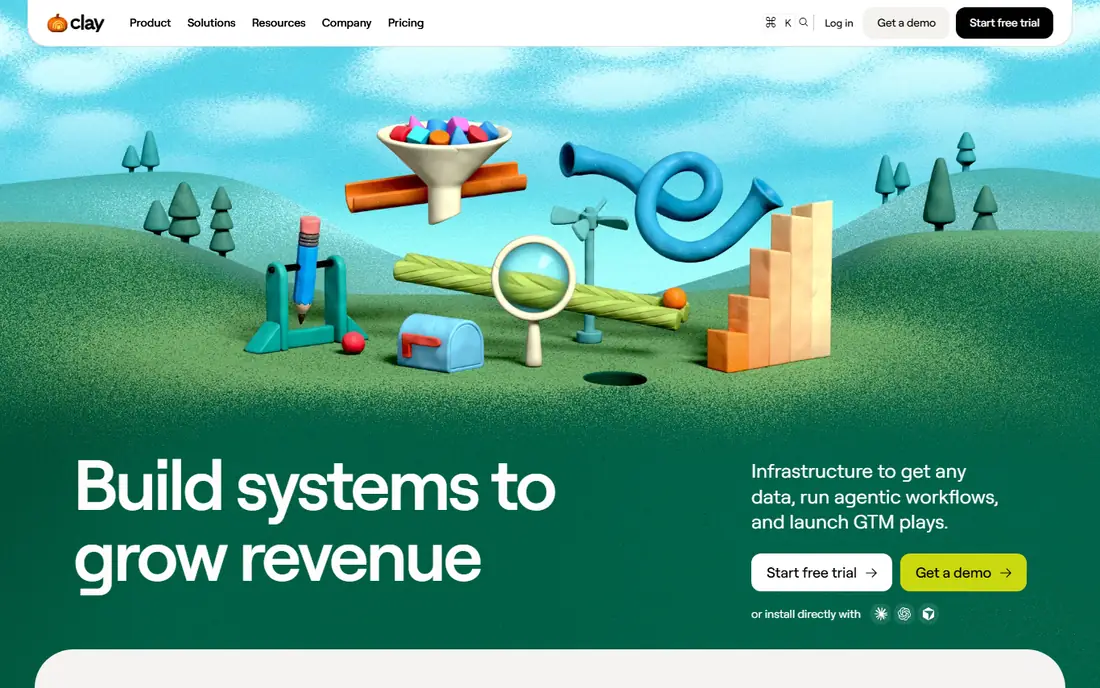
Clay is the tool the GTM engineer job title grew up around. It looks like a spreadsheet and behaves like a data pipeline: pull in accounts, run them through a waterfall of enrichment providers until an email or phone number lands, add AI research columns, score the rows, and push the results to your CRM or sequencer. Teams use it to build plays no single database sells, such as finding companies that just hired a head of sales and changed their pricing page in the same week.
The economics need care. Credits pay for lookups, failures included, and the plan sources we checked disagree on current entry prices, so this guide lists See website. There is a free plan to learn the tool. Clay rewards a builder on the team. Without one, it becomes an expensive table nobody maintains.
What we like- Waterfall enrichment across more than 100 providers lifts match rates
- Claygent agents research companies and write inside the table
- Huge template and community library
- Free plan with monthly credits to learn on
Watch out for- Credit burn is real, and failed lookups often still cost credits
- Learning curve is steep for non technical users
- Published entry prices conflict between sources
- Plays need an owner or they rot
Starting price$165 per month
Free planYes
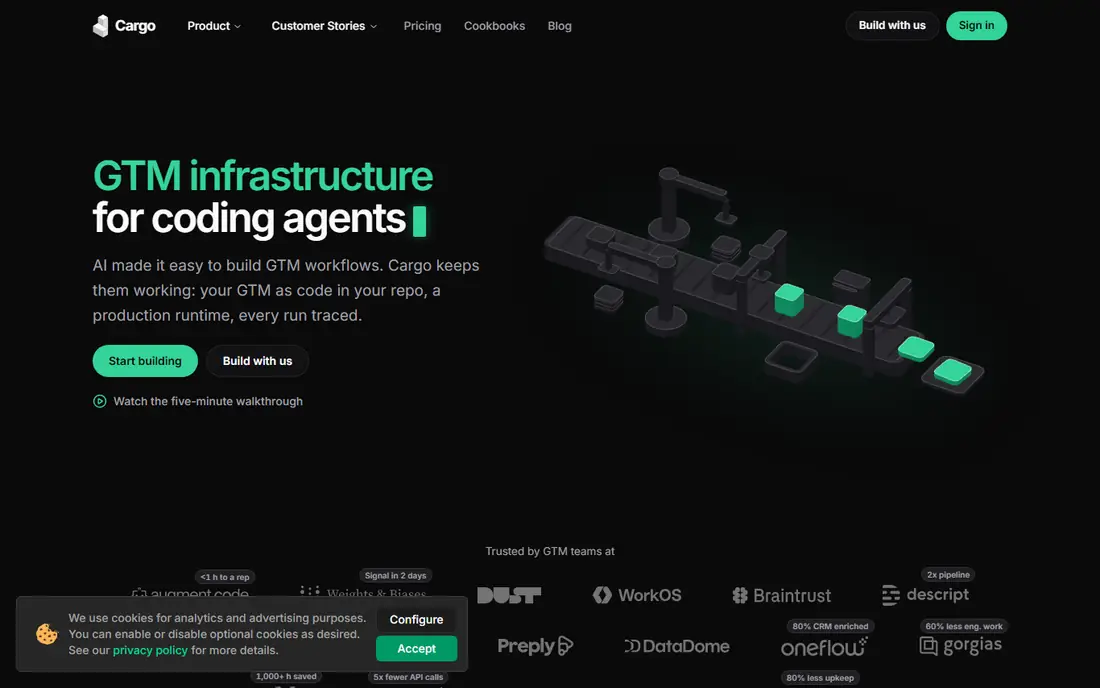
Cargo is where a GTM engineer goes after the signal fires. It connects data sources and CRMs, runs scoring models and AI agents over accounts and people, and routes the results to owners, sequences, or ads. Where Clay is a table you build plays in, Cargo is a workflow engine that keeps plays running and decides who gets what, when.
Pricing listings show a free start with 100 credits and a Starter plan at $165 per month, with integrations included across plans. Cargo suits a RevOps team that already has data in a warehouse or CRM and needs the logic layer above it. If your team has no signals yet, buy the signals first and Cargo second.
What we like- Workflows and AI agents built for scoring and routing
- More than 100 integrations on every plan per its listings
- Free tier with 100 credits
- Sits naturally on top of a warehouse or CRM
Watch out for- Smaller community than Clay
- Newer brand, so fewer templates to copy
- Credit model needs the same care as rivals
- Best value once signals already exist somewhere
Starting price$20 per seat per month
Free planYes
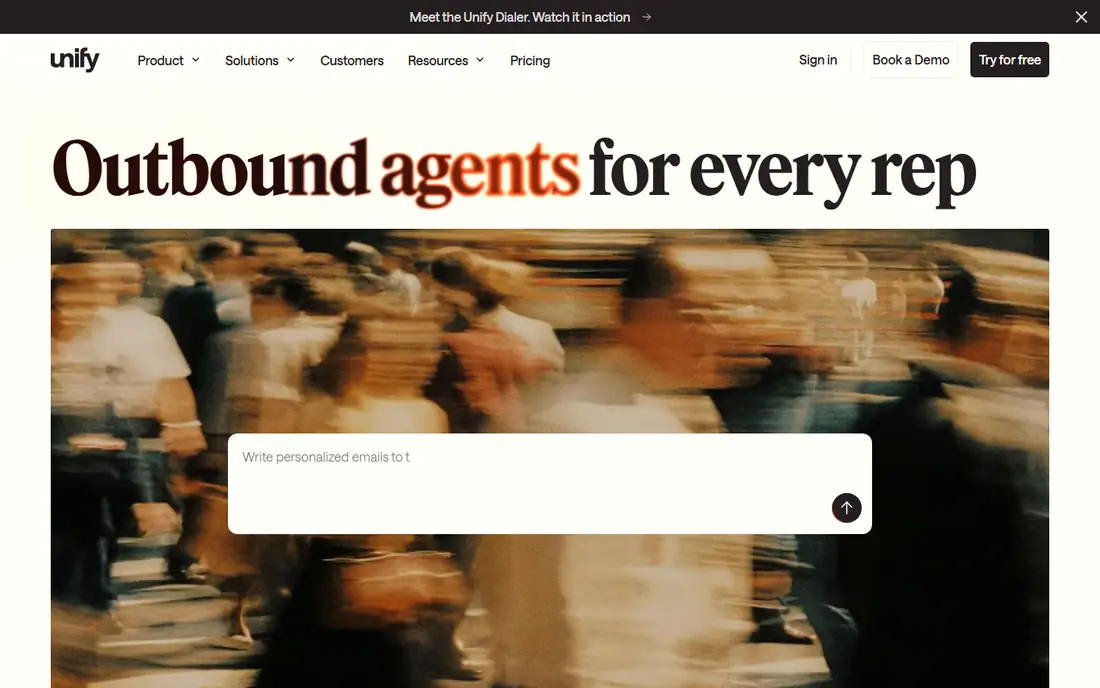
Unify sells the finished motion rather than the workbench. Its Plays watch for signals such as job changes, funding, and website visits, research the account with AI, and launch sequences, with managed mailboxes and warmup on the plans aimed at serious senders. GTM teams that want signal based outbound without assembling five tools start here.
At a cited $20 per seat per month for its base plan, it undercuts the assemble it yourself stack on headline price, though serious volume moves you up tiers. The trade off is control: Unify's way of working is set, and engineers who want to hand build every logic branch will prefer Clay. For a small team that wants pipeline from signals this quarter, Unify is a strong default.
What we like- Plays connect signals, research, and sequences in one product
- Managed deliverability on higher plans
- Cited pricing starts at $20 per seat per month
- Free entry point to test
Watch out for- Opinionated product, less free form than Clay
- Smaller data provider bench than Clay's
- Per seat pricing grows with team size
- Deliverability help sits on the higher tiers
#4
Persana AI
Best for: AI enrichment and prospecting for lean teams
Visit persana.ai
Starting price$68 per month
Free planYes
Persana AI packages the GTM engineering pattern for teams that cannot hire one. It pulls prospect and company data from many sources, uses AI agents to research accounts and draft personalisation, and pushes contacts into outreach tools. Directory listings cite paid plans from $68 per month and a free plan, which puts it within reach of a two person growth team.
Persana will not replace a builder platform for complex plays. Its waterfall depth, scoring logic, and integration range are narrower than Clay's. What it offers is the 80 percent version: good data, sensible AI research, and a short path from list to campaign. For lean teams, that trade is often right.
What we like- AI agents enrich and research prospects in plain workflows
- Entry price cited at $68 per month with a free plan
- Covers data from many sources in one subscription
- Quick to start for small teams
Watch out for- Shallower workflow control than Clay or Cargo
- Smaller brand and community
- Credit and data quality vary by segment
- Enterprise features are limited
Starting price$2,500 per month
Free planNo
Common Room sells the signal layer. It watches your product usage, your community spaces, your website, and social and job signals, ties them to people and accounts, and hands sales a brief on who is active and why. Its AI layer turns that activity into summaries a rep can act on in minutes.
The price is enterprise: listings cite the Essential plan at $2,500 per month billed annually, and there is no free plan. That only pencils out if your company generates real first party signals, a product people use, a community people post in. If it does, Common Room sees buying intent your competitors' databases cannot. If it does not, the platform has little to watch.
What we like- Unifies product usage, community, and website signals into one buyer graph
- AI features summarise accounts for reps
- Strong for product led companies
- Routes signals into CRM and outreach tools
Watch out for- Essential plan cited at $2,500 per month billed annually
- Value depends on having product and community data worth capturing
- Not an enrichment builder
- Overkill for small pipelines
#66sense
Best for: Enterprise intent data and ABM4.2/5 on
G2 (1,484 reviews, checked Oct 2026)
Visit 6sense.com
Starting priceSee website
Free planNo
6sense is the enterprise end of the signal market. It buys and models third party intent data, research activity across the web on your category's topics, and scores which accounts are in a buying cycle now. Marketing and sales then aim ads, content, and outreach at those accounts instead of the whole market.
Everything about 6sense is enterprise: quoted pricing, annual contracts, and an operating model that assumes an ABM team exists to act on the scores. Intent data is a probability, not a promise, and teams that treat scores as orders waste the money. For a large company coordinating spend across hundreds of target accounts, 6sense is the category reference.
What we like- Predictive models flag accounts in market for your category
- Identifies anonymous website visitors at account level
- Built for coordinated account based programs
- Deep integrations with major ad and CRM platforms
Watch out for- Pricing is quoted and enterprise level, commonly reported in the tens of thousands per year
- Needs a real ABM team to use the data
- Intent signals are probabilistic, not certain
- Contract terms are long
Starting priceSee website
Free planYes
Apollo is the workhorse database of outbound teams. Its search covers hundreds of millions of contacts with filters for role, company, technology, and funding, and because sequences live in the same product, a GTM engineer can go from a segment to a live campaign without exports. A free plan makes it the easiest entry on this list.
Apollo's weakness is data freshness at the edges: niche roles and regions return stale contacts more often than its headline numbers suggest, which is why many teams feed Apollo data into Clay for verification. As the affordable base layer of a GTM stack, though, Apollo is hard to displace.
What we like- Very large contact database with search filters GTM teams know well
- Sequences and dialer built in, so data flows straight to outreach
- Free plan to start
- Usually cheaper per seat than enterprise data rivals
Watch out for- Data accuracy varies by region and seniority level
- Credits gate the useful exports
- Deliverability tools are lighter than dedicated senders
- Advanced GTM plays need other platforms around it
#8ZoomInfo
Best for: Enterprise database and intent at scale4.5/5 on
G2 (9,130 reviews, checked Oct 2026)
Visit zoominfo.com
Starting priceSee website
Free planNo
ZoomInfo remains the database large sales organisations default to. Beyond contacts, it sells intent signals, organisational charts, and workflow tools that push the right accounts to the right reps. GTM engineers at bigger companies often build on ZoomInfo data even when the plays run in other platforms.
The cost is the story: mid market contracts are commonly reported between about $15,000 and $40,000 a year, with enterprise deals higher, and nothing is priced in public. For a 200 rep organisation with an ops team, the per lead economics work. For a startup, the same money buys the rest of this list combined. Buy ZoomInfo when scale and US data depth matter more than price.
What we like- The incumbent enterprise database, with deep US coverage
- Intent and org chart data beyond basic contacts
- Workflow tools and chat extend the platform
- Strong compliance and data governance story
Watch out for- Contracts commonly reported from about $15,000 a year upward
- Aggressive renewal and upsell reputation
- More platform than small teams need
- Pricing is never public
How we chose
We defined the category the way GTM engineers use it: platforms that enrich data, detect signals, score and route accounts, and connect to outreach, rather than general marketing software. Vendors were checked against 2026 category roundups from GTM focused publications and the vendors' own pricing pages in October 2026. Where sources conflicted on a price, we wrote See website and said so. We kept a spread of models: build your own platforms, finished signal products, and the data layers underneath. We left out pure sending tools, because sending is the last step of the motion, and general CRMs, which are the system of record rather than the growth engine.
Start with the job your team actually has. If you have signals and data but no logic, a builder such as Clay or Cargo earns its keep. If you have no signals, buy a signal or data platform first. Most failed purchases in this category are sequenced wrong: a beautiful workflow with nothing true flowing into it.
Then model the credit maths honestly. Every platform here meters something, lookups, credits, seats, accounts, and failed enrichment attempts commonly still count. Take your real list size, run it through the pricing page, and add a margin for the failures. Finally, keep the compliance line in view. These tools feed outreach, and outreach has rules: consent and lawful basis under GDPR, CAN-SPAM duties in the US, and suppression of anyone who opts out. The platform should make suppression and audit easy, because the liability is yours, not the vendor's.
Frequently asked questions
What does a GTM engineer actually do with these platforms?
A GTM engineer builds the systems behind pipeline: connecting data sources, enriching and scoring accounts, watching for buying signals, and routing the right accounts into campaigns and CRM workflows automatically. The platforms here replace the manual version of that work, spreadsheets, one off exports, and reps researching accounts by hand.
Is Clay worth it for a small team?
Only if someone on the team will build in it weekly. Clay's free plan is a fair test: if your team builds two or three real plays in the first month, the paid tiers will likely pay back. If the table sits unfinished, a packaged tool such as Unify or Persana will produce more pipeline for the same money.
How much do GTM platforms cost in total?
More than the plan price. Budget for credit top ups, the data providers inside a builder, and the sending tools downstream. Category roundups put a realistic small team stack in the range of a few hundred to a few thousand dollars a month, and enterprise signal platforms such as 6sense and Common Room start where that range ends.
Are intent signals reliable?
They are probabilities. Intent data shows that people at a company researched a topic, not that the company will buy. Good teams use intent to order their work, calling the warm accounts first, not to decide who exists. Treat any vendor claim of certain buyers as a warning sign.
Sources we checked (0)
Is your product missing or out of date?
We review this list regularly. Vendors can request a listing, send updated pricing or ask about featured placement.

Shihab Mia · Founder, Rankite
Shihab has 5+ years in B2B and SaaS SEO. He writes Rankite's software buying guides from pricing pages, documentation and public user reviews. More about Shihab.