How we make this list: we compare pricing pages, product documentation and public user reviews. Ratings come from G2, Capterra or Trustpilot, with the date we checked them.
Key takeaways
- The cheapest reliable unlimited plan in this guide starts at $25 per month, while the big three carriers start near $45 to $50 per month for one line.
- Network priority matters more than the headline price, because prepaid and budget brands can slow down first when a tower is busy.
- Taxes and fees change the real bill, so an all-in $25 plan can beat a $30 plan that adds taxes on top.
- Families usually save the most by checking the four-line price, not the single-line price, before they switch.
Quick comparison
| Tool | Best for | Starting price | Free plan |
|---|
 Verizon | Nationwide coverage and in-store support | $45 per month (Simplicity, with Auto Pay) | No |
 T-Mobile | 5G coverage and streaming extras | $50 per month (Essentials Saver, with Auto Pay) | No |
 AT&T | AT&T bundles and Latin America travel | $50 per month (Value 2.0, single line) | No |
 Visible | All-in unlimited service on Verizon | $25 per month | No |
 Mint Mobile | Low-cost prepaid on T-Mobile | $15 per month (6 GB, 12-month term) | No |
 US Mobile | Choosing among all three major networks | $10 per month (Light, 2 GB) | Free trial |
 Google Fi Wireless | International travel and light data users | $20 per month (Flexible, plus $10 per GB) | No |
 Cricket Wireless | Prepaid service with a store nearby | $30 per month (Sensible 10 GB, with Auto Pay) | No |
 Metro by T-Mobile | Prepaid T-Mobile service with stores | See website | No |
Is your product missing or out of date?
We review this list regularly. Vendors can request a listing, send updated pricing or ask about featured placement.
The best phone service providers for every kind of user
Starting price$45 per month (Simplicity, with Auto Pay)
Free planNo
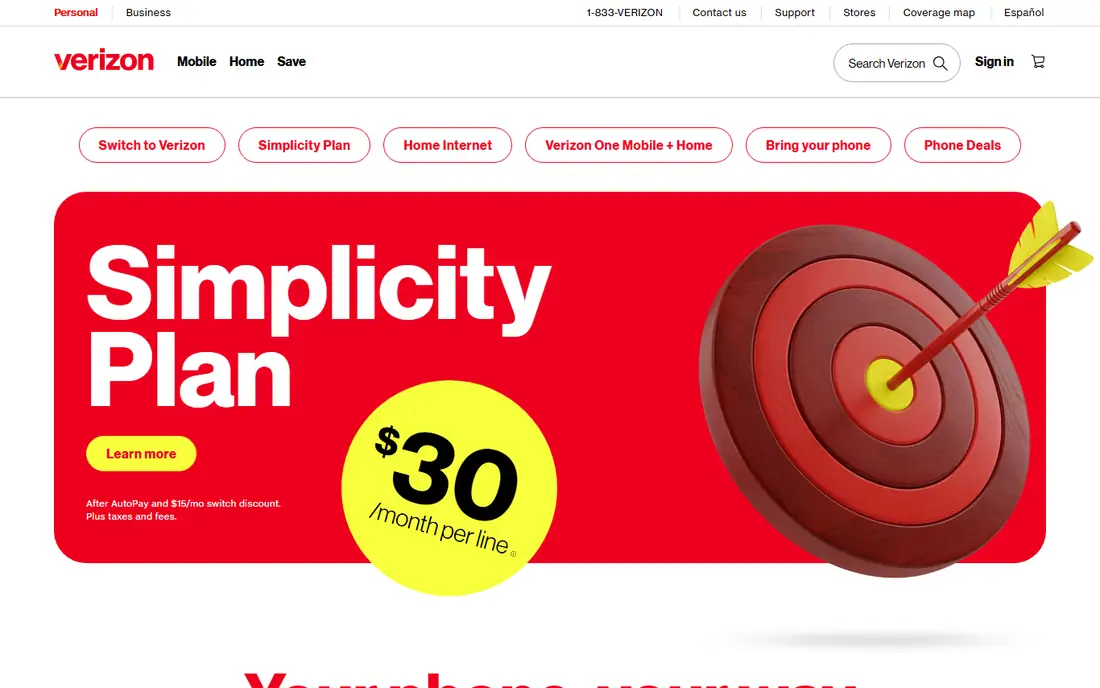
Verizon suits a buyer who wants the fewest coverage surprises. Its Simplicity plan gives one flat unlimited rate per line, with 10 GB of mobile hotspot data and talk and text in Canada and Mexico. That simplicity helps when a household mixes heavy and light users and does not want to compare three tiers every month. The higher Plus and Ultimate tiers add more hotspot data and travel benefits for people who pay more.
The catch is the final bill. Taxes and fees sit on top of the advertised price, and device payments are separate. Verizon still makes sense for families who value a store visit, a trade-in deal, or a bundled home internet offer. A single line buyer who only wants cheap unlimited service will usually find a better deal on Visible, which uses the same network.
What we like- Wide 5G Ultra Wideband coverage
- Strong rural reach
- Large store network
Watch out for- Taxes and fees are extra
- Single-line prices are high
Starting price$50 per month (Essentials Saver, with Auto Pay)
Free planNo
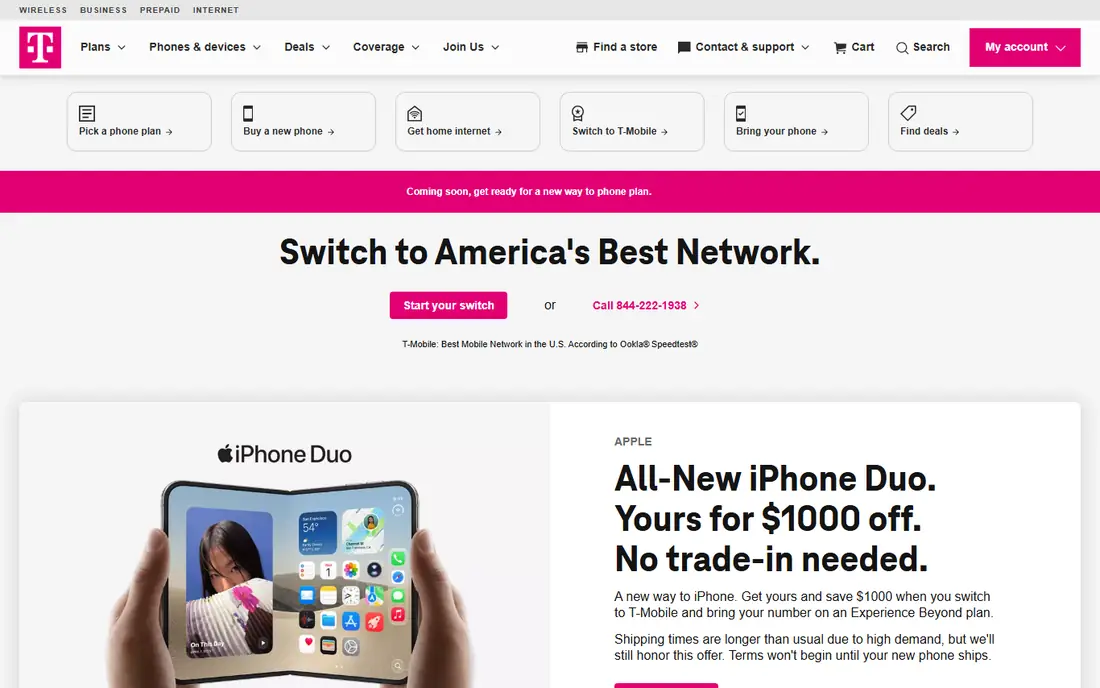
T-Mobile works well for households that stream a lot and travel in the US, Canada, and Mexico. Essentials Saver keeps the entry price lower, with 50 GB of premium data, while Experience More and Experience Beyond add unlimited premium data, larger hotspot allowances, and streaming benefits. The five-year price guarantee on the Experience plans gives some protection against mid-contract price rises, which is rare in this market.
The trade-off is that the cheapest plans are not the fastest when a network is congested. A buyer who needs top priority on every line should look at Experience More rather than Essentials. T-Mobile also runs discounts for people aged 55 and over, military members, veterans, and first responders, so eligible buyers should check those prices before they settle on the standard rate.
What we like- Broad 5G coverage
- Five-year price guarantee on Experience plans
- Generous multi-line pricing
Watch out for- Taxes and fees are extra on most plans
- Entry plans have lower priority data
#3
AT&T
Best for: AT&T bundles and Latin America travel
Visit att.com
Starting price$50 per month (Value 2.0, single line)
Free planNo
AT&T fits a household that already uses AT&T internet or wants one bill for several services. Value 2.0 covers basic unlimited use with 5 GB of premium data and 3 GB of hotspot data. Extra 2.0 raises those limits to 100 GB of premium data and 50 GB of hotspot data, while Premium 2.0 offers unlimited premium data and 100 GB of hotspot data. That ladder makes it easy to match the plan to real data use instead of paying for the top tier by default.
The weakness is price transparency. The lowest per-line figures on AT&T pages often assume four lines plus several discounts, so a single-line buyer pays more. Check the single-line price for your line count, and confirm whether a bank account Auto Pay is required for the full discount. AT&T remains a strong choice for a family that wants stores, device deals, and a familiar carrier.
What we like- Strong nationwide network
- Premium plans include large hotspot allowances
- Bundle options with fiber
Watch out for- Auto Pay and paperless billing are needed for the best price
- Taxes and fees are extra
Starting price$25 per month
Free planNo
Visible is the simplest way to get Verizon coverage without a Verizon postpaid bill. The base plan costs $25 per month with taxes and fees included, and it includes unlimited data, talk, and text plus unlimited hotspot at up to 5 Mbps. Visible+ at $35 per month adds unlimited premium data and faster hotspot speeds, while Visible+ Pro at $45 per month adds still faster hotspot, 4K video, and wider international calling. There is no store visit and no credit check.
That simplicity has limits. Support runs through the app and chat, which frustrates buyers who want a person in a store. The base plan can also slow down when a tower is busy, because it carries lower priority than Verizon postpaid lines. For a solo user or a couple who mostly use Wi-Fi at home and want a predictable bill, Visible is hard to beat.
What we like- Taxes and fees included
- No contract
- Unlimited hotspot at capped speeds
Watch out for- App and chat support only
- Base plan is deprioritized
Starting price$15 per month (6 GB, 12-month term)
Free planNo
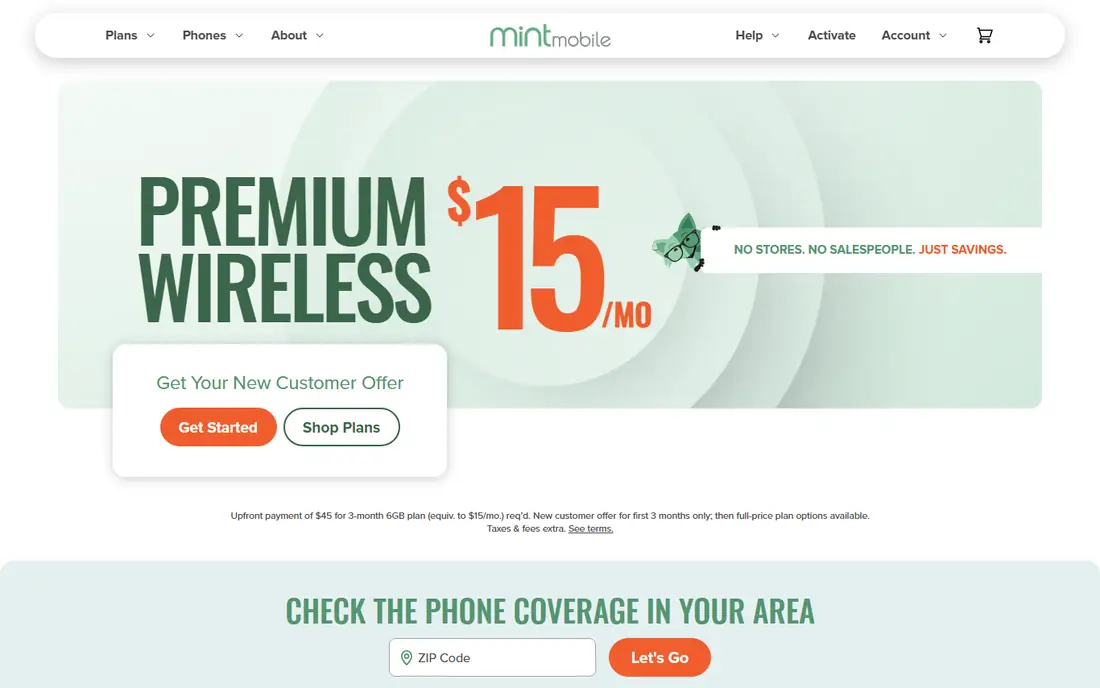
Mint Mobile rewards buyers who can pay ahead. On a 12-month term, plans cost $15 per month for 6 GB, $20 for 17 GB, $25 for 23 GB, and $30 for unlimited. The unlimited plan includes up to 20 GB of hotspot data and may slow after 50 GB in a month when the network is busy. New customers can try a shorter first term at an introductory price, which is a sensible way to check coverage at home and at work before committing to a year.
The main risk is the prepayment itself. If coverage disappoints after the first term, the money for the remaining months is already spent. Mint also has no physical stores, so activation and support happen online. For a light or moderate user on T-Mobile coverage who is happy to prepay, Mint delivers one of the lowest monthly costs in the US.
What we like- Very low annual prices
- Clear data tiers
- Free mobile hotspot from the plan allowance
Watch out for- Must prepay for months at a time
- Taxes and fees are extra
- Online support only
Starting price$10 per month (Light, 2 GB)
Free planFree trial
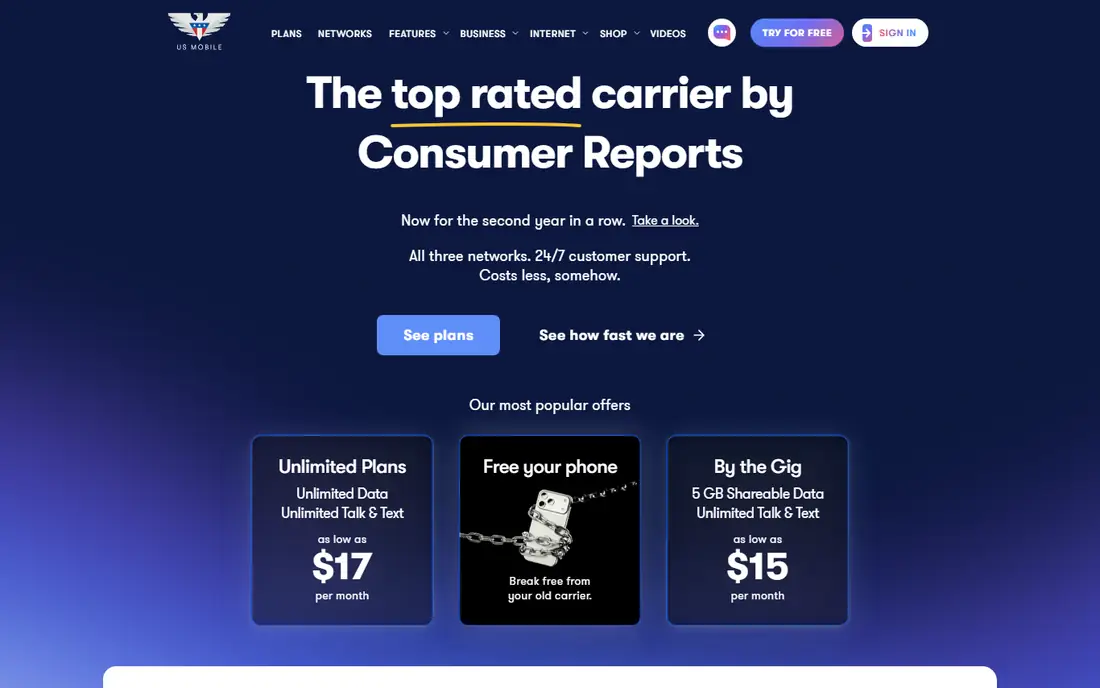
US Mobile stands out because one account can use any of the three major US networks. A line can start on one network and move to another later from the account dashboard, which helps when coverage differs between home, work, and a regular travel route. Light costs $10 per month for 2 GB, Unlimited Starter costs $25 per month, and Unlimited Premium costs $44 per month, with lower monthly equivalents on annual billing. Taxes and fees are included on those plans.
The downside is choice overload. Network options carry brand names rather than carrier names, and hotspot and priority rules vary by network. A new buyer should use the free trial to test the chosen network before paying for a year. For a household with mixed coverage needs, or a buyer who wants to switch networks without switching carriers, US Mobile offers flexibility that no single-network carrier can match.
What we like- Access to Verizon, T-Mobile, and AT&T networks
- Taxes and fees included on most plans
- 30-day trial
Watch out for- Plan menu can confuse new buyers
- Network names hide the underlying carrier
Starting price$20 per month (Flexible, plus $10 per GB)
Free planNo
Google Fi Wireless suits two very different buyers. Light users can take the Flexible plan at $20 per month plus $10 per GB, which keeps costs low in months with little cellular data. Frequent travelers should look at Unlimited Premium at $65 per month, which includes 100 GB of high-speed data, 50 GB of hotspot data, and data in more than 200 destinations. Unlimited Essentials at $35 per month and Unlimited Standard at $50 per month sit between those extremes.
The catch is that the cheapest unlimited plan does not travel well. Essentials is built for US use, and Standard covers Canada and Mexico only. A buyer who picks Essentials for a trip abroad will be disappointed. Google Fi also works best for people comfortable managing everything in an app and a Google account. For Pixel owners and regular international travelers, the Premium plan is a strong package.
What we like- Strong international coverage on Premium
- Flexible billing for light users
- Google account security features
Watch out for- Best travel features sit on the most expensive plan
- Essentials has no data abroad
Starting price$30 per month (Sensible 10 GB, with Auto Pay)
Free planNo
Cricket Wireless gives AT&T coverage with prepaid simplicity and a store to walk into. Plans run from $30 per month with Auto Pay for 10 GB, through Select Unlimited at $35 per month with Auto Pay, Smart Unlimited at $45 per month with Auto Pay, and Supreme Unlimited at $55 per month with Auto Pay. Higher plans add hotspot data and use in Mexico and Canada, which matters for cross-border callers and hotspot users.
The limits are easy to miss. Select Unlimited is for new lines only, includes no hotspot, and does not include use in Mexico or Canada. Data on the lower unlimited plans may also slow when the network is busy. Cricket still wins for a buyer who wants prepaid pricing, included taxes, and face-to-face help. A heavy hotspot user should compare Supreme Unlimited against US Mobile and Visible before deciding.
What we like- Taxes and fees included
- AT&T network
- Retail stores across the US
Watch out for- Cheapest unlimited plan has limits
- Video streams in standard definition on lower plans
Starting priceSee website
Free planNo
Metro by T-Mobile is the storefront prepaid brand for T-Mobile. It suits a buyer who wants T-Mobile coverage, a low monthly bill, and a person to help with activation, a phone purchase, or a ported number. Multi-line discounts bring the per-line cost down for families, and Metro often runs phone deals for new customers who switch. That combination of stores and prepaid pricing is the reason many buyers choose Metro over an online-only brand.
The weakness is priority and price stability. Metro lines can slow down before T-Mobile postpaid lines when a tower is busy, and promotional prices may rise after the first months. Check the current plan price, the hotspot allowance, and the renewal price before signing up, and confirm that the phone you want works on the plan you pick. For a T-Mobile area with good coverage, Metro is a practical middle ground between a big carrier bill and an online-only carrier.
What we like- T-Mobile network
- In-store activation and support
- Multi-line discounts
Watch out for- Prices and promotions change often
- Data priority is lower than T-Mobile postpaid
How we chose
We compared pricing pages, plan documents, and public reviews for the major carriers and the largest prepaid brands in the US. We favored plans that a new customer can actually buy now, with clear data, hotspot, and tax rules. We also weighed network coverage, priority during congestion, store support, and the cost for one line and for four lines, because a plan that looks cheap for one person can be expensive for a family.
What to check before you switch
Start with coverage where you live, work, and travel most often. A carrier map is a guide, not a guarantee, so ask neighbors or coworkers about dead spots and use a trial or a short first term when one is available. Check that your current phone is not tied to a carrier and is compatible, because a carrier-tied phone can block a switch even when the plan looks perfect.
Count the full bill
Add taxes and fees to any plan that does not include them, and add device payments separately. A $45 plan with taxes can cost more than a $25 all-in plan, and a free phone deal can cost more over 36 months than buying the phone outright. Read the hotspot limit too, because a plan with a small hotspot allowance will frustrate a buyer who works from a laptop on the road.
Match data to real use
Look at three months of data use on your current bill before choosing a capped plan. Light users who spend most of the day on Wi-Fi often waste money on unlimited plans, while heavy video users can hit a premium data limit sooner than they expect. If several people share an account, check whether each line can pick a different plan or network, because one heavy user should not force everyone onto the top tier.
Frequently asked questions
What is the best phone service for most people?
There is no single winner, because coverage and price trade off against each other. Visible and US Mobile give the best value for most solo users, while Verizon and T-Mobile suit buyers who want stores, top priority, and device deals. Start with the network that works best at your address, then pick the cheapest plan on that network that covers your data and hotspot needs.
Who has the best cell phone service for coverage?
Verizon, AT&T, and T-Mobile each claim strong nationwide coverage, and the best one depends on location. Verizon tends to perform well in rural areas, T-Mobile leads on 5G availability in many cities, and AT&T sits between them in many regions. Use a trial, a prepaid first month, or a coverage map checked against real addresses you visit often.
Is a prepaid carrier as good as a major carrier?
Prepaid carriers use the same towers as the major carriers, but they often carry lower network priority. That difference shows up mainly at crowded events, stadiums, and busy downtown areas. For everyday use at home, at work, and on Wi-Fi, most buyers will not notice a difference, and the savings can be large.
How much data do I really need?
Most light users need under 10 GB per month when Wi-Fi covers home and work. Moderate users who stream music and video on cellular data often use 15 GB to 30 GB. Heavy users who stream video daily, use a hotspot for work, or rarely connect to Wi-Fi should choose an unlimited plan with a large premium data allowance.
Can I keep my number when I switch?
Yes, in most cases you can port your number to a new carrier. Keep the old account active until the port completes, and have your account number and transfer PIN ready. A port usually completes within a few hours, although some transfers take up to a day.
Sources we checked (9)
- https://www.verizon.com/plans/
- https://www.t-mobile.com/cell-phone-plans
- https://www.att.com/wireless/
- https://www.visible.com/plans
- https://www.mintmobile.com/plans/
- https://www.usmobile.com/plans
- https://fi.google.com/about/plans
- https://www.cricketwireless.com/cell-phone-plans
- https://www.metrobyt-mobile.com/plans
Is your product missing or out of date?
We review this list regularly. Vendors can request a listing, send updated pricing or ask about featured placement.

Shihab Mia · Founder, Rankite
Shihab has 5+ years in B2B and SaaS SEO. He writes Rankite's software buying guides from pricing pages, documentation and public user reviews. More about Shihab.